
Streamline medical product distribution workflows in SEA
Regulatory pressure across Southeast Asia is rising sharply, and the cost of a compliance gap in medical product distribution can range from a delayed shipment to a full product recall. Supply chain managers and procurement professionals operating in this region face a genuinely complex environment: multiple national regulators, fragmented cold chain infrastructure, and increasing expectations around traceability and documentation. This guide walks through a practical, structured workflow for medical product distribution across Southeast Asia, covering regulatory foundations, resource preparation, digital traceability, and edge-case scenarios that most operational playbooks overlook.
Table of Contents
- Understand regulatory and operational prerequisites
- Prepare your distribution: People, process, and infrastructure
- Implement traceability, automation, and temperature control
- Handle edge cases: Fragile therapies, multi-country shipments, and compliance pitfalls
- What most guides miss: The compounding value of network readiness
- Ready to streamline your medical product distribution?
- Frequently asked questions
Key Takeaways
| Point | Details |
|---|---|
| Documented compliance mandatory | You need SOPs and regulated documentation for all major workflow steps. |
| Training and partner selection | Qualified staff and reliable partners are fundamental for resilient distribution. |
| Digital traceability is essential | Leverage data standards and automation to ensure transparent tracking and recall readiness. |
| Anticipate regional complexities | Equip your workflow for temperature excursions, handover gaps, and regulatory variation. |
| Automate for efficiency | Workflow automation reduces errors and accelerates response to supply chain disruptions. |
Understand regulatory and operational prerequisites
With the stage set for why optimized workflows matter, we begin by clarifying the regulatory landscape and foundational requirements you must address before a single shipment moves.
Southeast Asia is not a single market. It is a collection of distinct regulatory environments, each with its own licensing timelines, documentation standards, and inspection criteria. Before you can optimize a distribution workflow, you need a clear picture of what compliance looks like in each target country.
ASEAN market entry requirements vary considerably by country, but several frameworks apply regionally. The GDPMD (Good Distribution Practice for Medical Devices) and GDPMDS (GDP for Medical Device Services) frameworks set expectations for how distributors and importers must operate. According to the ASEAN distributor qualification report, distributors and importers must operate quality and distribution systems with SOPs covering storage, distribution, complaint handling, recalls, and traceability. These are not optional additions; they are prerequisites for market access.
The table below summarizes core regulatory and operational prerequisites across key Southeast Asian markets:
| Country | Primary Regulatory Body | Key Framework | Cold Chain Required | Local Entity Required |
|---|---|---|---|---|
| Singapore | HSA | GDP / GDPMD | Yes (for relevant products) | Yes |
| Malaysia | MDA / NPRA | GMP / GDP | Yes | Yes |
| Thailand | FDA Thailand | GDPMD | Yes | Yes |
| Indonesia | BPOM | CDOB / CDAKB | Yes | Yes |
| Philippines | FDA Philippines | GDP / RA 9711 | Yes | Yes |
| Vietnam | DAV | GMP / GSP | Yes | Yes |
Each of these markets requires documented SOPs as a baseline. The core SOPs that every distribution operation must have include:
- Storage SOPs: Temperature zoning, humidity controls, segregation of quarantine stock
- Distribution SOPs: Order picking, packing, dispatch, and handover documentation
- Complaint handling SOPs: Intake, investigation, response timelines, and escalation paths
- Recall SOPs: Identification, segregation, notification, and recovery procedures
- Traceability SOPs: Lot tracking, serialization records, and audit trail management
“A recall capability is not just a regulatory checkbox. It is the operational proof that your distribution system can protect patients. Without a tested, documented recall SOP, every product you distribute carries unquantified risk.”
Cold chain capability deserves particular attention. Products requiring 2°C to 8°C storage are common across pharmaceutical and medical device categories, and maintaining that integrity across Southeast Asia’s tropical climate requires validated equipment, calibrated monitoring, and qualified personnel who know what to do when an excursion occurs.
Prepare your distribution: People, process, and infrastructure
Once the base requirements are clear, you can assemble the distribution building blocks that enable both efficiency and compliance.
Building a reliable distribution operation is not simply a matter of booking warehouse space and arranging transport. It requires three interconnected elements working in alignment: qualified people, documented processes, and validated infrastructure. Weakness in any one of these creates downstream risk.

The table below outlines what “ready” looks like across each dimension:
| Dimension | Minimum Requirements | Common Gaps |
|---|---|---|
| People | GDP-trained staff, qualified person for releases, trained logistics coordinators | Inconsistent training records, high staff turnover |
| Process | Validated SOPs, change control procedures, deviation management | SOPs written but not practiced, outdated documents |
| Infrastructure | Validated cold rooms, calibrated temperature loggers, qualified packaging systems | Unvalidated equipment, informal calibration records |
Follow these steps to build a compliant distribution foundation:
- Assess internal resources. Map your current headcount, qualifications, and gaps against each country’s GDP requirements. Identify roles that need external support or formal training.
- Engage qualified logistics providers. Select 3PL partners with proven cold chain logistics capability and current GDP certifications. Request evidence of validation status for their cold rooms, vehicles, and packaging materials.
- Validate SOPs and packaging. Run through each core SOP with the actual team members who will execute them. Packaging validation should include thermal performance testing for your product’s temperature range and the anticipated transit conditions.
- Establish training cadence. Initial training is not enough. Build quarterly refreshers and deviation reviews into your calendar. Consistent training is what minimizes edge-case risk events when they inevitably occur.
- Document everything. GDP compliance is as much about documentation as it is about physical practice. If a step is not recorded, regulators treat it as if it did not happen.
As pharma-specialized networks demonstrate, integrating GDP/GxP warehousing, standardized processes, qualified packaging, and trained personnel creates the conditions for compliant, end-to-end medical distribution. The key word is “integrated.” Piecemeal approaches, where warehousing, transport, and documentation are managed by disconnected parties, introduce gaps that regulators and auditors will find.
Pro Tip: When prequalifying logistics partners, ask specifically about their packaging qualification documentation and whether it covers your product’s temperature range under local ambient conditions. A partner qualified for European winter transit may not have data for Southeast Asian humidity and heat.
Understanding why cold chain is crucial for pharma safety is foundational before you finalize any distribution partner selection. The consequences of a cold chain failure in this region are not theoretical; excursions during the last mile in high-humidity, high-temperature environments are among the most common causes of product loss.
Implement traceability, automation, and temperature control
With strong foundations in place, it’s time to translate process into action by digitizing and automating traceability, workflows, and environmental controls.
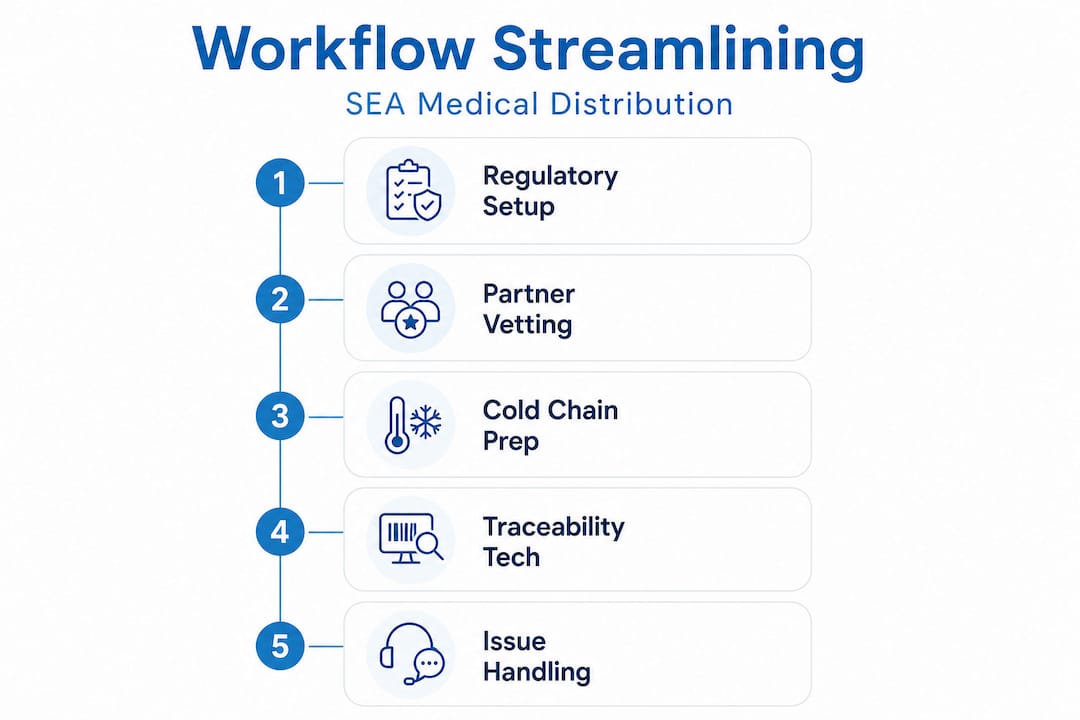
Traceability is no longer a value-add. It is a regulatory expectation in most Southeast Asian markets and a practical necessity for any organization that wants to manage recalls efficiently. The question is no longer whether to implement it, but how to do so in a way that integrates with your partners, your regulators, and your internal systems.
Follow this sequence to operationalize traceability and automation:
- Adopt GS1 EPCIS as your traceability standard. The GS1 EPCIS framework enables event-level and chain-of-custody data capture and sharing. It supports serialization, real-time event logging, and recall readiness across multiple parties in a supply chain. Implementing this standard means that every custody transfer, storage event, and shipment milestone is captured in a structured, shareable format.
- Integrate with a digital distribution portal. Automation through digital portals delivers real-time stock visibility, streamlined order tracking, digital workflows, and automated documentation generation. These are not small gains; they represent a structural reduction in manual errors and processing time.
- Install continuous temperature monitoring. Use calibrated data loggers with real-time alerts at every storage and transit point. Set alert thresholds at the product’s specified range, not at the alarm limit. Early warning is what prevents excursions from becoming compliance events.
- Establish a single source of truth for product status. Whether you use a warehouse management system, an ERP integration, or a purpose-built track-and-trace platform, ensure that every team member and partner can access current, accurate product status without making phone calls or sending emails.
- Conduct quarterly traceability drills. Simulate a recall scenario at least twice per year. Measure how quickly you can identify affected lots, locate product across the network, and generate the documentation regulators will request.
A useful guide to cold chain logistics in healthcare across Southeast Asia reinforces that temperature control and traceability are inseparable. You cannot verify temperature integrity without event records, and you cannot execute a recall without both.
Pro Tip: When implementing GS1 EPCIS, start with your highest-risk product categories first. A phased rollout allows you to resolve data quality and partner integration issues on a limited scope before expanding across your full portfolio.
The business case for automation is straightforward. Real-time event sharing across your supply chain network decreases recall delays significantly, because you spend less time reconstructing where product went and more time acting. Organizations that have implemented digital distribution portals consistently report reductions in order processing time, fewer documentation errors, and faster regulatory response capability.
Handle edge cases: Fragile therapies, multi-country shipments, and compliance pitfalls
No workflow is complete without strategies for handling the unexpected, especially in a region as diverse as Southeast Asia.
Standard distribution workflows handle routine products reasonably well. But Southeast Asia’s healthcare supply chains include scenarios that push well beyond routine: cell and gene therapies requiring cryogenic conditions, multi-country shipments with regulatory handovers at each border, and compliance pitfalls that vary by country and product category.
Understanding compliance challenges across SEA is essential before you encounter these situations in practice. The most common edge cases supply chain managers face include:
- Cryogenic shipments: Cell and gene therapies (CGTs) require liquid nitrogen dry shipper management, strict timelines, and personnel trained specifically in cryogenic handling. Building a secure CGT distribution network requires protecting fragile therapies, coordinating handovers, and ensuring traceability and timing for every cryogenic shipment.
- Multi-country regulatory handovers: A shipment moving from Singapore through Malaysia to Thailand crosses three distinct regulatory jurisdictions. Each handover point requires its own documentation, and a gap at any point can hold the entire shipment.
- Regulatory variability by product class: A product classified as a medical device in one country may be classified as a pharmaceutical in another, triggering entirely different registration and distribution requirements.
- Short shelf life products: Biologics and certain diagnostics have narrow windows between manufacture and use. Any delay in clearance or distribution can render a batch unusable.
- Infrastructure variability: Cold chain infrastructure quality varies significantly between urban centers and secondary cities across the region. A partner reliable in Kuala Lumpur may not have the same capability in Kota Kinabalu.
“Southeast Asia demands region-specific workflows, not regional workflows. What works efficiently in one corridor may be non-compliant or operationally impractical in the next. The diversity of this region is both its opportunity and its operational challenge.”
Best practices for handling these scenarios include assigning a dedicated point of contact for each country segment of a multi-country shipment, using pre-approved packaging validated for both cryogenic and high-ambient conditions where applicable, and conducting pre-shipment regulatory checks at least two weeks before dispatch.
The cold chain and compliance challenges specific to this region reinforce that robust SOPs must be adaptable. Rigid workflows that cannot accommodate regulatory updates or country-specific requirements will fail precisely when the pressure is highest.
For supply chain managers reviewing the key logistics drivers in Southeast Asia, the consistent finding is that organizations with well-trained personnel and reliable communication protocols navigate edge cases far better than those relying solely on technology. Technology captures data; people make decisions under pressure. Both matter.
Additional insights from pharma logistics and 3PL publications consistently highlight that edge-case preparedness is a differentiator, not a given. Organizations that document and rehearse edge-case responses before they occur are significantly better positioned to protect product integrity and patient safety.
What most guides miss: The compounding value of network readiness
Most optimization guides focus on tools, frameworks, and compliance checklists. These are necessary, but they address only the visible layer of distribution performance. The less visible layer, and the one that determines how a supply chain performs under real pressure, is network readiness.
Network readiness means having vetted, trained partners in each country who understand your products, your documentation standards, and your escalation protocols. It means maintaining redundant partner relationships so that a single partner’s capacity constraint or regulatory issue does not halt your distribution entirely. It means flexible SOPs that can absorb minor variations in local conditions without requiring a deviation report for every small adjustment.
The surprising lesson from operating across Southeast Asia’s logistics network is that redundancy and relationship investment consistently outperform complex technology layers when disruptions occur. A sophisticated track-and-trace system is valuable, but it cannot compensate for a partner who does not answer the phone during a temperature excursion at midnight.
Small, consistent investments in partner communication, joint training exercises, and relationship management create a form of operational resilience that is difficult to quantify but easy to observe when things go wrong. The networks that recover fastest from disruptions are almost always those with the strongest human infrastructure behind the digital one.
The practical implication is this: before you invest in the next technology upgrade, audit your partner network. Are your key providers truly qualified and regularly assessed? Do they have bench strength if a key employee leaves? Are your SOPs flexible enough to work across your network, or are they written for ideal conditions that do not reflect reality in every country you serve?
Ready to streamline your medical product distribution?
Now that you understand the critical elements of an optimized workflow, here’s how you can put these strategies into practice with expert support.
Labgistics Asia provides end-to-end healthcare logistics solutions built specifically for the regulatory and operational complexity of Southeast Asia. With over 20 years of experience, we support pharmaceutical companies, medical device manufacturers, and life science organizations across the region with services designed to reduce compliance risk and improve distribution efficiency.
Explore how our compliance and efficiency solutions can support your SOPs and regulatory documentation needs, and review our approach to cold chain and compliance for temperature-sensitive products across diverse Southeast Asian markets. For organizations managing distribution risk across multiple countries, our supply chain risk management services offer structured frameworks for partner qualification, redundancy planning, and operational resilience. Contact us to discuss your specific distribution requirements.
Frequently asked questions
What documentation is required for medical product distribution in Southeast Asia?
Distributors and importers must maintain documented SOPs covering storage, distribution, complaint handling, recalls, and traceability, with cold-chain documentation requirements also applying for temperature-sensitive products. Temperature monitoring records and calibration logs are typically reviewed during regulatory inspections.
How does digital traceability improve medical product distribution?
Digital traceability using GS1 EPCIS standards allows real-time chain-of-custody event capture and sharing across supply chain partners, enabling faster recall execution and stronger compliance documentation. It eliminates the delays caused by reconstructing product movement from paper records after a quality event.
What are the main cold chain challenges in Southeast Asia?
Key challenges include maintaining temperature integrity across high-ambient tropical conditions, managing cryogenic shipment handovers for fragile therapies, and ensuring qualified personnel are available at every stakeholder transition point. Infrastructure variability between urban and regional locations adds additional complexity.
Can automation really streamline medical product distribution workflows?
Yes. Digital distribution portals provide real-time stock visibility, automated documentation, and integrated order tracking that significantly reduce manual processing time and error rates. The gains are most pronounced in high-volume, multi-country operations where manual coordination creates consistent bottlenecks.
Recommended
- Elevate your pharma supply chain: Best practices for SEA
- Pharma supply chain optimization guide for Southeast Asia
- 5 key advantages of supply chain management in healthcare SEA
- Pharma logistics: Ensuring safe distribution and compliance