
Pharmaceutical distribution is far more than moving products from a factory to a hospital shelf. In Southeast Asia, it operates at the intersection of regulatory complexity, cold chain requirements, and fragmented market structures that can make or break a healthcare supply chain. Cold chain failures and counterfeiting are persistent threats across the region, and the consequences extend well beyond financial loss. For healthcare executives and procurement professionals operating across multiple ASEAN markets, understanding how pharmaceutical distribution actually works is not optional. It is a strategic necessity that directly affects patient outcomes, regulatory standing, and operational efficiency.
Table of Contents
- What is pharmaceutical distribution?
- The pharmaceutical distribution process: From factory to patient
- Core challenges in Southeast Asia: What can go wrong?
- Best practices for selecting a pharmaceutical distributor in Southeast Asia
- Public vs. private distribution models in Southeast Asia
- Why compliance-focused partnerships are the true differentiator
- Partnering for secure and compliant pharmaceutical distribution
- Frequently asked questions
Key Takeaways
| Point | Details |
|---|---|
| More than logistics | Pharmaceutical distribution involves strict compliance, risk management, and end-to-end oversight. |
| Regional risks matter | Cold chain failures and regulatory pitfalls are especially prominent in Southeast Asia. |
| Choose certified partners | Vet distributors for GDP certification, cold chain proficiency, and local regulatory expertise. |
| Model choice impacts outcomes | Public and private distribution models each have unique risks and benefits for healthcare supply chains. |
What is pharmaceutical distribution?
Pharmaceutical distribution refers to the complete system of processes, parties, and controls that move medicinal products from manufacturers to the end user, whether that is a hospital, clinic, pharmacy, or patient. It is not a single transaction. It is a regulated chain of custody with multiple handoffs, each carrying its own compliance requirements.
As import and distribution standards make clear, pharmaceutical distribution encompasses the journey from manufacturer to patient, involving multiple checks and compliance standards at every stage. The stakeholders involved are numerous and interdependent:
- Manufacturers responsible for product quality at origin
- Licensed importers who manage customs clearance and import permits
- Third-party logistics providers (3PLs) handling warehousing and transportation
- Wholesalers and distributors managing regional or national coverage
- Healthcare facilities as the final point of receipt and administration
Regulatory frameworks governing this chain vary by country but converge around Good Distribution Practice (GDP), which sets minimum standards for the storage, transportation, and handling of pharmaceutical products. Across ASEAN, the ASEAN Common Technical Dossier (ACTD) framework supports product registration harmonization, though national variations remain significant.
When distribution fails, the impact is immediate and serious. Hospitals face stockouts, temperature-sensitive products are rendered ineffective, and patients receive substandard care. Understanding pharma logistics challenges is therefore foundational to building a resilient supply chain strategy.
“Effective pharmaceutical distribution is not merely an operational function. It is a patient safety system.”
The pharmaceutical distribution process: From factory to patient
Having defined the field, let’s walk through the actual distribution steps. The journey from manufacturing site to patient involves a structured sequence of activities, each with documentation requirements and risk exposure.
- Manufacturing and quality release — Products are tested, certified, and released in accordance with Good Manufacturing Practice (GMP) standards before leaving the facility.
- Export and import clearance — Documentation including certificates of analysis, import permits, and product registration evidence must accompany each shipment through customs.
- Inbound warehousing — Products are received at licensed distribution centers where temperature, humidity, and storage conditions are actively monitored.
- Inventory management and order fulfillment — Stock is managed to prevent near-expiry distribution; orders are picked, packed, and validated.
- Last-mile delivery — Products reach healthcare facilities via temperature-controlled vehicles, with proof of delivery and chain-of-custody documentation.
Regional nuances significantly affect this process. For example, Vietnam’s retail restrictions require Vietnamese-owned entities for retail distribution, while import can be handled by foreign-established companies with local GDP-compliant partners. Understanding market entry requirements before entering any ASEAN market is therefore essential for compliance planning.
| Distribution stage | Key risk | Required documentation |
|---|---|---|
| Import clearance | Regulatory rejection | Import permits, product registration |
| Warehousing | Temperature excursion | GDP compliance records, monitoring logs |
| Last-mile delivery | Cold chain breach | Delivery manifests, temperature data |
| Expiry management | Near-expiry distribution | FIFO logs, inventory audit trails |
Pro Tip: Request temperature mapping reports and excursion logs from any prospective distribution partner before signing a contract. These records reveal operational discipline far more reliably than marketing materials.
Core challenges in Southeast Asia: What can go wrong?
Having looked at the main process, it is vital to understand the region-specific risks. Southeast Asia presents a distribution environment unlike any other, shaped by geography, regulatory fragmentation, and infrastructure gaps.
Cold chain failures cause significant losses in both public and private sectors, with public systems particularly vulnerable to stockouts and off-schedule deliveries. The consequences are not abstract. A single cold chain breach can render an entire shipment of biologics or vaccines unfit for use, triggering product recalls, regulatory scrutiny, and patient harm.
The most common risk areas include:
- Cold chain failures during transit in high-humidity, high-temperature climates
- Counterfeit medications entering distribution channels through weak verification checkpoints
- Documentation gaps causing customs delays or import rejections
- Near-expiry stock reaching end users due to poor inventory rotation
- Last-mile failures in remote or underserved areas with limited infrastructure
The contrast between public and private sector performance is notable. Public health systems often grapple with vehicle shortages, inventory inaccuracies, and budget constraints that delay procurement cycles. Private sector distributors generally operate with more agility but are not immune to failure. Understanding the importance of cold chain integrity is non-negotiable for either model.
From a regulatory standpoint, GDP noncompliance carries real consequences: product registration suspension, civil penalties, and reputational damage that can take years to recover from. Addressing pharmaceutical distribution challenges proactively is far less costly than managing the fallout after a failure occurs.

Best practices for selecting a pharmaceutical distributor in Southeast Asia
Knowing the risks, let us focus on what matters most in distributor selection. The criteria used by experienced procurement professionals go well beyond price and delivery timelines.
When evaluating a pharmaceutical distributor, prioritize the following:
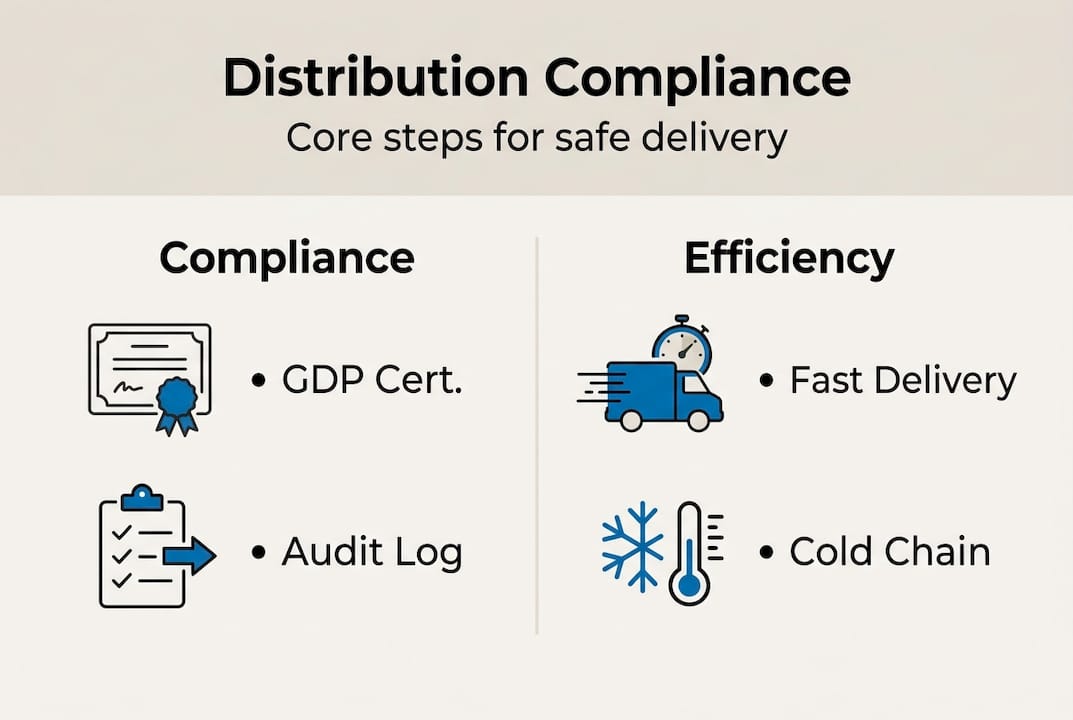
- GDP certification issued by the relevant national regulatory authority
- Cold chain infrastructure: validated cold rooms, refrigerated vehicles, temperature monitoring systems
- Regulatory compliance history: no outstanding violations, audit findings, or sanctions
- Local network depth: established relationships with customs brokers, healthcare facilities, and last-mile carriers
- Track record: participation in government tenders and hospital supply contracts
- SOPs and training: documented standard operating procedures and trained staff
As procurement professionals should prioritize GDP certification, cold chain expertise, and local networks, verifying via ASEAN regulatory records and hospital tender outcomes is a practical and effective approach. Do not rely solely on self-reported information from potential partners.
Verification should include requesting copies of current GDP compliance certificates, reviewing the most recent third-party audit report, and speaking directly with existing clients in comparable therapeutic categories. Weak infrastructure warning signs include unvalidated cold storage, staff with no formal GDP training, and a lack of documented SOPs.
Pro Tip: Ask for the distributor’s most recent regulatory inspection report. A distributor with nothing to hide will provide it without hesitation. One that stalls is signaling a problem.
Reviewing cold chain best practices before entering procurement negotiations will help you ask the right questions and evaluate answers with informed judgment.
Public vs. private distribution models in Southeast Asia
Finally, let us compare the main distribution models in the region. Healthcare executives often face a structural choice between working within public distribution systems or engaging private logistics providers.
Public distribution refers to government-managed systems where national or regional health agencies procure, warehouse, and distribute pharmaceuticals through state infrastructure. In many ASEAN countries, this covers essential medicines and vaccines for public health programs.
Private distribution typically involves 3PL providers contracted by pharmaceutical manufacturers or importers to manage logistics operations. These companies bring specialized infrastructure, technology platforms, and operational expertise.
Inventory inaccuracies and delivery delays persist in public sector systems, while 3PLs bring resilience but can increase dependency on external partners.
The advantages and disadvantages of each model are clear:
- Public model advantages: broad geographic reach in national health programs, political stability in procurement, alignment with public health mandates
- Public model disadvantages: vehicle shortages, inventory management gaps, slow procurement cycles
- Private 3PL advantages: operational agility, temperature-controlled infrastructure, real-time tracking, scalability
- Private 3PL disadvantages: cost structures, dependency risk, variable regulatory compliance across providers
“The choice between public and private is rarely binary. In practice, the most effective Southeast Asian pharmaceutical supply chains combine the reach of public networks with the precision of private logistics.”
Hybrid models are gaining traction across the region, particularly in countries like Indonesia and the Philippines, where geographic complexity demands both government reach and private sector capability. Understanding 3PL vs. 4PL models helps executives make informed structural decisions as they scale regional operations.
Why compliance-focused partnerships are the true differentiator
With distribution models in mind, here is what most conventional advice misses. Across Southeast Asia, procurement decisions are still too often anchored to price and speed. These are important factors. But they are not the factors that determine whether a distribution partnership survives a regulatory audit, a customs dispute, or a cold chain excursion.
The executives who have navigated supply chain crises in this region share a consistent lesson: the partners who held up under pressure were those with documented compliance systems, transparent audit trails, and proactive communication. Not necessarily the cheapest option. Not always the fastest. But the ones who treated compliance as a core operating principle rather than a box-ticking exercise.
Make compliance documentation non-negotiable in your tenders. Request audit reports, not just certificates. Ask for excursion records, not just assurances. The distributor who hands over a complete compliance dossier without being asked twice is demonstrating exactly the kind of operational culture you need in a regulated supply chain.
Building pharma security strategies into your procurement framework and investing in business support in logistics are not overhead costs. They are the foundation of supply chain resilience in one of the world’s most complex pharmaceutical markets.
Partnering for secure and compliant pharmaceutical distribution
For healthcare executives and procurement professionals ready to strengthen their pharmaceutical distribution strategy, the right partner makes the difference between a supply chain that performs and one that creates liability.
Labgistics Asia brings over 20 years of experience in healthcare logistics solutions across Southeast Asia, with fully accredited distribution centers, GDP-compliant cold chain infrastructure, and regulatory expertise spanning multiple ASEAN markets. Whether you need to optimize healthcare transportation or access smart solutions for pharma logistics, Labgistics offers end-to-end support tailored to your compliance and operational requirements. Connect with us to discuss a custom distribution assessment for your market.
Frequently asked questions
Why is GDP certification critical for pharmaceutical distributors?
GDP is central in distributor vetting for Southeast Asian pharma markets because it ensures safe handling, storage, and transportation of medicines, directly reducing the risk of product spoilage and regulatory noncompliance.
What are common risks in Southeast Asian pharmaceutical distribution?
Common risks include cold chain failures and counterfeiting along with stockouts, documentation gaps, and regulatory penalties for GDP noncompliance across ASEAN markets.
How do I verify a distributor’s compliance and reliability?
Review their GDP certification, most recent third-party audit report, and active licenses, then verify via certifications and hospital or government tender track records to confirm operational reliability.
Are private 3PLs better than public distribution for pharmaceuticals?
Private 3PLs raise dependency concerns but generally outperform public systems in operational resilience and cold chain capability, making hybrid models increasingly common across Southeast Asia.