
Business support in healthcare logistics: key functions explained
TL;DR:
- Effective healthcare logistics rely on support functions like regulatory compliance, data analytics, and contingency planning.
- In Southeast Asia, local compliance and cold chain management are crucial due to diverse regulations and infrastructure gaps.
- Strong business support systems enable better risk management, regulatory adherence, and supply chain resilience.
Most healthcare administrators assume logistics success hinges on fleet size, warehouse square footage, or transport speed. That assumption leaves organizations exposed. The real operational backbone of pharmaceutical and medical product supply chains is a set of support functions that rarely appear on a procurement checklist: regulatory compliance management, data analytics, order-to-cash processing, and contingency planning. The healthcare 3PL market growth reached $258.7 billion in 2025, and much of that expansion was driven not by more trucks, but by more sophisticated support infrastructure. This article breaks down exactly what business support means in healthcare logistics, why it matters across Southeast Asia, and how procurement leaders can use it as a competitive advantage.
Table of Contents
- Defining business support in healthcare logistics
- Key business support services and their impact
- The Southeast Asia context: Local compliance and cold chain realities
- Advanced methodologies: Digital tools, analytics, and continuous improvement
- Critical scenarios and edge cases: What most overlook
- Why business support is the real differentiator in Southeast Asian healthcare logistics
- Partnering with experts for reliable healthcare logistics
- Frequently asked questions
Key Takeaways
| Point | Details |
|---|---|
| Business support defined | These are operational services like compliance, analytics, and customer service that enable safe, efficient healthcare logistics. |
| Regional challenges matter | Southeast Asia’s strict and diverse regulations require specialized support for smooth logistics. |
| Digital tools drive results | AI and analytics make logistics more reliable, responsive, and efficient at scale. |
| Edge cases need planning | Critical scenarios like recalls and cold chain failures must be managed by robust business support protocols. |
| Choose expert partners | The best results come from providers with local expertise and advanced business support systems. |
Defining business support in healthcare logistics
Before exploring why business support is so crucial, let’s clarify exactly what falls under this category in healthcare logistics.
Business support is the operational layer that makes physical logistics possible, reliable, and compliant. It is not the forklift or the refrigerated truck. It is the documentation, the data, the regulatory filings, and the customer service protocols that ensure every shipment meets legal and quality standards before it leaves the facility.
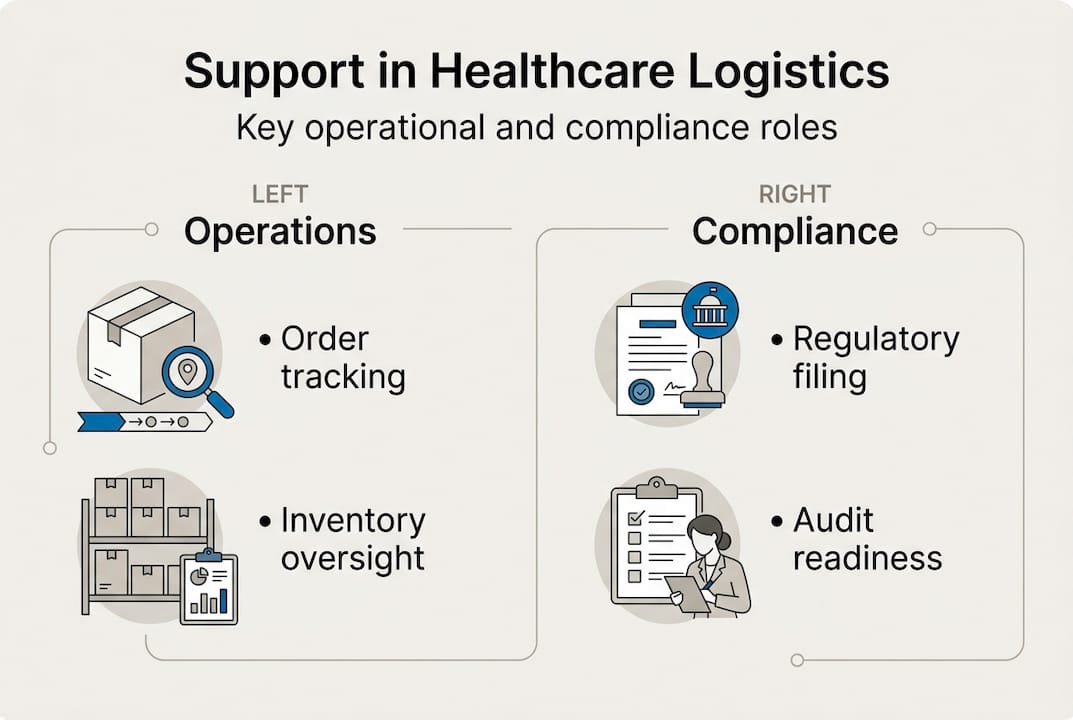
Business support in healthcare logistics refers to the non-core operational services provided by third-party logistics (3PL) providers or internal teams, covering administrative tasks, regulatory compliance assistance, customer service, order-to-cash management, data analytics, and strategic planning. These functions enable efficient logistics operations for pharmaceuticals and medical products. The word “non-core” is misleading. These services drive regulatory, operational, and financial outcomes at every stage of the supply chain.
Common business support functions in healthcare logistics include:
- Regulatory compliance management: Preparing and submitting import/export documentation, licenses, and product registrations
- Order-to-cash processing: Managing purchase orders, invoicing, and payment reconciliation
- Data analytics and reporting: Tracking KPIs, benchmarking supplier performance, and forecasting demand
- Customer service and issue resolution: Handling queries from healthcare providers, pharmacies, and distributors
- Inventory and warehouse management: Monitoring stock levels, expiry dates, and reorder triggers
- Sales and marketing support: Coordinating product launches, promotional logistics, and market entry activities
The table below illustrates how these functions translate into day-to-day operations:
| Support function | Real-world application |
|---|---|
| Regulatory compliance | Preparing GDP-compliant documentation for cross-border shipments |
| Data analytics | Generating expiry reports to prevent waste and stockouts |
| Order-to-cash | Reconciling invoices between distributor and manufacturer |
| Customer service | Resolving delivery discrepancies with hospital procurement teams |
| Inventory management | Triggering automated reorders based on consumption data |
These supply chain solutions are the connective tissue between physical movement and regulatory accountability. Without them, even the most sophisticated cold chain infrastructure cannot guarantee compliant, timely delivery.
Key business support services and their impact
With the main categories of support defined, let’s look at how these services operate in practice and why they’re transformative for health providers.
Centralized logistics support teams in hospitals and distribution centers perform a structured set of daily tasks. A typical workflow looks like this:
- Receive and validate incoming orders against purchase agreements and product specifications
- Check regulatory documentation for completeness, including import permits and certificates of analysis
- Assign inventory locations using FIFO (first in, first out) or EEFO (earliest expiry, first out) protocols
- Monitor temperature and storage conditions in real time using connected sensors
- Process outbound shipments with full chain-of-custody documentation
- Report KPIs to procurement and clinical teams on a scheduled basis
This structured approach is what AI-driven optimization in logistics is now augmenting, with centralized onsite services like stocking carts, equipment management, and waste handling freeing clinical staff from non-clinical tasks. Studies indicate nurses can reclaim up to 10% of their working time when logistics support functions are properly centralized, which translates to more than 10 full-time equivalents in a mid-sized hospital.
The comparison below shows the practical difference between in-house and outsourced support models:
| Function | In-house model | Outsourced to 3PL |
|---|---|---|
| Regulatory filing | Internal staff, variable expertise | Dedicated compliance specialists |
| Inventory analytics | Manual spreadsheets or basic ERP | Real-time dashboards with predictive alerts |
| Waste and returns handling | Ad hoc, often reactive | Structured reverse logistics protocols |
| Scalability | Limited by headcount | Scales with contract terms |
Outsourcing to a qualified 3PL provider gives organizations access to specialized expertise without the overhead of building it internally. The tradeoff is selecting a partner whose standards match your regulatory obligations, which is especially important when navigating pharma logistics challenges in markets with strict product registration requirements.

Pro Tip: Use a phased implementation approach when adding new support functions. Start with the highest-risk area, such as regulatory compliance or cold chain monitoring, before expanding to analytics or customer service automation. This minimizes workflow disruption and allows staff to adapt systematically.
The Southeast Asia context: Local compliance and cold chain realities
While the above applies globally, Southeast Asia adds regulatory and infrastructure complexities healthcare administrators must consider.
The region is not a single market. It is a collection of distinct regulatory environments, each with its own product registration requirements, import licensing rules, and quality standards. Thailand’s Food and Drug Administration (TFDA), Vietnam’s Drug Administration (DAV), Indonesia’s BPOM, and Singapore’s HSA all operate under different frameworks. A shipment compliant in one country may be held at customs in another.
Regional regulatory requirements in Southeast Asia mean business support must emphasize GDP and GMP compliance, import licensing, local representation, and cold chain management for pharmaceuticals. Infrastructure gaps, diverse regulations, and demand surges create compounding challenges for logistics teams operating across borders.
Vietnam stands out as a notable growth market. Its pharmaceutical sector is among the fastest growing in Asia, yet cold chain for GLP-1 medications and other temperature-sensitive products still faces infrastructure gaps in secondary cities and rural provinces.
Practical compliance tips for Southeast Asia operations:
- Appoint local regulatory representatives in each target country to manage product registrations and import permits
- Maintain country-specific documentation sets that reflect each regulator’s formatting and language requirements
- Use digital track-and-trace tools that generate audit-ready records for GDP inspections
- Partner with providers experienced in cold chain challenges in Southeast Asia to ensure temperature excursion protocols are in place
- Review eco-friendly cold chain options that meet both regulatory and sustainability targets
Pro Tip: Before signing with any logistics provider in Southeast Asia, request documented proof of GDP certification and ask for a live demonstration of their real-time temperature monitoring system. A provider that cannot show you both is a compliance liability.
Advanced methodologies: Digital tools, analytics, and continuous improvement
Regional practicalities aside, future-ready logistics teams invest in advanced methodologies. Here’s how digital innovation is reshaping business support.
Data analytics and AI are no longer optional features in healthcare logistics. They are operational requirements for organizations managing large product portfolios across multiple markets. Route optimization algorithms can cut empty logistics miles by 30 to 40%, directly reducing cost and carbon output.
“80% of health systems lack real-time visibility into their supply chains. Closing this gap is not a technology project. It is a patient safety priority.”
The table below maps key digital tools to their measurable impact on logistics KPIs:
| Digital tool | KPI impacted | Typical improvement |
|---|---|---|
| AI route optimization | Empty miles, delivery time | 30-40% reduction in empty miles |
| Real-time temperature sensors | Cold chain excursions | Early detection, reduced product loss |
| Supplier scorecards | Vendor performance | Faster issue resolution, fewer delays |
| Demand forecasting software | Stockouts and overstock | 15-25% improvement in inventory accuracy |
Rolling out digital improvements effectively requires a structured approach:
- Audit current data gaps by identifying which KPIs lack reliable real-time data
- Pilot one tool in a controlled environment, such as a single distribution center or product category
- Measure baseline vs. post-implementation performance using agreed metrics
- Involve 3PL partners and suppliers in the rollout to ensure data compatibility
- Scale across markets once the pilot demonstrates consistent results
AI in cold chain logistics is particularly valuable for managing temperature-sensitive pharmaceuticals across Southeast Asia’s varied infrastructure. Combined with smart logistics solutions, these tools shift business support from reactive problem-solving to proactive risk management.
Critical scenarios and edge cases: What most overlook
Even with the best systems, disruptions and exceptions occur. How your business support is structured in these moments is make-or-break.
Product recalls, temperature excursions, and rural last-mile delivery failures are not theoretical risks. They are recurring operational events in Southeast Asia’s healthcare supply chain. Edge cases including temperature excursions, recalls, reverse logistics, rural last-mile delivery, and counterfeit prevention require dedicated protocols, not improvised responses.
“Advanced preparation for exceptions can mean the difference between patient safety and a public health crisis.”
Common edge cases and the business support responses they require:
- Temperature excursion: Immediate product quarantine, deviation reporting, regulatory notification, and root cause analysis
- Product recall: Batch traceability activation, distributor notification, reverse logistics coordination, and regulatory filing
- Rural last-mile delivery failure: Alternative carrier activation, cold storage handoff protocols, and real-time status updates to the receiving facility
- Counterfeit detection: Serialization verification, supplier audit trigger, and regulatory escalation
- Demand surge: Safety stock activation, expedited import licensing, and priority allocation protocols
Every administrator should require the following from their logistics support structure:
- A documented recall response SOP with defined response time targets
- Real-time cold chain safety in Southeast Asia monitoring with automated alerts
- A dedicated reverse logistics process for expired or recalled products
- Serialization and batch tracking capability integrated with regulatory systems
- A named compliance contact for each country of operation
These protocols are not administrative overhead. They are the difference between a contained incident and a regulatory investigation.
Why business support is the real differentiator in Southeast Asian healthcare logistics
Here is a perspective that most procurement conversations miss entirely.
The industry defaults to evaluating logistics providers on price per pallet, fleet size, and warehouse certifications. Those metrics matter, but they do not predict performance when things go wrong. In Southeast Asia, where regulatory frameworks shift, infrastructure is inconsistent, and demand can spike without warning, the real differentiator is the quality of a provider’s support infrastructure.
Organizations that avoid costly fines, product seizures, and delivery failures are not necessarily the ones with the largest networks. They are the ones with the strongest compliance processes, the most responsive data pipelines, and the deepest local regulatory relationships. A provider with 500 trucks but no local regulatory representative in Vietnam is a higher-risk partner than a smaller operator with proven GDP compliance and real-time visibility.
The uncomfortable truth is this: in Southeast Asia, your logistics chain’s strength is only as good as its weakest compliance process or data pipeline. Procurement leaders who prioritize business support capabilities over headline price will consistently outperform those who do not. Reviewing pharma logistics insights from experienced regional operators can sharpen your evaluation criteria before the next tender process.
Partnering with experts for reliable healthcare logistics
Translating these lessons into action means having the right strategic partner.
Labgistics Asia connects every business support function described in this article to real-world pharmaceutical and medical device operations across Southeast Asia. From regulatory compliance and GDP-certified cold chain to AI-driven logistics and rural last-mile delivery protocols, the team brings over 20 years of regional experience to every engagement.
Whether you need to address pharma logistics challenges in a new market or strengthen your existing support infrastructure, Labgistics offers end-to-end solutions built for Southeast Asia’s regulatory and operational realities. Contact the team to discuss how a tailored logistics support model can reduce your compliance risk and improve supply chain performance.
Frequently asked questions
What are examples of business support in healthcare logistics?
Business support in healthcare logistics includes order management, regulatory paperwork processing, real-time tracking, inventory analytics, and supplier compliance management. These functions are provided by 3PL teams or internal logistics departments to keep pharmaceutical supply chains compliant and efficient.
Why is regulatory compliance support critical in Southeast Asia?
Diverse regulations across countries, including TFDA in Thailand and the DAV in Vietnam, mean that expert compliance support prevents costly delays, fines, and product seizures at customs. Without local regulatory expertise, even correctly manufactured products can be blocked from reaching patients.
How does AI benefit healthcare logistics support?
AI reduces empty miles by 30 to 40%, optimizes delivery routes, enables real-time cold chain monitoring, and helps logistics teams manage exceptions like recalls and temperature excursions before they escalate.
What is an edge case in healthcare logistics and how is it managed?
Edge cases include recalls, temperature excursions, and rural last-mile delivery failures, which are managed through pre-defined SOPs, digital tracking systems, and dedicated reverse logistics protocols that activate automatically when a trigger event is detected.
How can healthcare administrators select the right logistics partner?
Prioritize providers with proven local compliance expertise, GDP-certified cold chain capabilities, digital tracking tools, and real-time supply chain visibility across all operating countries in Southeast Asia.