
Logistics risk management: healthcare supply chain strategies
Hidden risks in medical logistics can quietly erode performance long before a formal audit catches them. Demand-side risks reduce operational performance by 19.1% and supply-side risks by 13.1%, according to empirical benchmarks from pharmaceutical supply chain research. Yet most healthcare executives in Southeast Asia still treat risk management as a compliance checkbox rather than a strategic operational discipline. That misalignment is costly. This article breaks down what logistics risk management actually means in the medical sector, identifies the specific risk categories that matter most in the region, and outlines practical frameworks your team can apply to build genuine supply chain resilience.
Table of Contents
- What is logistics risk management in healthcare?
- Major types of logistics risks in Southeast Asian medical supply chains
- Frameworks and strategies for managing logistics risks
- Trade-offs and best practices for high-risk medical logistics
- A local perspective: Lessons learned on logistics risk in Southeast Asia healthcare
- Explore tailored logistics risk solutions for Southeast Asia healthcare
- Frequently asked questions
Key Takeaways
| Point | Details |
|---|---|
| Operational impact | Demand-side logistics risks can reduce performance by nearly 20%, requiring proactive management. |
| Dynamic frameworks | Dynamic quantitative risk models outperform static registers for Southeast Asian healthcare logistics. |
| Cybersecurity urgency | Cyberattacks on medical logistics are set to double in 2026, elevating technical risk mitigation. |
| Trade-off decisions | Choosing between dedicated and shared fleets involves quantifying cost vs. contamination risks for each medical shipment. |
| Local adaptation | Adapting risk management best practices to Southeast Asia’s infrastructure and regulatory context is essential. |
What is logistics risk management in healthcare?
Logistics risk management in healthcare refers to the systematic process of identifying, assessing, and mitigating risks that could disrupt the movement, storage, or delivery of medical products. It covers the entire supply chain, from raw material sourcing to last-mile patient delivery. The scope is broad and includes physical, regulatory, financial, and informational risks.
In the healthcare context, the stakes are uniquely high. A delayed insulin shipment or a temperature excursion in a biologic product is not just an operational problem. It is a patient safety issue. That reality demands a risk management approach that goes far beyond maintaining a spreadsheet of potential incidents.
Key risks threatening healthcare supply chains include:
- Demand variability: Unpredictable patient volumes, seasonal disease outbreaks, and rapid shifts in treatment protocols.
- Vendor concentration: Over-reliance on a single active pharmaceutical ingredient (API) supplier or contract manufacturer.
- Cold chain failures: Temperature deviations during transit or storage that render products unusable.
- Regulatory non-compliance: Failure to meet country-specific import, labeling, or storage requirements across Southeast Asia’s fragmented regulatory landscape.
- Information gaps: Poor visibility into real-time inventory levels, shipment status, or expiry data.
Understanding healthcare logistics security as an integrated component of risk management is critical. Security breaches, whether physical or digital, can compromise product integrity and data confidentiality simultaneously.
Traditional risk registers, those static documents listing potential hazards with assigned severity scores, are increasingly inadequate for modern healthcare logistics. Research confirms that static risk registers are insufficient compared to dynamic quantitative models that can adapt to real-time data and shifting supply chain conditions.
“Effective risk management in healthcare logistics is not a document. It is a living operational capability that responds to new information, new partners, and new disruptions as they emerge.”
Dynamic, data-driven models allow supply chain leaders to run scenario analyses, quantify probability distributions for disruptions, and make resource allocation decisions based on measurable risk exposure. For executives managing supply chain risks across SEA, this distinction between static and dynamic approaches is not theoretical. It determines operational outcomes.
Major types of logistics risks in Southeast Asian medical supply chains
With definitions established, it is useful to break down the specific risk categories that regularly disrupt medical logistics across Southeast Asia. These fall into three broad groups: demand-side, supply-side, and operational risks.
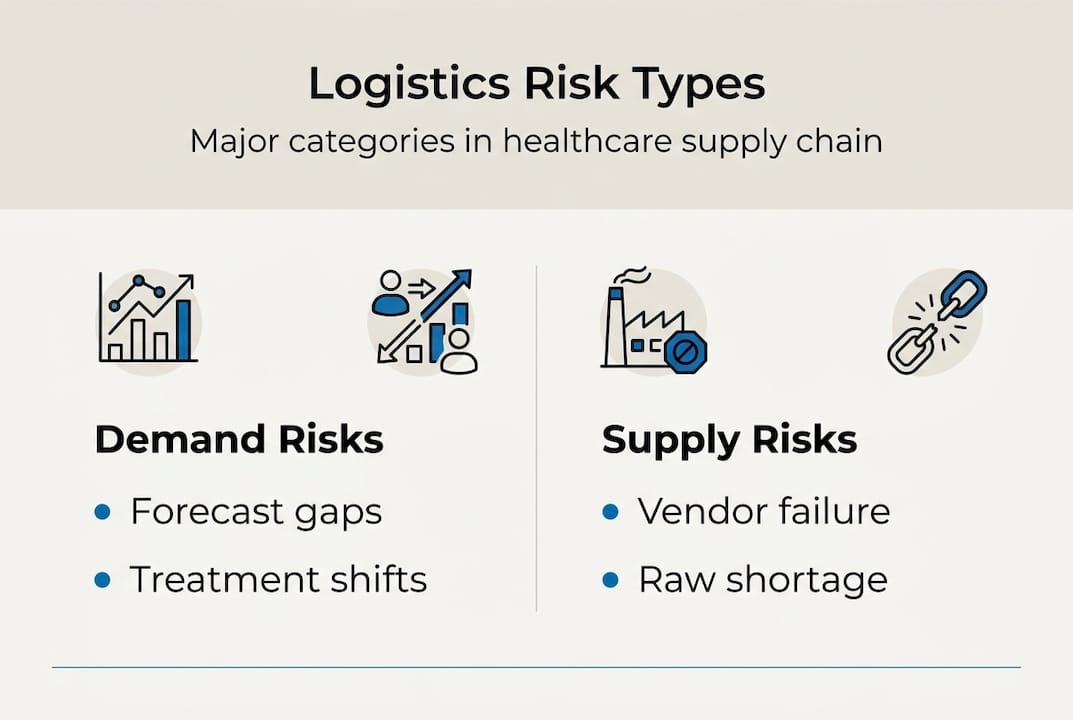
Demand-side risks arise when actual product requirements diverge from forecasts. In Southeast Asia, this is amplified by fragmented healthcare infrastructure, variable reimbursement policies, and sudden shifts in disease burden. Forecast errors lead to overstocking or stockouts, both of which carry direct cost and patient care consequences.
Supply-side risks include vendor failures, raw material shortages, and geopolitical disruptions affecting API sourcing. Countries like Vietnam, Thailand, and Indonesia depend heavily on imported pharmaceutical inputs, making them vulnerable to global supply shocks.
Operational risks are arguably the most diverse category. They include cold chain failures, transportation delays, documentation errors, and increasingly, cyberattacks. Cyberattacks on logistics are expected to double by 2026, making digital risk mitigation as urgent as physical security measures.

| Risk category | Common triggers | Estimated performance impact |
|---|---|---|
| Demand-side | Forecast errors, policy changes | Up to 19.1% reduction |
| Supply-side | Vendor failure, API shortages | Up to 13.1% reduction |
| Operational | Cyberattacks, cold chain breaks | Variable; potentially severe |
Key operational risks worth prioritizing include:
- Cold chain interruptions during last-mile delivery in high-humidity environments.
- Customs delays caused by incomplete or inaccurate import documentation.
- Warehouse contamination events linked to inadequate environmental controls.
- IT system failures that break real-time inventory visibility.
Understanding the relative weight of each risk category is essential for effective resource allocation. Reviewing common pharma logistics challenges in the region helps contextualize where your supply chain is most exposed.
Pro Tip: Rank your risk categories by their measured impact on operational performance, not just perceived likelihood. Demand-side risks consistently outpace supply-side risks in measurable performance reduction, so prioritize forecasting accuracy and demand sensing investments first.
To strengthen your pharma supply chain in Southeast Asia, executives need to move from intuitive risk awareness to quantified risk prioritization.
Frameworks and strategies for managing logistics risks
Understanding risk categories sets the foundation. The next step is selecting and applying frameworks that translate risk awareness into operational action.
A practical step-by-step risk management framework for medical logistics looks like this:
- Risk identification: Map all supply chain nodes, partners, and product flows. Identify where disruptions have occurred historically and where vulnerabilities exist structurally.
- Risk quantification: Assign probability and impact scores using real data, not assumptions. Dynamic quantitative models significantly outperform static risk registers here.
- Risk prioritization: Focus mitigation resources on the highest-impact categories first, guided by measurable performance benchmarks.
- Mitigation planning: Develop response protocols for each prioritized risk, including backup suppliers, alternate transport routes, and inventory buffers.
- Monitoring and review: Establish continuous monitoring through real-time data systems and conduct structured reviews after every significant disruption.
Three proven methodologies stand out for healthcare logistics:
| Framework | Best suited for | Key advantage |
|---|---|---|
| Lean Six Sigma | Process efficiency, stockout reduction | Reduced order fulfillment time and fewer stockouts |
| Probabilistic Risk Assessment (PRA) | Regulatory-sensitive environments | Quantifies uncertainty in complex systems |
| Agent-based simulation | Multi-node supply chains | Models interaction between supply chain actors dynamically |
Agent-based simulation, in particular, consistently outperforms static risk register effectiveness in complex, multi-stakeholder healthcare supply chains. It allows teams to model how disruptions cascade through interdependent nodes, which is especially relevant in Southeast Asia where logistics networks often span multiple regulatory jurisdictions.
Local adaptation matters as much as framework selection. Friend-shoring (preferring suppliers from politically aligned nations) and near-shoring (sourcing from regional rather than distant suppliers) are increasingly used in Southeast Asia to reduce geopolitical exposure.
Pro Tip: When selecting a risk management framework, anchor the decision in measurable outcomes. If your primary challenge is stockouts, Lean Six Sigma has direct evidence. If your supply chain spans five or more countries, agent-based simulation will expose interdependencies that simpler tools miss. Use transportation management improvement data to validate which strategies reduce real disruption frequency. Strong inventory management practices also reinforce framework performance by reducing the downstream impact of upstream risk events.
Trade-offs and best practices for high-risk medical logistics
Frameworks and strategies inform decisions. But daily operations require navigating real trade-offs, particularly when managing high-risk shipments like biologics, vaccines, or controlled substances.
Fleet dedication vs. cost efficiency is one of the most consequential decisions for high-risk product logistics. Dedicated fleets reduce contamination risk for high-risk biologics compared to shared fleets, but they carry higher fixed costs. The right choice depends on product sensitivity, regulatory requirements, and shipment frequency.
Key best practices for high-risk medical logistics include:
- Cold chain documentation: Maintain unbroken temperature records from origin to delivery point. Regulators across Southeast Asia are increasingly requiring full data trail audits.
- Dual sourcing for critical APIs: Reduce single-supplier dependency by qualifying at least two vendors for every critical raw material.
- Scenario planning for customs delays: Pre-file documentation and maintain buffer stock near key distribution hubs to absorb regulatory processing time.
- Real-time monitoring integration: Deploy IoT-enabled tracking on high-risk shipments to enable early intervention before excursions become irreversible.
Statistic: Dedicated fleet models can reduce cross-contamination incidents by a measurable margin compared to shared transport, a factor that matters enormously when handling temperature-sensitive biologics or high-potency compounds.
Sourcing strategy also plays a major role in risk exposure. Friend-shoring and near-shoring reduce reliance on distant API suppliers from China or India, improving supply stability for Southeast Asian healthcare companies. This is particularly relevant in 2026 as geopolitical pressures continue to reshape global pharmaceutical supply chains.
Cold chain compliance across SEA requires not just the right equipment but also trained personnel, validated SOPs, and regular calibration of monitoring devices.
Pro Tip: Use scenario planning sessions with your logistics team to quantify trade-offs numerically before committing to fleet or sourcing decisions. Assign cost estimates to contamination events, stockouts, and delay penalties. That data will consistently outperform gut instinct in executive decision-making.
A local perspective: Lessons learned on logistics risk in Southeast Asia healthcare
Most global risk frameworks are designed for mature, centralized healthcare systems. They assume consistent infrastructure, reliable road networks, and predictable regulatory timelines. Southeast Asia frequently offers none of those.
The uncomfortable truth is that infrastructure variability across countries like Myanmar, Cambodia, and the Philippines means that even well-designed risk frameworks fail if they are not locally calibrated. A cold chain protocol that works in Singapore may be operationally unworkable in a secondary city in Indonesia.
Rapid response logistics during recent regional disruptions, including COVID-19 and subsequent supply shocks, exposed a pattern: organizations that had invested in relationship-based logistics networks, not just contract-based ones, recovered faster. Local partners with embedded regulatory knowledge and physical proximity to key markets proved far more resilient than centralized, cost-optimized models.
The deeper lesson is that cultural and regulatory complexity in Southeast Asia requires adaptive, not just compliant, risk management. Checklists do not account for the informal coordination that often determines whether a critical shipment clears customs or sits in a warehouse. Sustainable supply chain practices in medical warehousing are part of building that long-term, adaptive resilience that purely transactional models cannot replicate.
Explore tailored logistics risk solutions for Southeast Asia healthcare
Building a risk-resilient healthcare supply chain in Southeast Asia requires more than the right framework on paper. It requires operational infrastructure, regulatory expertise, and local networks that can respond when plans meet reality.
Labgistics Asia supports healthcare and pharmaceutical executives with end-to-end logistics risk solutions, including optimized transportation management, logistics security across SEA, and fully validated cold chain logistics services. With over 20 years of experience and accredited distribution centers across the region, Labgistics Asia provides the local expertise and operational depth your risk strategy needs to perform under real-world conditions. Connect with our team to assess your current risk exposure and identify the highest-impact improvements for your supply chain.
Frequently asked questions
How do demand-side risks affect Southeast Asian healthcare logistics?
Demand-side risks such as forecast errors and rapidly shifting treatment requirements can lower operational performance by nearly 20%, creating stockouts, excess inventory, and compromised patient access to essential medicines.
What is the most effective risk management framework for medical logistics?
Dynamic quantitative models such as agent-based simulations and PRA consistently outperform static risk registers for managing complex, region-specific disruptions in healthcare logistics.
Are cyberattacks a significant threat to Southeast Asian healthcare logistics in 2026?
Yes. Cyberattacks targeting logistics are expected to double in 2026, making digital security protocols and IT resilience planning essential components of any modern healthcare logistics risk strategy.
How do dedicated fleets help in managing logistics risks for high-risk biologics?
Dedicated fleets lower contamination risk compared to shared transport, though at higher fixed costs; quantifying trade-offs for each shipment type using scenario planning helps executives make the most defensible fleet decisions.
Recommended
- Logistics security for healthcare: safeguarding SEA supply chains
- Top inventory management tips for healthcare logistics
- Top medical supply chain risks in Southeast Asia 2026
- Sustainable Supply Chain Practices in Medical Warehousing