
Pharma supply chain optimization guide for Southeast Asia
Logistics inefficiency in pharmaceutical distribution isn’t just a cost problem. It’s a patient safety problem. Logistics costs exceed 20% of product value in some pharmaceutical supply chain sectors, and in Southeast Asia, where fragmented infrastructure, variable cold chain quality, and country-level regulatory differences compound the challenge, those costs climb even higher. Supply chain managers operating across this region face a tougher operating environment than most. This guide breaks down the key strategies, tools, and step-by-step processes for achieving measurable efficiency gains while staying fully compliant with regional regulations.
Table of Contents
- Understanding supply chain challenges in Southeast Asia pharma
- Building your optimization toolkit: Methods and digital solutions
- Step-by-step optimization: Improving storage, distribution, and cost efficiency
- Verification and compliance: Ensuring sustainable improvement
- A fresh perspective: Why balance matters more than chasing efficiency
- Next steps: Partnering for supply chain success in Southeast Asia
- Frequently asked questions
Key Takeaways
| Point | Details |
|---|---|
| Digital tools drive results | IoT and AI can improve delivery performance and cut inventory costs in pharma supply chains. |
| Reduce tiers for savings | Direct delivery and fewer distribution layers lower logistics costs and transit times. |
| Regulations matter | Compliance needs tailored strategies due to varying country rules in Southeast Asia. |
| Verify and sustain | Regular monitoring and adapting to changes keep improvements on track and prevent setbacks. |
Understanding supply chain challenges in Southeast Asia pharma
Southeast Asia’s pharmaceutical logistics landscape is shaped by a unique combination of geographic, regulatory, and infrastructural factors. The region spans over 11 countries with vastly different infrastructure maturity levels, from Singapore’s world-class cold chain facilities to more resource-constrained environments in Cambodia or Myanmar. Getting product from point A to point B reliably and within regulatory parameters requires more than operational discipline. It requires a deep understanding of local conditions.
The most common pain points facing supply chain managers in the region include:
- High logistics costs driven by multi-tier distribution models, long last-mile distances, and inconsistent transport infrastructure
- Regulatory fragmentation across ASEAN member states, even with regional harmonization initiatives in place
- Cold chain gaps including inadequate storage facilities, unreliable power supply, and limited qualified cold chain transport providers in secondary markets
- Stock management inefficiencies resulting in both overstock and stockouts due to poor demand forecasting and manual processes
- Limited supply chain visibility, particularly in cross-border distribution where product tracking becomes inconsistent
Country-level differences present a persistent challenge. While the ASEAN Medical Device Directive (AMDD) represents meaningful progress toward regional harmonization, country variations persist in approval timelines, product registration requirements, and GDP (Good Distribution Practice) enforcement. A product registered in Singapore cannot simply be distributed in Thailand under identical regulatory assumptions.
The cost impact of these inefficiencies is significant. Multi-tier distribution models, where product moves from national distributor to regional sub-distributor to local pharmacy or clinic, add cost at every handoff. The opportunity is clear: reducing tiers and shortening lead times while minimizing stock carrying costs represents one of the highest-leverage interventions available.
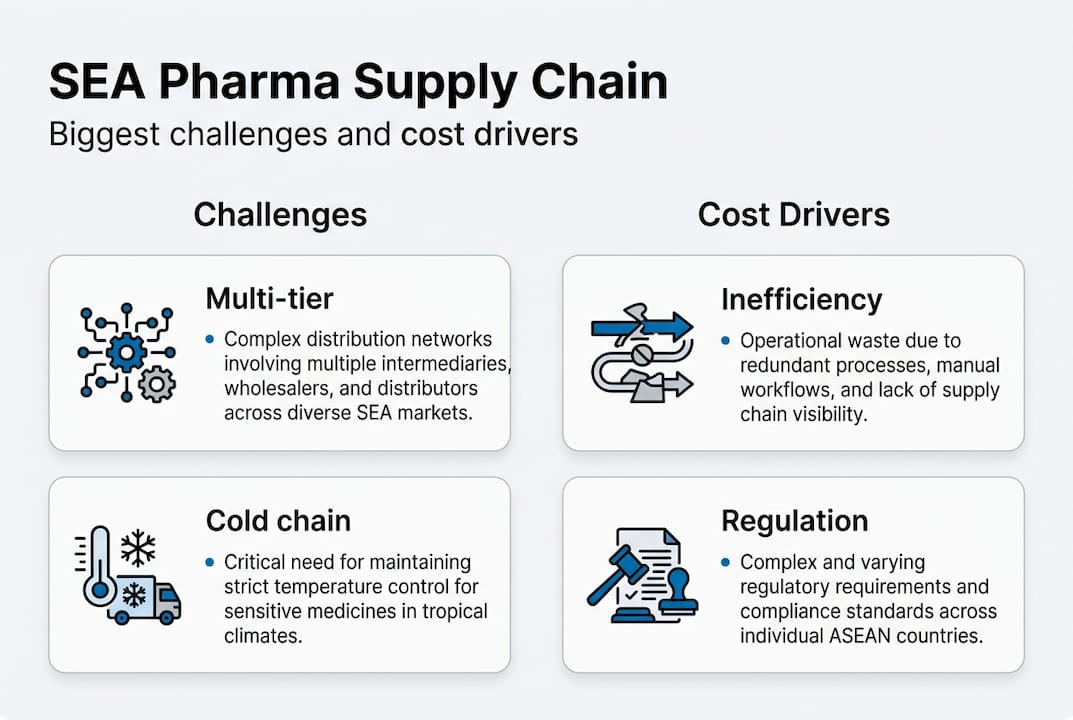
Understanding how these SEA logistics drivers interact is the foundation for any meaningful optimization effort. And distribution compliance across multiple markets requires this foundational understanding before any tools or technology are layered on top.
| Challenge | Primary impact | Common root cause |
|---|---|---|
| Multi-tier distribution | Cost inflation, extended lead times | Fragmented local market infrastructure |
| Regulatory divergence | Compliance delays, market access gaps | Uneven ASEAN harmonization adoption |
| Cold chain failures | Product spoilage, patient safety risk | Inadequate facility standards |
| Inventory inaccuracies | Stockouts and overstock | Manual tracking, poor demand data |
| Limited visibility | Reactive problem-solving | Low technology adoption |
With this context in mind, let’s look at how supply chain managers can prepare for optimization.
Building your optimization toolkit: Methods and digital solutions
Knowing where the problems are is only the beginning. Solving them requires the right combination of structured methodologies and digital tools. For pharmaceutical supply chains in Southeast Asia, this means drawing from both proven operational frameworks and emerging technology platforms.
The key methodologies for optimization in pharma supply chains include:
- Value Stream Mapping (VSM): A lean tool that visualizes every step in the supply chain, making waste and bottlenecks immediately visible. In pharma, this is particularly useful for identifying unnecessary storage touchpoints and approval delays.
- Kanban (pull systems): Replaces push-based inventory replenishment with demand-driven signals. This reduces overstock and ensures that slow-moving SKUs don’t consume cold storage capacity unnecessarily.
- Multi-Criteria Decision Models (MCDM): Helps prioritize supplier selection, distribution route decisions, and facility investments across competing variables like cost, compliance risk, and lead time.
- Probabilistic Risk Assessment (PRA): Quantifies supply chain risk scenarios, enabling proactive mitigation rather than reactive crisis management.
- Agent-based simulation: Models complex supply chain behaviors across multiple nodes, useful for stress-testing proposed changes before implementation.
On the digital side, the evidence base is strong. IoT, AI forecasting, and visibility platforms reduce spoilage and improve on-time delivery by 15 to 20% in pharmaceutical logistics environments. These aren’t aspirational projections. They reflect documented results from operational implementations.
| Method or tool | Key benefit | Implementation notes |
|---|---|---|
| Value Stream Mapping | Identifies waste and redundant steps | Requires cross-functional team input |
| Kanban/pull replenishment | Reduces overstock in cold storage | Best paired with ERP system integration |
| IoT temperature sensors | Real-time cold chain monitoring | Needs infrastructure investment upfront |
| AI demand forecasting | Reduces stockouts and overstock | Requires 12+ months of clean historical data |
| Digital twin simulation | Models supply chain scenarios before deployment | High setup cost; high long-term value |
| Visibility platforms | End-to-end shipment tracking | Vendor integration with 3PL partners needed |
Integrating AI for cold chain management is increasingly accessible even for mid-sized operations, and the advantages of SCM in the healthcare context extend well beyond cost. Better data leads to better decisions, and better decisions protect product integrity and patient safety.
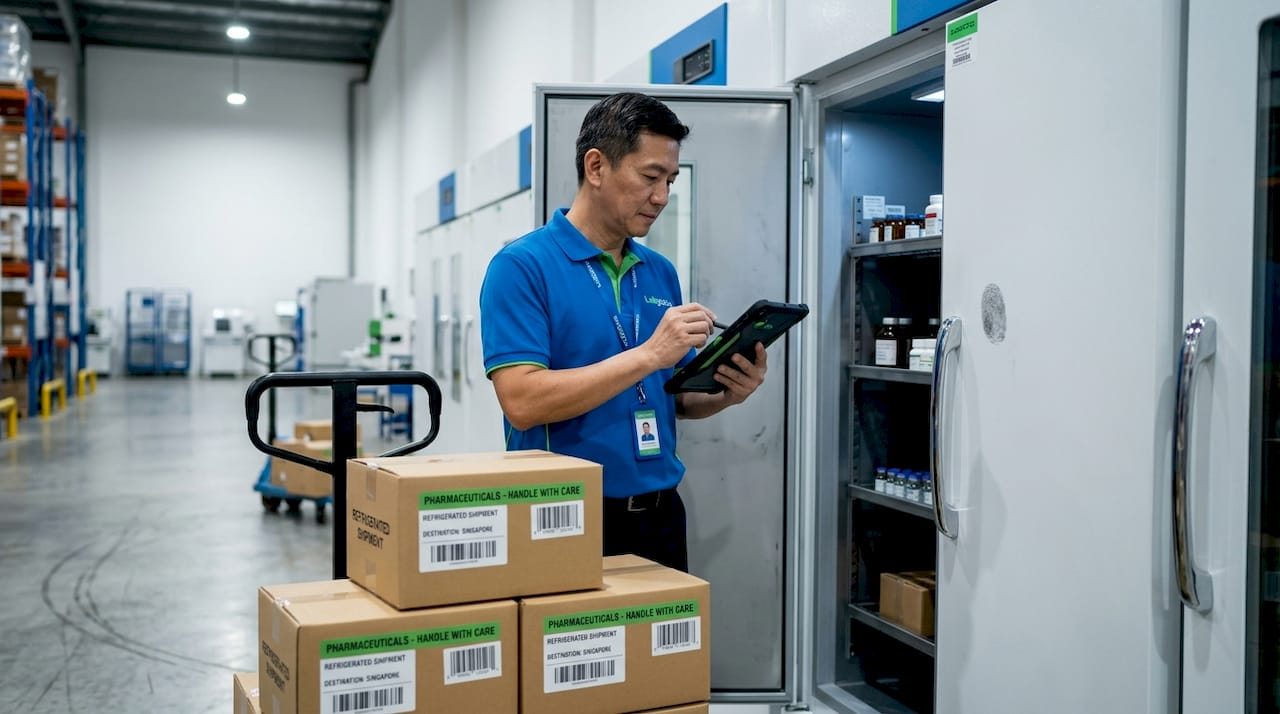
Pro Tip: When integrating digital tools, build your compliance workflow first. Temperature excursion alerts, for example, should trigger documented SOPs (Standard Operating Procedures) automatically. Technology that generates data without a compliance response protocol creates liability rather than reducing it.
Once the right tools and methodologies are identified, it’s time to move into the practical steps of execution.
Step-by-step optimization: Improving storage, distribution, and cost efficiency
Executing supply chain optimization in Southeast Asia requires a structured approach. The following steps provide a practical framework that supply chain managers can adapt to their specific market footprint and product portfolio.
-
Audit your current distribution tier structure. Map every node in your supply chain from manufacturer to end customer. Identify where product sits, for how long, and at what cost. Many organizations discover that two or three tiers can be consolidated without sacrificing service levels. Transit times reduced 12 to 22% and costs declined 8 to 15% in documented cases where tier reduction was implemented effectively.
-
Segment your product portfolio by supply chain need. Temperature-sensitive biologics, controlled substances, and ambient products have fundamentally different logistics requirements. Managing them under a single undifferentiated supply chain model inflates cost and increases risk. Segment by product type and build tailored pathways.
-
Implement real-time inventory visibility. Whether through an ERP (Enterprise Resource Planning) system, a warehouse management system, or a specialized visibility platform, accurate inventory data is non-negotiable. Without it, you’re optimizing blindly. Visibility at every storage node enables responsive replenishment and reduces the safety stock buffer you need to carry.
-
Deploy digital temperature monitoring for cold chain products. Digital tools reduce spoilage and improve on-time delivery by 15 to 20%, with inventory cost reductions of 8 to 12%. IoT sensors with automated alert systems should be standard in any cold chain operation, not a premium add-on.
-
Optimize transport routes and carrier selection. Use transportation data to identify inefficient routing, carrier reliability gaps, and load consolidation opportunities. In markets with limited carrier options, transport management strategy must account for seasonal disruptions, border crossing delays, and last-mile quality variation.
-
Establish clear KPIs and measure against them consistently. Key performance indicators should include order fulfillment rate, temperature excursion frequency, lead time by route, and inventory turnover. Without consistent measurement, gains made during implementation quietly erode over time.
-
Review and address supply chain risks systematically. Medical supply chain risks in Southeast Asia include geopolitical disruptions, natural disasters, port delays, and supplier concentration risk. Risk reviews should be scheduled quarterly, not triggered only by incidents.
Pro Tip: One of the most common mistakes in optimization programs is treating storage and transport as separate workstreams. In reality, your warehousing strategy directly determines your transport costs. Consolidate storage at strategically located distribution centers first, then redesign transport flows around those fixed points.
| Optimization step | Expected outcome | Common mistake to avoid |
|---|---|---|
| Tier reduction | Lead time down 12 to 22%, cost down 8 to 15% | Cutting tiers without service level analysis |
| Portfolio segmentation | Right-fit supply chain per product type | Applying cold chain to all products by default |
| Inventory visibility | Reduced safety stock, faster replenishment | Investing in tools without data governance |
| Digital temperature monitoring | Spoilage reduction, compliance documentation | Alert fatigue from poorly calibrated thresholds |
| Route optimization | Lower freight cost, better on-time rates | Ignoring carrier reliability data |
| KPI management | Sustained improvement over time | Measuring too many metrics without prioritization |
For a broader view of how smart logistics solutions address the specific challenges in this region, the operational principles above translate directly into actionable programs.
Once optimization is underway, verification and compliance are critical to sustain improvements.
Verification and compliance: Ensuring sustainable improvement
Implementing optimization measures is one thing. Verifying that they’re delivering real results, and that those results hold up under regulatory scrutiny, is another matter entirely. Sustainable supply chain improvement in Southeast Asia requires a disciplined approach to both performance measurement and compliance maintenance.
Key metrics to monitor after implementation include:
- Order fill rate: Are orders being fulfilled completely and on time?
- Temperature excursion rate: How frequently are cold chain thresholds being breached, and how quickly are deviations resolved?
- Lead time by origin-destination pair: Has tier reduction actually shortened delivery windows in each market?
- Inventory turnover ratio: Are stock levels becoming leaner without increasing stockout frequency?
- Complaint and deviation rate: Are product quality complaints declining as a result of supply chain improvements?
Regulatory compliance cannot be treated as a separate lane from operational efficiency. Regulatory harmonization via AMDD reduces complexity, but country variations persist across Southeast Asia. Pairing digitalization with active compliance management is essential, not optional.
“Digitalization without regulatory alignment creates false confidence. A supply chain that tracks temperature in real time but fails to document deviations in a format acceptable to local health authorities has closed one gap while leaving another wide open.”
Sustainable improvement tips include:
- Conduct regular GDP audits at every distribution node, including 3PL partners and last-mile carriers
- Maintain calibrated equipment records for all temperature monitoring and storage systems
- Update SOPs whenever distribution routes, carriers, or storage facilities change
- Train local teams on both operational procedures and the regulatory requirements specific to their market
- Build compliance documentation into digital workflows rather than treating it as a separate manual process
Ensuring cold chain compliance across multiple ASEAN markets is an ongoing process. Understanding pharmaceutical distribution compliance in detail gives supply chain managers the foundation to build verification frameworks that satisfy both internal quality standards and national regulatory requirements.
With strategies implemented and verified, the next step is continuous improvement. Here’s our unique take on sustaining supply chain optimization in Southeast Asia.
A fresh perspective: Why balance matters more than chasing efficiency
The conventional narrative around supply chain optimization focuses almost entirely on cost reduction and speed. Reduce tiers. Accelerate delivery. Cut inventory. These are legitimate goals, and the data supports pursuing them. But there is a version of this thinking that leads supply chain managers in the wrong direction.
Lean, fast supply chains are more fragile than robust ones. A distributor network trimmed to minimum viable nodes has no redundancy when a port shuts down, a typhoon disrupts road access, or a single third-party logistics provider fails an audit. In Southeast Asia, these are not hypothetical scenarios. They happen with regularity. The organizations that performed best during the COVID-19 supply chain disruptions were not the leanest ones. They were the ones that had maintained buffer capacity, multi-source supplier relationships, and flexible transport options, even when those elements looked like inefficiency on a spreadsheet.
Resilience and efficiency are not opposites. They exist on a spectrum, and the right position on that spectrum depends on your product portfolio, your market footprint, and your regulatory risk exposure. A biologics manufacturer distributing temperature-sensitive products across five ASEAN markets needs more redundancy built into its cold chain than a distributor of ambient generics in a single market. That redundancy has a cost, and it is a cost worth bearing.
This is where risk management strategies become a core part of optimization rather than a separate workstream. The most effective supply chain leaders in this region treat risk quantification as an input to every efficiency decision, not a separate concern addressed after the fact.
The practical advice is this: optimize for reliability first, efficiency second. A supply chain that consistently delivers product within specification, on time, and fully documented is worth more to your organization and to your patients than one that is 10% cheaper but fails unpredictably. Build your efficiency gains on a foundation of resilience, and they will last.
Next steps: Partnering for supply chain success in Southeast Asia
Achieving measurable, sustainable supply chain optimization in Southeast Asia requires more than internal process improvements. It requires a logistics partner with deep regional expertise, validated infrastructure, and the regulatory knowledge to keep your operations compliant across every market you serve.
Labgistics Asia brings over 20 years of specialized experience in pharmaceutical and healthcare logistics across Southeast Asia. From healthcare supply chain risk management to transportation management optimization and fully validated cold chain compliance solutions, our end-to-end capabilities are built specifically for the demands of pharma and life science supply chains in this region. Our distribution centers are fully accredited, our teams are trained to GDP standards, and our regulatory support helps clients navigate the complexities of multi-market operations. Connect with Labgistics Asia to discuss how we can support your supply chain optimization goals across Southeast Asia.
Frequently asked questions
What is the most cost-effective way to optimize pharma supply chains in Southeast Asia?
Reducing delivery tiers for more direct distribution is one of the highest-impact interventions, with documented transit time reductions of 12 to 22% and cost declines of 8 to 15% when paired with digital inventory management tools.
How do IoT and AI tools help in pharmaceutical logistics?
IoT sensors and AI-driven forecasting improve on-time delivery by 15 to 20% and reduce inventory carrying costs by 8 to 12% through real-time monitoring, predictive restocking signals, and automated excursion alerts.
Why is compliance challenging in Southeast Asia pharma logistics?
Despite regional efforts like AMDD, country variations persist in product registration requirements and GDP enforcement standards, requiring market-specific compliance strategies rather than a single regional approach.
How can storage and distribution optimization prevent product spoilage?
Shortening lead times through tier reduction reduces the time products spend in transit, while IoT temperature monitoring provides real-time alerts that allow teams to intervene before temperature excursions cause irreversible product damage.
Recommended
- Pharma logistics: Ensuring safe distribution and compliance
- Pharmaceutical Distribution Explained: Compliance and Efficiency
- SE Asia healthcare logistics: key drivers and strategies
- Healthcare logistics: cold chain and compliance in SE Asia