Healthcare supply chains are only as resilient as their least visible link. A single unmapped dependency, whether an unverified cold chain junction or an undocumented secondary supplier, can cascade into product loss, regulatory non-compliance, or patient harm. Effective mapping treats the exercise not as a one-time diagram but as an ongoing risk and visibility process with explicit goals, defined scope, and regular review cycles. This article walks supply chain managers and logistics professionals through a practical, replicable framework for mapping pharmaceutical and medical product distribution networks across Southeast Asia.
Table of Contents
- Why step-by-step supply chain mapping is critical in healthcare
- What you need before you start: Tools, data, and prerequisites
- The step-by-step mapping process: From data to actionable map
- Troubleshooting and optimizing your pharma supply chain map
- A practical perspective: What most supply chain mapping guides miss
- Next steps: Enhance your healthcare supply chain resilience with expert support
- Frequently asked questions
Key Takeaways
| Point | Details |
|---|---|
| Dynamic mapping is essential | Treat supply chain maps as living tools to manage risks and visibility, not just as one-time diagrams. |
| Start with structured data | Gather and standardize internal records before building process and geographic maps. |
| Verify each step | Use site checks and partner validation to confirm flows and uncover weak points at every junction. |
| Cold chain must be visible | Map and monitor temperature and compliance-critical steps for pharma and medical supply chains. |
| Review and update regularly | Schedule consistent mapping reviews to catch changes, disruptions, or emerging risks. |
Why step-by-step supply chain mapping is critical in healthcare
Healthcare supply chains operate under pressures that few other industries face. Regulatory requirements, temperature sensitivity, short product shelf lives, and multi-tier distribution networks combine to create a complexity that static diagrams cannot capture. A map built once and shelved quickly becomes a liability rather than an asset.
Systematic mapping exposes dependencies and quality threats that routine reporting overlooks. Consider a temperature-sensitive biologic traveling from a Singapore distribution center to a regional hospital in Vietnam. Each handoff point, freight forwarder, customs agent, last-mile carrier, and cold storage facility represents a potential failure node. Without explicit visibility into those nodes, risk management strategies in healthcare supply chains remain reactive rather than preventive.
Mapping also enables disruption simulation. By overlaying your map with risk scenarios such as port congestion, supplier insolvency, or temperature excursion events, you can identify chokepoints before they become emergencies. HIC SMART Guidance frames this as mapping critical functions and dependencies, then using disruption simulation to identify chokepoints and concentrations of risk. That framing shifts mapping from a documentation exercise to a decision-support tool.
The benefits of detailed end-to-end mapping include:
- Full visibility into tier-1, tier-2, and tier-3 supplier relationships
- Identification of single-source dependencies for critical raw materials or APIs (active pharmaceutical ingredients)
- Documentation of cold chain requirements at each transition point
- Clarity on regulatory obligations across multiple country borders
- Faster root-cause analysis when quality events or delivery failures occur
“A mapping exercise is not a one-off diagram but an ongoing, living risk analysis.”
This distinction is foundational. Organizations that revisit their maps only during audits miss the real-time shifts in supplier performance, route reliability, and regulatory requirements that occur between reviews.
What you need before you start: Tools, data, and prerequisites
With the stakes set, gather your resources. Effective supply chain mapping requires specific inputs before you draw a single node or process flow. Attempting to map without structured, verified data produces a diagram that looks complete but conceals the gaps that matter most.
Supply chain mapping typically starts with internal records, then builds structured datasets using standardized IDs, locations, and fields, before moving to visualization. That sequence matters because maps built on unstandardized data compound errors at every level.
Essential data inputs for pharma and medical supply chain mapping:
| Data category | Key fields to collect | Common gaps |
|---|---|---|
| Procurement records | Supplier name, location, material type, lead time | Tier-2 and tier-3 suppliers often missing |
| Shipment logs | Origin, destination, carrier, transit time, temperature readings | Cold chain data frequently incomplete |
| Quality and compliance records | GMP certificates, batch release data, excursion reports | Supplier-issued certificates not always verified |
| Regulatory documentation | Import/export licenses, country-specific approvals | Multi-country routes expose inconsistencies |
| Cold chain specifications | Temperature ranges, acceptable excursion windows, packaging validation | Product-level detail often absent |
Standardizing identifiers across all records is non-negotiable. If your procurement system calls a supplier “PT Farma Indo” and your shipment log records it as “PT FI,” your map will fracture at that junction. Assign consistent IDs to every site, supplier, and product category before building any visualization.
Align the scope of your mapping effort with a specific business goal or risk profile. Don’t attempt to map your entire global network in the first pass. Focus on a high-risk product route, a single therapeutic category, or a newly entered market. Scope control accelerates the process and produces a more accurate initial map.
Reviewing the medical supply chain risks checklist for Southeast Asia before you begin will help you identify the risk categories most relevant to your product mix and distribution geography. Understanding the supply chain management benefits of structured mapping also reinforces the business case for investing in this process.
Team setup requirements:
- A cross-functional mapping team that includes procurement, logistics, quality assurance, and regulatory affairs
- Designated data owners for each input category
- Executive sponsorship to unlock access to supplier and partner records
- A defined review schedule before mapping begins, not after
Pro Tip: Start with a single high-risk product route before scaling mapping organization-wide. A well-executed narrow map delivers more actionable intelligence than a broad, data-thin network diagram.
The step-by-step mapping process: From data to actionable map
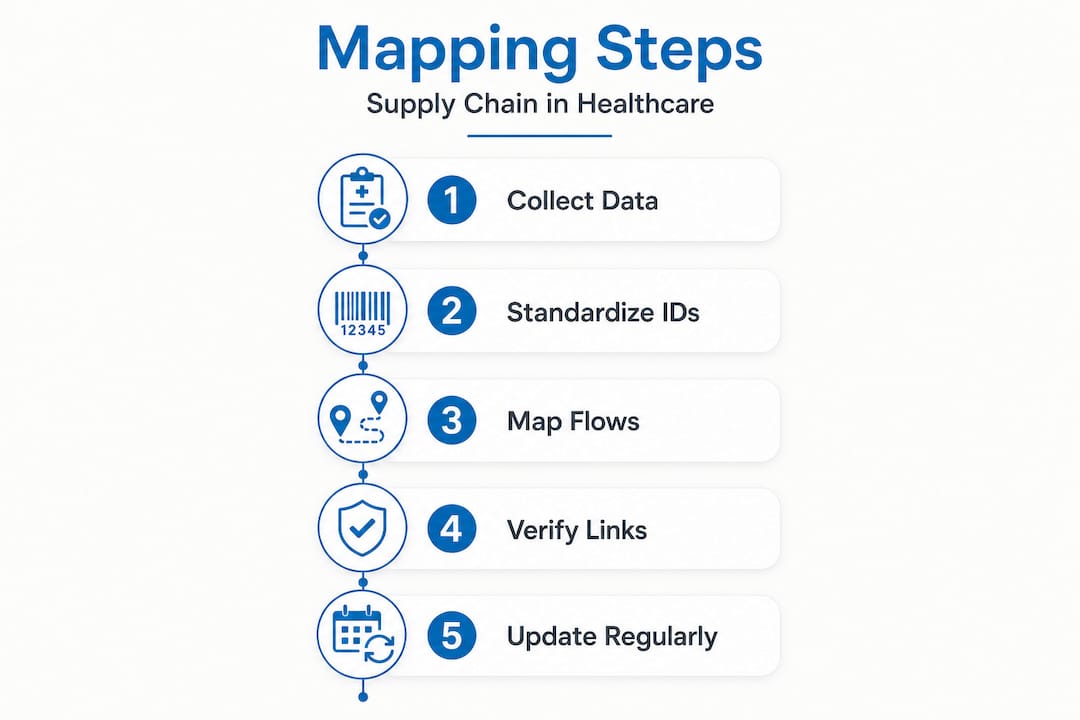
Once your data is in order, you’re ready to move from structured inputs to a living, actionable supply chain map. The process is iterative by design. Pharma mapping methods used in global health contexts combine a preliminary map from trade and procurement data with iterative verification at each junction, sometimes extending upstream to key starting materials (KSMs).
The six-stage mapping process:
-
Define objectives. Specify what the map must answer. Are you assessing cold chain integrity for a biologic product? Evaluating single-source supplier exposure? Documenting distribution routes for a new market entry? The objective shapes every subsequent decision about scope, data, and verification.
-
Collect internal records. Pull procurement data, shipment logs, quality records, and regulatory documentation for the defined scope. Prioritize completeness over speed. Missing records at this stage become blind spots on the finished map.
-
Structure and standardize the data. Assign consistent IDs to all sites, suppliers, and products. Resolve naming conflicts. Build a master reference table that all team members use. This step is tedious but prevents the map from fracturing along data inconsistencies.
-
Visualize the flows. Draw the process flow from raw material sourcing through API production, formulation, quality release, warehousing, and cold chain logistics steps to final delivery. For pharma specifically, mapping should capture the end-to-end value chain from APIs through formulation to temperature-controlled distribution, explicitly noting cold chain and quality-critical steps at every transition.
-
Verify through partner and site check-ins. Contact suppliers, 3PL (third-party logistics) providers, freight forwarders, and distributors to confirm the data you’ve mapped reflects current reality. Discrepancies between your records and partner confirmations are high-value findings. They reveal hidden risks that no internal audit would surface.
-
Iterate and update. Incorporate verification findings, flag unresolved gaps, and schedule the next review cycle. A map that does not have a scheduled update date is already becoming obsolete.
Mapping approach comparison:
| Method | Advantages | Limitations | Best suited for |
|---|---|---|---|
| Paper-based mapping | Low cost, accessible, easy to share in meetings | Difficult to update, no data integration, version control issues | Initial scoping workshops |
| Spreadsheet mapping | Flexible, supports standardized fields, easy to export | No real-time data feeds, limited visualization capability | Small to mid-size networks |
| Software-based mapping | Integrates live data, supports alerts and compliance overlays, scalable | Higher cost, requires implementation time and training | Complex, multi-country pharma networks |
For organizations managing cold chain and compliance mapping across multiple Southeast Asian markets, software-based mapping tools provide the most value. They allow temperature alert thresholds, regulatory status flags, and carrier performance scores to be embedded directly into the map, making risk visible at a glance.

Pro Tip: Use visual mapping tools that integrate compliance and temperature alerts directly into the supply chain visualization. Waiting for a deviation report to identify a cold chain failure is too slow. Your map should surface the risk before the failure becomes a non-conformance.
Troubleshooting and optimizing your pharma supply chain map
With your map built, ongoing vigilance is what separates a useful tool from an expensive archive. The most common failure mode in supply chain mapping is not poor initial construction. It is the failure to maintain and interrogate the map after it is built.
Disruption simulation is the most effective diagnostic method available. Run scenarios against your map: What happens if your primary cold chain carrier in Malaysia experiences a three-day delay? Which products breach temperature thresholds first? Which customers lose supply? What is the earliest point at which you can reroute? These exercises surface chokepoints and risk concentrations that routine monitoring misses entirely.
Regular review cycles are essential for map accuracy. At minimum, conduct a full map review quarterly. For high-risk suppliers, critical cold chain routes, or markets undergoing regulatory change, monthly reviews are more appropriate. Any significant operational change, such as a new distribution partner, a route modification, or a new product registration, should trigger an immediate map update.
Common mapping pitfalls that erode accuracy and usefulness:
- Outdated procurement and supplier data. Supplier locations, certifications, and capabilities change. Maps built on stale records create false confidence.
- Overlooked junctions. Secondary processing sites, co-packers, and contract testing laboratories are frequently omitted from initial maps, creating blind spots in quality and cold chain traceability.
- Siloed risk responsibility. When quality, logistics, and regulatory teams maintain separate risk registers that do not connect to the supply chain map, the map becomes incomplete by design.
- Incomplete cold chain tracking. Temperature data captured only at warehouse receipt misses excursion events during transit, at border crossings, or during last-mile delivery.
- No designated map owner. Maps without a named owner and update schedule degrade faster than those with clear accountability.
Incorporating security-focused supply chain mapping practices reinforces the accuracy of your network picture, particularly for high-value pharmaceutical products moving through multiple jurisdictions. Understanding why cold chain integrity must be visible at every transition, not just at the warehouse gate, is essential for maps that genuinely protect product quality.
“If your map hasn’t changed in six months, you’re probably missing real shifts in your supply chain.”
This is a practical test worth applying. Major supply chains in Southeast Asia rarely stay static for six months. Supplier performance changes, regulatory requirements shift, new distribution corridors open, and weather events disrupt established routes. A map that has not been updated in that period almost certainly contains gaps.
A practical perspective: What most supply chain mapping guides miss
After working through the how-to and common obstacles, it is worth reflecting on why so many mapping projects underdeliver, and what genuinely produces resilience in healthcare and pharma logistics.
The most persistent problem is not technical. It is organizational. Many teams still treat supply chain mapping as a compliance artifact: something produced for an audit, filed in a shared drive, and forgotten until the next regulatory review. That behavior produces maps that describe the past rather than illuminate the present. A map treated as paperwork will always underperform a map treated as a decision-making tool.
Resilient supply chains emerge from maps that are revisited after every disruption, not only after every scheduled audit. A port congestion event, a temperature excursion, or a supplier quality failure all contain information about your network’s actual behavior under stress. Capturing that information systematically through post-disruption mapping sessions is one of the highest-return activities available to supply chain teams. It turns operational problems into institutional knowledge.
Maps should also empower on-the-ground teams, not be locked in a senior manager’s folder. A logistics coordinator managing a cold chain shipment should have access to the current map and know which alternative carriers are pre-approved if the primary carrier fails. A quality manager at a distribution center should be able to see at a glance which suppliers are approaching certificate expiry. That kind of accessibility requires deliberate design, not just document sharing.
Keeping cold chain and quality steps visible at every transition, beyond the warehouse and into the last mile, is where most maps fall short. The overcoming pharma logistics challenges framework consistently identifies last-mile temperature management and multi-country regulatory variation as the highest-risk gaps in Southeast Asian distribution. These are precisely the gaps that a well-maintained, team-accessible map should surface before they become incidents.
Pro Tip: Schedule post-disruption mapping sessions as a standing agenda item in your supply chain review calendar. Don’t wait for the next formal audit to update your map. Disruptions are your most accurate source of real network intelligence.
Next steps: Enhance your healthcare supply chain resilience with expert support
Translating a supply chain map into measurable operational improvements requires more than good documentation. It requires partners with deep expertise in pharma logistics, cold chain management, and regulatory compliance across Southeast Asia’s complex multi-market environment.
Labgistics Asia supports pharmaceutical companies, medical device manufacturers, and healthcare distributors in building and maintaining supply chain visibility across the region. From healthcare supply chain risk management frameworks to fully validated pharma cold chain solutions, the team brings over 20 years of field experience to every engagement. Whether you are mapping a network for the first time or optimizing an existing distribution model, cold chain compliance support from a specialized 3PL partner can close the gaps between your map and your operational reality. Reach out to discuss how expert logistics support can strengthen your supply chain resilience across Southeast Asia.
Frequently asked questions
What data sources are best for starting supply chain mapping in pharma?
Shipment logs, procurement records, and quality documentation are the strongest starting points. Structured datasets with standardized IDs and location fields make these sources directly actionable in any mapping format.
How often should supply chain maps be reviewed in healthcare?
Quarterly reviews are the minimum standard, with monthly reviews recommended for high-risk suppliers or during periods of significant operational change such as new market entry or route restructuring.
What are the key steps in mapping a healthcare supply chain end-to-end?
Start by collecting trade and procurement data to build a preliminary map, then verify each junction through direct contact with suppliers and logistics partners, and update the map iteratively as you confirm or correct each data point.
Why is cold chain visibility essential in healthcare supply chain mapping?
Temperature-sensitive pharmaceuticals require accurate cold chain documentation at every handoff to maintain product integrity and regulatory compliance. Maps that explicitly capture cold chain steps give quality and logistics teams the visibility needed to prevent and respond to excursion events before they affect patients.