
Radioactive material transport from the production facility to patient suite sounds straightforward until you realize that the medicine may be inert by the time it arrives if a single handoff runs late. Radiopharmaceuticals are not simply regulated drugs that require careful handling. They are time-locked clinical tools where the window between manufacture and administration can be measured in hours, not days. For pharmaceutical companies and healthcare providers operating across Southeast Asia, this distinction shapes every decision in the supply chain, from carrier selection to customs filing strategy.
Table of Contents
- What is radiopharmaceutical logistics?
- Regulatory requirements in Southeast Asia
- Real-world risks and how logistics mitigates them
- Quality assurance and traceability in radiopharmaceutical logistics
- Practical realities: What most overlook about radiopharmaceutical logistics
- Expert solutions for radiopharmaceutical logistics in Southeast Asia
- Frequently asked questions
Key Takeaways
| Point | Details |
|---|---|
| Speed is essential | Radiopharmaceuticals must be delivered quickly due to short radioactive half-lives, or they become clinically useless. |
| Complex regulations | Moving radiopharmaceuticals requires compliance with international, regional, and local regulatory standards. |
| Risks must be managed | Delays or disruptions can severely impact both cost and patient outcomes, making risk mitigation vital. |
| Quality ensures safety | End-to-end quality assurance and traceability protect both patient safety and regulatory compliance. |
| Expert partners matter | Partnering with specialized logistics providers ensures regulations, timelines, and patient needs are met efficiently. |
What is radiopharmaceutical logistics?
Radiopharmaceutical logistics is the specialized movement of radioactive drugs used in nuclear medicine diagnostics and therapy. This includes agents used in PET imaging, SPECT scans, and targeted radionuclide therapies. What separates this discipline from conventional logistics challenges in pharma is not just the regulatory overhead but the physical behavior of the product itself.
Radioactive isotopes decay continuously. F-18, one of the most widely used PET tracers, has a half-life of 110 minutes, meaning that roughly half of its diagnostic potency is lost every 110 minutes after production. A shipment delayed by four hours may arrive with only a fraction of its intended activity. This is not a quality deviation that can be corrected in the warehouse. It is an irreversible physical reality.
Key characteristics that define radiopharmaceutical logistics:
- Just-in-time manufacturing coordinated with delivery schedules
- Rapid quality control (QC) release, often completed within 30 to 60 minutes of production
- Time-definite delivery windows measured in hours, not business days
- Radiation shielding requirements that add weight and handling complexity
- Strict documentation aligned with international radioactive material transport standards
The contrast with ordinary drug shipments is substantial. Most pharmaceuticals tolerate delays of hours or even days without clinical impact, provided temperature controls are maintained. Radiopharmaceuticals offer no such flexibility.
| Feature | Radiopharmaceutical shipping | Conventional drug shipping |
|---|---|---|
| Time window | Hours | Days to weeks |
| Product shelf life | Minutes to days | Months to years |
| Radiation shielding | Required (lead/tungsten) | Not applicable |
| Regulatory class | Class 7 radioactive material | Standard pharmaceutical |
| QC release time | 30 to 60 minutes | Hours to days |
| Customs delay tolerance | Near zero | Moderate |
“Radiopharmaceutical logistics demands just-in-time production, rapid QC, and time-definite delivery—constraints that exist nowhere else in pharmaceutical supply chains.” This operational reality means that pharma supply chain security for radioactive drugs requires an entirely separate operational framework.
Every failed delivery carries a direct clinical cost. Patients scheduled for cancer imaging or radionuclide therapy may face rescheduled procedures, delayed diagnoses, or interrupted treatment courses. The financial loss from a wasted dose is significant, but the impact on patient outcomes is the more pressing concern.
Regulatory requirements in Southeast Asia
With these unique logistics needs established, strict regulatory control and regulatory services are the necessary foundation for safe and lawful movement, particularly across Southeast Asia’s multi-jurisdictional environment. No two countries in the region apply identical rules, and a shipment that is fully compliant in Singapore may require additional permits or documentation before it crosses into Malaysia or Thailand.
The international framework begins with IAEA SSR-6, which governs the transport of Class 7 radioactive materials and addresses containment, shielding design, criticality safety, and worker training requirements. Air transport is additionally governed by IATA Dangerous Goods Regulations (DGR), while road movements follow ADR standards for hazardous materials. All of this operates in parallel with Good Distribution Practice (GDP) requirements for pharmaceutical products, which mandate quality systems, chain of custody documentation, and traceability from manufacturer to end user.
In Singapore, the National Environment Agency (NEA) enforces specific licensing requirements. Transport operators must hold IR1, IR2, or IR3 licenses depending on the category of radioactive material. Drivers and handlers must be R1-certified, and vehicles must be approved for radioactive cargo. Understanding Singapore radioactive transportation compliance is essential before any movement of radiopharmaceuticals within or through the city-state.
| Country | Key regulatory body | License/permit required | Key requirement |
|---|---|---|---|
| Singapore | NEA | IR1/IR2/IR3 | R1-certified workers, approved vehicles |
| Malaysia | AELB | Radioactive substance license | Approved consignee registration |
| Thailand | OAP | Import/transport permit | Pre-notification to authorities |
| Indonesia | BAPETEN | Source use license | Country-specific import authorization |
| Philippines | PNRI | Transport license | Radiation protection officer on file |
For organizations managing a Singapore-based shipment of radiopharmaceuticals, the compliance process typically follows this sequence:
- Confirm product classification under IAEA SSR-6 and identify the applicable exemption or Type A/B packaging category.
- Verify that the logistics provider holds the correct NEA license class for the specific isotope and activity level.
- Confirm that all transport workers involved are R1-certified and that training records are current.
- Prepare the radiation transport index (RTI) documentation and surface contamination records.
- File IATA DGR shipper declarations if the shipment will be transported by air.
- Coordinate with the receiving facility to confirm their radiation safety officer is available at the time of delivery.
- Retain all shipment records for regulatory inspection as required under GDP guidelines.
Pro Tip: Regulatory applications for radioactive material transport licenses in Singapore and neighboring markets can take weeks to process. If you are planning to introduce a new radiopharmaceutical product or expand into a new country, initiate the licensing process at least two to three months before the first planned shipment. Delays at this stage create cascading problems across your clinical launch timeline.
For organizations seeking to understand the global radioactive transport regulations that underpin these country-specific rules, the IAEA framework provides the authoritative reference point. Regional implementations add layers, but the core safety principles remain consistent.
Real-world risks and how logistics mitigates them
Understanding the rules is only half the story. Real-world execution is about managing risk where every hour matters, and Southeast Asia’s geography and infrastructure introduce challenges that are not always visible in compliance documentation.
Flight disruptions are among the most common threats to radiopharmaceutical supply chains. A rerouted or canceled flight does not simply delay a shipment. It may render the dose unusable by the time an alternative carrier is arranged. Customs holdups pose a similar problem. Customs delays reduce dose activity by more than 20% per day for many isotopes, and for short-lived tracers like F-18, even a partial-day delay at customs can destroy clinical utility entirely.
Geopolitical events add another layer of unpredictability. Airspace closures or route restrictions can force carriers to reroute shipments through alternative hubs, extending transit times significantly. Logistics providers who serve the nuclear medicine sector have documented cases where political crises required complete restructuring of transport routes within hours of departure.
Best practices for a resilient radiopharmaceutical supply chain:
- Establish pre-approved contingency transport routes before each shipment, not after an incident occurs
- Maintain relationships with multiple certified carriers across key corridors in Southeast Asia
- Position regional distribution hubs to reduce the distance between production and clinical sites
- Implement real-time tracking systems that provide dose-level visibility throughout transit
- Conduct regular tabletop exercises with logistics partners to rehearse emergency response scenarios
- Ensure customs brokers are pre-briefed on the time-critical nature of the cargo and have all documentation prepared in advance
- Maintain an emergency contact list that includes radiation safety officers at the receiving facility
Vertical integration, where a single organization controls production, QC, logistics, and delivery, is increasingly recognized as a structural solution to these risks. When one team manages the entire chain, communication gaps shrink and response time to incidents improves dramatically. For organizations that do not operate an integrated model, working with transport services for radioactive material that specialize exclusively in this category offers comparable risk reduction.
Pro Tip: Before any shipment departs, confirm fallback routes and emergency contacts are documented in writing and shared with all parties in the chain. Verbal contingency plans fail under pressure. Written protocols with named contacts and pre-authorized alternatives hold up in real incidents.
Quality assurance and traceability in radiopharmaceutical logistics
Risk management and regulatory compliance set the boundaries. Quality assurance and traceability systems ensure that every dose that reaches a patient is potent, legally compliant, and fully documented from the point of manufacture to point of administration.
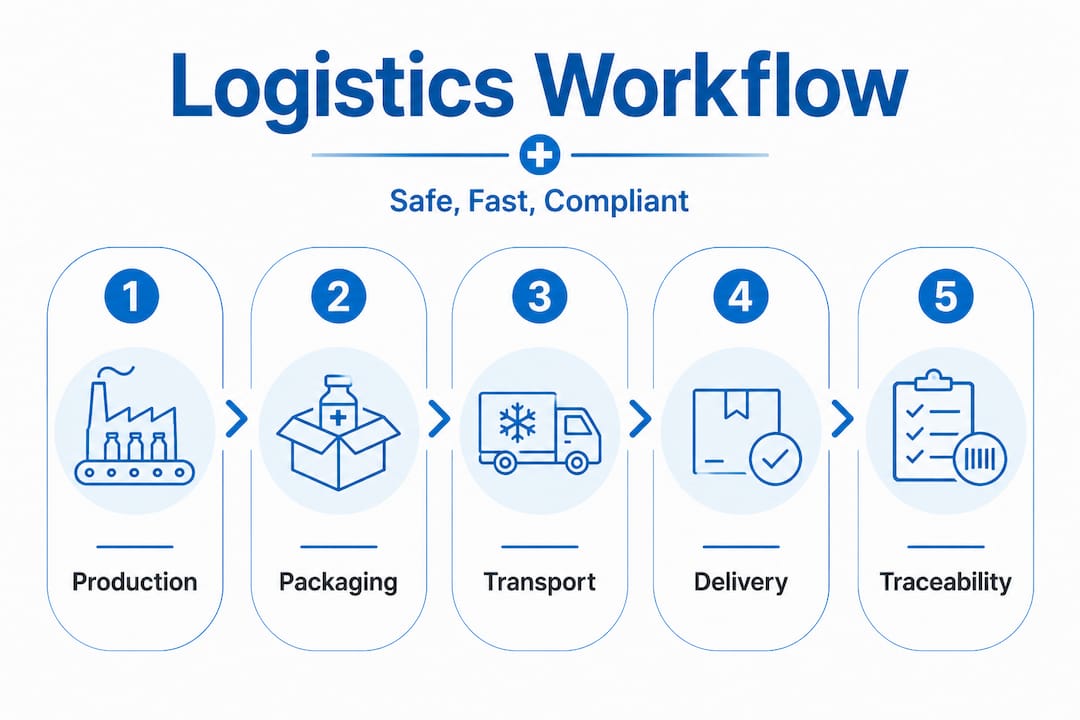
GDP requirements apply to radiopharmaceuticals just as they do to other regulated drugs. Under IAEA SSR-6 and GDP standards, shipments must maintain an unbroken, documented chain of custody. Tamper evidence, temperature records where applicable, radiation exposure logs, and handover signatures are all mandatory components of a compliant shipment record.
Real-time tracking technology has become essential in this context. GPS-enabled tracking allows logistics teams to monitor package location continuously. More advanced systems incorporate radiation monitoring sensors and temperature probes that transmit data at defined intervals. This level of visibility allows a quality team to detect and respond to a deviation in transit rather than discovering it at the point of delivery when it is too late to intervene.
A fully compliant radiopharmaceutical shipment follows a documented process:
- QC release and batch record generation at the production facility, timed precisely against the delivery schedule.
- Transfer to certified packaging (Type A or Type B container) with documented RTI and surface contamination readings.
- Handover to the licensed transport operator with signed documentation covering dose identity, activity, and transport conditions.
- Real-time monitoring throughout transit, with alerts configured for any deviation from approved conditions.
- Delivery to the clinical facility with a signed receipt confirming time of arrival, dose identity, and condition.
- Post-delivery documentation filed and retained as part of the GDP quality record.
“Logistics is clinical performance. Disruptions equal missed scans and missed treatments. Every link in the chain must be treated as a patient safety function, not an administrative formality.”
This perspective is not rhetorical. When a nuclear medicine department schedules a patient for a PET scan or Lu-177 therapy, the logistics chain is embedded in that clinical commitment. Failure to deliver is not an operational inconvenience. It is a missed diagnostic or a delayed cancer treatment. Quality assurance in pharma logistics for radioactive drugs therefore demands the same rigor applied to any critical clinical process. Organizations looking to review current standards and frameworks can also refer to published GDP guidance for authoritative reference material.
Practical realities: What most overlook about radiopharmaceutical logistics
The conventional view in pharmaceutical operations tends to treat logistics as a downstream function, something that executes after the clinical and regulatory decisions have been made. In radiopharmaceutical supply chains, this view is not just outdated. It is clinically risky.
Late or lost shipments do not produce a backorder scenario that can be resolved next week. They produce gaps in patient treatment schedules that cannot always be recovered. A patient receiving targeted alpha therapy with a short-lived emitter who misses a treatment cycle due to a logistics failure may face a clinically meaningful setback. As emerging alpha-emitters demand tighter timelines, the margin for error in logistics shrinks further with each new isotope that enters clinical use.
The rise of novel radioisotopes, particularly short-range alpha emitters being developed for targeted cancer therapy, compresses time windows even further than current PET tracers. Logistics teams that are calibrated for F-18 will need to recalibrate significantly for products with half-lives measured in tens of minutes rather than 110 minutes.
What most organizations underestimate is the specialized training requirement. Handling radioactive packages is not simply a matter of following a procedure. Certified personnel must understand decay physics well enough to make real-time decisions about whether a delayed shipment is still clinically viable. This requires ongoing training, not a one-time certification. The pharma logistics challenges in this space are technical, regulatory, and human simultaneously.
One practical recommendation that carries significant operational value: treat your logistics provider as a partner in clinical outcomes, not just a vendor managing transport. This means involving them in production scheduling conversations, sharing clinical delivery requirements directly rather than routing everything through procurement, and investing in joint contingency planning. When logistics teams understand the clinical stakes of the products they handle, decision-making in high-pressure situations improves substantially.
Expert solutions for radiopharmaceutical logistics in Southeast Asia
Having understood what’s at stake and what works, here’s how you can put these solutions to work for your organization in Southeast Asia.
Labgistics Asia provides end-to-end logistics support for radiopharmaceutical supply chains across the region, with capabilities that directly address the challenges covered in this article. From regulatory compliance management and healthcare supply chain risk management to time-definite transport and GDP-aligned quality systems, the services are built specifically for the precision that nuclear medicine demands.

Whether your priority is optimizing delivery windows, navigating country-specific licensing requirements, or building contingency capacity into your transport network, Labgistics Asia offers structured solutions backed by over 20 years of healthcare logistics experience. Explore how to optimize healthcare transportation for your clinical program, or learn more about safe radioactive transport in Singapore and how to ensure every shipment arrives on time, compliant, and fully documented.
Frequently asked questions
Why are radiopharmaceutical shipments so time-sensitive compared to ordinary drugs?
Radioisotopes decay continuously after production, so short isotope half-lives like F-18’s 110 minutes mean that even modest delays can render a dose clinically unusable, unlike conventional drugs that remain stable for weeks or months.
What licenses are required for radiopharmaceutical logistics in Singapore?
Singapore’s NEA mandates IR1, IR2, or IR3 licenses depending on the radioactive material category, along with R1-certified personnel and vehicles approved specifically for Class 7 radioactive cargo.
How do customs delays impact radiopharmaceutical logistics?
Customs holdups reduce dose activity by more than 20% per day for many isotopes, which means even a partial-day delay can make a shipment clinically ineffective or entirely wasted.
What are best practices for reducing risk in radiopharmaceutical supply chains?
Redundancy through regional hubs, pre-approved contingency routes, real-time tracking, and certified logistics partners with specific radiopharmaceutical experience form the core of an effective risk reduction strategy.