
Pharmaceutical product spoilage rarely announces itself in advance. A shipment of biologics traveling from Singapore to a rural clinic in Vietnam can pass through multiple vehicles, warehouses, and border checkpoints, each representing a potential temperature excursion that degrades efficacy before the product ever reaches a patient. Temperature-controlled logistics goes beyond refrigerated transport and requires an end-to-end approach involving packaging, storage, and monitoring. For healthcare logistics managers operating across Southeast Asia, understanding what cold chain logistics truly involves is the first step toward protecting both patients and supply chain investments.
Table of Contents
- Defining cold chain logistics in healthcare
- Core components of the cold chain
- Best practices and compliance: Ensuring product safety
- Cold chain in Southeast Asia: Market growth and unique challenges
- Practical steps: Building a resilient cold chain
- A Southeast Asian perspective: What most guides miss about cold chain logistics
- Explore trusted cold chain solutions for Southeast Asia
- Frequently asked questions
Key Takeaways
| Point | Details |
|---|---|
| Cold chain protects product safety | Proper cold chain logistics prevent pharmaceutical spoilage and preserve patient safety throughout distribution. |
| Core components are essential | Temperature-controlled packaging, storage, transportation, and monitoring work together for compliance. |
| SE Asia presents unique hurdles | Managers must address climate, last-mile, and infrastructure risks specific to the region. |
| Compliance and partnerships matter | Choosing GDP-compliant 3PL partners and verifying documentation ensures resilient supply chains. |
| Continuous improvement is vital | Ongoing audits, tech upgrades, and ground-level training keep your cold chain robust as markets evolve. |
Defining cold chain logistics in healthcare
Cold chain logistics is the integrated management of temperature-sensitive products from the point of manufacture through storage, transportation, and final delivery, ensuring that temperature conditions remain within validated limits at every stage. It is not a single technology or a single vehicle. It is a system.
In the pharmaceutical and life science sectors, this discipline is critical because many products lose their therapeutic value when exposed to temperatures outside their specified range. Vaccines, insulin, monoclonal antibodies, cell and gene therapies, and diagnostic reagents all fall into this category. The pharma cold chain in Southeast Asia is especially demanding given the region’s tropical climate and fragmented infrastructure.
Consider what happened during the global rollout of mRNA COVID-19 vaccines. These products required storage at minus 70 degrees Celsius or colder, making every step of the supply chain a precision engineering challenge. A single power failure, a poorly calibrated freezer, or the lack of calibration services could render an entire shipment unusable. That example illustrated, at a global scale, exactly why pharma logistics depends on more than placing products in a cooler truck.
The core benefits of a well-executed cold chain include:
- Patient safety: Products arrive with full therapeutic efficacy intact
- Regulatory compliance: Documentation and temperature records satisfy GDP and national authority requirements
- Financial risk reduction: Preventing spoilage avoids the cost of replacing inventory, which can run into millions of dollars for specialty biologics
- Brand protection: Consistent quality delivery builds trust with healthcare providers and regulators
- Supply continuity: Robust systems prevent stockouts caused by product degradation
The lifecycle of a pharmaceutical cold chain spans manufacturing, validated primary packaging, temperature-controlled secondary packaging, certified cold storage facilities, refrigerated transportation, and last-mile delivery to hospitals, clinics, or pharmacies.
Core components of the cold chain
Now that you know what the cold chain is, let’s break down its building blocks and how they work together.
Key components include temperature-controlled packaging, cold storage facilities, refrigerated transportation, and continuous monitoring systems. Each element must function in coordination, because a failure at any single point invalidates the entire chain.
| Component | Technologies used | Contribution to quality |
|---|---|---|
| Temperature-controlled packaging | Insulated shippers, phase-change materials, vacuum panels, data logger inserts | Maintains product temperature during transit gaps and ambient exposure |
| Cold storage | Temperature-zoned warehouses, redundant refrigeration units, continuous sensors | Protects bulk inventory through staging periods between shipments |
| Refrigerated transport | Reefer trucks, refrigerated containers, air freight with dry ice or liquid nitrogen | Maintains temperature during movement between facilities |
| Continuous monitoring | IoT sensors, RFID tags, cloud-based dashboards, automated deviation alerts | Provides real-time visibility and enables immediate corrective action |
Here is a step-by-step journey of a temperature-sensitive medicine vial from factory to a rural clinic, with the highest-risk points identified:
- Manufacture and fill: The vial is produced under controlled cleanroom conditions. Temperature risk here is low but traceability begins.
- Primary packaging: The vial is placed into validated insulated packaging with a calibrated data logger recording temperature continuously.
- Cold storage at origin: Products are held in a temperature-zoned warehouse pending transport scheduling. Risk increases if staging time is prolonged.
- Customs and border clearance: This is one of the highest-risk stages. Delays can extend ambient exposure beyond validated windows, especially in tropical heat.
- Refrigerated transport to distribution hub: Reefer trucks maintain set-point temperatures, but pre-cooling and door-open protocols must be enforced.
- Regional distribution center: Products are checked, restaged, and allocated for last-mile routing. Sensor data is reviewed for excursions.
- Last-mile delivery to rural clinic: Often completed by smaller vehicles with less sophisticated temperature control. This is the second highest-risk stage.
- Receipt and verification: The clinic staff verify temperature records and product condition before accepting the shipment.
Ensuring cold chain compliance in SE Asia requires particular attention at steps 4 and 7, where infrastructure limitations are most acute. Operators exploring sustainable options are also examining eco-friendly cold chains that balance carbon reduction with performance requirements.
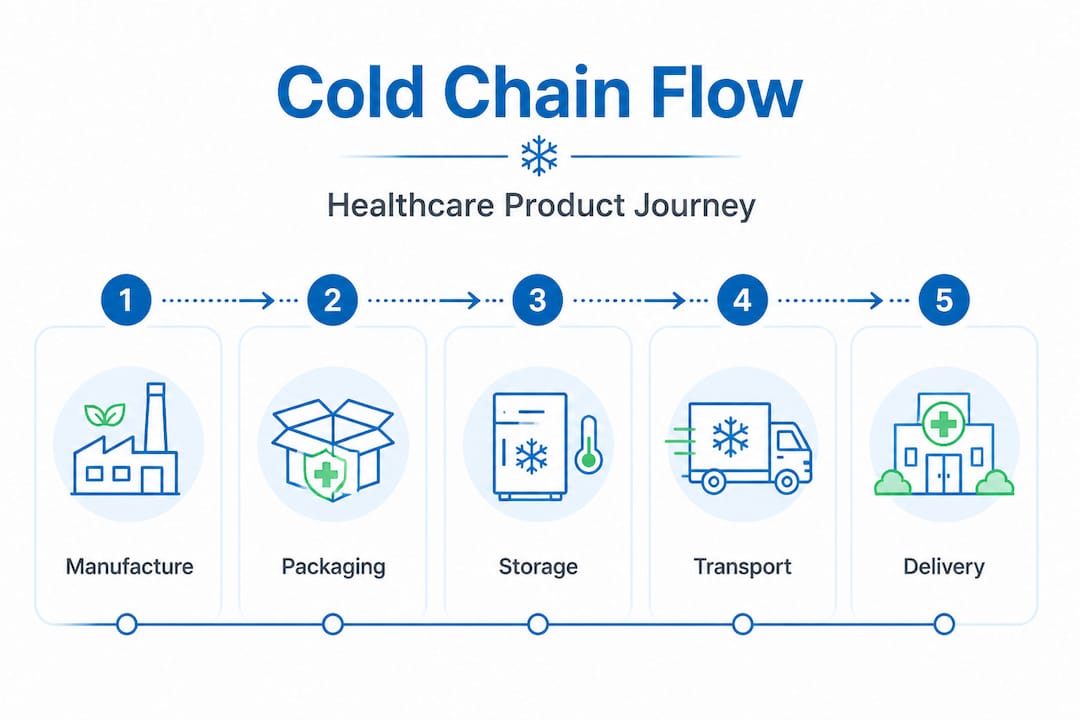
Pro Tip: Prioritize packaging validation and real-time data visibility at steps 4 and 7, the customs handoff and rural last-mile segments. These are where temperature excursions are most likely and where the documentation gap is widest.
Best practices and compliance: Ensuring product safety
With the toolbox established, let’s look at how to apply global standards and avoid common pitfalls in your operation.
GDP, or Good Distribution Practice, is the internationally recognized framework that governs how pharmaceutical products should be handled, stored, and transported after leaving the manufacturer. HACCP, or Hazard Analysis and Critical Control Points, adds a systematic layer by identifying risk points before distribution begins and establishing controls at each one.
Together, these frameworks for safe distribution and compliance form the foundation of any serious pharmaceutical cold chain program. The following practices are considered essential:
- Pre-cooling all packaging and transport units before loading to eliminate thermal mass absorption at the start of transit
- Using validated shippers with documented temperature performance profiles matched to the expected route and ambient conditions
- Deploying IoT sensors at every handoff point to generate a continuous, auditable temperature record
- Developing and training to SOPs for loading, unloading, excursion response, and documentation
- Conducting annual or biannual 3PL audits that evaluate documentation quality, alerting response times, and proven excursion recovery protocols
- Applying HACCP methodology to identify the critical control points on each qualified lane, especially for high-value biologics
These methodologies include pre-cooling products and packaging, the use of validated shippers, continuous IoT monitoring with automated alerts, HACCP for hazard identification, and GDP compliance for all stages of pharmaceutical distribution.
“Continuous IoT monitoring with automated alerts is not optional. It is the minimum standard for regulatory confidence and patient safety in temperature-sensitive pharmaceutical distribution.”
Pro Tip: When auditing a 3PL partner, ask specifically for documented examples of temperature excursion events and how they were managed. A provider who has never recorded an excursion is either operating without adequate monitoring or is not being transparent. Experience handling excursions correctly is more valuable than a perfect-looking record.
Cold chain in Southeast Asia: Market growth and unique challenges
Understanding general best practices, let’s now address what makes Southeast Asia different and especially challenging.
$1.2 billion. That is the estimated scale of Thailand’s pharmaceutical cold chain logistics market alone, with the broader Southeast Asian region tracking rapid growth trajectories driven by aging populations, rising chronic disease burdens, and expanded vaccine programs. Government investment in cold chain infrastructure is rising across the region, but the pace varies significantly by country.
The Asia-Pacific healthcare cold chain is the fastest-expanding segment globally, with China and India leading in volume, while Southeast Asian markets face persistent infrastructure gaps. Government spending on distribution infrastructure is increasing, but private sector 3PL investment remains critical to filling the gap.
Southeast Asia presents a distinct set of challenges that do not appear in logistics frameworks developed for temperate, high-income markets:
- Tropical climate: Ambient temperatures routinely exceed 35 degrees Celsius, compressing the window for safe product exposure during transfers and reducing packaging performance
- Infrastructure variability: Road quality, port efficiency, and cold storage density vary dramatically between urban centers like Singapore and rural provinces in Vietnam, Myanmar, or Indonesia
- Last-mile complexity: Reaching rural clinics and community health centers often requires the use of smaller vehicles, motorcycles, or manual carriers with limited temperature control capability
- GDP compliance gaps: Not all distribution partners in the region operate to GDP standards, creating inconsistency within multi-party supply chains
- Cross-border regulatory variation: Each ASEAN country has its own import, storage, and distribution regulations, which increases documentation burden and customs delay risk
| Market | Key challenge | Observed response |
|---|---|---|
| Thailand | Tropical heat, rural reach | Government cold chain investment, growing 3PL sector |
| Vietnam | Infrastructure gaps, GDP compliance | Public-private partnerships, pilot monitoring programs |
| Singapore | High standards, high cost | Regional hub model, advanced sensor integration |
| China | Scale, regulatory complexity | Centralized investment, major 3PL consolidation |
| India | Last-mile gaps, volume pressure | Phased infrastructure build, government vaccine programs |
These market dynamics show that Southeast Asian cold chain growth is real, but it requires adaptation strategies that go beyond importing solutions designed for Western or Northeast Asian markets. Experienced providers are bridging the gap through qualified lane programs, investment in last-mile infrastructure, and real-time monitoring technology that is scalable to lower-resource settings.
Understanding last-mile healthcare delivery readiness is particularly relevant for managers operating routes that extend beyond central distribution hubs into community health facilities.
Practical steps: Building a resilient cold chain
Now that we understand the region’s constraints, here’s how to put strategies into practice and minimize losses.
Temperature failure remains the leading cause of pharmaceutical product loss in tropical regions. That single fact should anchor every procurement and operations decision a logistics manager makes in Southeast Asia. Building resilience requires deliberate action at each stage of partner selection and network design.
Follow these steps to build or audit your cold chain program:
- Audit your current supply chain against GDP standards, mapping every handoff point and identifying gaps in documentation, monitoring, or facility certification
- Define qualification criteria for 3PL partners, including GDP certification status, IoT infrastructure, excursion response protocols, and experience with your specific product types
- Conduct a pilot test on your highest-risk lane before committing full volume, using independent temperature loggers to verify partner performance claims
- Establish qualified lanes for each key origin-destination pair, with documented temperature performance data and approved deviation thresholds
- Build contingency protocols for extreme weather events, port or border delays, and last-mile rural scenarios, including backup cold storage locations and alternative routing
- Implement continuous improvement loops by reviewing excursion data quarterly, updating SOPs, and revalidating packaging performance for route changes
For Southeast Asia healthcare logistics managers, GDP-compliant 3PLs with IoT visibility, qualified lanes designed for tropical climates, and robust contingency planning for last-mile rural delivery are the minimum standard for minimizing excursion risk.
Managers looking to implement or upgrade their cold chain operations will find that 3PL Singapore solutions provider for the Southeast Asian healthcare environment offers the most direct path to compliance and operational resilience.
Statistic callout: Pharmaceutical product loss attributable to temperature control failures in tropical distribution environments represents a disproportionate share of total supply chain loss, reinforcing that cold chain investment is not a cost center but a risk mitigation tool.
A Southeast Asian perspective: What most guides miss about cold chain logistics
Most published frameworks for pharmaceutical cold chain management are written from a Western or Northeast Asian vantage point. They assume reliable road infrastructure, consistent regulatory enforcement, and a logistics partner market where GDP compliance is the norm rather than the exception. In Southeast Asia, none of those assumptions hold universally.
The practical reality is that cold chain success in this region depends heavily on human factors and network relationships, not just technology spend. A sensor-laden shipment managed by a handler who has not been trained on excursion response protocols is no safer than one with no monitoring at all. Ground-level staff at border crossings, rural distribution points, and clinic receiving docks make or break temperature integrity in ways that no amount of dashboard visibility can substitute for.
Conventional wisdom tends to overrate advanced technology as the primary solution to cold chain challenges in emerging markets. The assumption is that IoT investment solves the problem. But technology without trained responders, without local partner accountability, and without regulatory agility produces data that no one acts on. AI in cold chain logistics is a genuinely emerging capability, but it amplifies the value of well-trained, well-networked operations rather than replacing them.
“In Southeast Asia, human factors and network resilience often outweigh pure tech spend when it comes to protecting pharmaceutical product integrity at the last mile.”
What the region needs more of is pilot projects that test local adaptations, granular staff training programs designed for specific route conditions, and patient-centric distribution design that starts from the clinic endpoint and works backward. A strategy built on understanding local regulatory rhythms, forging relationships with reputable local 3PLs, and preparing ground-level teams for unplanned delays will consistently outperform a strategy built on technology procurement alone.
Explore trusted cold chain solutions for Southeast Asia
Labgistics Asia has spent over 20 years building the infrastructure, regulatory expertise, and regional partnerships that pharmaceutical and life science companies need to manage cold chain distribution across Southeast Asia with confidence.
Whether you are evaluating your current cold chain program, entering a new Southeast Asian market, or looking to strengthen last-mile capabilities for rural healthcare delivery, Labgistics offers GDP-compliant, end-to-end logistics solutions purpose-built for this region. From accredited cold storage facilities to IoT-enabled transport and regulatory support, every service is designed to protect product integrity and support compliance. Explore our cold chain and compliance expertise or review the key drivers in SE Asia logistics shaping how successful operators are building resilient supply chains in 2026.
Frequently asked questions
What are the main risks of cold chain failure in pharmaceuticals?
Temperature excursions can lead to loss of product efficacy, wasted inventory, regulatory non-compliance, and patient safety issues. Vaccine and biologic efficacy is directly compromised by temperature deviations, making cold chain integrity a patient safety imperative.
How does GDP compliance benefit a healthcare cold chain?
GDP compliance prevents product spoilage, improves traceability, builds trust with regulators, and reduces the risk of costly product recalls. It also provides a documented quality framework that simplifies audits and market access in multiple ASEAN jurisdictions.
What are the common cold chain challenges in Southeast Asia?
The region faces infrastructure gaps, tropical climate conditions, shortfalls in GDP compliance across distribution partners, and significant rural last-mile delivery hurdles that require localized solutions.
What role do IoT sensors play in cold chain logistics?
IoT sensors and RFID provide real-time temperature monitoring with automated deviation alerts, allowing logistics teams to respond immediately to excursions before product integrity is lost.
How can healthcare logistics managers improve last-mile delivery?
Partner with GDP-compliant 3PLs that have documented experience on tropical rural routes, use qualified lanes with validated temperature profiles, and develop contingency plans for weather events and border delay scenarios.