
Pharma Regulatory Services: A 2026 Professional Guide
Regulatory compliance in pharmaceuticals is not a checkpoint you pass once and move on from. It is a continuous, multi-layered process that spans the entire product lifecycle. Pharma regulatory services cover everything from initial drug development strategy and clinical trial compliance through submission dossiers, quality management systems, and post-market surveillance. For pharmaceutical industry professionals operating across multiple jurisdictions, understanding how these services interlock is not optional. This guide covers global regulatory frameworks, approval pathways, quality systems, emerging technology trends, and practical criteria for selecting the right service partners.
Table of Contents
- Key takeaways
- Global pharma regulatory services framework
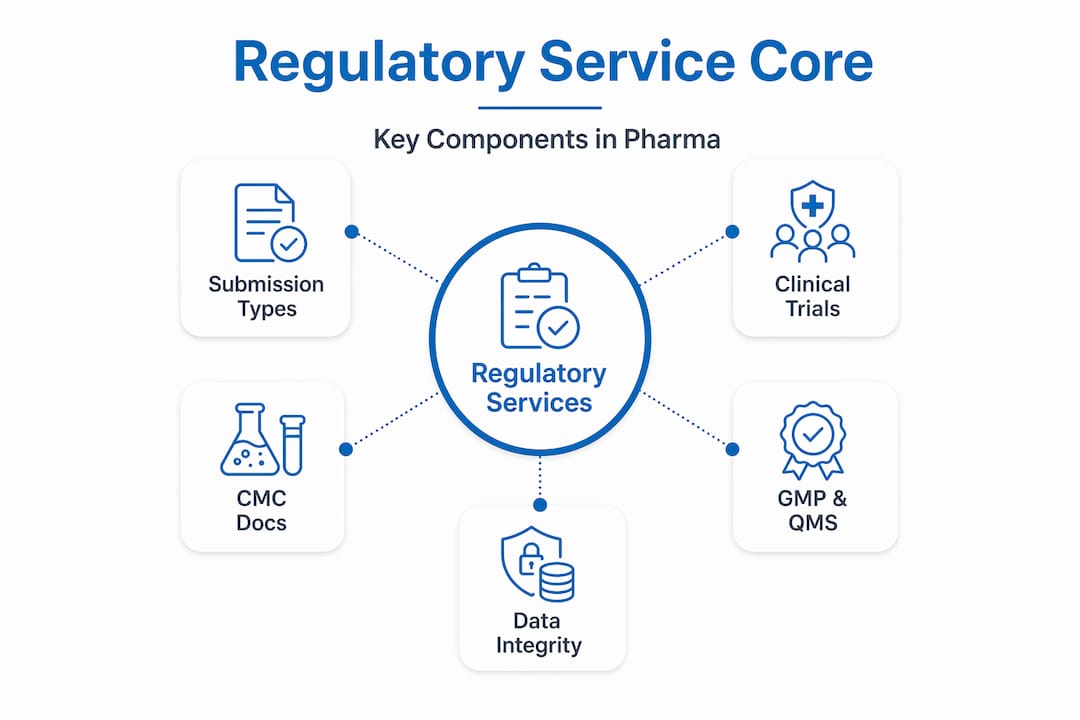
- Core components of pharma regulatory services
- Quality management in pharma: GMP and beyond
- Trends shaping pharma regulatory services in 2026
- Selecting and working with regulatory service providers
- My perspective on regulatory services as a strategic asset
- How Labgistics supports pharma regulatory compliance
- FAQ
Key takeaways
| Point | Details |
|---|---|
| Compliance is continuous | Regulatory oversight spans the full product lifecycle, not just the approval phase. |
| Submission types vary widely | IND, NDA, BLA, MAA, and 510(k) each carry distinct data and documentation requirements. |
| Quality systems underpin approval | GMP compliance, CAPA programs, and data integrity are prerequisites for sustained market authorization. |
| Early consultant integration wins | Engaging regulatory consultants before critical project phases reduces risk and accelerates approval timelines. |
| Technology is transforming compliance | AI-powered platforms and cloud-based systems are shifting pharma quality management from reactive to proactive. |
Global pharma regulatory services framework
Key agencies and their jurisdictional reach
Pharmaceutical products moving across international markets must satisfy the requirements of multiple regulatory authorities. The principal agencies shaping global drug approval services include the U.S. Food and Drug Administration (FDA), the European Medicines Agency (EMA), the Medicines and Healthcare products Regulatory Agency (MHRA) in the UK, and the Pharmaceuticals and Medical Devices Agency (PMDA) in Japan. In Southeast Asia, national authorities such as Singapore’s Health Sciences Authority (HSA) and Indonesia’s BPOM add further layers of jurisdiction-specific requirements.
Each agency operates under its own legislative framework, though significant harmonization has been achieved through International Council for Harmonisation (ICH) guidelines. ICH Q10, for example, establishes the Pharmaceutical Quality System model adopted across FDA, EMA, and PMDA jurisdictions. Despite this, divergences remain in labeling requirements, post-market pharmacovigilance obligations, and submission formats.
Multi-jurisdictional strategy
The table below summarizes key differences across major regulatory regions:
| Region | Primary Agency | Major Submission Format | Notable Requirement |
|---|---|---|---|
| United States | FDA | NDA / BLA / ANDA | Risk Evaluation and Mitigation Strategy (REMS) |
| European Union | EMA | MAA (CTD format) | Centralized or decentralized procedure |
| United Kingdom | MHRA | UK MA (post-Brexit) | Great Britain-specific dossier |
| Japan | PMDA | J-NDA | Japanese language data requirements |
| Southeast Asia | HSA / BPOM | ASEAN CTD | ACTD format for regional submissions |
A multi-jurisdictional regulatory strategy is not simply about filing the same dossier in multiple markets. It requires understanding where data packages can be leveraged and where local bridging studies or translations are required. Strategic regulatory planning early in drug development minimizes setbacks and delivers smoother approvals across all target markets.
Core components of pharma regulatory services
Submission types and approval pathways
The pharma submissions process begins with selecting the correct regulatory pathway. The primary submission categories include:
- Investigational New Drug (IND) / Clinical Trial Authorization (CTA): Required before initiating clinical trials in the US and EU respectively.
- New Drug Application (NDA) / Biologics License Application (BLA): Full approval submissions for small molecules and biologics in the US.
- Marketing Authorization Application (MAA): The EU equivalent of the NDA, submitted in Common Technical Document (CTD) format.
- 510(k) and Premarket Approval (PMA): Medical device pathways in the US, differentiated by risk classification.
- Abbreviated New Drug Application (ANDA): Used for generic drug approval services, supported by bioequivalence studies demonstrating therapeutic equivalence to the reference listed drug.
Each pathway carries distinct data requirements, review timelines, and fee structures. Choosing the wrong pathway wastes months. Choosing the right one requires experienced regulatory affairs consulting from the outset.
Clinical trial compliance and GCP
Clinical trial regulations under Good Clinical Practice (GCP) govern trial design, conduct, monitoring, and reporting. Non-compliance at this stage does not just delay a submission. It can invalidate data, triggering complete trial repeats. FDA regulatory guidance on GCP expectations, combined with ICH E6(R3) updates adopted in 2023, requires that sponsors maintain robust oversight of clinical research organizations (CROs) and site-level data quality.

CMC documentation and strategic dossier development
Chemistry, Manufacturing, and Controls (CMC) documentation represents one of the most technically demanding elements of any regulatory submission. CMC documentation demands scientific rigor and manufacturing insight well beyond simple paperwork, and deficiencies here are among the most common causes of regulatory delays. Effective CMC strategy requires detailed characterization of drug substance and drug product, process validation data, container closure system justification, and stability protocols aligned to ICH Q1A(R2) guidelines.
Pro Tip: Draft your CMC sections in parallel with clinical development rather than after it. Regulators expect manufacturing processes to be well-defined before Phase III, not just before submission.
Quality management in pharma: GMP and beyond
GMP fundamentals and CAPA programs
Good Manufacturing Practice (GMP) compliance is the operational baseline for any manufacturing facility seeking or sustaining market authorization. Pharmaceutical compliance services in this domain cover facility qualification, batch record review, standard operating procedure (SOP) development, and supplier qualification programs. Regulatory observations from inspections, whether from the FDA, EMA, or local agencies, must be addressed through formal Corrective and Preventive Action (CAPA) programs.
An effective CAPA program follows a structured sequence:
- Define the problem clearly. Regulatory investigators expect specificity, not generalities. Identify the exact deviation, the affected batch range, and the patient risk assessment.
- Conduct a root cause analysis. Use established tools such as fishbone diagrams or fault tree analysis. Agencies scrutinize whether the root cause identified actually explains the observation.
- Develop corrective actions. Actions must address the root cause, not just the symptom. Replacing a malfunctioning instrument without fixing the calibration verification process will invite repeat observations.
- Implement preventive actions. Extend corrections across similar processes, equipment, or facilities where the same root cause could exist.
- Verify effectiveness. Set a defined monitoring period and metric to confirm the CAPA worked. Unverified CAPAs are a frequent 483 observation category.
Data integrity and inspection readiness
Data integrity requirements under ALCOA+ principles (attributable, legible, contemporaneous, original, accurate, plus complete, consistent, enduring, and available) have become a central focus of regulatory inspections globally. Centralized, cloud-based compliance systems are necessary to keep pace with evolving 2026 regulations, replacing manual paper-based systems that cannot reliably demonstrate data traceability.
Inspection readiness is a continuous operational state, not a reactive project initiated when a notice arrives. Facilities with permanent inspection readiness programs maintain audit-ready documentation at all times, conduct unannounced internal audits, and train staff regularly on regulatory expectations. This approach, anchored in pharma quality assurance systems, consistently outperforms firms that treat regulatory visits as isolated events.
Pro Tip: Run mock inspections quarterly using rotating internal auditors from different departments. Inspectors notice when staff from one area cannot answer basic questions about adjacent processes.
Trends shaping pharma regulatory services in 2026
Regulatory service delivery is changing rapidly, driven by three converging forces: artificial intelligence adoption, cloud infrastructure maturity, and market consolidation among specialized consulting firms.
On the AI front, AI-powered APQR software reduces review time and increases audit readiness through data integration and intelligent analysis. Rather than manually compiling Annual Product Quality Reviews from disparate data sources, AI platforms can detect subtle quality trends across batch release data, environmental monitoring results, and complaint records simultaneously. This moves organizations from retrospective quality review to genuinely proactive quality management.
Cloud-based document management systems are resolving a persistent challenge in pharmaceutical compliance services: version control across global teams. When a regulatory submission requires input from sites in Singapore, Germany, and New Jersey simultaneously, a centralized system is not a luxury. It is the only practical way to maintain document control integrity.
Market consolidation is also reshaping who delivers regulatory affairs consulting. BioPhorum acquired Compliance Hub in April 2026 to expand its pharmaceutical training capabilities, integrating codes including ABPI, EFPIA, and ABHI. At the same time, leading firms maintain networks of 250 to 350+ experts covering 70 to 120 countries, allowing clients to access jurisdictional expertise for simultaneous multi-market submissions without building those capabilities in-house.
Separately, FDA introduced Compliance Program 7346.832M for CDER-regulated biologics in 2026, establishing an integrated inspection framework distinct from traditional Preapproval Inspections for NDAs and ANDAs. Biologics manufacturers submitting BLAs need to understand how this program changes the pre-approval inspection timeline and scope.
Selecting and working with regulatory service providers
Criteria for evaluating consulting expertise
Choosing a regulatory affairs consulting partner requires more than reviewing credentials. The criteria that matter most in practice are:
- Therapeutic area depth. A firm with strong oncology biologics experience may not be the right fit for a generic oral solid dose program. Ask for case studies specific to your product modality.
- Geographic coverage. If your market access strategies include Southeast Asia, confirm the firm has direct experience with HSA, BPOM, and NPRA submissions, not just familiarity with the general ASEAN CTD framework.
- Internal team integration model. Successful regulatory consultants integrate early with internal teams rather than being engaged reactively. Ask prospective partners how they handle knowledge transfer and what their process looks like for onboarding into your existing program.
- Technology and tools. Confirm whether the firm uses modern submission publishing platforms and whether their document management approach is compatible with your internal systems.
- Regulatory intelligence capability. The regulatory environment changes continuously. A strong partner proactively flags relevant FDA regulatory guidance updates, EMA reflection papers, and regional guideline changes before they become submission problems.
Managing the engagement for maximum value
Engaging regulatory consultants ahead of critical project phases creates better knowledge integration, reduces risk, and accelerates approvals. In practice, this means bringing your regulatory partner into target product profile discussions, not just handing them a completed dossier to review.
Knowledge transfer is also a two-way obligation. Your internal team must document institutional knowledge about the manufacturing process, clinical program history, and prior agency interactions. Consultants who inherit undocumented history spend significant time reconstructing context that should have been captured systematically.
Pro Tip: Establish a shared regulatory intelligence repository from day one of any engagement. Document every agency meeting, informal communication, and guideline interpretation decision. This repository becomes your single most valuable asset when personnel change on either side of the engagement.
Aligning your service provider to your company’s risk tolerance and regulatory environment is also important. A startup biotech pursuing accelerated approval under Breakthrough Therapy Designation operates very differently from a generic manufacturer managing an ANDA portfolio. Your consulting partner’s experience, pace, and communication style should match that reality.
My perspective on regulatory services as a strategic asset
I have observed a consistent pattern across pharmaceutical organizations of all sizes: those that treat regulatory compliance as a reactive burden consistently spend more time, more money, and more political capital on approvals than those that treat it as a strategic function embedded from the start.
The companies that accelerate to market are not the ones with the largest regulatory departments. They are the ones where regulatory strategy informs clinical protocol design, manufacturing process selection, and market sequencing decisions from day one. When a clinical team designs a Phase II trial without regulatory input, they often generate data that satisfies the science but not the submission. That gap is expensive to close.
Technology is changing the operational burden significantly. AI-powered trend analysis, automated submission formatting, and cloud-based audit readiness tools are reducing the manual work that once consumed regulatory resources. But technology does not replace judgment. It frees experienced regulatory professionals to focus on the decisions that matter. What the market needs more of is senior regulatory talent applying strategic thinking earlier in development programs, with technology handling the administrative layer.
My honest view is that the industry still undervalues pre-submission regulatory intelligence. Reading draft guidances, attending agency advisory committees, and building relationships with regulatory contacts before you need them are habits that pay compounding returns. The organizations that do this consistently do not get surprised by inspection findings or complete response letters.
— Brandcore
How Labgistics supports pharma regulatory compliance
For pharmaceutical companies operating in Southeast Asia, regulatory compliance does not end with a successful submission. It extends through every link in the physical supply chain.
Labgistics brings over 20 years of specialized experience in pharma regulatory logistics across the region, covering product registration support, market entry coordination, and end-to-end distribution for temperature-sensitive and regulated healthcare products. Its fully accredited distribution centers operate under GMP-aligned quality assurance systems, supporting pharmaceutical compliance services that meet HSA and regional authority standards.
From cold chain logistics and calibration services to 3PL warehousing and healthcare supply chain risk management, Labgistics offers the operational infrastructure that keeps compliant products moving safely and accurately through Southeast Asian markets. Contact Labgistics to discuss how its regulatory and logistics capabilities can support your product compliance and market access goals.
FAQ
What do pharma regulatory services include?
Pharma regulatory services cover the full spectrum of activities required to bring a drug or medical device to market and maintain its authorization, including submission preparation, clinical trial compliance, CMC documentation, GMP consulting, and post-market pharmacovigilance.
How do bioequivalence studies relate to regulatory submissions?
Bioequivalence studies are required for generic drug approvals, demonstrating that the generic product performs the same way in the body as the reference listed drug. They are a core component of ANDA submissions reviewed by the FDA.
When should you engage a regulatory affairs consulting firm?
Engaging consultants early, ideally at the target product profile stage rather than pre-submission, reduces the risk of protocol design errors and dossier deficiencies that cause costly delays later in development.
What is inspection readiness in pharma?
Inspection readiness is the practice of maintaining audit-ready documentation, processes, and staff training at all times, rather than preparing only when an inspection notice is received. It is considered a permanent operational requirement under current GMP expectations.
How does FDA regulatory guidance affect submission strategy?
FDA regulatory guidance documents, while not legally binding, define agency expectations for data quality, format, and clinical endpoints. Teams that align their submission strategy to current guidance consistently achieve faster and more complete review outcomes.
Recommended
- Quality assurance in pharma logistics: A compliance guide
- Pharma logistics: Ensuring safe distribution and compliance
- Regulatory Services for Medical Devices and Pharmaceuticals in Southeast Asia | Labgistics Asia
- Maintain GMP Standards in Pharma Logistics: A Practical Guide