
Liquid Nitrogen Shipping for Labs: Claim A152 and Use 95 kPa Packaging
The fastest, carrier-accepted way to handle liquid nitrogen shipping for cryogenic biological samples is a properly charged vapor-phase “dry shipper” prepared to meet the IATA Special Provision A152 exemption. Done correctly, this avoids a Class 2.2 LN2 declaration entirely. You need manufacturer-verified prep (no free liquid, continuous venting, orientation independence), the exact A152 airway bill wording, and validated packaging that holds -150°C to -196°C for the full transit window.
TL;DR:
- Properly charged vapor-phase dry shippers can avoid full dangerous-goods declaration by ensuring no free liquid nitrogen remains and using validated packaging that maintains -150°C to -196°C.
- The correct airway bill must include the exact phrase “Not restricted, as per Special Provision A152” to claim exemption from a Class 2.2 liquid nitrogen declaration.
- Repeated fill-and-drain cycles over 24 hours are necessary to fully saturate the absorbent core and eliminate residual free liquid before shipment.
- Packaging must include a cryogenic-rated primary container, a leakproof secondary layer rated to 95 kPa, and an outer box with venting and proper labels to pass inspection.
- An oxygen displacement hazard exists when nitrogen vapor exceeds 15% of a room’s volume, requiring safety measures like insulated gloves and transfer protocols during loading and unloading.
Table of Contents
- What Is Liquid Nitrogen Shipping and Why Dry Shippers Dominate It
- How to Prepare and Charge a Dry Shipper Correctly
- IATA Documentation: The A152 Wording That Makes or Breaks Your Shipment
- Packaging and Labeling: What Actually Passes Carrier Inspection
- Safety Controls: The Hazard You Cannot See or Smell
- Pre-Shipment Checklist and Timing That Prevents Holds
- Where a Specialist 3PL Adds Real Value
- Operational Lessons From the Field
- How Labgistics Asia Supports Compliant Dry-Shipper Shipments
- Sources
- FAQ
What Is Liquid Nitrogen Shipping and Why Dry Shippers Dominate It
Most cryogenic biological shipments never travel with actual liquid nitrogen sloshing around inside them. They travel inside a dry shipper: a vacuum-insulated dewar built around a porous absorbent core that soaks up liquid nitrogen and releases it as cold vapor. That vapor holds the interior at -150°C to -196°C, cold enough to keep cell lines, cryopreserved tissue, and other temperature-critical biological material stable for days at a stretch.
The regulatory logic matters as much as the engineering. A shipper carrying free liquid nitrogen is transporting a Class 2.2 non-flammable gas under UN 1977, which triggers full dangerous-goods paperwork. A shipper with zero free liquid is carrying only vapor, and it can typically move under the biological substance classification (UN 3373) rather than a second, simultaneous refrigerant declaration, according to Unicorn Lifescience’s cryogenic transport guidance. That distinction is why dry shippers dominate:
- No free liquid to spill, boil off unpredictably, or trigger a separate hazard class
- Orientation-independent design that survives tipping during handling
- Hold times measured in days, not hours, unlike loose dry ice
- Compatible with commercial air networks that restrict liquid LN2 dewars outright
Compare that against liquid-filled dewars or dry ice, and the trade-offs become clear in a broader look at temperature control options for healthcare logistics.
How to Prepare and Charge a Dry Shipper Correctly
Charging a dry shipper is not a one-pour operation. It is a soak-and-drain cycle, repeated until the unit holds vapor and nothing else.
- Fill according to the manufacturer’s charge cycle. Pour liquid nitrogen into the shipper and let the absorbent core saturate for the specified soak time.
- Drain the free liquid. Invert the shipper as instructed and let any unabsorbed liquid pour back into a bulk dewar.
- Repeat until no liquid drains. Depending on the model, this can take several fill-and-drain cycles across 24 hours or more before the core is fully saturated with no residual free liquid.
- Test orientation independence. Tip the shipper on its side. Nothing should leak, and the vapor should keep circulating regardless of position.
- Confirm continuous venting. The pressure relief valve or vent path must stay clear so vapor escapes as it forms.
- Verify the unit holds temperature for longer than your expected transit time, including any buffer for delays.
Before packing the payload, run a final checklist: secondary packaging rated to the 95 kPa pressure requirement, interior supports that stop the primary container from shifting, adequate absorbent material in the secondary layer, and a physical check that every required document is in the box or attached to the outside.
Pro Tip: Charge the shipper 24 to 48 hours before your scheduled pickup, not the morning of. Soak cycles that look complete after one pass often still show free liquid on a second drain, and you do not want to discover that an hour before the courier arrives.
IATA Documentation: The A152 Wording That Makes or Breaks Your Shipment
Two separate hazards can attach to a single cryogenic shipment: the biological content under UN 3373, and the refrigerant itself under UN 1977 if it is carried as free liquid. A correctly prepared dry shipper eliminates the second one. Because there is no free liquid nitrogen present, the shipment does not require a UN 1977 declaration, only the biological substance provisions under IATA Packing Instruction PI 650.
That exemption is not automatic. It has to be claimed, in writing, on the airway bill, using this exact phrase:
“Not restricted, as per Special Provision A152.”
Omit that line and carriers will often treat the package as an undeclared dangerous goods shipment, which typically means it gets held, rejected, or bounced back for a full Shipper’s Declaration for Dangerous Goods under PI 202. Missing paperwork, not bad packaging, is one of the most common causes of shipment rejection for LN2-temperature cargo.
A few routing habits reduce your exposure further.
- Book pickups early in the week so a delay does not strand the shipment over a weekend
- Confirm with the carrier whether Saturday or Sunday handling exists on your specific route
- Verify customs clearance timelines at both origin and destination before committing to a ship date
- Confirm the receiving facility can accept the package the same day it arrives
Packaging and Labeling: What Actually Passes Carrier Inspection
Carriers and customs officers check specific, testable details, not general impressions of a well-packed box. Get these wrong and the shipment stalls regardless of how well the dry shipper itself was charged.
- Primary receptacle: cryogenic-rated vials or tubes, volumes limited per IATA guidance, fragile items cushioned and separated from each other
- Secondary packaging: leakproof, rated to the 95 kPa pressure differential, with enough absorbent material to contain the primary contents if a vial fails; any refrigerant sits outside this layer, never inside it
- Outer packaging: allows continuous venting (never sealed airtight), displays the UN 3373 diamond label, and includes a label panel of at least 100 by 100 millimeters
- Never tape the outer box shut completely. Sealed outer packaging traps escaping vapor and risks a pressure buildup that institutional guidance explicitly warns against.
The most common failures on inspection: secondary bags with no 95 kPa rating printed anywhere on the spec sheet, interior supports that let the primary container slide during transit, and outer boxes taped so thoroughly they cannot vent. Teams sourcing interior packaging materials for fragile reagents can find useful configuration guidance in this peptide packaging materials guide, which covers similar cushioning and containment principles. For a full validated packaging workflow, see this cold chain packaging checklist.
Safety Controls: The Hazard You Cannot See or Smell
Frostbite gets the attention because it is visible. Oxygen displacement is the hazard that actually kills, because liquid nitrogen vapor is colorless, odorless, and heavier than the room’s normal atmosphere once it pools. If nitrogen vapor exceeds roughly 15% of an enclosed room’s volume, oxygen concentration can drop low enough to cause loss of consciousness with no warning smell or color to alert anyone in the space.
- Wear insulated cryogenic gloves, a face shield, and a thermal apron whenever charging or transferring liquid nitrogen.
- Train every staff member who handles dry shippers on spill response and the evacuation triggers for their specific facility.
- Move dewars using two-person transfer protocols, and restrict room access during any active transfer.
- Never accompany a dewar in an elevator. A leak in a closed elevator car can displace oxygen faster than anyone can react.
Pro Tip: Post emergency contact numbers directly on the wall of any room where dry shippers get charged, not just in a binder somewhere. In an oxygen-displacement event, seconds matter and nobody has time to search a folder.
Pre-Shipment Checklist and Timing That Prevents Holds
A shipment that is technically compliant on paper can still fail if it leaves the building at the wrong time. Cryogenic hold times are generous, but they are not infinite, and a Friday afternoon pickup that sits in a warehouse over the weekend eats into that buffer fast.
- No free liquid remains after the final drain cycle
- Airway bill carries the exact A152 exemption phrase
- UN 3373 diamond label and correct panel size are applied to the outer box
- Secondary packaging’s 95 kPa rating is documented and verifiable
- Interior supports are in place and the shipper cannot shift during transit
- Carrier has confirmed hold time is compatible with the planned route and any buffer for delays
| Timing step | When to complete it |
|---|---|
| Charge and verify no free liquid | 24 to 48 hours before pickup |
| Confirm carrier weekend handling | Before booking the shipment |
| Notify consignee and confirm receiving readiness | At least 24 hours before arrival |
| Final documentation check | Morning of pickup |
Notify the receiving lab before the shipment leaves, confirm someone will be there to check it in, and send along your emergency contacts and arrival-check SOPs so the other end knows exactly what to look for when the box lands.
Where a Specialist 3PL Adds Real Value
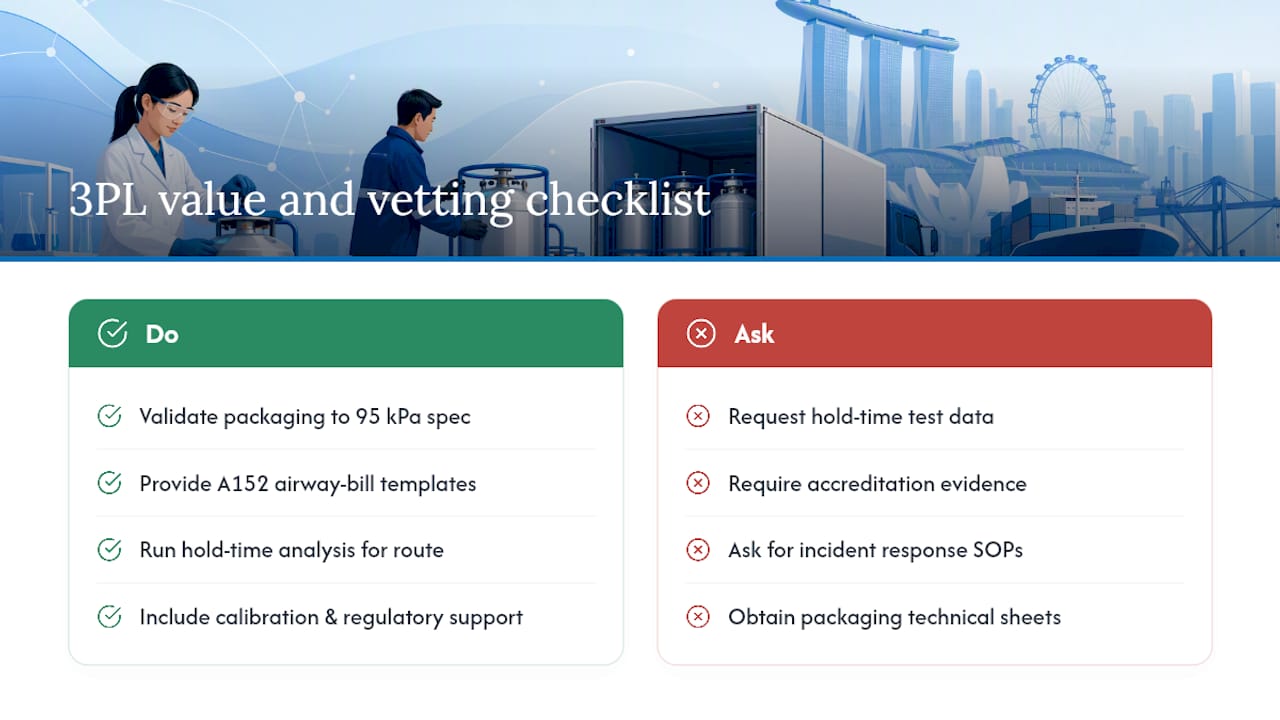
Most rejected LN2 shipments fail on paperwork or prep, not physics. A logistics partner experienced in cold chain logistics can validate packaging against the 95 kPa spec, supply A152-compliant airway bill templates, and run hold-time analysis against your actual route. When vetting any provider, ask directly for hold-time test data, accreditation evidence, incident response SOPs, and technical sheets proving packaging compliance. Some specialized 3PL providers work with these exact requirements as part of their calibration services and regulatory support offerings for life science shippers across Southeast Asia.
Operational Lessons From the Field
The failures that actually happen are almost never dramatic. It is the missing A152 phrase, a Friday shipment that sits over a weekend, or a taped-shut outer box that traps vapor. Every one of those is a process fix, not an equipment upgrade. People, procedure, and validated packaging have to work together, or one weak link undoes the rest.
— Brandcore
How Labgistics Asia Supports Compliant Dry-Shipper Shipments
Labgistics is the partner for teams who need cryogenic shipments handled right the first time, not re-shipped after a carrier rejection. As a healthcare-focused 3PL in Singapore built specifically around pharma logistics and life science cargo, Labgistics reviews packaging against the 95 kPa specification, prepares A152-compliant airway bill documentation, and coordinates secure transport with customs clearance built into the timeline rather than bolted on afterward.

Calibration services can validate dry shipper hold times against actual shipping routes, not generic manufacturer averages, and regulatory teams may handle product registration and compliance paperwork relevant for teams shipping into new Southeast Asian markets. If your lab is planning a cryogenic shipment and wants a compliance review before it leaves the building, request a quote from Labgistics and get the paperwork checked before the carrier does.
Sources
- Liquid Nitrogen Dry Shippers Preparation and Shipping Requirements (Weill Cornell EHS)
- Handling, Transportation and Storage Liquid Nitrogen and other Cryogenic Material – NUS Chemistry
- Cryogenic Sample Transport: Essential Regulations and Best Practices for Lab Shipping – Unicorn Lifescience
FAQ
How Is Liquid Nitrogen Transported?
Biological samples requiring liquid-nitrogen temperatures are typically transported inside vapor-phase dry shippers rather than as free liquid, since a properly charged dry shipper holds temperature without carrying loose LN2 that triggers a separate hazardous-goods declaration.
How Long Will Liquid Nitrogen Stay Cold in a Dry Shipper?
A charged dry shipper maintains -150°C to -196°C for several days depending on the model and how well it was charged, so confirming your specific unit’s rated hold time against your transit schedule is essential before shipping.
What Airway Bill Wording Do I Need for a Dry Shipper Shipment?
The airway bill must state “Not restricted, as per Special Provision A152” to claim the exemption from a Class 2.2 LN2 declaration; omitting this exact phrase is one of the most common causes of carrier rejection.
Do I Need a Dangerous Goods Declaration for a Dry Shipper?
Not if the shipper contains zero free liquid nitrogen and is documented under IATA Packing Instruction PI 650 with the A152 exemption; if any free liquid remains, the shipment reverts to a full UN 1977 dangerous-goods declaration under PI 202.
Can Labgistics Help With Liquid Nitrogen Shipping Compliance?
Yes. Labgistics Asia supports packaging validation, A152 documentation preparation, and route-specific hold-time analysis for pharmaceutical and life science clients shipping cryogenic materials across Southeast Asia.
Recommended
- Dry Ice Shipping Regulations: A Compliance Officer’s Guide
- Temperature Controlled Storage: A Pharma Compliance Guide
- Cold Chain Packaging for Pharma Supply Chains: Validated 3PL Checklist
- UN3373 Category B: Compliance and Packaging Requirements