
Cold Chain Packaging for Pharma Supply Chains: Validated 3PL Checklist
For regulated pharmaceutical exports from the US to Southeast Asia, cold chain packaging means one thing: a thermally validated system integrated into your 3PL’s documented SOPs, qualified through DQ/OQ/PQ protocols, monitored by calibrated devices, and supported by lane-specific validation data. The packaging itself is not the product — the qualification evidence is.
Before you issue an RFP or sign a logistics contract, request these three items from every prospective 3PL, following key guidance on cold chain medical supplies:
- OQ/PQ reports for the specific packaging configuration and lane profiles you require
- Calibration certificates for all temperature-monitoring devices, with traceable reference standards
- Lane validation plan covering seasonal ambient extremes for your Southeast Asia routes
If a 3PL cannot produce all three within a reasonable due-diligence window, that is your answer.
Key Takeaways
Validated cold chain packaging for pharmaceutical exports to Southeast Asia requires DQ/OQ/PQ evidence, calibrated monitoring, lane-specific field qualification, and documented SOPs — not just a thermally rated shipper.
| Point | Details |
|---|---|
| Demand qualification evidence first | Request OQ/PQ reports, calibration certificates, and a lane validation plan before signing any 3PL contract. |
| Logger specs are contractual | Require ±0.5°C accuracy, 5–15 minute recording intervals, and GxP-compliant data retention in your RFP. |
| Lane PQ is non-negotiable for SEA | Pre-qualified systems need risk-based review against actual SEA ambient profiles and customs-hold scenarios. |
| SOPs and change control protect you | Pack-out SOPs, conditioning records, and active change control logs are audit evidence, not administrative overhead. |
| Labgistics as your SEA partner | Labgistics provides validated cold chain programs, lane-specific PQ data, and accredited distribution across Southeast Asia. |
Table of Contents
- What does “cold chain packaging” actually mean for regulated pharma logistics?
- Which regulations and standards govern validated cold chain packaging?
- How do DQ, OQ, and PQ apply to passive thermal packaging?
- What temperature monitoring specs should you require from a 3PL?
- How do you assess and audit a 3PL’s cold chain packaging capability?
- What does operational rollout look like for SEA cold chain lanes?
- What do validation timelines and costs look like?
- How Labgistics operationalizes validated cold chain packaging for US shippers
- The case for putting validation before cost in every packaging decision
- Labgistics supports your validated cold chain program across Southeast Asia
- Sources
- FAQ
What does “cold chain packaging” actually mean for regulated pharma logistics?
For the purposes of this article, cold chain packaging refers to the validated, integrated use of thermal packaging systems within a 3PL or 4PL operation — not the procurement of foam shippers or gel packs as standalone products. The distinction matters because pharma cold chain compliance is a system-level obligation, not a component-level one.
Included in scope:
- Packaging system validation (DQ, OQ, PQ) tied to specific routes and ambient profiles
- Temperature monitoring SOPs, device calibration, and data integrity controls
- Lane validation covering Southeast Asia climate extremes and transit durations
- Re-icing, reconditioning, and pack-out SOPs with documented change control
- Cross-border handoff protocols for SEA customs and last-mile carriers
Excluded from scope: packaging manufacturer product specifications, component datasheets, and material-level testing not tied to a validated shipment system.
The jurisdictional context here is US-originated product shipped into Southeast Asia lanes — Thailand, Vietnam, Indonesia, Malaysia, Singapore, and the Philippines. Each market has its own import and storage regulations, and customs holds at ports like Tanjung Priok or Laem Chabang can extend transit times well beyond the validated window. Your packaging qualification must account for that.
Which regulations and standards govern validated cold chain packaging?
The standards below form the compliance backbone for any RFI, contract, or vendor audit. Reference them explicitly when specifying packaging qualification requirements.
- WHO TRS 961 Annex 9: Model guidance for storage and transport of time- and temperature-sensitive pharmaceutical products (TTSPPs). Sets GDP-aligned documented controls as the baseline; local legislation in each SEA market takes precedence.
- PIC/S GDP Guide: Requires wholesale distributors to qualify key equipment and processes — including storage, pick-and-pack, and transportation — using a documented risk assessment, with calibration and validation records maintained.
- EU GDP Guidelines: Require validated temperature-control systems, annual calibration of monitoring equipment, and documented SOPs for cool-pack reuse and seasonal pack configurations.
- ISTA Pharma OQ Guideline: Industry best-practice framework for OQ of passive thermal packaging, covering thermocouple mapping, chamber test plans, mechanical testing, and documentation expectations.
- USP <1079> / <1118>: US Pharmacopeia guidance on good storage and distribution practices and monitoring devices — directly relevant for FDA-regulated products.
- FDA 21 CFR Parts 211 and 600: Current Good Manufacturing Practice requirements that extend to distribution and storage conditions for finished drug products and biologics.
Pro Tip: When evaluating a 3PL, request their OQ/PQ summary report and chamber validation certificate first. These two documents reveal more about operational maturity than any sales presentation.
How do DQ, OQ, and PQ apply to passive thermal packaging?
Qualification follows a three-phase structure. Each phase has defined inputs, test elements, and acceptance criteria that your QA team should verify before approving a packaging system.
Design Qualification (DQ) establishes that the packaging system is fit for purpose before any testing begins. Inputs include the User Requirements Specification (URS), expected external ambient profiles for SEA lanes (often 25°C–43°C for tropical routes), maximum transit duration, and permitted handling points.
Operational Qualification (OQ) is where the ISTA Pharma OQ Guideline provides the most detailed industry guidance. Key test plan elements:
- Chamber profiles simulating worst-case summer and winter ambient conditions
- Pre-conditioning of phase-change materials (PCMs) to specified temperatures
- Thermocouple placement at the geometric center, worst-case corner positions, and PCM interface
- Minimum replicate runs (typically three) to demonstrate repeatability
- Mechanical tests: shock, vibration, and orientation challenges per ISTA or ASTM protocols
- Documented acceptance criteria and a formal OQ report with executive summary
Performance Qualification (PQ) moves from the chamber to the real lane. Requirements:
- Representative field shipments on actual SEA routes, including seasonal runs
- Multiple replicate shipments per season including summer and winter extremes
- Calibrated data loggers at the same positions used in OQ
- Excursion investigation procedure and documented disposition criteria
| OQ/PQ Element | Acceptance Criteria |
|---|---|
| Environmental chamber OQ | All payload positions within specified temperature range for full duration |
| Worst-case thermocouple positions | No excursion beyond ±0.5°C of the validated range boundary |
| Mechanical shock and vibration | No structural failure; packaging integrity confirmed post-test |
| PQ field replicates | At least several successful runs per seasonal profile with no unresolved excursions |
What temperature monitoring specs should you require from a 3PL?
Monitoring is where qualification evidence becomes operational reality. The device specifications and data practices you require in your contract determine whether shipment data will hold up under a regulatory audit.
Minimum device specifications to demand:
- Accuracy of ±0.5°C across the validated temperature range, with calibration traceable to national standards
- Recording interval of 5–15 minutes depending on route duration and product stability margin
- Tamper-evident design with secure, auditable data download
Logger placement: calibrated sensors at the geometric center of the payload, at worst-case corner positions, and at the PCM interface — consistent with the positions used during OQ. The number of loggers per pack should be specified in the SOP and matched to pack size.
Data integrity and chain of custody require that calibration certificates document reference standards and measurement uncertainty, and that records are retained per GxP policies aligned to product stability data and CAPA procedures. Annual recalibration is the standard expectation for reusable devices.
Monitoring decision tree: automated real-time alerts are warranted for high-value biologics or narrow-stability products on long-haul SEA routes. For shorter domestic legs with wider stability margins, post-shipment data review against pre-defined acceptance criteria may be sufficient — but the decision must be documented in the monitoring strategy.
Pro Tip: In your RFP, specify: “Calibration certificates must document the reference standard used, measurement uncertainty, and pass/fail result, and records should be retained in accordance with GxP policies.” This single clause eliminates vendors who treat calibration as a checkbox.
How do you assess and audit a 3PL’s cold chain packaging capability?
Documents to request upfront
- DQ/OQ/PQ reports for the packaging configurations relevant to your product and lane
- Chamber validation records and annual recalibration certificates for test equipment
- Calibration certificates for all temperature-monitoring devices in use
- SOPs for pack-out, conditioning, re-icing, and reusable component control
- GDP or ISO accreditation certificates for distribution centers
- Change control log showing how packaging or SOP modifications are managed
On-site audit priorities
- Controlled staging areas: temperature, segregation of frozen and chilled packs, and access controls
- Conditioning rooms: documented pre-conditioning times and temperature verification records
- Staff training records: evidence that pack-out SOPs are trained, not just posted
- Mechanical handling capability: orientation controls, shock protection in loading areas
- Change control documentation: is it active and current, or a binder that hasn’t been touched?
Audits should verify operating behavior, not just documentation. Watch whether staff actually follow the documented pack-out SOP under realistic time pressure, and whether cool-pack acclimatization is performed correctly — not just whether a procedure exists on paper.
Red flags
- Missing or incomplete OQ/PQ reports for the lanes you need
- Calibration intervals longer than annually for reusable monitoring devices
- No documented SOP for cool-pack reuse or conditioning
- Uncontrolled reuse of phase-change materials without inspection criteria
- No lane validation data for SEA routes or seasonal profiles
Use Labgistics’ GDP and cold chain readiness checklist as a structured starting point for your vendor assessment.
What does operational rollout look like for SEA cold chain lanes?
Execution quality depends on documented SOPs that your 3PL follows consistently, not just during audits. A practical SOP outline for pack-out and staging should cover:
- Conditioning: PCMs pre-conditioned to specified temperatures in a controlled room, with time and temperature verified and recorded before pack-out begins
- Pack-out QC: payload configuration matches the validated layout; thermocouple or logger placement confirmed; outer packaging inspected for damage
- Labeling and documentation: shipment ID, product identity, temperature range, and handling instructions on every package; chain-of-custody record initiated
- Change control: any deviation from the validated configuration triggers a documented change control review before the shipment is released
For temperature-sensitive shipment handling, lane management adds another layer. Seasonal requalification is triggered when ambient profiles shift significantly — typically when summer or monsoon conditions push ambient temperatures beyond the validated OQ envelope. Customs holds at major SEA ports represent a specific risk: a 48-hour hold at a tropical port can exhaust the validated transit window of a 2°C–8°C system. Contingency plans must include pre-identified cold storage options at key ports and carrier escalation protocols.
Mechanical handling notes: packages should be oriented per the validated configuration, and drop or shock events during loading must be documented and assessed against the mechanical test acceptance criteria.
What do validation timelines and costs look like?
Budget and schedule vary significantly based on whether you use a pre-qualified packaging system or commission a bespoke validation program.
| Validation Phase | Typical Duration |
|---|---|
| DQ and URS development | 2–4 weeks |
| OQ chamber testing | 3–6 weeks |
| OQ reporting and review | 2–3 weeks |
| PQ field shipments (per season) | 4–8 weeks per seasonal run |
| Final PQ report and change control | 2–4 weeks |
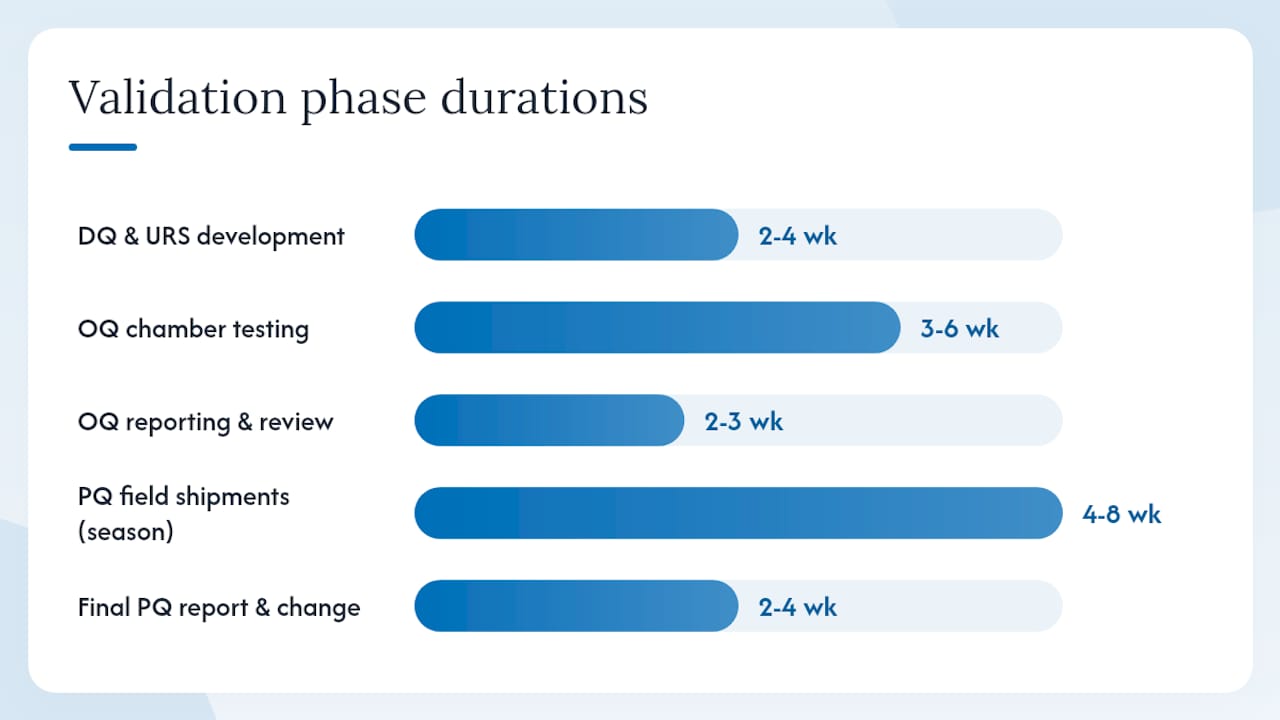
Major cost drivers include chamber testing fees, PCM procurement and conditioning equipment, calibrated logger costs, personnel time for protocol development and review, and the cost of field PQ shipments on live SEA lanes.
Pre-qualified solutions reduce onboarding time and cost considerably, but a risk-based evaluation is still required to confirm lane-specific performance under regional climate extremes. They are appropriate when your product has a wide stability margin, your lane profiles fall within the system’s validated envelope, and shipment frequency justifies the reduced upfront investment.
Custom PQ fieldwork is warranted when your product has a narrow stability margin, your SEA lanes include high-ambient tropical legs or extended customs-hold risks, or your shipment volumes justify the investment in a fully lane-specific qualification package. For guidance on temperature control solution types and their operational tradeoffs, that resource covers the decision criteria in detail.
How Labgistics operationalizes validated cold chain packaging for US shippers
Labgistics brings over 20 years of healthcare logistics experience across Southeast Asia, operating from fully accredited distribution centers with GDP-aligned infrastructure. For US pharmaceutical and life science companies shipping into SEA lanes, Labgistics provides an end-to-end validated cold chain program that covers the full qualification lifecycle.
Service capabilities include:
- Validated packaging programs with DQ/OQ/PQ documentation packages available for review
- Lane validation covering major SEA corridors, including seasonal ambient profiles
- Calibrated temperature monitoring with traceable calibration records and GxP-compliant data retention
- SOP development and change control management for pack-out, conditioning, and re-icing
- Regulatory support and customs coordination across Singapore, Malaysia, Thailand, Indonesia, Vietnam, and the Philippines
- Accredited distribution center evidence and audit-ready documentation
The client engagement flow runs from intake and URS development through DQ/OQ oversight, PQ field runs on actual SEA lanes, SOP handover, and ongoing monitoring with CAPA support. Procurement and QA teams can request DQ/OQ/PQ packets, calibration records, and accredited distribution center certificates directly during the vendor assessment phase.
For pharmaceutical warehousing compliance specifics, Labgistics’ accredited Singapore facility serves as the operational hub for SEA distribution, with cold storage validated across 2°C–8°C and 15°C–25°C ranges.
The case for putting validation before cost in every packaging decision
The most common failure mode in pharmaceutical cold chain programs is not a packaging system that performs poorly in the chamber. It is a packaging system that performs well in the chamber but was never validated for the actual lane — the 38°C tarmac at Soekarno-Hatta, the 72-hour customs hold at Manila, the last-mile handoff to a carrier with no temperature-controlled vehicle.
Operations managers under budget pressure often accept a pre-qualified system’s OQ data as sufficient and skip the lane-specific PQ. That decision saves money once and creates regulatory exposure indefinitely. The EU GDP Guidelines and PIC/S GDP Guide both make clear that validation must reflect the actual conditions of use — not a laboratory approximation of them.
The practical prioritization step: before any packaging decision, map your three highest-risk SEA lanes by ambient profile, transit duration, and customs-hold probability. That map tells you whether a pre-qualified system is defensible or whether you need field PQ data. It takes a week and costs nothing. Skipping it costs far more.
Labgistics supports your validated cold chain program across Southeast Asia
US pharmaceutical and life science companies entering or expanding across Southeast Asia need more than a packaging spec. They need a logistics partner with validated lane data, accredited infrastructure, and the regulatory depth to navigate each market’s import requirements.
Labgistics delivers specialized healthcare logistics built around compliance: validated cold chain programs, calibrated monitoring, GDP-aligned SOPs, and customs coordination across all major SEA markets. With over 20 years of regional experience and fully accredited distribution centers, Labgistics gives procurement and QA teams the documentation they need to approve a 3PL with confidence. Contact Labgistics to request a technical scoping call or a validated packaging RFP package for your SEA lanes.
Sources
The following authoritative documents underpin the guidance in this article. When evaluating vendor documentation, cross-reference the specific clauses each 3PL cites against these primary sources — not against secondary summaries.
- TRS 961 – Annex 9: Model guidance for the storage and transport of time and temperature sensitive pharmaceutical products
- ISTA Pharma Committee Passive Thermal Packaging System OQ Guideline
- PIC/S GDP Guide
- Commission Guidelines on Good Distribution Practice of Medicinal Products for Human Use
When a 3PL cites compliance with any of these standards, ask for the specific clause reference and the corresponding internal procedure or validation record. A citation without a document trail is not evidence.
This article is general information, not a substitute for advice from a qualified doctor. Consult a qualified healthcare professional about your own circumstances before acting on anything here.
FAQ
What is cold chain packaging in pharmaceutical logistics?
In regulated pharmaceutical logistics, cold chain packaging refers to the validated thermal packaging system used within a 3PL’s documented operations — qualified through DQ/OQ/PQ protocols and supported by calibrated monitoring and lane-specific performance data.
Which standards govern cold chain packaging qualification for US pharma exports?
WHO TRS 961 Annex 9, PIC/S GDP, EU GDP Guidelines, ISTA Pharma OQ Guideline, and USP <1079>/<1118> are the primary references. FDA 21 CFR Parts 211 and 600 apply to finished drug products and biologics.
When is a pre-qualified packaging system sufficient for SEA lanes?
A pre-qualified system is appropriate when your product has a wide stability margin and your lane profiles fall within the system’s validated ambient envelope. Narrow-stability products or lanes with high customs-hold risk typically require lane-specific PQ field runs.
What calibration evidence should a 3PL provide for temperature monitoring devices?
Calibration certificates must document the reference standard used, measurement uncertainty, and pass/fail result. Annual recalibration is the standard expectation for reusable devices, with records retained per GxP policies.
How does Labgistics support validated cold chain programs for Southeast Asia?
Labgistics provides end-to-end validated cold chain logistics from its accredited Singapore distribution hub, including DQ/OQ/PQ documentation, calibrated monitoring, lane validation across major SEA corridors, and regulatory support for each market’s import requirements.
Recommended
- Singapore 3PL: What Makes a 3PL Ready for Clinics, Labs, and Hospitals
- How to choose a 3PL warehouse for pharma supply chains
- Cold Chain Logistics for Pharma in Southeast Asia | Labgistics
- Temperature Controlled Storage: A Pharma Compliance Guide