
UN3373 Category B: Compliance and Packaging Requirements
UN3373 Category B identifies infectious substances assigned to Hazard Class 6.2 that do not meet the criteria for Category A. Most diagnostic specimens, including routine blood draws, swabs, and tissue samples, fall into this category. The compliance headline is simple: package every shipment under IATA PI650 triple-packaging rules, mark the outer box with the UN3373 diamond, and confirm the shipper has classified the material correctly before it ever reaches a carrier counter.
Before you tender any package, verify these two things:
- The triple packaging is intact, leakproof, and rated for the contents inside it.
- The UN3373 mark, proper shipping name, and responsible person’s contact details are all printed and legible on the outer surface.
Key Takeaways
Compliant UN3373 Category B shipping depends on triple packaging under IATA PI650, correct UN3373 marking, and accurate shipper classification, with a pressure-rated primary receptacle as the most overlooked requirement.
| Point | Details |
|---|---|
| Classification is the shipper’s job | Verify Category B status before packaging; misclassification is the leading cause of rejections. |
| Primary receptacle rating matters most | Rate liquid containers for a 95 kPa pressure differential, not just outer box durability. |
| Follow PI650 exactly | Use triple packaging, pass the 1.2 m drop test, and size the UN3373 mark at 50 mm minimum. |
| Documentation prevents rejections | Include a 24-hour contact, shipper/consignee details, and matching air waybill data. |
| Specialist partners reduce risk at scale | Labgistics Asia offers validated packaging, cold chain handling, and carrier pre-acceptance checks for high-volume shippers. |
Table of Contents
- What Does UN3373 Category B Actually Cover?
- What Are the IATA PI650 Requirements for Air Transport?
- How Do You Triple-Package a UN3373 Category B Sample?
- What Marking and Documentation Does a UN3373 Shipment Need?
- UN3373 Packaging Checklist Before You Tender a Shipment
- How Does a Specialized Logistics Partner Reduce UN3373 Risk?
- Why Compliance Teams Get UN3373 Wrong
- How Labgistics Asia Supports Compliant UN3373 Shipments
- Sources
- FAQ
What Does UN3373 Category B Actually Cover?
Category B substances are infectious materials that, under normal transport conditions, are not expected to cause permanent disability or life-threatening disease in otherwise healthy people or animals. That’s the line separating them from Category A pathogens like Ebola or Marburg virus, which require far stricter packaging and a different UN number (UN2814 for substances affecting humans). The StatPearls packaging summary confirms this risk threshold and notes that most routine diagnostic specimens, blood panels, throat swabs, biopsy tissue sit squarely in Category B.
Typical Category B shipments include:
- Routine clinical chemistry and hematology samples
- Microbiology cultures being sent for confirmatory testing
- Tissue biopsies destined for pathology review
- Environmental or research swabs with low individual risk
The distinction matters because misclassification is the leading cause of shipment rejections and regulatory exposure. Shippers, not carriers, carry legal responsibility for getting the classification right. If a specimen’s risk profile is uncertain, laboratories typically default to the more conservative Category A protocol rather than gamble on an incorrect Category B designation.
What Are the IATA PI650 Requirements for Air Transport?
Air carriage of UN3373 Category B material runs on one governing document: IATA Packing Instruction 650. It sets out three binding requirements you cannot shortcut.
- Triple packaging system. A leakproof primary receptacle sits inside a leakproof secondary packaging, both housed in a rigid outer package.
- Drop test compliance. The outer packaging must survive a 1.2-meter drop test in the orientation most likely to cause failure.
- Pressure differential rating. Primary receptacles holding liquids must withstand a 95 kPa internal pressure differential, a spec carriers and labs frequently overlook, according to Gov.
Statistic callout: The UN3373 diamond mark must measure at least 50 mm × 50 mm, with the proper shipping name “Biological Substance, Category B” printed in letters no smaller than 6 mm high, per GOV.UK’s official specification.
For road and rail movement in Europe, ADR packing instruction P650 mirrors these same triple-packaging and marking principles, so a package built to PI650 standards generally satisfies surface transport too. Refrigerated or dry-ice shipments carry additional handling instructions under ICAO rules, covered separately in the packaging checklist below. When technical questions arise about volume limits or exceptions, the PI650 PDF itself remains the authoritative source to consult.
How Do You Triple-Package a UN3373 Category B Sample?
Building compliant packaging is a sequence, not a checklist you can complete out of order. Follow these steps in this exact sequence:
- Select and seal the primary receptacle. Choose a container rated for the specimen type. If it holds liquid, confirm it can withstand a 95 kPa pressure differential before you seal it.
- Wrap it in leakproof secondary packaging. Add absorbent material sized to fully contain the entire liquid volume of the primary receptacle, not just a portion of it.
- Place the assembly in a rigid outer box. This outer packaging must independently pass the 1.2-meter drop test. Print the UN3373 diamond and proper shipping name on its outer surface.
- Separate multiple vials and respect volume limits. Individual specimens generally stay under 4 L (liquids) or 4 kg (solids) per outer package, excluding coolant weight. Cushion each vial so they cannot contact or crush one another in transit.
- Run final pre-tender checks. Confirm all seals are secure, markings are legible, shipper and consignee details are complete, and an emergency contact appears on the label. Note any dry ice or temperature-control requirements clearly on the outside.
Pro Tip: Don’t rely on the outer box’s drop-test rating as your only insurance against leaks. A 1.2-meter drop test proves the outer package survives impact, but a pressure-rated primary receptacle is what actually stops the specimen from leaking during altitude changes or rough handling.
What Marking and Documentation Does a UN3373 Shipment Need?

Carrier acceptance staff reject more Category B packages over labeling gaps than almost any other single issue. The UN3373 diamond mark needs to measure at least 50 mm on each side, with the proper shipping name in high-contrast lettering at least 6 mm tall placed directly beside it, standards confirmed by both GOV.UK and the Swiss Expert Committee for Biosafety.
Beyond the mark itself, every package needs:
- Full shipper and consignee name and address printed on the outer surface
- A 24-hour phone number for a person knowledgeable about the shipment’s contents in case of emergency
- Air waybill documentation matching the package’s declared contents and weight exactly
- Dry ice labeling (Class 9) applied separately when used as a coolant, alongside the UN3373 mark
Patient samples carry an added wrinkle: labels must identify the shipment for carrier and customs purposes without disclosing identifiable patient information, a balance Time and Temperature labeling guidance addresses for temperature-sensitive healthcare shipments specifically.
UN3373 Packaging Checklist Before You Tender a Shipment
Run through this list before any Category B package leaves your facility.
- Primary receptacle is leakproof and, for liquids, rated for a 95 kPa pressure differential.
- Secondary packaging is leakproof with absorbent material sized to the full liquid volume.
- Rigid outer packaging has passed a 1.2 m drop test and displays the UN3373 diamond plus proper shipping name.
- Shipper and consignee names, addresses, and a 24-hour emergency contact appear on the package.
- Total volume or weight stays within limits, and dry ice or refrigerant use is documented and labeled separately.
Keep this list next to your packing station. Most rejected shipments fail on one of these five points, not on some obscure technicality buried deeper in the regulations.
How Does a Specialized Logistics Partner Reduce UN3373 Risk?
Handling Category B shipments in-house works fine at low volume, provided someone owns classification decisions and packaging validation full time. At higher volume, or when audit-readiness matters, a dedicated healthcare logistics partner changes the risk profile considerably.
Labgistics Asia brings several capabilities to bear on this specific problem: regulatory support for classification decisions, validated cold chain logistics for refrigerated specimens, and in-house calibration and validation services that keep packaging materials within spec.
- Classification audits that catch Category A/B ambiguity before it becomes a shipment rejection
- Validated packaging processes tested against PI650 drop-test and pressure standards
- 24/7 emergency contact staffing built into every shipment’s documentation
- Carrier pre-acceptance checks that flag labeling gaps before a package reaches the counter
Labgistics Asia facilitated regulatory approval and compliant shipment logistics for the LUCIRA™ Health COVID-19 test across Southeast Asian markets, coordinating classification, packaging validation, and market entry requirements in a single workflow.
Outsourcing makes the most sense once shipment volume, audit exposure, or multi-country distribution outpaces what a single compliance officer can track manually.
Why Compliance Teams Get UN3373 Wrong
Most guidance on Category B shipping treats it as a paperwork exercise: get the diamond mark the right size, print the shipping name, done. That framing misses the actual failure point. The research here points somewhere else entirely, toward the primary receptacle, not the outer box.
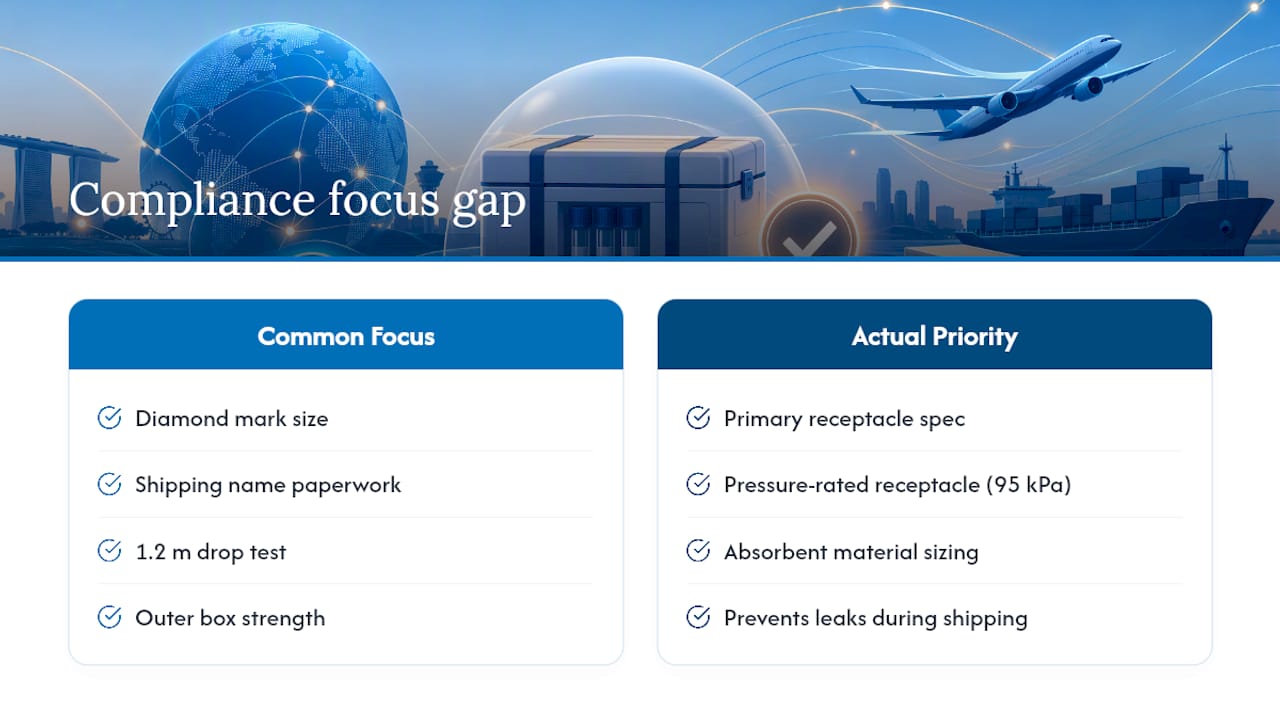
Teams obsess over the 1.2-meter drop test because it’s the most visible, most quotable spec in PI650. But a pressure-rated primary receptacle prevents leaks that a sturdy outer box cannot. An outer package that survives a drop test perfectly can still ship a leaking specimen if the primary container wasn’t rated for a 95 kPa pressure differential in the first place. That’s the gap between what looks compliant and what actually protects a handler.
If you take one thing from this guide, prioritize your primary receptacle specification and your absorbent material sizing over cosmetic label placement. Classification accuracy comes second. Everything else, drop tests, diamond dimensions, contact numbers, is procedural hygiene that matters, but rarely causes a real incident on its own.
— Brandcore
How Labgistics Asia Supports Compliant UN3373 Shipments
Building compliant triple packaging in-house means owning classification calls, validated materials, and carrier relationships all at once, a full-time job most labs don’t have the headcount for. Labgistics Asia is the alternative: a Singapore-based specialized logistics partner that handles validated packaging, cold-chain handling, and carrier booking under one contract, so your team stops re-solving the same compliance puzzle on every shipment.

Our services cover regulatory support for classification decisions, GDP/MDS-compliant warehousing, and 24/7 emergency contact staffing built into every UN3373 shipment we handle across Southeast Asia. For labs managing frequent Category B volume or expanding into new markets, that consistency removes the guesswork carriers routinely reject packages over. If your team is ready to hand off packaging validation and carrier coordination to a partner built for regulated healthcare logistics, request a compliance consultation with Labgistics Asia and get a shipment-by-shipment review of where your current process stands.
Sources
Air transport rules come from IATA PI650 directly; surface transport in the UK follows GOV.UK’s UN3373 guidance. Lab-specific procedures appear in APHL’s packing guidance, with clinical context from NCBI StatPearls.
- Packaging and Shipping Infectious Materials – StatPearls – NCBI Bookshelf
- Gov
- IATA PI650 packing instruction (PI650 PDF) – IATA
- Infectious substances, Category B – Swiss Expert Committee for Biosafety SECB
FAQ
What is UN3373 Category B?
UN3373 Category B designates infectious substances under Hazard Class 6.2 that don’t meet the higher-risk criteria of Category A, covering most routine diagnostic specimens like blood, swabs, and tissue samples.
What level of risk does a UN 3373 biological substance Category B pose?
Category B substances are not considered capable of causing permanent disability or life-threatening disease in healthy humans or animals under normal transport conditions, though they still require triple packaging to protect handlers from exposure.
What is a Category B infectious substance?
It’s any infectious material assigned UN3373 status because its risk profile falls below Category A thresholds, typically routine clinical or research specimens rather than high-consequence pathogens.
Can Category B infectious substances be shipped by air?
Yes, provided the shipment follows IATA PI650 triple-packaging requirements, passes the 1.2-meter drop test, and carries correct UN3373 marking and shipper documentation.
How is Category B different from Category A shipping?
Category A substances pose a higher risk of causing serious disease or death and require stricter packaging under UN2814, while Category B substances use the somewhat less stringent PI650/P650 triple-packaging standard.
Recommended
- Type A Radioactive Packaging: What Compliance Teams Must Know
- GDP-Compliant Warehousing: What Good Looks Like
- Hazardous Materials Logistics: A Compliance Guide for 2026
- Time and Temperature Labels: The IATA Compliance Guide for Healthcare Procurement