
Hazardous Materials Logistics: A Compliance Guide for 2026
Hazardous materials logistics is defined as the end-to-end process of classifying, packaging, labeling, documenting, and transporting substances that pose risks to human health, public safety, or the environment. Known in international trade as “dangerous goods” logistics, this discipline operates under strict regulatory frameworks including U.S. DOT Title 49 CFR, the IATA Dangerous Goods Regulations (DGR), the IMDG Code for sea freight, and the ADR for European road transport. Over 3,000 substances fall under these rules worldwide. Shippers carry absolute legal liability for compliance, regardless of which carrier or third party moves the goods.
What is hazardous materials logistics and how are substances classified?
Hazardous materials logistics covers over 3,000 regulated substances organized into nine UN hazard classes. That classification system creates a shared global language for packaging, labeling, and handling rules across every transport mode.
The nine UN hazard classes are:
- Class 1: Explosives (fireworks, ammunition)
- Class 2: Gases (compressed oxygen, aerosol cans)
- Class 3: Flammable liquids (acetone, ethanol)
- Class 4: Flammable solids and reactive substances
- Class 5: Oxidizers and organic peroxides
- Class 6: Toxic and infectious substances (biological samples, certain pharmaceuticals)
- Class 7: Radioactive materials (medical isotopes used in diagnostics)
- Class 8: Corrosives (battery acid, cleaning agents)
- Class 9: Miscellaneous dangerous goods (lithium batteries, dry ice)
Many logistics professionals are surprised to learn that common goods like lithium batteries, aerosols, and cleaning chemicals qualify as regulated hazardous materials. A standard laptop battery shipped in cargo hold quantities requires the same regulatory attention as industrial chemicals. Hand sanitizers and aerosol whipped cream cans fall under Class 2 or Class 3 rules depending on their formulation.
Classification also determines the correct UN Proper Shipping Name, which must appear on all shipping documents. Trade names are not acceptable on shipping papers. Using a brand name instead of the official Proper Shipping Name is one of the most common and costly compliance errors in hazardous material shipping.
The terminology also shifts by transport mode. Air freight follows IATA DGR language. Sea freight uses IMDG Code terminology. Road transport in Europe follows ADR. The substance is the same, but the rulebook changes. Logistics professionals must know which framework applies to each leg of a shipment.
| Transport Mode | Governing Regulation | Key Focus |
|---|---|---|
| Air | IATA DGR | Quantity limits, forbidden goods lists |
| Sea | IMDG Code | Segregation, stowage, emergency procedures |
| Road (Europe) | ADR | Vehicle requirements, driver certification |
| Road/Rail (U.S.) | DOT Title 49 CFR | Packaging, placarding, shipping papers |
What are the essential compliance requirements for hazardous materials transportation?
Compliance in dangerous goods logistics is not optional. Shippers are legally responsible for proper classification, packaging, labeling, and documentation, and that liability is absolute and non-transferable even when a third-party carrier moves the goods. Outsourcing transport does not shift legal exposure away from the original shipper.
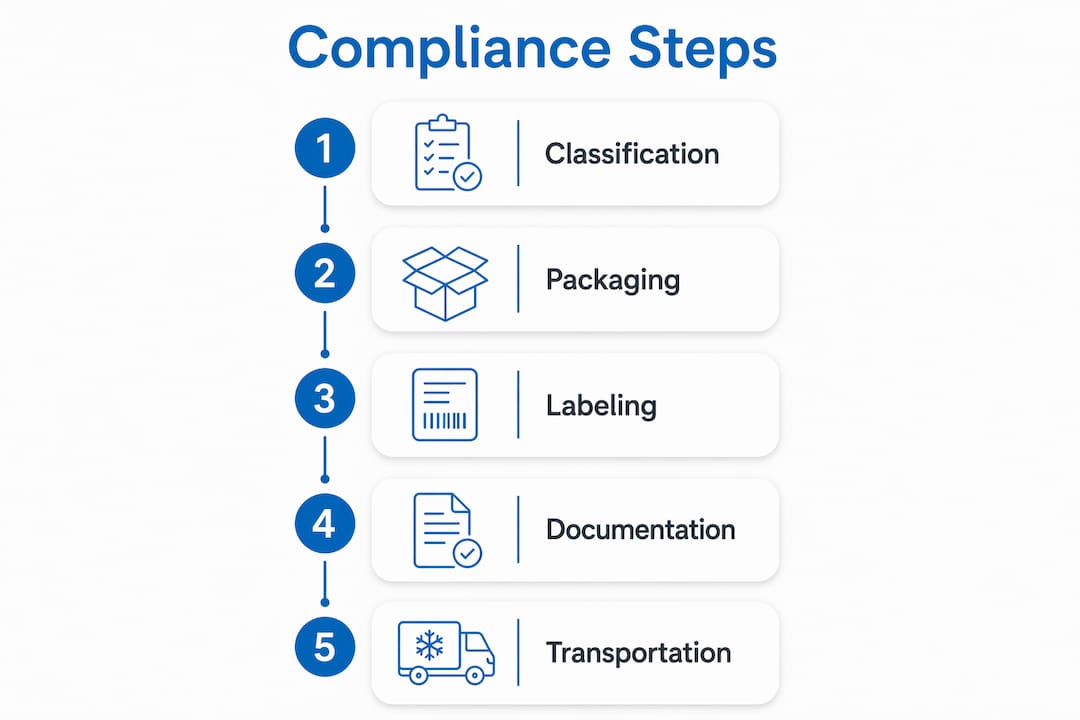
The core compliance requirements follow a clear sequence:
- Classify the substance correctly. Assign the correct UN hazard class, UN number, and packing group (I, II, or III, reflecting the degree of danger).
- Use UN-specification packaging. Packaging must carry the UN mark showing it has passed performance tests for the specific hazard class and packing group.
- Apply mandatory labels and markings. Each package requires the correct hazard class label, UN number, Proper Shipping Name, and orientation arrows where applicable.
- Prepare complete shipping papers. Documents must include the Proper Shipping Name, hazard class, UN number, packing group, quantity, and emergency contact information.
- Provide emergency response information. Carriers must have access to emergency response data, either through a 24-hour emergency number or an approved emergency response guide.
- Train all personnel who handle hazmat. U.S. DOT regulations require documented hazmat training for every employee who prepares, offers, or transports dangerous goods. Training must be renewed every three years.
- Verify mode-specific rules before each shipment. IATA DGR, IMDG Code, and ADR each carry specific quantity limits, forbidden goods lists, and segregation requirements that override general rules.
Pro Tip: Keep a shipment-specific compliance checklist tied to the UN number and transport mode. A checklist built for air freight will not cover all IMDG Code requirements for the same substance shipped by sea.
Institutional shippers face an additional layer. Formal review by an Environmental Health and Safety department is required before hazardous materials reach a carrier in many organizations. That review process can take several days to weeks. Building that lead time into your shipping schedule prevents last-minute compliance failures.
What operational challenges arise in hazardous materials logistics?
The complexity of managing dangerous goods logistics across multiple transport modes creates real operational pressure. Regulations differ by mode, by country, and by substance, which means a shipment moving from Singapore to Europe by air and then road must comply with IATA DGR, ADR, and potentially local national rules simultaneously.
The financial stakes are high. Penalties for non-compliance with U.S. DOT hazardous materials regulations can exceed $80,000 per violation as of 2026. That figure represents a sharp escalation from the previous ceiling of $32,500. A single misclassified shipment can generate multiple violations, each carrying a separate penalty.
Key operational challenges include:
- Regulatory fragmentation: Different rules apply by mode, region, and substance type, requiring teams to maintain current knowledge across multiple frameworks.
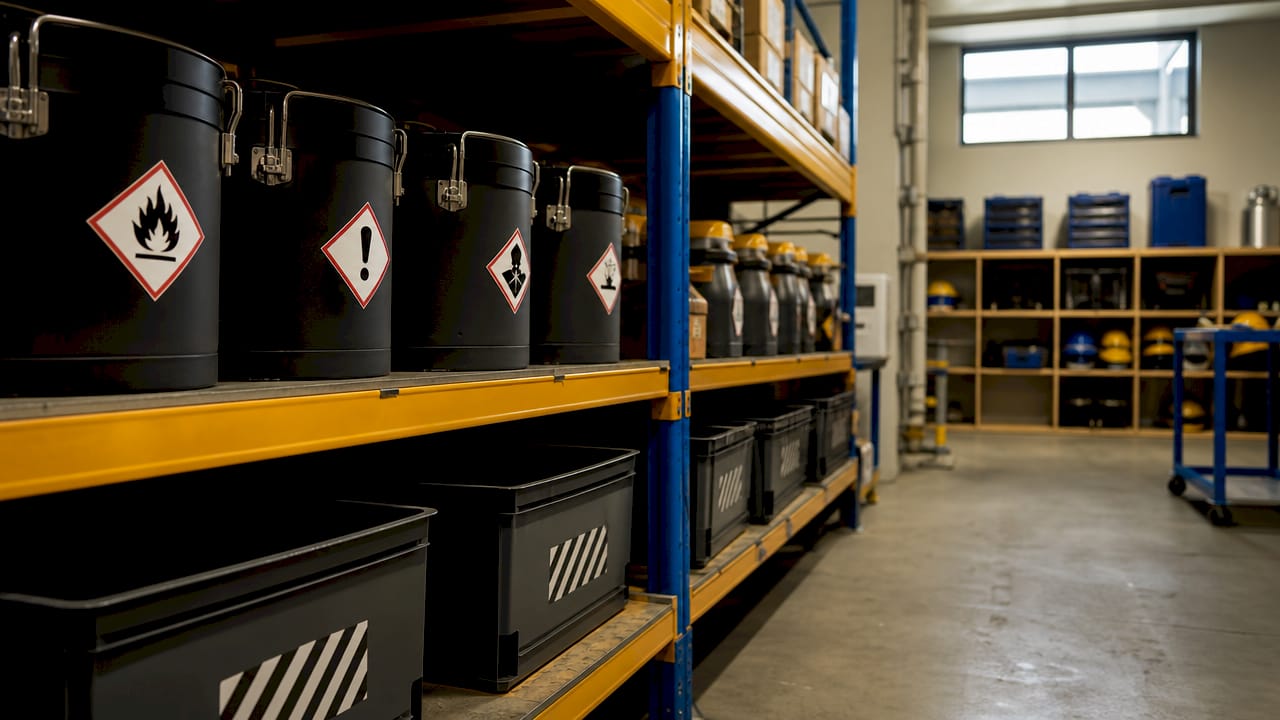
- Segregation and storage: Incompatible hazardous materials must be stored and transported separately. Mixing oxidizers with flammables, for example, creates explosion risk.
- Specialized equipment: Certain classes require explosion-proof storage zones, temperature-controlled vehicles, or secondary containment systems.
- Incident risk: Spills, leaks, and contamination events carry both safety consequences and regulatory reporting obligations.
- Documentation errors: Missing or incorrect shipping papers are the leading cause of carrier rejections and regulatory citations.
“Compliance should be viewed as risk management, not just paperwork, involving control over classification, packaging, labeling, and documentation verified against mode-specific regulations such as IATA DGR and IMDG Code.” — Logistics Concepts
For road transport specifically, proactive mitigation measures such as segregated storage areas and explosion-proof zones help maintain public safety before hazardous materials enter transit networks. That means compliance work begins in the warehouse, not at the loading dock. Effective logistics risk management in healthcare supply chains applies the same principle: control the risk at the source.
How do logistics professionals execute safe and compliant hazmat shipments?
Safe hazardous material shipping follows a defined process. Skipping any step creates legal exposure and safety risk. The following sequence applies across transport modes, with mode-specific adjustments at each stage.
- Identify and classify the substance. Confirm the UN number, hazard class, and packing group using the relevant regulatory publication (49 CFR, IATA DGR, or IMDG Code). Never rely on a previous shipment’s classification without verifying it against the current edition of the applicable regulation.
- Select UN-specification packaging. Match the packaging UN mark to the packing group and hazard class. Packing Group I substances require the most protective packaging. Reusing packaging without verifying its UN certification is a common and serious error.
- Label and mark each package correctly. Apply the hazard class diamond label, UN number, Proper Shipping Name, and any subsidiary risk labels. For air freight, quantity limits per package are strictly enforced and vary by substance.
- Prepare and verify shipping documents. The shipping paper must list the Proper Shipping Name first, followed by the hazard class, UN number, packing group, and total quantity. For healthcare-related shipments, additional documentation such as a Material Safety Data Sheet (MSDS) or Safety Data Sheet (SDS) is standard practice.
- Confirm trained personnel at every handoff. The driver, warehouse staff, and freight forwarder must each hold current hazmat training certification relevant to their role. Training records must be available for inspection.
- Coordinate with the carrier before tendering. Carriers have their own acceptance policies that may be stricter than regulatory minimums. Confirming acceptance in advance prevents shipment rejection at the terminal.
Pro Tip: Request a carrier’s dangerous goods acceptance policy in writing before booking. Carrier policies for lithium batteries and radioactive materials in particular often exceed IATA DGR minimums.
| Common Pitfall | Correct Practice |
|---|---|
| Using trade name on shipping paper | Use the official UN Proper Shipping Name |
| Reusing uncertified packaging | Verify UN mark on every package before use |
| Applying air freight rules to sea shipments | Check IMDG Code for each sea freight leg |
| Skipping EH&S review in institutional settings | Build review lead time into the shipping schedule |
| Assuming carrier handles compliance | Confirm shipper retains full legal liability |
What regulatory trends are shaping hazardous materials logistics in 2026?
Enforcement intensity is rising. The increase in U.S. DOT penalties from $32,500 to over $80,000 per violation signals a broader global trend toward stricter enforcement of dangerous goods regulations. Regulators are treating non-compliance as a public safety failure, not an administrative oversight.
Lithium battery regulations are receiving particular attention in 2026. IATA has tightened quantity limits and state-of-charge requirements for lithium-ion cells shipped by air. These changes affect electronics manufacturers, medical device distributors, and any supply chain that ships battery-powered equipment. Staying current with the annual IATA DGR edition is non-negotiable for air freight teams.
Current trends shaping the field include:
- Digital compliance tools: Platforms that automate UN number lookup, packaging selection, and document generation are reducing human error in classification and labeling.
- Regional harmonization: Southeast Asian regulatory bodies are progressively aligning with UN Model Regulations, which affects radioactive material transport and pharmaceutical distribution across the region.
- Healthcare hazmat growth: The expansion of biologics, radiopharmaceuticals, and temperature-sensitive medical products is increasing demand for specialized logistics providers with dual competency in cold chain and dangerous goods compliance.
- Risk-based auditing: Regulators are shifting from document-check audits to operational risk assessments, examining actual handling practices and incident records rather than paperwork alone.
- Hazardous waste management logistics: Proper disposal and reverse logistics for expired pharmaceuticals and contaminated materials are drawing increased regulatory scrutiny across Southeast Asia.
The convergence of healthcare logistics and hazardous materials compliance is particularly relevant for providers operating in Singapore and across Southeast Asia. Radioactive transportation for diagnostic imaging, biological sample shipments, and cytotoxic drug distribution all require dangerous goods expertise layered on top of pharmaceutical-grade quality systems.
Key Takeaways
Hazardous materials logistics requires absolute shipper liability, mode-specific regulatory knowledge, and trained personnel at every point in the supply chain to prevent penalties and protect public safety.
| Point | Details |
|---|---|
| Shipper liability is non-transferable | Legal responsibility for classification, packaging, and documentation stays with the shipper, even when using third-party carriers. |
| Nine UN hazard classes govern all substances | Every regulated substance maps to a UN class that determines packaging, labeling, and transport rules. |
| Penalties exceed $80,000 per violation | U.S. DOT enforcement escalation makes a single compliance error financially severe. |
| Mode-specific rules apply at every leg | IATA DGR, IMDG Code, and ADR each carry distinct requirements for the same substance. |
| Compliance is risk management | Treating dangerous goods rules as operational risk control, not paperwork, reduces incidents and regulatory exposure. |
The compliance mindset that separates good operators from great ones
The most persistent misconception I encounter in hazardous materials logistics is that compliance is a documentation exercise. Teams invest in the right forms, the right labels, and the right training certificates, and then assume the work is done. The reality is that paperwork reflects a physical state. If the substance is misclassified, the correct-looking document is still wrong, and the shipper is still liable.
The operators who handle dangerous goods well treat every shipment as a risk event, not a transaction. They ask whether the classification is current, whether the packaging has been physically inspected, and whether the person handing off the shipment actually understands what they are moving. That mindset is harder to build than a compliance checklist, but it is what prevents incidents.
The growth of healthcare-related hazardous materials, particularly radiopharmaceuticals and biologics, is pushing logistics providers to develop genuine dual competency. Cold chain expertise and dangerous goods expertise are no longer separate specializations. A provider that understands temperature-sensitive shipments but not IATA Class 7 requirements is not equipped for the full scope of modern healthcare logistics. The industry is moving toward integrated compliance, and providers who have not built that capability are already behind.
— Brandcore
Labgistics: specialized logistics for healthcare hazardous materials
Healthcare supply chains in Southeast Asia face a unique combination of regulatory complexity and product sensitivity. Pharmaceutical products, medical devices, radioactive diagnostics, and biological samples each carry distinct compliance requirements that general freight providers are not equipped to manage.
Labgistics brings over 20 years of experience in specialized healthcare logistics across Singapore and Southeast Asia, with direct competency in dangerous goods handling, cold chain management, and regulatory compliance for pharmaceutical and life science products. From radioactive material transport to cytotoxic drug distribution, Labgistics operates fully accredited distribution centers with the infrastructure and trained personnel that hazardous materials logistics demands. Explore how tailored logistics solutions from Labgistics can support your compliance obligations and supply chain performance across the region.
FAQ
What is hazardous materials logistics?
Hazardous materials logistics is the regulated process of classifying, packaging, labeling, documenting, and transporting substances that pose risks to health, safety, or the environment. It operates under frameworks including DOT Title 49 CFR, IATA DGR, and the IMDG Code.
Who is legally responsible for hazmat shipment compliance?
The shipper holds absolute and non-transferable legal liability for correct classification, packaging, and documentation, even when a third-party carrier or freight forwarder handles the physical movement.
What are the nine UN hazard classes?
The nine classes cover explosives, gases, flammable liquids, flammable solids, oxidizers, toxic and infectious substances, radioactive materials, corrosives, and miscellaneous dangerous goods such as lithium batteries and dry ice.
What penalties apply for hazmat non-compliance in the U.S.?
U.S. DOT penalties for hazardous materials violations can exceed $80,000 per occurrence as of 2026, up from a previous ceiling of $32,500, reflecting a significant escalation in enforcement.
Do everyday products require hazmat compliance?
Yes. Lithium batteries, aerosols, cleaning chemicals, and hand sanitizers are all regulated as hazardous materials and must be handled according to the applicable dangerous goods rules for each transport mode.
Recommended
- Chain of Custody in Logistics: A 2026 Compliance Guide
- Understand Compliance in Healthcare Logistics: SEA Guide
- Radioactive Material Transport Safety and Regulations | Labgistics