
Dry Ice Shipping Regulations: A Compliance Officer’s Guide
Dry ice (UN 1845) is a Class 9 miscellaneous dangerous good, and yes, it is regulated for air and ocean transport. Ground shipments face lighter federal oversight, but that does not mean anything goes. Before you hand a package to any carrier, three items are non-negotiable: vented packaging that lets carbon dioxide gas escape, correct markings including the proper shipping name, UN number, and net weight, and hazmat training for staff handling quantities above the regulated threshold.
Air shipments fall under IATA Packing Instruction 954, and sea shipments follow the IMDG Code. Both require confirming your specific carrier’s operator variations before every shipment, since limits shift by aircraft type, route, and airline.
- Vent the package; never use an airtight or hermetically sealed container.
- Mark the proper shipping name, UN 1845, and net weight in kilograms at handover.
- Train any employee packing regulated quantities under hazmat employee training rules.
Quick fact: Under IATA Packing Instruction 954, allowable dry ice quantities per package vary by aircraft type and airline, so a limit that worked last month may not apply to your next shipment.
Key Takeaways
Dry ice shipping compliance comes down to three things: vented packaging, accurate net-weight documentation at handover, and confirming carrier-specific rules before every shipment.
| Point | Details |
|---|---|
| Classification drives the rules | Dry ice is UN 1845, Class 9, which triggers IATA PI 954 for air and IMDG Code requirements for sea. |
| Venting is mandatory | Packages must never be hermetically sealed; trapped CO2 gas causes pressure buildup and rupture risk. |
| Net weight is a handover figure | Record the weight at the moment of carrier pickup, not at pack time, since sublimation reduces mass in transit. |
| Confirm operator variations every time | Airline-specific quantity limits change by aircraft and carrier, so verify before each shipment rather than assuming last time’s limit still applies. |
| Labgistics validates the workflow | Labgistics pairs hazmat-trained pack teams with carrier coordination to catch packaging and documentation gaps before pickup. |
Table of Contents
- Dry Ice Shipping Regulations by Transport Mode
- Packaging and Venting Rules That Prevent Package Failures
- Dry Ice Label Requirements and Shipping Documentation
- How Much Dry Ice Do You Need for Transit?
- Training and Carrier Acceptance Checks
- Handling and Storage Safety for Dry Ice
- Building a Repeatable Compliance Workflow
- What Actually Goes Wrong in Practice
- Get Packaging Validation and Carrier-Ready Compliance Support
- Sources
- FAQ
Dry Ice Shipping Regulations by Transport Mode
Regulators classify dry ice as UN 1845, Class 9, because solid carbon dioxide sublimates directly into gas. That gas buildup inside a sealed container creates pressure that can rupture packaging, and in enclosed spaces it displaces oxygen fast enough to cause asphyxiation. The classification exists because of that specific failure mode, not because dry ice is flammable or corrosive like most other hazard classes.
Mode determines which rulebook governs your shipment, and the differences matter more than most shippers assume.
- Air transport falls under IATA Packing Instruction 954, which sets packaging, marking, and quantity rules tied to the current IATA Dangerous Goods Regulations (DGR) edition. Cargo aircraft and passenger aircraft can carry different net weight limits, and individual airlines layer their own operator variations on top of the baseline IATA rule. Always confirm the current DGR edition and the specific carrier’s variation before booking.
- Ocean transport runs on the IMDG Code, which adds stowage requirements. Certain shipments require marking that says “Carbon Dioxide, Solid. Do Not Stow Below Decks,” since CO2 gas that accumulates in an unventilated hold poses a crew safety risk.
- Ground transport in the United States falls under the DOT Hazardous Materials Regulations in 49 CFR, but many jurisdictions exempt dry ice from full hazmat treatment when it moves by highway alone. That exemption disappears the moment the shipment touches an aircraft or vessel, which describes most express and international freight today.
Packaging and Venting Rules That Prevent Package Failures
Every dry ice package needs one design feature above all others: a path for carbon dioxide gas to escape. Sealed foam coolers, taped-shut plastic tubs, and any container marketed as “airtight” all violate this rule, because trapped gas builds pressure until the container cracks, bulges, or bursts during transit.
Follow these packing steps at your pack station:
- Choose a vented shipping container. Use insulated boxes designed with venting gaps, not solid foam blocks sealed on every side.
- Skip brittle materials. Avoid glass and rigid plastics that crack under internal pressure or cold-related stress; corrugated cardboard combined with a vented foam liner performs better under sublimation stress.
- Secure the payload. Pack products so they cannot shift as the dry ice shrinks in volume, using dividers or cushioning that stays in place through sublimation.
- Check box strength. Confirm the outer carton rating supports stacking and rough handling, since a weakened box invites carrier refusal at acceptance.
- Inspect before reuse. Never reuse a box that shows moisture damage, crushing, or prior tape residue from another hazmat shipment.
Pro Tip: Run a five-minute acceptance check at your own pack station before the carrier ever sees the box: venting intact, no cracks, weight recorded, labels affixed. Catching a failure internally costs you five minutes; catching it at the carrier’s dock costs you the whole shipment cycle.
For teams standardizing this across multiple sites, a validated 3PL packaging checklist removes the guesswork from vendor selection and box specification.
Dry Ice Label Requirements and Shipping Documentation
Acceptance clerks look for specific markings, and missing even one triggers a hold or refusal. Every package needs:
- The proper shipping name: “Carbon Dioxide, Solid” or “Dry Ice,” written clearly on the outer package.
- UN 1845 displayed alongside the shipping name.
- Net weight of dry ice in kilograms, recorded at the moment of handover to the carrier, not at the moment you packed it.
- A Class 9 label when the shipment meets regulated thresholds. Place the label on the same surface as the shipping name, using a self-adhesive label sized to remain legible after handling. Sun-faded or smudged labels are a common cause of rejected shipments.
Air shipments generally require these details entered on the air waybill, and larger or higher-risk shipments may require a full Shipper’s Declaration for Dangerous Goods. Freight forwarders and airlines frequently ask for pre-notification ahead of pickup, particularly for international routes, so confirm that requirement with your carrier before the truck arrives.
How Much Dry Ice Do You Need for Transit?
A widely used rule of thumb calls for roughly 2 to 5 kilograms of dry ice per 24 hours of transit for small shipments, though actual sublimation rates depend heavily on insulation quality and ambient temperature. Treat that range as a starting point, not a formula, and confirm against your specific container’s vendor specifications.
- Estimate transit time generously. Add a buffer for weekend transit, customs holds, or holiday closures that could delay delivery beyond the planned window.
- Record net weight at handover, not the weight you packed with hours earlier, since sublimation reduces the quantity in transit and regulators expect the handover figure on your documentation.
- Check per-package thresholds. Quantities above certain limits push a shipment into full dangerous goods treatment, triggering additional documentation and training requirements.
- Coordinate with the consignee. Confirm someone will be present to receive the package promptly, since a delayed pickup burns through your dry ice buffer fast.
Training and Carrier Acceptance Checks
Shipping regulated quantities of dry ice by air or sea generally requires hazmat employee training, and most compliance programs renew that training every two to three years with documented recordkeeping tying each shipment to a trained employee.
Carriers run their own acceptance checks before loading, and they typically look for:
- Correct proper shipping name, UN number, and net weight on the package.
- Visible venting features and no signs of physical damage.
- A Class 9 label where the shipment requires one.
- Matching information between the package markings and the air waybill or shipping documents.
Operator variations mean one airline’s per-package limit can differ sharply from another’s, which is why confirming with the carrier before each shipment beats relying on last quarter’s approved limit. Undeclared dry ice or a safety incident during transit should be reported to the carrier and documented internally, since repeated undeclared shipments can jeopardize your shipping account standing.
Handling and Storage Safety for Dry Ice
Dry ice sits at negative 78.5 degrees Celsius, cold enough to cause frostbite on contact within seconds. Staff handling it need insulated gloves and eye protection, and they should never handle it with bare hands.
Store dry ice only in ventilated areas, never in walk-in freezers, closed vehicle cabs, or other confined spaces where sublimating CO2 gas can accumulate and displace breathable air. Post warning signage at storage points and restrict access to trained personnel.
- Ventilate storage and vehicle compartments before and during loading.
- Evacuate and ventilate immediately if a package ruptures in an enclosed space.
- Mark transport units carrying dry ice so handlers and drivers know what they are carrying.
Pro Tip: If a driver ever reports a “sweet, slightly metallic” smell or lightheadedness in a cargo van, that is a CO2 buildup warning sign, not a minor annoyance. Get them out and ventilate before troubleshooting anything else.
Building a Repeatable Compliance Workflow
Labgistics maintains a validated packaging checklist built specifically for temperature-sensitive and dangerous goods shipments moving through Southeast Asian supply chains. Coordinators can adapt the same structure for their own SOPs:
- Confirm venting integrity and box strength before sealing.
- Record net weight at handover, timestamped and logged against a shipment ID.
- Pre-notify the carrier using standard language: “Shipment contains UN 1845, Carbon Dioxide, Solid, [X] kg net weight, packed [date/time].”
- Gate every shipment on a completed acceptance checklist before it leaves the pack station.
Coordinators who log net weight at the moment of handover, rather than at pack time, catch discrepancies before a carrier does. That single habit prevents most of the rejected-shipment cycles compliance teams have to chase down after the fact.
Teams building this into a broader cold chain packaging program tend to see fewer late-stage documentation surprises.
What Actually Goes Wrong in Practice
The recurring failures we see are rarely exotic: sealed coolers instead of vented ones, missing net-weight entries, and consignees notified too late to receive a time-sensitive package.
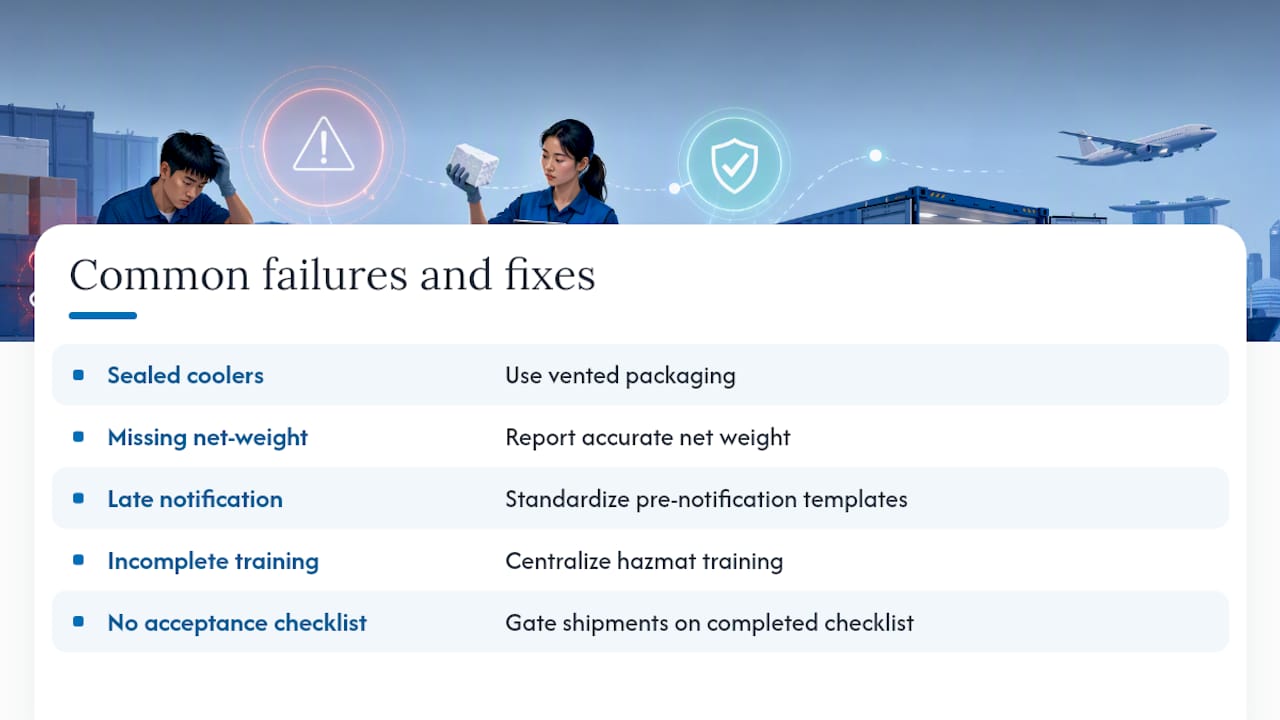
The fixes are just as unglamorous. Standardize pre-notification templates, centralize hazmat training instead of leaving it to individual sites, and gate every shipment on a completed acceptance checklist. Shipments built this way get refused less often and clear customs faster, because nothing on the paperwork surprises the person checking it.
Get Packaging Validation and Carrier-Ready Compliance Support
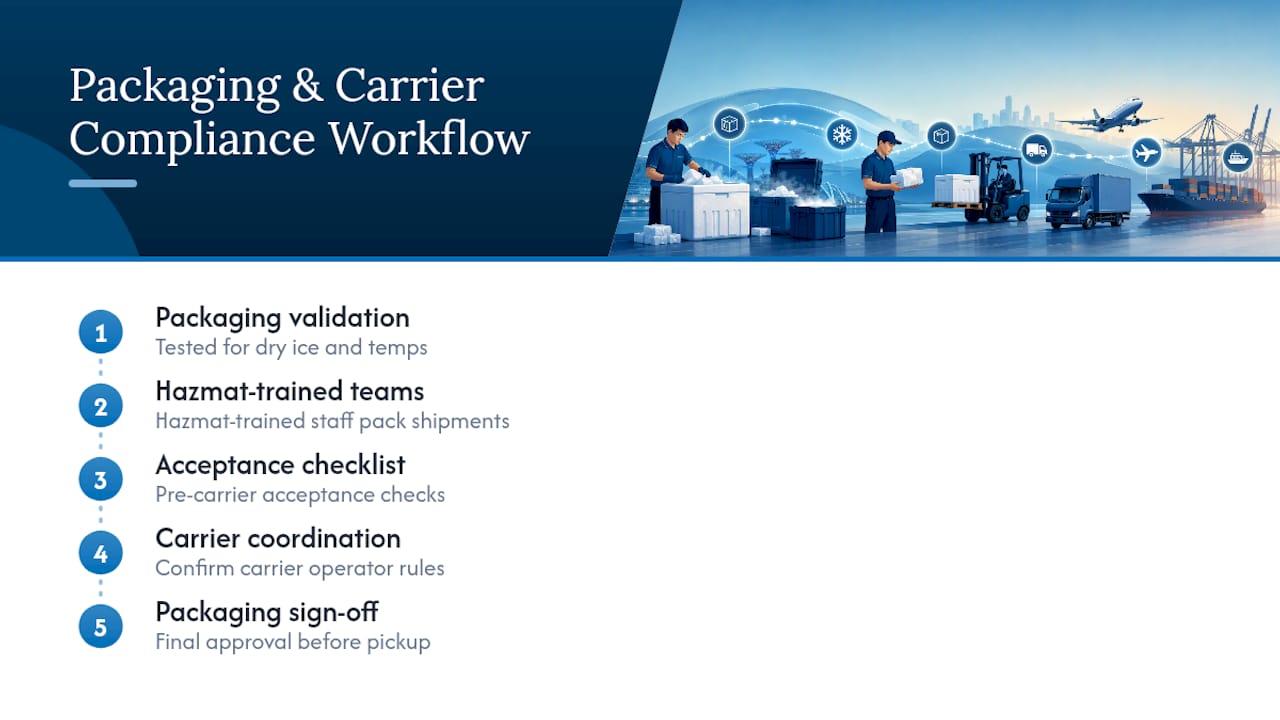
Labgistics builds dry ice compliance into the same workflow it uses for cold chain pharmaceutical and medical device shipments across Southeast Asia, which means packaging validation, hazmat-trained pack teams, and carrier coordination sit under one roof instead of scattered across vendors.

That matters most when a shipment involves temperature-sensitive biologics or diagnostic samples riding alongside dry ice, where a rejected package does not just cost a shipping fee. It costs the product. Labgistics’ hazmat-trained teams handle the acceptance checklist, confirm carrier operator variations before booking, and sign off on packaging before it ever reaches a carrier’s dock. If your current process leans on informal knowledge held by one or two staff members, that is a single point of failure waiting to surface during a busy shipping week.
Request a packaging validation and compliance review to see where your current dry ice workflow has gaps before your next regulated shipment goes out.
Sources
Consult these primary sources directly rather than relying on secondhand summaries, since packing instructions and thresholds update periodically.
- Dry Ice Fact Sheet for Shippers & Freight Forwarders
- Navigating Dry Ice Shipping Regulations, Is It Hazmat or Not? | J. J. Keller® Compliance Network
- UO Guide to Shipping with Dry Ice (pdf)
FAQ
What are the rules for shipping dry ice?
Package dry ice in vented, non-airtight containers, mark it as UN 1845 with net weight in kilograms, and confirm the carrier’s current operator variation under IATA PI 954 or the IMDG Code before shipping.
How long does dry ice last during shipping?
Sublimation rates vary with insulation and ambient temperature, but a common planning estimate is roughly 2 to 5 kilograms per 24 hours for small shipments, so always verify against your specific container’s specifications.
What should be avoided when shipping dry ice?
Never use a sealed or airtight container, never omit the net weight or UN 1845 marking, and never assume last shipment’s carrier limit still applies without confirming current operator variations.
Can dry ice be transported by air and sea?
Yes, dry ice can be transported by both air and sea, but air shipments must follow IATA Packing Instruction 954 and sea shipments must follow the IMDG Code, each with distinct marking and stowage rules.
When does dry ice shipping require hazmat training?
Employees packing or handling regulated quantities of dry ice for air or sea transport generally need hazmat employee training, renewed on a recurring cycle with documented recordkeeping tied to each shipment.
Recommended
- Good Distribution Practice: The U.S. Compliance Guide
- Temperature Controlled Storage: A Pharma Compliance Guide
- How to Handle Temperature-Sensitive Shipments in Healthcare
- Controlled Room Temperature Logistics: A Pharma Guide