
Controlled room temperature (CRT) logistics is defined as the management of temperature-sensitive products within a precisely maintained range of 20°C to 25°C (68°F to 77°F) throughout storage and transportation. The United States Pharmacopeia (USP) establishes this standard, and it applies directly to pharmaceuticals, biologics, and medical products distributed across healthcare supply chains. Understanding what is controlled room temperature logistics is not optional for supply chain managers in Southeast Asia. Regulatory bodies including the Health Sciences Authority (HSA) in Singapore and international frameworks like the PIC/S GDP Guide require documented, validated compliance at every stage of the distribution process. Non-compliance puts product efficacy, patient safety, and operating licenses at risk.
What are the regulatory standards governing CRT logistics?
CRT logistics compliance is defined by two primary USP chapters: USP <659> and USP <1079>. These chapters specify the acceptable temperature range, permissible excursions, and documentation requirements for pharmaceutical storage and transport.
USP temperature requirements permit brief excursions between 15°C and 30°C, and allow spikes to 40°C for up to 24 hours, provided the Mean Kinetic Temperature (MKT) remains within acceptable limits. This is a critical distinction. A single temperature spike does not automatically constitute a compliance failure. What matters is the cumulative thermal exposure over the full shipment duration.
Mean Kinetic Temperature (MKT) is a calculated value that reflects the total thermal stress a product experiences over time. It accounts for all temperature fluctuations rather than averaging them linearly, giving a more accurate picture of product risk. Relying on a simple average temperature reading will underestimate excursion impact in most real-world shipments.
Key regulatory requirements for CRT logistics include:
- Continuous temperature monitoring using calibrated, validated data loggers throughout storage and transit
- Complete data records available for regulatory audits, including time-stamped logs from every leg of the journey
- MKT calculation for any shipment where excursions occur, to determine whether product quality has been compromised
- Validated storage facilities with documented temperature mapping studies conducted at least annually
- Written SOPs covering excursion response, product quarantine, and disposition decisions
Documented temperature history is not optional. Failure to maintain complete records can result in product loss, regulatory fines, and revocation of distribution licenses.
Pro Tip: Humidity control is part of CRT compliance. USP guidelines recommend maintaining relative humidity between 30% and 60% in CRT storage areas. Many facilities monitor temperature rigorously but overlook humidity, which can degrade hygroscopic pharmaceutical products.
How does CRT logistics differ from ambient and cold chain logistics?
Supply chain managers frequently conflate ambient storage, controlled room temperature logistics, and cold chain logistics. These are three distinct categories with different equipment requirements, regulatory obligations, and product applications.
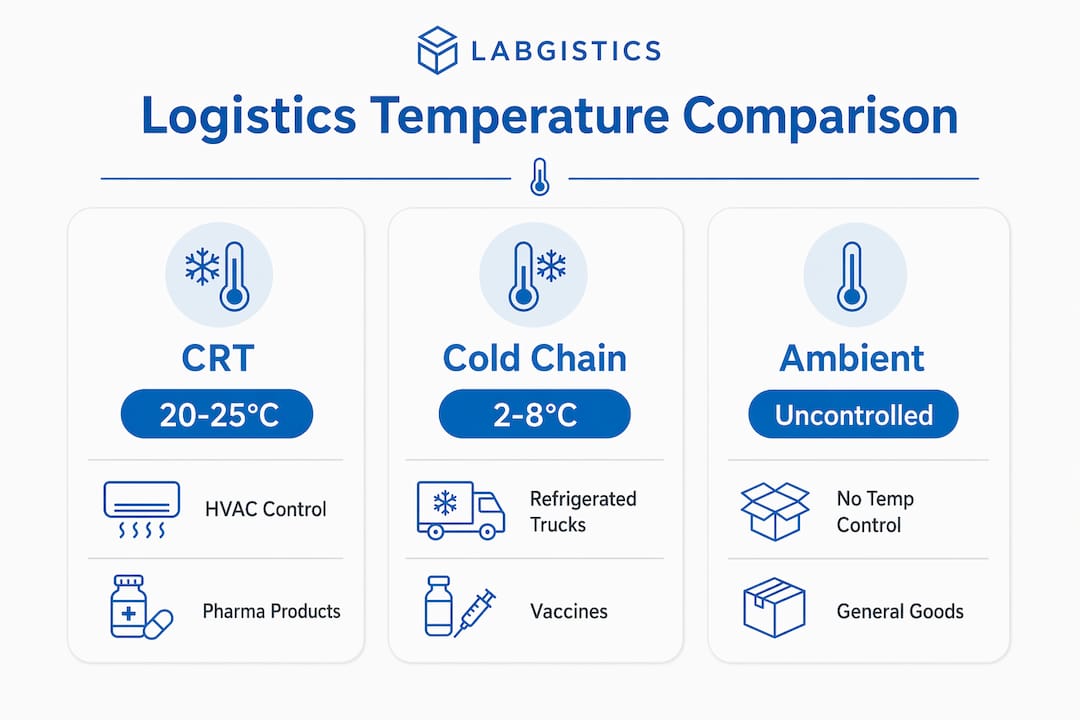
Ambient temperature refers to uncontrolled environmental conditions. No active temperature management is applied. This is acceptable only for non-sensitive products and is not a valid default for pharmaceuticals, even those labeled as “store at room temperature.” Accepting ambient as safe without validated excursion data is a significant source of product loss and regulatory risk across the industry.
The table below summarizes the operational differences across all three categories:
| Category | Temperature Range | Control Method | Typical Products |
|---|---|---|---|
| Ambient | Uncontrolled (varies) | None | Non-sensitive consumer goods |
| Controlled Room Temperature | 20°C–25°C (excursions: 15°C–30°C) | HVAC, validated warehouses, insulated packaging | Oral solid dosage forms, some biologics, clinical trial materials |
| Cold Chain | 2°C–8°C or below | Refrigerated transport, cold rooms, dry ice | Vaccines, insulin, blood products, certain biologics |
The operational gap between CRT and cold chain logistics is significant. Cold chain logistics requires refrigerated vehicles, validated cold rooms, and specialized packaging such as dry ice or phase-change materials. CRT logistics relies on HVAC-controlled warehouses, insulated passive packaging, and climate-managed transport. The cost difference is substantial, which makes correct product classification critical. Placing a CRT product in a cold chain unnecessarily adds cost. Placing it in uncontrolled ambient conditions creates regulatory and patient safety exposure.
For supply chain managers working across Southeast Asia, understanding cold chain compliance in the region is particularly relevant given the high ambient temperatures in markets like Thailand, Indonesia, and the Philippines, where uncontrolled storage can exceed 35°C for extended periods.
What are best practices for maintaining CRT compliance in transport and storage?
Maintaining CRT compliance across the full supply chain requires validated infrastructure, appropriate packaging selection, and technology-enabled monitoring. Each element must function as part of an integrated system.
Warehouse validation and temperature mapping
Warehouse temperature mapping requires deploying multiple calibrated sensors across all storage zones for an extended period, typically 24 hours minimum under both summer and winter conditions. This process identifies hot and cold spots that a single thermostat reading will miss entirely. Every pallet location must be confirmed as CRT-compliant before product is stored there. Mapping studies must be repeated after any significant facility modification or HVAC change.
Packaging selection: active vs. passive
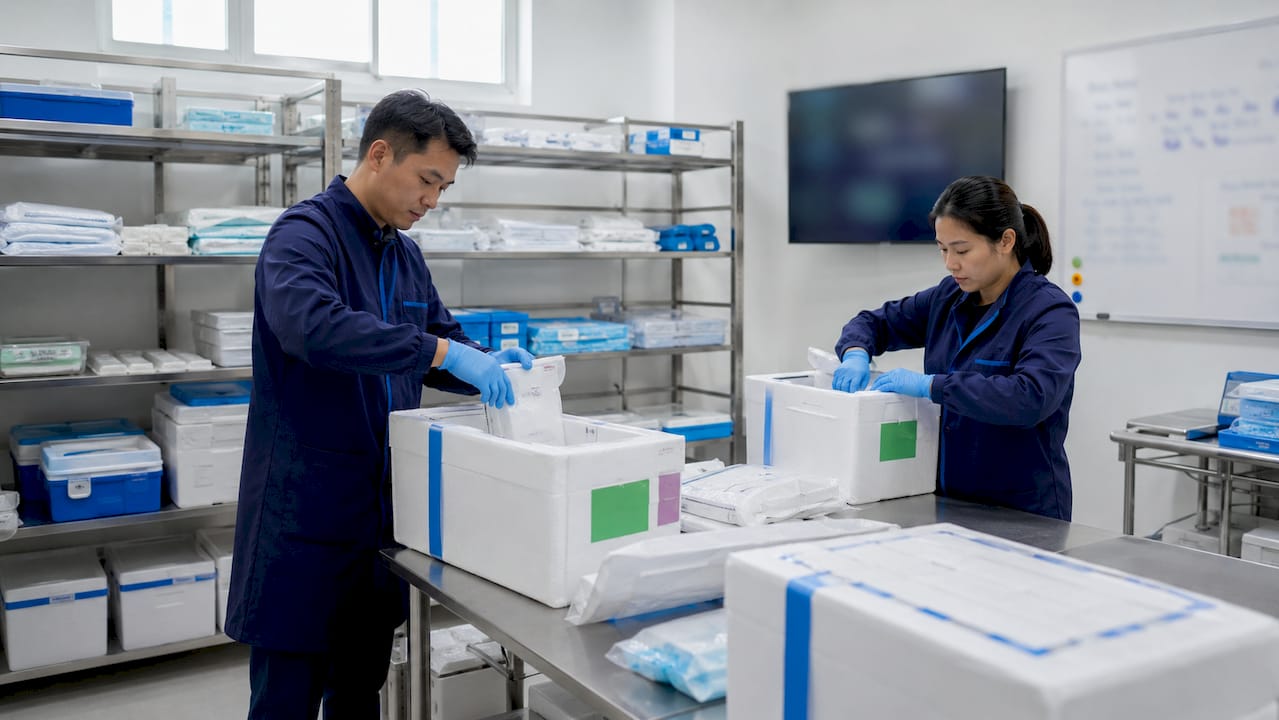
Temperature-controlled transportation uses two packaging approaches. Active systems use refrigerated or temperature-controlled vehicles with powered cooling units. Passive systems use insulated containers, expanded polystyrene (EPS) foam boxes, and pre-conditioned gel packs to maintain temperature without external power. For CRT shipments, passive packaging is often sufficient for short transit legs, while active systems are required for longer routes or high-ambient-temperature environments. Selection depends on shipment duration, product sensitivity, and the environmental conditions along the route.
Technology and monitoring
Best-in-class CRT logistics operations deploy IoT-enabled data loggers with Bluetooth and GPS connectivity. Real-time sensor technology allows logistics coordinators to detect excursions during transit and trigger corrective action before product is compromised. Data from these devices feeds directly into audit-ready records, reducing manual documentation burden and improving response time.
Critical SOP elements for CRT transport include:
- Pre-cooling vehicles and loading bays before product is loaded
- Minimizing door-open time during loading and unloading
- Defining maximum allowable time at loading docks before product must be returned to controlled storage
- Establishing clear escalation protocols when an excursion is detected in transit
- Training all staff who handle CRT products on excursion recognition and response
Pro Tip: Pre-condition passive packaging according to the ambient temperature at the origin facility, not the destination. A gel pack conditioned for a Singapore warehouse may perform differently when a shipment transits through a Bangkok distribution hub in peak summer.
What are the critical risks in CRT logistics and how can you mitigate them?
The greatest risk in CRT logistics does not occur in the warehouse or during the main transit leg. The most vulnerable points are loading docks and handoff locations, where products move between controlled environments and are briefly exposed to uncontrolled conditions. Thirty minutes on a warm loading dock can irreversibly degrade temperature-sensitive pharmaceuticals. This is not a theoretical risk. It is a documented failure mode in pharmaceutical distribution.
The following are the top risk areas in CRT logistics and the corresponding mitigation actions supply chain managers should implement:
-
Loading dock exposure. Limit dock time to a defined maximum, typically 15 minutes. Use climate-controlled dock enclosures where available. Schedule loading during cooler parts of the day in high-ambient-temperature markets.
-
Handoff gaps between carriers. Require temperature data logs from every carrier in the chain. Define contractual temperature accountability at each transfer point. Do not accept a shipment without a complete data record from the previous leg.
-
Single-point temperature verification. A single “good” temperature reading at delivery does not confirm CRT compliance. MKT-based evaluation of the full shipment history is the correct standard. Require MKT calculations for any shipment where excursions are recorded.
-
Inadequate staff training. Logistics personnel who do not recognize an excursion or do not know the escalation SOP are a compliance liability. Conduct documented training at least annually, with competency assessments.
-
Unvalidated third-party storage. When products are held at third-party facilities, including freight forwarder warehouses or airport cargo terminals, confirm that those facilities meet CRT requirements. Request validation documentation before approving any third-party storage location.
-
Seasonal temperature variation. In Southeast Asia, temperature and humidity fluctuate significantly between seasons. Warehouse mapping conducted in one season may not reflect conditions in another. Conduct mapping studies under worst-case conditions and repeat them seasonally where environmental variation is significant.
For a detailed look at managing pharma logistics challenges across the region, supply chain managers will find practical frameworks that address these exact risk categories.
How is CRT logistics applied in real-world pharma supply chains?
CRT logistics applies to a broad range of pharmaceutical and healthcare products. Biologics, vaccines, and clinical trial materials that are stable within the 20°C to 25°C range but sensitive to excursions all require CRT management throughout distribution. Oral solid dosage forms, including tablets and capsules, are the most common CRT products in pharmaceutical distribution. Many branded and generic medicines fall into this category.
In clinical trial supply chains, CRT compliance is particularly demanding. Investigational medicinal products (IMPs) often have limited stability data, meaning excursion tolerance is narrower than for approved commercial products. Clinical supply managers must maintain chain-of-custody documentation that satisfies both Good Clinical Practice (GCP) and Good Distribution Practice (GDP) requirements simultaneously.
In Southeast Asia, the regional logistics infrastructure adds complexity. Singapore functions as the primary logistics hub for pharmaceutical distribution across the region, with products moving onward to markets including Malaysia, Indonesia, Vietnam, and the Philippines. Each country has its own regulatory requirements for temperature-sensitive shipments, and transit times can be extended by customs clearance delays. This makes pre-shipment planning, validated packaging selection, and real-time monitoring non-negotiable for CRT compliance across the region.
Continuous improvement in CRT logistics is measured through key performance indicators including excursion frequency, MKT deviation rates, and time-at-dock metrics. Organizations that track these metrics systematically identify failure patterns and address them before they result in product loss or regulatory findings.
Key takeaways
Controlled room temperature logistics requires validated infrastructure, continuous monitoring, and MKT-based compliance evaluation at every stage of the pharmaceutical supply chain.
| Point | Details |
|---|---|
| CRT range is precisely defined | USP defines CRT as 20°C–25°C, with permissible excursions to 30°C and brief spikes to 40°C within MKT limits. |
| MKT is the compliance standard | A single good temperature reading at delivery does not confirm compliance; cumulative thermal exposure must be evaluated. |
| Loading docks are the highest-risk point | Thirty minutes of uncontrolled dock exposure can irreversibly degrade CRT pharmaceuticals. |
| Warehouse mapping is mandatory | Multiple calibrated sensors must confirm every storage location meets CRT requirements, not just the thermostat. |
| Southeast Asia requires extra planning | High ambient temperatures and multi-country transit routes demand validated packaging and real-time monitoring on every leg. |
The shift toward time-weighted compliance is overdue
The industry has spent years debating whether a temperature excursion constitutes a compliance failure. The answer has always been in the data. A single spike to 32°C for 20 minutes is not the same as a sustained 30°C exposure over six hours. MKT-based evaluation captures that difference. Snapshot compliance does not.
What I find consistently underestimated is the human element. Technology can flag an excursion in real time. What determines whether that excursion becomes a product loss is whether the person receiving the alert knows exactly what to do in the next 10 minutes. SOPs that sit in a binder and are reviewed once a year do not build that capability. Competency-based training, practiced through realistic scenarios, does.
The regulatory direction is clear. Agencies across Southeast Asia are aligning with PIC/S GDP standards, which require documented, continuous temperature monitoring and MKT evaluation as baseline expectations. Supply chain managers who are still relying on periodic manual checks and paper logs are not just behind operationally. They are accumulating regulatory risk with every shipment.
The organizations that handle temperature-sensitive shipments most effectively are those that treat CRT compliance as a system, not a checklist. Every element, from warehouse mapping to carrier qualification to staff training, must be designed and maintained as part of a single, integrated quality system.
— Brandcore
How Labgistics supports your CRT logistics compliance
Labgistics brings over 20 years of specialized experience in pharmaceutical and healthcare logistics across Southeast Asia. For supply chain managers who need CRT-compliant warehousing, validated packaging, and real-time temperature monitoring, Labgistics provides end-to-end solutions built to meet USP, PIC/S GDP, and HSA standards.
From fully accredited distribution centers in Singapore to multi-country transport management, Labgistics manages every link in the CRT supply chain. The team supports pharma logistics compliance with documented temperature mapping, IoT-enabled monitoring, and calibration services for temperature and humidity instruments. Whether you are managing commercial pharmaceutical distribution or clinical trial supply chains across the region, Labgistics delivers the infrastructure and regulatory expertise your products require.
FAQ
What temperature range defines controlled room temperature?
USP defines controlled room temperature as 20°C to 25°C (68°F to 77°F), with permissible excursions between 15°C and 30°C, and brief spikes to 40°C allowed for up to 24 hours provided MKT remains within acceptable limits.
How does MKT differ from average temperature in CRT compliance?
Mean Kinetic Temperature (MKT) is a weighted calculation that reflects cumulative thermal stress over time, accounting for the greater damage caused by higher temperatures. A simple average underestimates excursion risk, making MKT the correct compliance metric.
What is the difference between CRT and cold chain logistics?
CRT logistics maintains products at 20°C to 25°C using HVAC-controlled warehouses and insulated packaging. Cold chain logistics maintains products at 2°C to 8°C or below using refrigerated vehicles and cold rooms, and applies to vaccines, insulin, and other highly temperature-sensitive biologics.
Why are loading docks the highest-risk point in CRT logistics?
Loading docks expose products to uncontrolled ambient temperatures during transfer between controlled environments. Even 30 minutes of uncontrolled exposure can irreversibly degrade sensitive pharmaceuticals, making dock time limits and climate-controlled enclosures critical controls.
Is a single temperature check at delivery sufficient for CRT compliance?
No. Regulatory standards require evaluation of the full temperature history using MKT calculation, not a single reading at the point of delivery. Complete, time-stamped data logs from every shipment leg are required for audit-ready CRT compliance.