
Clinical Trial Logistics Workflow: A 2026 Optimization Guide
A clinical trial logistics workflow is the coordinated management of investigational product distribution, specimen transport, cold chain governance, and documentation control, all integrated with real-time data to maintain compliance and trial timelines. Getting this right is not optional. Regulatory frameworks including ICH GCP E6(R3), EU EudraLex Volume 4 Annex 13, and GDP guidelines define strict standards that every shipment, temperature log, and chain-of-custody record must meet. For clinical researchers and project managers, the difference between a trial that runs on schedule and one that accumulates protocol deviations often comes down to how well the logistics workflow is designed before the first investigational product leaves the manufacturing site.
What are the essential prerequisites for a clinical trial logistics workflow?
A compliant trial logistics workflow requires documented chain-of-custody from GMP manufacturing through clinical site disposition, as defined under ICH GCP E6(R3). That documentation is not a formality. It is the audit trail regulators will examine if a deviation occurs. Before execution begins, teams need to confirm that every operational layer is in place.
Regulatory and documentation prerequisites:
- Written SOPs covering receipt, storage, dispensing, and return of investigational products
- Chain-of-custody logs with timestamps, shipment IDs, and responsible party signatures
- Qualified Person (QP) release documentation for each batch
- Import and export permits for cross-border shipments, particularly across Southeast Asia
Technology enablers:
- Integrated IRT (Interactive Response Technology) and CTMS platforms for real-time supply visibility
- Electronic data capture (EDC) systems linked to site dosing records
- Digital temperature monitoring devices with automated alerts and shipment-linked reports
- API-driven data architectures that connect supply, patient activity, and logistics systems
Operational partners:
- Designated clinical couriers with validated cold chain capabilities
- Quality assurance teams at depot and site level
- A 3PL provider with pharmaceutical-grade warehousing and regulatory expertise
| Prerequisite Category | Key Requirement |
|---|---|
| Regulatory compliance | ICH GCP E6(R3) chain-of-custody documentation |
| Cold chain equipment | Validated containers, digital loggers, quarantine protocols |
| Technology platform | Integrated IRT and CTMS with real-time data feeds |
| Logistics partner | GDP-compliant 3PL with clinical trial experience |
| Documentation | QP release records, import permits, proof-of-delivery |
Pro Tip: Audit your technology stack before trial start. If your IRT, CTMS, and EDC systems cannot share data without manual transfers, you already have a fragmentation risk that will surface during the trial.
How to execute a step-by-step clinical trial logistics workflow
An effective clinical trial process flow moves investigational products from manufacturing to patient without gaps in documentation or temperature control. Each step must be sequenced deliberately, with clear handoffs between parties.
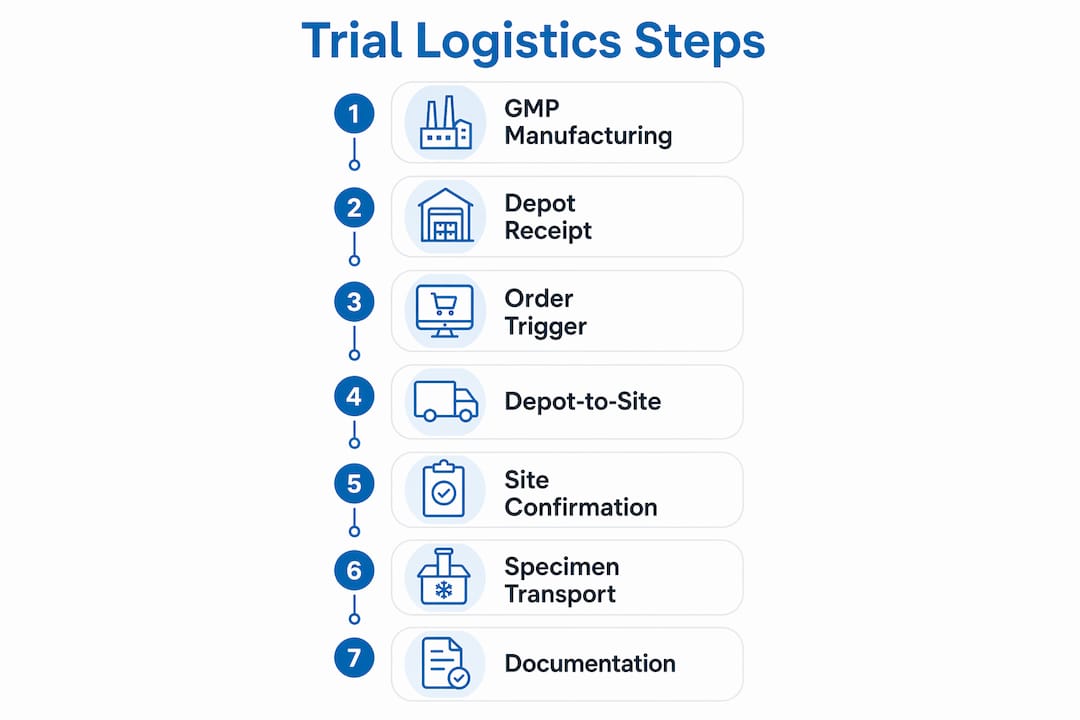
1. GMP manufacturing and batch release
The investigational product is manufactured under GMP conditions and released by a Qualified Person. Batch records, certificates of analysis, and QP release documentation travel with the product.
2. Depot receipt and storage
The product moves to a regional depot or 3PL warehouse. On receipt, staff verify shipment integrity, check temperature logs, and confirm documentation against the packing list. Products requiring cold chain storage go directly into validated cold rooms or refrigerators.
3. Site order and resupply triggering
The IRT system monitors site inventory levels and triggers resupply orders automatically when stock falls below a defined threshold. This removes manual ordering from the critical path and reduces the risk of site-level stockouts.
4. Depot-to-site distribution
A designated clinical courier collects the product under validated cold chain conditions. Temperature-sensitive shipments travel in qualified containers with continuous digital monitoring. Courier timing is synchronized with the clinical site’s dosing schedule to avoid product sitting in transit over weekends or public holidays.
5. Site receipt and confirmation
Site staff verify the shipment on arrival, check temperature records, and log receipt in the CTMS. Any temperature excursion triggers an immediate quarantine and escalation to the sponsor’s quality team.
6. Specimen collection and transport
After dosing, biological specimens are collected according to the protocol. Specimens are packaged in biohazard-compliant containers with appropriate cold chain conditions and transported to the central laboratory. Cold chain governance at this stage is equally critical as for investigational products, since degraded specimens produce unreliable data.
7. Documentation capture and closure
Chain-of-custody logs, digital signatures, and proof-of-delivery records are captured at every handoff. These records feed into the eTMF (electronic Trial Master File) and are available for regulatory inspection at any point.
| Workflow Step | Key Action | Compliance Anchor |
|---|---|---|
| Batch release | QP sign-off, certificate of analysis | GMP, ICH GCP E6(R3) |
| Depot receipt | Temperature check, documentation verification | GDP guidelines |
| Resupply trigger | IRT-automated order generation | Protocol-defined thresholds |
| Site delivery | Validated cold chain, synchronized timing | EU EudraLex Annex 13 |
| Specimen transport | Biohazard packaging, cold chain monitoring | ICH GCP E6(R3) |
| Documentation closure | Digital signatures, eTMF upload | Regulatory inspection readiness |
Pro Tip: Synchronize courier collection times with site dosing schedules at the protocol design stage. Retrofitting this coordination mid-trial costs time and creates unnecessary risk.
What common challenges arise in clinical trial logistics workflows?
Most clinical trial logistics failures come from treating workflow steps as sequential tasks rather than an integrated system. When one step is delayed, the downstream effects compound quickly. A customs hold on an investigational product shipment can delay a patient visit, which shifts the dosing window, which invalidates a data point.
The most frequent sources of disruption include:
- Fragmented systems: When IRT, CTMS, and EDC do not share data in real time, teams rely on manual reconciliation. Manual reconciliation introduces errors and delays.
- Misaligned schedules: Coordination gaps between clinical sites and couriers cause most logistics disruptions in decentralized trials. Clinicians are not logistics coordinators, and expecting them to manage courier delays risks both patient safety and protocol adherence.
- Temperature excursions: Without automated alerts and a pre-defined escalation path, a temperature breach discovered hours after the fact may result in product loss and a protocol deviation.
- Customs delays: Cross-border shipments in Southeast Asia require advance import permits and local regulatory documentation. Missing a single document can hold a shipment for days.
- Unclear role ownership: When logistics responsibilities are not explicitly assigned, tasks fall to whoever is available, which is usually the site coordinator or investigator. That is the wrong person for the job.
“Logistics is less about transportation and more about strict protocol adherence. Failures often occur at clinical sites due to unclear logistics responsibilities, not courier errors.” — Clinical Trial Logistics: Processes, Risks & Best Practices 2026
The most effective mitigation is an exception playbook built before the trial starts. This document defines the response to every foreseeable disruption: who is notified within what timeframe, what quarantine steps apply, and how the sponsor quality team escalates to the regulatory authority if needed. Building this playbook before trial start prevents chain reactions of protocol deviations during operational disruptions.
Real-time monitoring platforms with automated alerts reduce the window between an event and a response. When a temperature logger sends an alert the moment a threshold is breached, the quality team can act before the product is compromised. That is the difference between a manageable deviation and a batch loss.
How can integrated digital technology transform trial logistics outcomes?
Integrated software platforms replace fragmented manual trackers with unified data environments, giving project managers a single source of truth across supply, patient activity, and logistics functions. This is not a convenience upgrade. It is a structural change in how decisions get made.
The core of a modern digital workflow is the connection between CTMS, EDC, and eTMF systems. When these platforms share data through API-driven architectures, information flows without manual transfers. A patient visit recorded in the EDC automatically updates the supply forecast in the IRT. A shipment confirmed in the logistics system updates the eTMF without a separate data entry step.
Intelligent IRT platforms go further by applying predictive forecasting to supply management. Rather than waiting for a site to report low stock, the system models enrollment velocity, dropout rates, and visit schedules to project future demand. Dynamic resupply strategies reduce the need for excess buffer stock while maintaining continuity. Buffer stock is a significant hidden cost in clinical trials. Reducing it without raising risk requires the kind of real-time data that only integrated platforms can provide.
Automation also shifts the workflow from reactive to predictive. When resupply orders, temperature alerts, and documentation captures happen automatically, the project manager’s attention moves from firefighting to oversight. That shift improves both trial quality and team capacity.
| Approach | Data flow | Forecasting | Manual touchpoints |
|---|---|---|---|
| Fragmented manual systems | Siloed, batch updates | Spreadsheet-based | High |
| Integrated digital platforms | Real-time, API-driven | Predictive, enrollment-modeled | Low |
Pro Tip: When evaluating digital platforms, ask specifically whether the IRT integrates with your EDC via API or requires scheduled data exports. Scheduled exports create lag that undermines real-time decision-making.
Biopharma increasingly treats logistics as a strategic capability that influences program timelines and quality under complex global regulatory environments. That shift in perspective is what separates trials that finish on schedule from those that accumulate avoidable delays.
Key Takeaways
An optimized clinical trial logistics workflow requires integrated systems, explicit role ownership, and proactive exception planning, not just reliable transportation.
| Point | Details |
|---|---|
| Define the workflow before trial start | Map every handoff from GMP manufacturing to site delivery and assign clear ownership at each step. |
| Integrate your technology stack | Connect IRT, CTMS, and EDC via API to eliminate manual data transfers and reduce decision lag. |
| Build an exception playbook | Document escalation paths for temperature excursions, customs delays, and courier failures before the trial begins. |
| Separate logistics from clinical roles | Assign logistics coordination to dedicated operations staff, not site investigators or coordinators. |
| Use predictive forecasting to manage supply | Intelligent IRT platforms reduce buffer stock costs while maintaining site-level continuity. |
Why logistics strategy determines trial outcomes
Having managed complex pharmaceutical supply chains across Southeast Asia for over two decades, the pattern is consistent: trials that treat logistics as a tactical afterthought pay for it in protocol deviations, delayed timelines, and avoidable regulatory queries.
The most common mistake I see is assigning logistics coordination to clinical site staff. Site coordinators are trained to protect patient safety and data quality. When they are also managing courier disruptions and temperature excursion paperwork, something suffers. Usually it is the documentation, and that is what regulators examine first.
The second mistake is building the exception playbook after the first problem occurs. By then, the team is already in reactive mode. A playbook written before trial start, with input from the quality team, the logistics partner, and the regulatory affairs team, turns a potential crisis into a managed procedure.
Digital integration is not a luxury for large trials. Even a Phase II study with 10 sites across three countries generates enough data complexity to overwhelm manual tracking. The teams that invest in connected platforms early spend less time reconciling data and more time making decisions. That is where project managers add the most value.
The supply chain mapping discipline that underpins good logistics planning also builds regulatory confidence. When an inspector asks for the chain-of-custody record for a specific shipment, the answer should be available in seconds, not hours.
— Brandcore
How Labgistics supports clinical trial logistics operations

Labgistics brings over 20 years of healthcare logistics experience to clinical trial supply chains across Southeast Asia. The company’s fully accredited distribution centers, validated cold chain infrastructure, and GDP-compliant warehousing provide the operational foundation that clinical trial teams need to meet ICH GCP E6(R3) and EU EudraLex Annex 13 requirements. Labgistics handles temperature-sensitive investigational products, biological specimens, and regulated materials with documented chain-of-custody at every step.
For teams managing specialized healthcare supply chains, Labgistics offers end-to-end support including inventory management, regulatory compliance, and transportation coordination tailored to the demands of clinical research. Explore Labgistics’ pharmaceutical warehousing solutions to see how compliant storage and distribution can reduce logistics risk across your trial program.
FAQ
What is a clinical trial logistics workflow?
A clinical trial logistics workflow is the structured management of investigational product distribution, specimen transport, cold chain control, and documentation from manufacturing through clinical site delivery. It must comply with ICH GCP E6(R3), GDP guidelines, and applicable regional regulations.
What regulatory standards govern logistics in clinical trials?
ICH GCP E6(R3), EU EudraLex Volume 4 Annex 13, and GDP guidelines define the core standards for investigational product manufacturing, distribution, and documentation in clinical trials.
How does cold chain management affect trial compliance?
Temperature excursions that are not detected and documented immediately can result in product loss, protocol deviations, and regulatory findings. Digital temperature monitoring linked to shipment IDs and quarantine protocols is required for audit readiness.
Why should logistics tasks be separated from clinical site roles?
Misalignment between clinical site schedules and courier operations causes most logistics disruptions. Assigning logistics coordination to dedicated operations staff protects both patient safety and protocol adherence.
How do IRT platforms improve clinical trial supply management?
Intelligent IRT platforms apply real-time data and predictive forecasting to automate resupply orders, reduce buffer stock, and maintain site-level continuity without manual intervention.
Recommended
- The Role of Logistics in Clinical Trials: A 2026 Guide
- Controlled Room Temperature Logistics: A Pharma Guide
- Optimize your lab supply chain for maximum efficiency
- Lab Supply Chain Trends 2026: What Professionals Need to Know