
Good Distribution Practice: The U.S. Compliance Guide
Good Distribution Practice (GDP) is the set of quality requirements that ensures medicinal products — including finished pharmaceuticals, active pharmaceutical ingredients (APIs), and veterinary medicines — maintain their quality, safety, and efficacy throughout every stage of the legal supply chain, from the manufacturer’s site to the point of dispensing. As the European Medicines Agency defines it, GDP sets the minimum standards wholesale distributors must meet to maintain product integrity for both human and veterinary medicinal products and their active ingredients. In the United States, no single federal statute is titled “GDP,” but the same obligations are distributed across several interlocking frameworks every distributor must understand.
Primary U.S. and international references you need to know:
- FDA guidance and inspections: The FDA enforces Current Good Manufacturing Practice (cGMP) regulations and conducts inspections of wholesale distributors; its guidance documents inform GDP-equivalent expectations for storage, handling, and distribution of drug products.
- Drug Supply Chain Security Act (DSCSA): Federal law requiring product-level serialization, lot-level traceability, and authorized trading-partner verification across the pharmaceutical supply chain.
- State wholesale distributor licensing: Each state independently licenses wholesale drug distributors; requirements vary but typically mirror or exceed federal standards for storage, personnel, and recordkeeping.
- NABP VAWD program: The National Association of Boards of Pharmacy’s Verified-Accredited Wholesale Distributors program provides voluntary accreditation that signals GDP-level compliance to trading partners and state boards.
- DEA registration: Distributors handling Schedule II–V controlled substances must hold a DEA registration and comply with additional security, recordkeeping, and reporting requirements that overlay GDP obligations.
- WHO and PIC/S guidance: The WHO’s international distribution standards (TRS 1025, Annex 7) and the PIC/S GDP Guide provide the internationally recognized benchmarks that U.S. companies operating cross-border supply chains or seeking international market access should align with.
Table of Contents
- What does good distribution practice require in daily operations?
- How U.S. law and regulation shape GDP expectations
- How to implement GDP controls across your distribution operation
- What cold chain validation actually demands from distributors
- How DSCSA traceability requirements work in practice
- What inspectors look for and what happens when they find problems
- How to run a pre-audit review and mock recall drill
- Key Takeaways
- Why GDP compliance is harder than it looks in practice
- Labgistics supports your GDP compliance from warehouse to last mile
- Useful sources
- FAQ
What does good distribution practice require in daily operations?
GDP compliance is not a filing exercise. Regulators and auditors expect to see a functioning quality management system (QMS) that governs every operational step, with records that prove it works under normal conditions and under pressure.
Quality management system
A documented QMS is the backbone of GDP. It must include written SOPs for every distribution activity, a change-control process, a corrective and preventive action (CAPA) system, and scheduled management reviews. Risk-based Quality Risk Management (QRM) is a central principle: distributors must identify, assess, and control risks to product quality across storage, transport, and traceability functions.
Records and traceability
Every product movement must be documented. Batch records, distribution logs, receiving and shipping records, and recall-ready documentation are the minimum. Inspectors will pull a sample lot and expect you to trace it forward and backward within hours, not days.
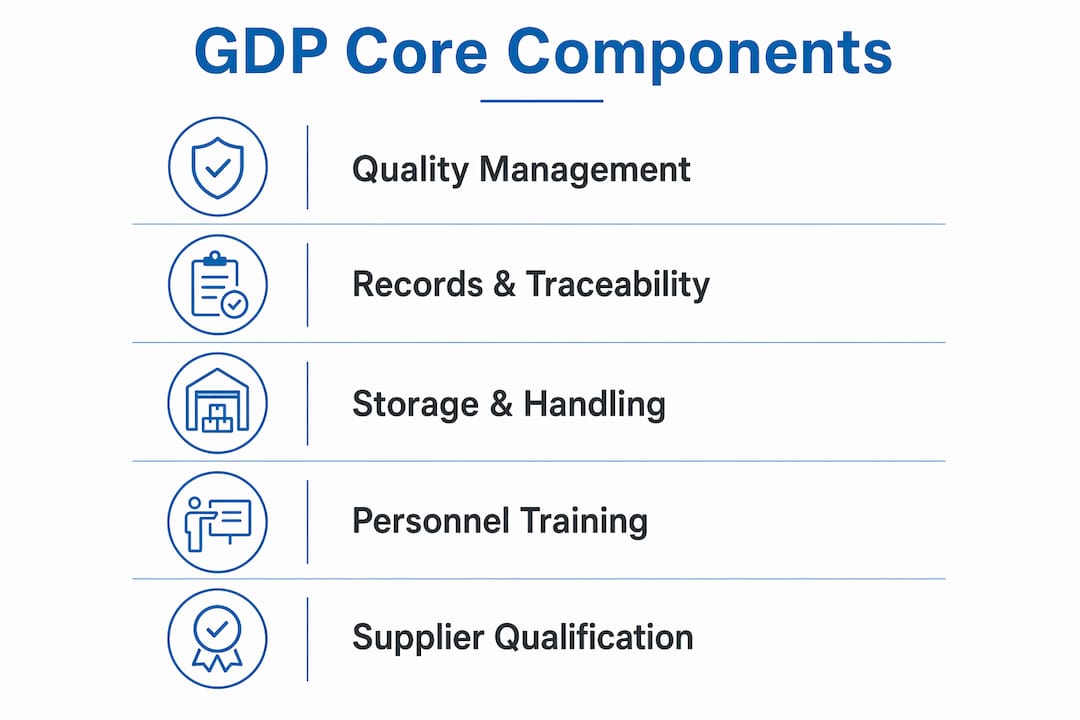
Storage and handling
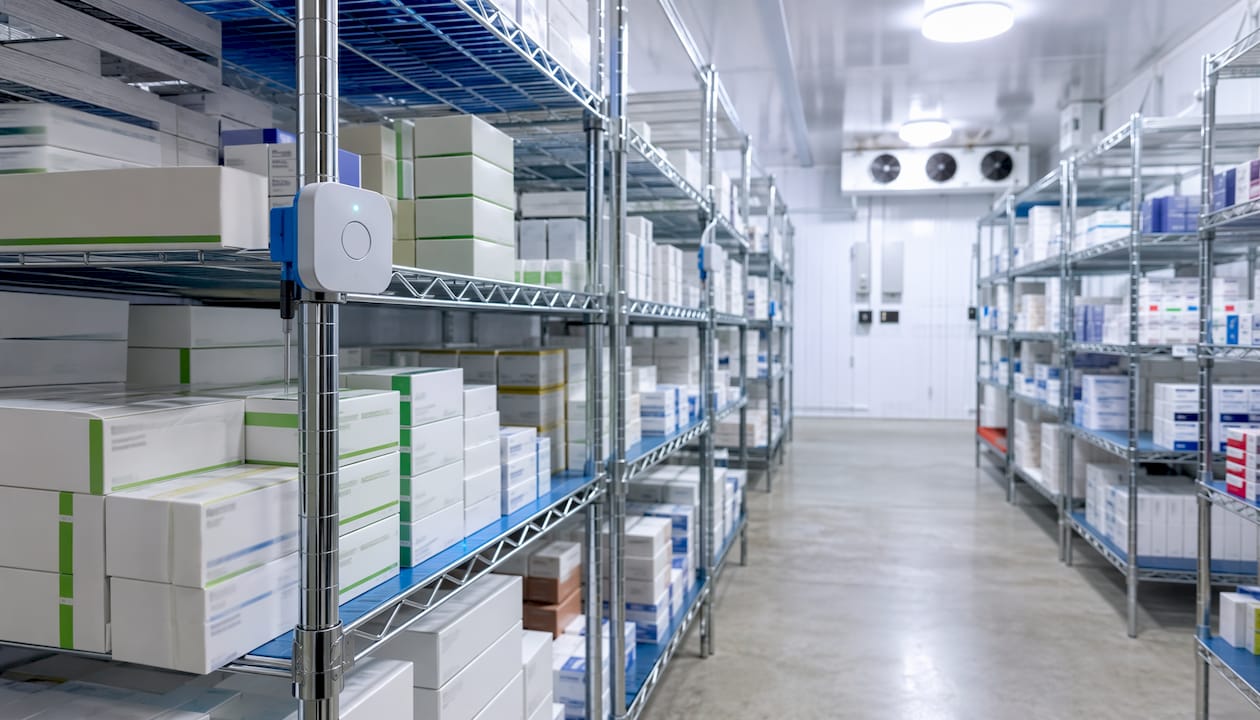
Storage areas must be validated for temperature, humidity, and light exposure. Products require physical segregation by status (quarantine, approved, rejected, returned), and expiry control through a first-expired, first-out (FEFO) rotation system. Contamination controls — including pest management and cleaning records — must be documented and current.
Personnel and training
Every person handling medicinal products must receive role-specific training before they work independently, with competency assessments and refresher cycles on record. Training records are one of the first documents an inspector requests.
Supplier and vendor qualification
Vendor qualification must be as rigorous as internal controls: authenticated communication, proof of the supplier’s licensing or authorization, and documented evidence that third-party transport and storage meet validated conditions. Approved supplier lists, written quality agreements, and periodic re-qualification audits are all expected.
Inspector readiness checklist:
- SOPs present, version-controlled, and actively followed
- Batch and distribution records complete and retrievable
- Training records current for all personnel
- Temperature logs validated and within specification
- Calibration certificates current for all monitoring equipment
- Supplier agreements signed and qualification records on file
- Recall procedure tested and documented
Pro Tip: Auditors do not just read SOPs — they watch whether staff follow them without prompting. Run unannounced internal spot-checks quarterly to confirm that daily practice matches what the SOP says.
How U.S. law and regulation shape GDP expectations
The U.S. regulatory framework for pharmaceutical distribution is layered: federal statutes set the floor, FDA guidance and enforcement set practical expectations, state licensing adds jurisdiction-specific requirements, and voluntary programs like NABP VAWD raise the bar further.
FDA’s role
The FDA does not publish a document titled “GDP Guide,” but its authority over drug distribution is extensive. Under 21 CFR Parts 210 and 211, manufacturers performing distribution activities are subject to cGMP. The FDA also inspects wholesale distributors under its drug supply chain oversight authority, and its guidance on drug storage and distribution conditions informs what inspectors expect to find. Warning letters and import alerts are the most visible enforcement tools.

Drug Supply Chain Security Act (DSCSA)
Enacted in 2013 and phased in over a decade, the DSCSA is the closest U.S. equivalent to a comprehensive GDP traceability mandate. Key obligations include:
- Product identifier: Each saleable unit must carry a unique product identifier (National Drug Code, serial number, lot number, and expiration date) in both human-readable and 2D barcode format.
- Authorized trading partners: Manufacturers, wholesale distributors, dispensers, and third-party logistics providers must verify that every trading partner holds the required federal and state licenses before conducting transactions.
- Transaction data: Each change of ownership requires a Transaction Information (TI), Transaction History (TH), and Transaction Statement (TS) — collectively known as T3 data — to accompany the product.
- Lot-level traceability: As of the November 2023 enforcement date, the supply chain is expected to support electronic, interoperable, lot-level traceability.
- Verification and investigation: Distributors must be able to verify product identifiers and investigate suspect or illegitimate products within defined timeframes.
State wholesale distributor licensing
Every state independently licenses wholesale drug distributors operating within its borders. Most states use the National Association of Boards of Pharmacy’s model rules as a baseline, but requirements for facility standards, personnel qualifications, and inspection frequency differ. Multi-state distributors must maintain active licenses in every state where they take title to or physically handle product.
NABP VAWD accreditation
The NABP Verified-Accredited Wholesale Distributors (VAWD) program evaluates distributors against a comprehensive set of criteria that closely mirrors GDP expectations: facility standards, SOPs, personnel training, security, and DSCSA compliance. VAWD accreditation is voluntary, but many manufacturers and health systems require it as a condition of doing business. It also reduces the likelihood of state board scrutiny.
DEA requirements for controlled substances
Distributors handling Schedule II–V controlled substances carry an additional compliance layer. DEA registration is mandatory, and DEA regulations govern security (vault and cage requirements), recordkeeping (ARCOS reporting), ordering systems (DEA Form 222 or CSOS), and suspicious-order monitoring. These requirements run parallel to GDP obligations and must be integrated into the QMS.
International standards: WHO, PIC/S, and EU GDP guidance
The EU GDP Guidelines (revised 2013) and the PIC/S GDP Guide are the most widely cited international references. WHO’s TRS 1025, Annex 7 provides guidance on good storage and distribution practices for medical products used by Member States globally. U.S. companies exporting to the EU or operating in markets that reference PIC/S standards must align their QMS with these frameworks. In practice, distributors meeting both EU GDP and DSCSA requirements are well positioned for most international markets.
How to implement GDP controls across your distribution operation
Implementation works best as a phased program, not a one-time project. The sequence below reflects how experienced compliance teams approach it.
- Gap assessment: Audit current operations against GDP requirements. Map every distribution activity — receiving, storage, picking, packing, dispatch, returns — and identify where documented controls are absent or inadequate.
- Prioritized remediation: Rank gaps by risk to product quality and patient safety. Address temperature-control failures and traceability gaps before administrative documentation issues.
- SOP creation and approval: Write or revise SOPs for every identified gap. Each SOP must have an owner, a version number, an effective date, and a training requirement attached.
- Staff training: Train all affected personnel before the SOP goes live. Document training completion and competency assessments. For pharmaceutical warehousing operations, role-based training matrices help manage this at scale.
- Validation and monitoring: Validate storage areas (thermal mapping), transport routes (worst-case lane testing), and monitoring equipment (calibration). Establish alarm thresholds and response procedures.
- Continuous improvement: Schedule management reviews at least annually. Feed CAPA data, internal audit findings, and customer complaints into the review. Update SOPs when processes change.
Practical controls for daily operations:
- Receive goods against a purchase order; inspect packaging integrity and temperature indicators before accepting.
- Segregate quarantined, approved, and rejected stock physically or by validated electronic status.
- Apply FEFO rotation at every pick; use system controls to prevent manual override without supervisor authorization.
- Capture dispatch records including carrier identity, vehicle temperature log reference, and estimated transit time.
- Retain all distribution records for the period required by state law and DSCSA (minimum three years for DSCSA transaction data).
Pro Tip: Tie every SOP to a training record and a CAPA metric. Auditors expect SOPs to be living documents — if your last SOP revision was more than two years ago and nothing in your operation has changed, that itself raises questions.
What cold chain validation actually demands from distributors
Cold chain failures are the leading cause of temperature-sensitive pharmaceutical losses, and they concentrate at the points regulators find hardest to control: the last mile and multi-leg international transfers. In practice, last-mile cold-chain assurance requires real-time telemetry, redundant sensors, and validated contingency procedures to manage humidity and transit delays — passive data loggers alone are not sufficient for high-risk lanes.
Standard pharmaceutical temperature bands
| Storage Category | Temperature Range | Typical Monitoring Frequency |
|---|---|---|
| Controlled room temperature | — | Continuous logging; review daily |
| Refrigerated | — | Continuous logging; alarm promptly on excursion |
| Frozen | — | Continuous logging; dual-sensor redundancy |
| Ultra-cold (e.g., mRNA vaccines) | — | Continuous real-time telemetry; backup power required |
Validation elements
Transport validation begins with packaging qualification: testing the shipper or insulated container against the worst-case temperature profile for the intended route. Worst-case route testing accounts for seasonal extremes, maximum transit time, and the longest expected delay at customs or transfer points. Shippers and containers must be re-qualified when the route, carrier, or packaging configuration changes.
Thermal mapping of storage areas must cover all four seasons or simulate equivalent temperature extremes. Sensor placement follows a documented protocol, and mapping results determine where in the facility products may and may not be stored.
Monitoring and alarm management
Real-time telemetry systems transmit temperature data continuously and trigger alerts when a threshold is breached. Each sensor must be calibrated against a traceable standard, and calibration certificates must be current. For temperature-sensitive shipments, dual-sensor configurations reduce the risk of a single-point failure going undetected.
When an excursion occurs, a documented procedure must activate immediately: quarantine the affected product, notify the responsible person, conduct a stability assessment, and decide on disposition before the product moves further in the supply chain.
Pro Tip: Retain raw temperature data files, not just summary reports. Inspectors increasingly request the underlying data to verify that alarm thresholds were not manually adjusted after the fact.
How DSCSA traceability requirements work in practice
The DSCSA transformed pharmaceutical distribution from a paper-based, lot-level tracking system into an electronic, unit-level traceability network. Understanding what the law actually requires operationally is where many distributors still have gaps.
What DSCSA requires at the transaction level:
- A unique product identifier on every saleable unit (NDC + serial number + lot + expiration date, encoded as a 2D barcode)
- Verification that every trading partner is an authorized trading partner before conducting a transaction
- Capture and retention of TI, TH, and TS data for each change of ownership
- The ability to investigate and respond to suspect or illegitimate product reports
Operational steps to achieve DSCSA readiness:
- Confirm your enterprise system can capture and store TI/TX/TS data at the lot and serial number level.
- Establish a process to verify trading-partner licensure before each transaction — use the FDA’s drug establishment registration database and state licensing databases.
- Define record retention policies: DSCSA requires transaction records to be retained for at least three years and made available to the FDA within two business days upon request.
- Build a suspect-product investigation procedure: define who is notified, how product is quarantined, and how the FDA is alerted if the product is confirmed illegitimate.
- Test your system’s ability to retrieve a complete transaction history for a given lot within the timeframe your trading partners and the FDA expect.
DSCSA readiness checklist:
- Authorized trading partner verification process documented and active
- System capable of capturing and storing TI/TS/TH data at unit level
- Record retention policy set at minimum three years
- Suspect-product investigation SOP in place and trained
- Serialization scanning equipment calibrated and operational at receiving and dispatch
- Staff trained on DSCSA obligations and escalation procedures
Pro Tip: Do not wait for a trading partner to flag a verification failure to discover your system has a gap. Run a quarterly internal drill: pull a random lot, attempt to retrieve its full transaction history, and time how long it takes. If it takes more than 30 minutes, your system needs work.
What inspectors look for and what happens when they find problems
Regulatory inspections of wholesale distributors — whether conducted by the FDA, a state board of pharmacy, or a customer auditor — follow a consistent pattern. Inspectors examine the QMS on paper first, then verify that what the documents say matches what actually happens on the warehouse floor.
Common inspection focus areas:
- QMS documentation: are SOPs current, version-controlled, and accessible to staff?
- Temperature-control records: are storage and transport logs complete, within specification, and reviewed?
- Receiving and shipping records: do they capture all required data and link to DSCSA transaction records?
- Traceability and recall readiness: can the distributor trace a lot forward and backward and initiate a recall within the required timeframe?
- Personnel training: are training records current and linked to the SOPs staff are expected to follow?
Most common deficiencies found during inspections:
- Incomplete or missing distribution records for specific lots
- SOPs that describe a process no longer in use, or that have not been updated after a process change
- Calibration certificates expired for temperature monitoring equipment
- Transport validation not performed for new lanes or carriers added after the original qualification
- Vendor qualification records absent or not re-qualified within the required cycle
- Training records that show completion but no competency assessment
The consequences of these findings scale with severity. A minor observation may require a written response with a CAPA plan. Major deficiencies can result in FDA warning letters, state license suspension, or loss of VAWD accreditation. In serious cases — particularly where falsified or adulterated product has entered the supply chain — criminal referral and civil monetary penalties are possible. Supply-chain disruption is often the most immediate business impact: trading partners may suspend transactions pending resolution.
Remediation after an inspection finding follows a structured path: acknowledge the observation, conduct a root-cause analysis, implement corrective actions, verify effectiveness, and update the QMS to prevent recurrence. Regulatory compliance in logistics depends on closing this loop quickly and completely.
Pro Tip: Treat every warning letter issued to a peer distributor as a free audit. The FDA publishes warning letters publicly; reading them regularly is one of the most efficient ways to identify gaps in your own operation before an inspector does.
How to run a pre-audit review and mock recall drill
Preparation for a regulatory inspection should be a scheduled, recurring activity, not a reactive scramble. The following sequence covers both a pre-audit review and a mock recall drill.
Pre-audit actions
- Pull a representative sample of distribution records from the past 12 months and verify completeness against the SOP requirements.
- Check all calibration certificates for temperature monitors, data loggers, and scanning equipment — flag any that expire within 90 days.
- Review training records for every active employee; identify anyone overdue for a refresher or competency reassessment.
- Confirm that all supplier quality agreements are signed, current, and filed where they can be retrieved within minutes.
- Walk the warehouse floor with a checklist: verify that segregation is physically maintained, that FEFO rotation is being applied, and that SOP documents are posted or accessible at the point of use.
- Brief staff on what to expect during an inspection: answer questions truthfully, retrieve documents promptly, and escalate to the responsible person if asked something outside their role.
Mock recall drill
A mock recall tests whether the organization can identify, quarantine, notify, and retrieve a product lot within the timeframe required by its recall SOP. Run it at least annually, and document the results.
- Step 1 — Identification: Select a lot number at random. Confirm the system can identify all units of that lot currently in inventory and all units previously shipped.
- Step 2 — Quarantine: Place all in-house units on hold within the time specified in the SOP (typically two hours for a Class I scenario).
- Step 3 — Notification: Draft mock notifications to the trading partners who received the lot. Verify that contact information is current and that the notification template meets FDA recall communication requirements.
- Step 4 — Retrieval tracking: Simulate the process of tracking returned units and reconciling quantities against the original distribution record.
- Step 5 — Root-cause and documentation: Document the drill results, note any gaps in retrieval time or record completeness, and open a CAPA for each gap identified.
Physical items that must be verifiable at audit time:
- Calibration labels affixed to all monitoring equipment
- Temperature charts or electronic logs accessible for the past 12 months
- SOP sign-off sheets showing staff acknowledgment of current versions
- Supplier quality agreements physically filed or electronically accessible within the facility
Key Takeaways
Good Distribution Practice compliance requires a functioning QMS, validated cold-chain controls, DSCSA-ready traceability systems, and a culture where SOPs are followed and tested under real operating conditions.
| Point | Details |
|---|---|
| GDP scope | Covers finished pharmaceuticals, APIs, and veterinary medicines — not just finished drug products. |
| U.S. framework | FDA guidance, DSCSA, state licensing, and NABP VAWD together define the compliance baseline for U.S. distributors. |
| Cold chain validation | Temperature bands from controlled room temperature to ultra-cold each require continuous monitoring and validated packaging, not passive logging alone. |
| DSCSA readiness | Transaction records must be retained for at least three years and retrievable within two business days upon FDA request. |
| Labgistics capability | Labgistics provides GDP-aligned 3PL warehousing, cold chain logistics, calibration, and regulatory support for pharmaceutical and life science supply chains. |
Why GDP compliance is harder than it looks in practice
GDP has moved well beyond a back-office logistics standard. As supply chains have grown more complex and counterfeit medicine risks have intensified, the controls required have become genuinely sophisticated — serialization, real-time telemetry, electronic trading-partner verification, and documented QRM processes that would have been considered advanced quality-system work a decade ago.
The gap most organizations underestimate is the distance between having a document and having a culture. Auditors with experience know within the first hour of a warehouse visit whether SOPs are followed because staff understand why they matter, or whether they exist to satisfy a filing requirement. That distinction determines whether an inspection ends with a handshake or a Form 483.
For distributors operating across international lanes — particularly those moving product between Southeast Asia and the U.S. market — the alignment between WHO, PIC/S, and U.S. expectations is closer than many assume. The core principles are the same: documented controls, validated conditions, traceable records, and a QMS that improves rather than stagnates. What differs is the specific regulatory authority, the licensing structure, and the serialization format. A distributor that has genuinely internalized GDP as an operational discipline, rather than a compliance checklist, adapts to those differences without rebuilding from scratch.
Labgistics supports your GDP compliance from warehouse to last mile
Pharmaceutical companies and medical device manufacturers navigating U.S. GDP obligations and international distribution requirements need more than storage space. They need a logistics partner whose infrastructure is built around compliance from the ground up.
Labgistics brings over 20 years of healthcare logistics experience to every engagement, operating specialized logistics for healthcare supply chains that include GDP-aligned 3PL and 4PL warehousing, validated cold chain logistics, calibration and validation services, and regulatory compliance support across pharmaceutical, medical device, and life science product categories. Facilities are fully accredited, temperature-monitoring systems are continuously calibrated, and every distribution workflow is governed by documented SOPs aligned with WHO, PIC/S, and U.S. regulatory expectations. For companies managing temperature-sensitive products across multi-leg international lanes, Labgistics’ cold chain capabilities cover the full spectrum from controlled room temperature to ultra-cold. Contact Labgistics to request a compliance readiness review or validation consultation tailored to your distribution operation.
Useful sources
The following primary and authoritative sources support the regulatory definitions, requirements, and implementation guidance covered in this article.
- WHO TRS 1025, Annex 7 — Good storage and distribution practices for medical products: The WHO’s international standard for storage and distribution quality; used by Member States and referenced by distributors seeking alignment with global GDP norms.
- EU GDP Guidelines (2013/C 68/01) — EUR-Lex: The European Commission’s foundational GDP guidelines for medicinal products for human use; the most widely cited international GDP reference document.
- European Medicines Agency — Good Distribution Practice overview: EMA’s regulatory overview of GDP scope, obligations, and inspection framework for human and veterinary medicines and APIs.
- EUR-Lex — 2013 GDP Guidelines (full text): Full legal text of the November 2013 EU GDP guidelines, including definitions, QMS requirements, and transport and storage obligations.
- GMP-Compliance.org — What is Good Distribution Practice (GDP)?: Industry-level explanation of GDP principles, QRM integration, and inspection expectations; useful for compliance teams mapping internal controls to regulatory requirements.
- European GDP Association — What is GDP?: Practitioner-focused overview of how GDP has evolved in response to counterfeit risks and supply-chain complexity; relevant for understanding modern serialization and vendor-qualification expectations.
This article provides general informational guidance on Good Distribution Practice requirements. It does not constitute legal or regulatory advice. Readers should verify current requirements with the FDA, their state board of pharmacy, and qualified regulatory counsel for their specific situation.
FAQ
What is the difference between GMP and GDP?
Good Manufacturing Practice (GMP) governs the production and quality control of medicinal products at the manufacturing site; Good Distribution Practice (GDP) governs the quality and integrity of those products after they leave the manufacturer, throughout storage, transport, and distribution to the point of dispensing.
How many core principles does GDP cover?
GDP frameworks typically organize requirements around nine operational areas: quality management, personnel, premises and equipment, documentation, operations (including receiving, storage, and dispatch), complaints and returns, falsified medicines, outsourced activities, and self-inspection. The exact numbering varies by the reference standard (EU GDP, WHO, PIC/S), but the substantive requirements are consistent across all three.
Does GDP apply to APIs as well as finished drug products?
Yes. GDP applies to active pharmaceutical ingredients and excipients in addition to finished medicinal products; importers and distributors of APIs may also carry registration obligations with national competent authorities.
What does DSCSA require from wholesale distributors?
The DSCSA requires wholesale distributors to verify authorized trading partners, capture and retain Transaction Information, Transaction History, and Transaction Statement data for each product transfer, scan and verify product identifiers, and investigate suspect or illegitimate products — with transaction records retained for at least three years and available to the FDA within two business days upon request.
How does Labgistics support GDP compliance for pharmaceutical distributors?
Labgistics provides GDP-aligned 3PL warehousing, validated cold chain logistics, calibration and validation services, and regulatory compliance support for pharmaceutical and medical device companies operating across international supply chains, with infrastructure and SOPs aligned to WHO, PIC/S, and U.S. regulatory expectations.
Recommended
- Pharmaceutical Distribution Explained: Compliance and Efficiency
- The Role of Logistics in Regulatory Compliance: 2026 Guide
- Medical Device Regulatory Compliance Guide for 2026