
The Role of Logistics in Regulatory Compliance: 2026 Guide
Logistics is the operational foundation of regulatory compliance in pharmaceutical and medical device supply chains. Without validated logistics processes, even a correctly manufactured product can fail regulatory scrutiny at the point of distribution. The role of logistics in regulatory compliance extends across every movement, storage event, and handoff in the supply chain, from the manufacturer’s loading dock to the end recipient. Frameworks including WHO Good Distribution Practices (GDP), US FDA guidelines, EU EudraLex Volume 4, and the UN Model Regulations for Dangerous Goods define exactly what logistics teams must document, control, and verify. Logistics is not a support function in this context. It is the mechanism through which regulatory adherence is either proven or lost.
What are the primary regulatory standards governing pharma logistics?
WHO GDP sets the baseline for pharmaceutical distribution worldwide. It requires documented temperature control, qualified personnel, validated equipment, and written procedures for every stage of distribution. EU EudraLex Volume 4 extends these requirements within European markets, mandating authorized persons for distribution and formal quality management systems. US FDA guidelines impose additional traceability requirements under the Drug Supply Chain Security Act (DSCSA), requiring serialization and electronic interoperability across the supply chain.
For medical devices and pharmaceutical products classified as dangerous goods, the regulatory layer deepens significantly. International dangerous goods transport is governed by the UN Model Regulations, operationalized through modal codes: IMDG for sea freight, IATA DGR for air, and ADR for road. Non-compliance with these codes causes measurable lead time increases, cargo rejection, and financial penalties. That consequence is not theoretical. Regulators and carriers enforce these codes at every modal checkpoint.
The release for distribution process illustrates how logistics and quality functions intersect in practice. Distribution requires dual authorization: quality units approve product specifications per WHO GDP Chapter 8, while logistics units verify temperature control and shipping readiness. Neither sign-off alone is sufficient. This dual-verification model means logistics managers carry a formal compliance role, not just an operational one.
Key regulatory requirements that logistics operations must satisfy include:
- Temperature mapping and monitoring for all storage and transport environments
- Batch-level traceability records covering receipt, storage, and dispatch
- Qualified personnel training documented against GDP and GMP standards
- Written SOPs for handling, deviation reporting, and corrective action
- Validated packaging for temperature-sensitive and dangerous goods shipments
How does logistics ensure product integrity and traceability?
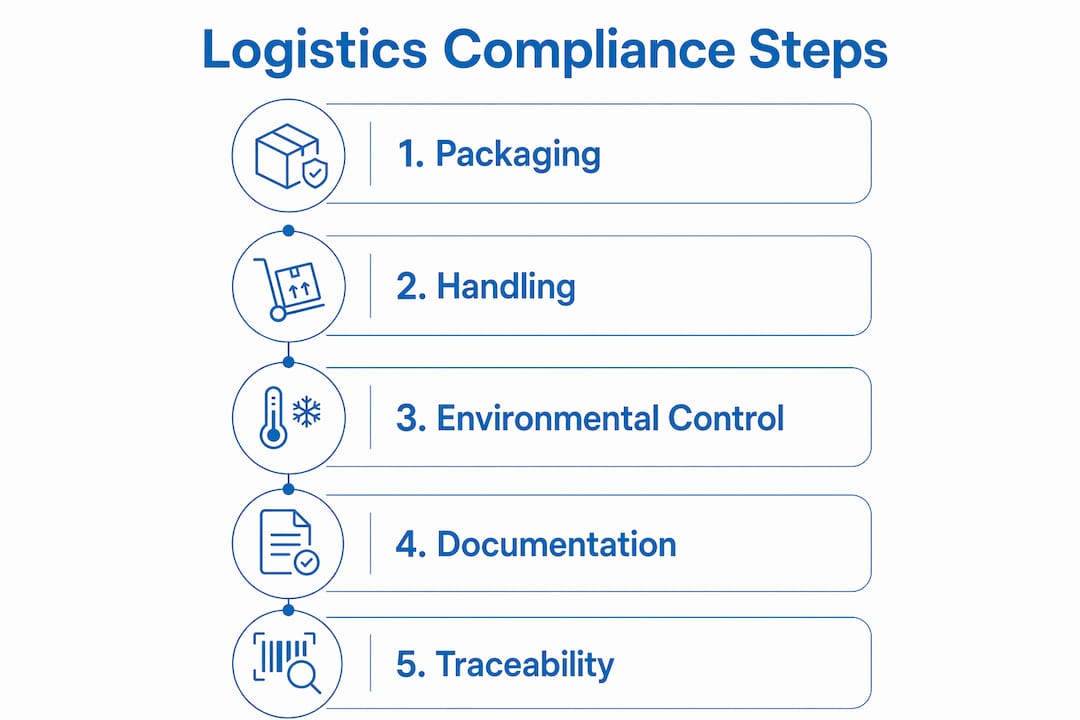
Product integrity in pharmaceutical and medical device logistics depends on three controls: packaging, handling, and environmental monitoring. Packaging must be validated to maintain product stability across the full distribution journey, including worst-case temperature and humidity scenarios. Handling procedures must prevent physical damage, contamination, and mix-ups at every transfer point. Environmental monitoring must generate continuous, time-stamped records that regulators can audit.

Temperature excursions are among the most frequent non-compliance findings in pharma logistics audits. A single unmonitored excursion can invalidate an entire batch, trigger a product recall, and generate a regulatory observation that follows the organization for years. Validated cold chain logistics with real-time monitoring and documented corrective actions directly reduces this audit risk. The investment in monitoring infrastructure is not optional under GDP. It is a compliance requirement.
Traceability goes beyond knowing where a product is. Regulators require batch numbers, expiry dates, storage condition records, and chain-of-custody documentation that can be reconstructed for any unit at any point in its distribution history. Batch-level visibility and real-time trace data are the proof of GMP adherence that regulators now expect as standard. Paper-based systems cannot reliably deliver this at scale.
Pro Tip: Map your traceability gaps before your next regulatory audit by running a mock recall exercise. Select a batch at random and attempt to reconstruct its full distribution history within four hours. Any gap you find is a compliance risk that an inspector will also find.
The operational risks of traceability failure include:
- Inability to execute targeted recalls, forcing broader market withdrawals
- Regulatory observations citing inadequate distribution records
- Loss of GDP certification or distribution authorization
- Patient safety incidents linked to compromised product reaching end users
Logistics teams managing temperature-sensitive shipments must treat every data point as a compliance record, not just an operational metric.
What are the key compliance challenges in international pharma distribution?
Cross-border pharmaceutical and medical device distribution multiplies compliance complexity. Each market applies its own regulatory approval timelines, import licensing requirements, and customs controls. A product approved in one jurisdiction may require additional documentation, local testing, or a separate registration number in the next. Logistics teams must coordinate these requirements without causing shipment delays that disrupt patient access or clinical trial timelines.
Pharmaceutical internationalization has made airfreight a strategic tool for synchronizing inventory positioning with region-specific regulatory approvals. When regulatory clearances arrive at different times across markets, airfreight absorbs the variability by enabling rapid repositioning of stock. This is not simply a speed advantage. It is a compliance strategy that prevents products from sitting in unauthorized storage while waiting for market clearance.
Early involvement of trade compliance and logistics experts during clinical trial design avoids delays caused by customs valuation errors, incorrect product descriptions, and country of origin misclassification. These are not administrative oversights. They are compliance failures that can halt shipments at Ministry of Health borders and generate regulatory scrutiny. Proactive planning at the design stage is the most cost-effective compliance strategy available.
Quality agreements frequently fail to define responsibility for deviation management and change notifications between logistics providers. These gaps surface during regulatory audits, not during routine operations. Explicit contract clauses covering deviation ownership, escalation timelines, and change control notifications close the gaps before inspectors find them.
Effective logistics compliance strategies for international distribution include:
- Centralizing regulatory documentation management across all markets
- Designating a single point of accountability for customs compliance per lane
- Aligning inventory positioning with regulatory approval sequencing
- Conducting pre-shipment compliance checks against destination-country requirements
- Reviewing quality agreements annually to capture regulatory and operational changes
For cross-border documentation best practices, guidance on peptide shipping documentation illustrates how precise trade documentation prevents regulatory holds across healthcare product categories.
How does logistics technology improve regulatory compliance?
Transportation Management Systems (TMS) and Warehouse Management Systems (WMS) are the primary technology platforms that convert logistics operations into auditable compliance records. TMS and WMS integrated with compliance processes provide end-to-end visibility critical for regulatory adherence and real-time decision-making. Manual processes cannot match the speed, accuracy, or audit-trail depth that these systems generate. The shift from paper-based to digital compliance records is now a regulatory expectation in most major markets.
The compliance benefits of technology integration follow a clear progression:
- Real-time temperature and handling data capture eliminates retrospective reconstruction of storage conditions, which regulators treat as unreliable.
- Automated deviation alerts trigger corrective and preventive action (CAPA) workflows before a non-conformance becomes a regulatory event.
- Electronic batch records linked to shipment data provide the batch-level traceability that GDP and DSCSA require.
- Audit trail generation creates immutable records of every system action, supporting inspection readiness without manual preparation.
- Inventory management integration prevents expired or recalled stock from entering the distribution chain.
Logistics providers investing in GDP-compliant processes and advanced technology gain a measurable competitive advantage as pharmaceutical companies raise their compliance standards for third-party partners. Demonstrated compliance capability differentiates providers in tightly regulated markets. For compliance officers evaluating 3PL partners in Singapore and Southeast Asia, technology capability is now a qualification criterion, not a preference.
Pro Tip: When evaluating a logistics technology platform for compliance use, request a demonstration of its audit trail function specifically. Ask the vendor to show how it records a deviation event from detection through CAPA closure. If the trail has gaps, the platform will create gaps in your compliance record.
Pharmaceutical warehousing practices that support compliance are detailed in Labgistics’ pharmaceutical warehousing compliance guide, which covers GDP-aligned storage requirements for regulated healthcare products.
Key Takeaways
Logistics is the operational proof of regulatory compliance in pharmaceutical and medical device supply chains, and no amount of documentation replaces validated, technology-supported execution at every distribution stage.
| Point | Details |
|---|---|
| Dual authorization at distribution | Quality and logistics units must both verify readiness before any GDP-regulated shipment proceeds. |
| Temperature excursions are the top audit risk | Validated cold chain monitoring with documented CAPA responses directly reduces regulatory findings. |
| Early cross-border planning prevents delays | Involving trade compliance experts during trial design avoids customs holds at Ministry of Health borders. |
| Technology closes traceability gaps | TMS and WMS platforms generate the batch-level, real-time records that regulators now treat as standard proof of GMP adherence. |
| Quality agreements need explicit deviation clauses | Undefined responsibility for deviation management between logistics providers creates compliance gaps that audits expose. |
Logistics compliance as the true currency of trust
The phrase “logistics compliance” still gets treated as a checklist activity in too many organizations. That framing is wrong, and it costs companies dearly during inspections. Regulators do not read SOPs and conclude that a company is compliant. They observe operations, examine deviation logs, and trace a batch through its full distribution history. What they find in that trace is the real compliance record.
The organizations that perform best in regulatory inspections are the ones where logistics teams understand that their daily operational decisions are compliance decisions. A driver who skips a temperature check is not cutting a corner on operations. That driver is creating a documentation gap that an inspector will find. That gap can escalate into a regulatory observation, a warning letter, or a product recall.
The technology investment required to close these gaps is significant but not optional in 2026. Regulators across Southeast Asia, Europe, and North America are raising their expectations for real-time data and electronic audit trails. Organizations that rely on manual records are already behind the standard. The question is not whether to invest in compliant logistics infrastructure. The question is how quickly the gap can be closed before the next inspection.
Multi-market launches add another layer of complexity that most compliance teams underestimate. Regulatory approval sequences rarely align across markets. Logistics teams that are not involved in launch planning from the start end up managing compliance emergencies rather than executing planned distributions. Early engagement between regulatory affairs, trade compliance, and logistics is not a best practice. It is the only approach that works reliably at scale.
— Brandcore
Labgistics: GDP-compliant logistics for regulated healthcare products
Labgistics operates across Southeast Asia with over 20 years of experience in pharmaceutical and medical device logistics, built specifically around the compliance demands that healthcare supply chains require.
Labgistics delivers specialized healthcare logistics covering GDP-compliant warehousing, validated cold chain transportation, real-time shipment visibility, and full documentation management. Its fully accredited distribution centers in Singapore support audit-ready operations for pharmaceutical companies and medical device manufacturers entering or expanding across Southeast Asian markets. For compliance officers and logistics managers who need a 3PL partner that treats regulatory adherence as an operational standard rather than an add-on, Labgistics provides the infrastructure, the qualified personnel, and the documented processes to meet that standard consistently. Learn more about Labgistics’ regulatory services for healthcare and how they support product registration and market access across the region.
FAQ
What is the role of logistics in regulatory compliance?
Logistics is the function that physically executes the storage, handling, and distribution requirements mandated by regulatory frameworks such as WHO GDP, US FDA guidelines, and EU EudraLex. Without validated logistics processes, a product cannot demonstrate regulatory adherence from manufacturer to end recipient.
What are the most common logistics compliance failures in pharma?
Temperature excursions and documentation lapses are the most frequent non-compliance findings in pharmaceutical logistics audits. Undefined responsibility for deviation management between logistics providers is a close third, typically surfacing only during regulatory inspections.
How does a TMS or WMS support regulatory compliance?
Transportation Management Systems and Warehouse Management Systems generate electronic audit trails, real-time temperature records, and batch-level traceability data that regulators require as proof of GDP adherence. These systems replace manual records that cannot reliably meet current regulatory standards.
Why does early logistics involvement matter for clinical trials?
Early involvement of logistics and trade compliance experts during clinical trial design prevents customs valuation errors, incorrect product descriptions, and country of origin misclassification that halt shipments at regulatory borders. Proactive planning at the design stage is the most cost-effective way to avoid trial delays.
How does airfreight support international regulatory compliance?
Airfreight enables pharmaceutical companies to synchronize inventory positioning with fragmented regulatory approval timelines across multiple markets. This prevents products from sitting in unauthorized storage while awaiting market clearance, which is itself a compliance risk under GDP.
Recommended
- Hazardous Materials Logistics: A Compliance Guide for 2026
- Understand Compliance in Healthcare Logistics: SEA Guide
- Medical Device Regulatory Compliance Guide for 2026