
Accreditation in healthcare logistics is defined as the formal process by which an independent body evaluates whether a logistics provider meets established quality, safety, and regulatory standards for handling and distributing healthcare products. This evaluation covers everything from warehouse conditions and temperature monitoring to documentation practices and staff training. Frameworks like Good Distribution Practice (GDP), the US Drug Supply Chain Security Act (DSCSA), and USP General Chapters govern what compliance looks like in practice. For healthcare professionals and logistics managers, understanding what is accreditation in healthcare logistics means recognizing it as the foundation of a trustworthy, audit-ready supply chain. Without it, pharmaceutical companies, medical device manufacturers, and healthcare providers face significant regulatory and patient safety exposure.
What standards define accreditation in healthcare logistics?
GDP is the primary global framework for pharmaceutical supply chain compliance. It mandates specific controls over storage conditions, transportation procedures, temperature monitoring, and documentation for all medicinal products moving through the supply chain. Regulatory bodies across the European Union, Southeast Asia, and beyond require GDP compliance as a baseline condition for operating as a licensed pharmaceutical distributor.

The US DSCSA adds a layer of serialization and traceability requirements specific to the American market. Non-compliance with DSCSA can result in fines up to US$500,000 and suspension of operating licenses. That financial exposure alone makes accreditation a risk management priority, not just a regulatory formality.
USP General Chapters <1079> and <1079.2> address temperature control and excursion management for pharmaceutical products. These chapters define acceptable temperature ranges, monitoring protocols, and the documentation required when a deviation occurs. Logistics providers seeking accreditation must demonstrate compliance with these chapters as part of any quality audit.
The table below compares the core standards and their primary requirements:
| Standard | Scope | Core Requirement |
|---|---|---|
| GDP (EU/PIC/S) | Storage and transport of medicinal products | Temperature control, documentation, SOPs |
| DSCSA (US) | Drug serialization and traceability | Track-and-trace, verification, reporting |
| USP <1079> | Temperature management in pharmaceutical distribution | Validated storage, monitoring, excursion response |
| USP <1079.2> | Temperature excursion documentation | Deviation records, impact assessments |
| ISO 9001 | Quality management systems | Process consistency, audit trails, continuous improvement |
- GDP compliance is mandatory for pharmaceutical distribution licenses in the EU, Singapore, and most of Southeast Asia.
- DSCSA applies to any provider touching the US pharmaceutical supply chain, including international 3PL partners.
- USP chapters apply to both storage facilities and last-mile couriers handling temperature-sensitive products.
Pro Tip: When preparing for a GDP audit, treat your standard operating procedures (SOPs) as living documents. Auditors look for evidence that SOPs are actively used and regularly reviewed, not filed away and forgotten.
How does the accreditation process work?
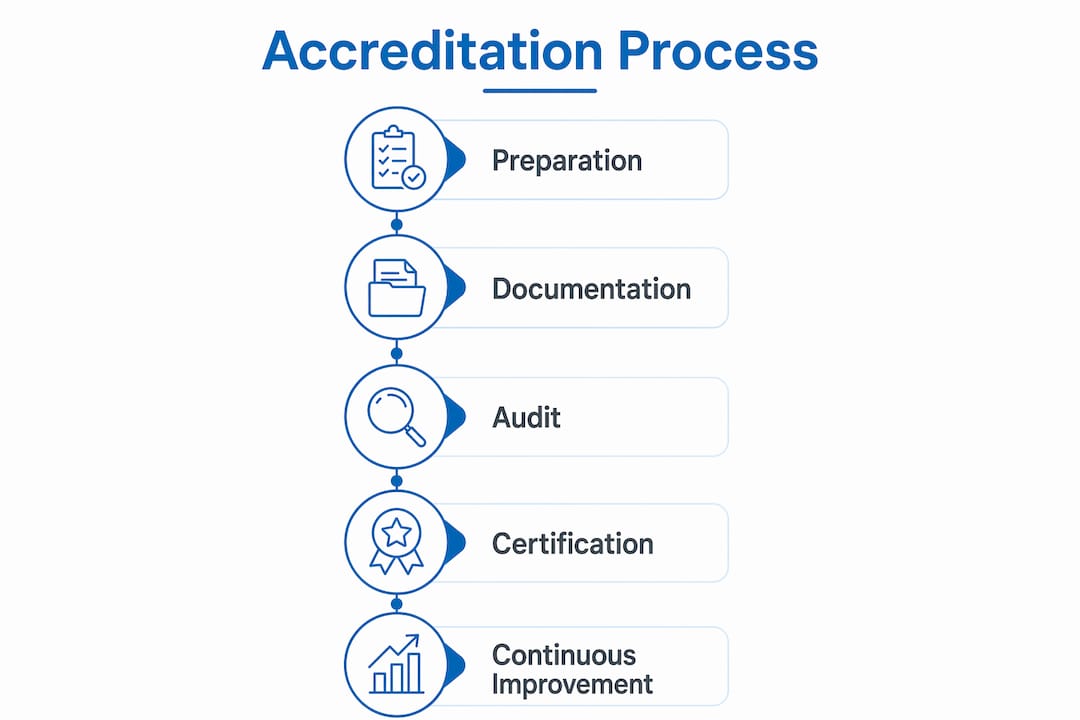
The accreditation process in healthcare logistics follows a structured sequence that tests both documentation quality and operational reality. Understanding each phase helps logistics managers allocate resources correctly and avoid the most common compliance failures.
-
Initial application and documentation review. The provider submits quality manuals, SOPs, facility layouts, equipment calibration records, and personnel training logs. Accrediting bodies use this submission to assess whether the organization has a functional quality management system (QMS) in place before scheduling any site visit.
-
Onsite facility audit. Auditors inspect warehouses, cold rooms, transportation vehicles, and IT systems. They verify that physical conditions match documented procedures. Unannounced follow-up inspections are standard practice for bodies like Joint Commission International and national health authority inspectors in Singapore and across Southeast Asia.
-
Temperature and QMS assessment. Auditors evaluate continuous temperature monitoring systems, alarm response protocols, and data logger calibration records. They also assess whether the QMS is integrated into daily workflows or exists only on paper.
-
Corrective action and response period. Providers receive a findings report identifying non-conformances. Major findings must be resolved before accreditation is granted. Minor findings require a documented corrective action plan with timelines.
-
Accreditation decision and certification. The accrediting body issues a formal decision. Certification periods typically run one to three years, after which full re-certification is required.
-
Continuous monitoring and periodic surveillance. Most accrediting bodies conduct annual surveillance audits between full re-certification cycles. Providers must maintain audit trails and update documentation continuously.
Pro Tip: The most common reason healthcare logistics providers fail their first accreditation audit is incomplete temperature excursion records. Build your deviation logging process into your warehouse management system from day one, not as a manual workaround.
What are the key benefits of logistics accreditation?
Accreditation provides independent, verifiable proof of operational standards. This shifts the conversation from self-claimed capability to documented, evidence-based performance. For pharmaceutical buyers and hospital procurement teams, that distinction is decisive.
Many pharmaceutical buyers pre-qualify providers based on accreditation status before commercial discussions begin. A logistics company without the right credentials is simply excluded from the tender process. Accreditation is therefore a commercial prerequisite in high-value healthcare supply chain contracts, not just a quality badge.
Accreditation also enables risk-based customs clearance through programs like the Authorized Economic Operator (AEO) framework. Accredited providers face fewer inspections and reduced documentation requirements at customs. For time-sensitive pharmaceutical shipments, that speed advantage directly protects product integrity.
The operational benefits extend beyond compliance:
- Supply chain agility. Accredited organizations demonstrate better personnel and equipment tracking, which translates to faster crisis response and stronger emergency supply chain management.
- Stakeholder confidence. Hospitals, regulators, and pharmaceutical manufacturers trust accredited providers with higher-value and more sensitive product lines.
- Continuous improvement culture. The audit cycle forces regular review of processes, which surfaces inefficiencies that would otherwise go unaddressed.
- Reduced disruption risk. Documented procedures and trained staff reduce the likelihood of costly supply chain failures during peak demand or crisis periods.
“Accreditation assures procurement teams by replacing vendor reputation with documented compliance and consistent performance.” — Setting the Gold Standard: Why Accreditation Matters in Modern Logistics
For logistics managers operating in Singapore and Southeast Asia, accreditation also supports market access. Regulatory bodies like the Health Sciences Authority (HSA) in Singapore recognize accredited distribution centers as part of the product registration and licensing process, which directly affects how quickly new pharmaceutical products reach market.
How do temperature-sensitive products shape accreditation requirements?
Cold chain compliance is one of the most demanding dimensions of healthcare supply chain accreditation. Over 43% of drugs approved between 2018 and 2023 require cold storage, and 6% require freezing or ultra-cold conditions. That volume means the majority of new pharmaceutical products entering the market today demand accreditation-backed cold chain infrastructure.
Accreditation for cold chain logistics requires validated packaging systems, continuous temperature monitoring with calibrated data loggers, and documented contingency plans for equipment failures or power outages. USP <1079.2> specifically governs how temperature excursions must be documented and assessed for product impact. Providers must demonstrate that every deviation is recorded, investigated, and resolved with a written impact assessment.
Last-mile couriers are treated as extensions of pharmacy quality systems under accreditation frameworks. This means delivery personnel and courier vehicles must meet the same documentation and temperature control standards as the warehouse. Accreditation auditors will request courier compliance records as part of their review. Providers who rely on third-party last-mile partners must include those partners in their quality agreements.
The table below outlines key cold chain accreditation requirements by product type:
| Product Category | Temperature Range | Key Accreditation Requirement |
|---|---|---|
| Standard cold chain pharmaceuticals | 2°C to 8°C | Validated cold rooms, continuous monitoring, excursion SOPs |
| Frozen biologics and vaccines | -20°C to -15°C | Validated freezers, alarm systems, backup power |
| Ultra-cold products (e.g., mRNA vaccines) | -80°C to -60°C | Ultra-low temperature equipment, specialized packaging validation |
| Ambient pharmaceuticals | 15°C to 25°C | Controlled storage, humidity monitoring, seasonal risk assessment |
For practical guidance on managing these requirements day to day, Labgistics has published detailed resources on handling temperature-sensitive shipments in the healthcare sector.
Pro Tip: Validate your cold chain packaging systems under the worst-case temperature conditions your shipments will realistically face, not just average conditions. Regulators and accrediting bodies expect worst-case scenario data in your validation reports.
Key takeaways
Accreditation in healthcare logistics is the formal, independent validation that a provider meets GDP, DSCSA, and temperature control standards required to safely distribute pharmaceutical and medical products.
| Point | Details |
|---|---|
| Accreditation is standards-based | GDP, DSCSA, USP <1079>, and ISO 9001 define the compliance baseline for healthcare logistics providers. |
| The process is multi-stage | Providers must pass documentation review, onsite audits, and corrective action cycles before certification is granted. |
| Commercial access depends on it | Pharmaceutical buyers pre-qualify providers by accreditation status, excluding non-accredited companies from tenders. |
| Cold chain adds complexity | 43% of recently approved drugs require cold storage, making temperature validation a core accreditation requirement. |
| Accreditation is ongoing | Surveillance audits and QMS integration mean compliance must be maintained as a daily operational discipline. |
Why accreditation is more than a certificate
From my perspective, the most common mistake logistics managers make is treating accreditation as a project with a finish line. You achieve certification, file the certificate, and move on. That approach fails within the first surveillance audit cycle.
Successful companies integrate quality management systems into everyday workflows. Audit trails and SOPs function as living operational records, not documents assembled retroactively for an inspector. The difference is visible the moment an auditor walks through a facility. A warehouse where staff can explain their deviation logging process from memory is fundamentally different from one where the quality manager scrambles to locate the relevant SOP.
Accreditation also creates a transparency dividend that most logistics managers undervalue. When your processes are documented, monitored, and regularly reviewed, you identify problems before they become supply chain failures. That operational visibility is worth more than the certificate itself.
For healthcare logistics managers in Southeast Asia, accreditation is increasingly a market access tool. Regulatory bodies like HSA Singapore and ASEAN harmonization frameworks recognize accredited providers in licensing and distribution approval processes. Providers who treat accreditation as a compliance cost miss the commercial upside entirely. Those who treat it as an operational standard gain access to higher-value contracts, faster customs clearance, and stronger client relationships built on documented performance rather than reputation alone.
The advice I give consistently: build your quality management system before you apply for accreditation, not during the process. Providers who try to construct their QMS in response to audit findings spend twice the time and resources compared to those who embed compliance into their operations from the start.
— Brandcore
Accredited healthcare logistics solutions from Labgistics
Labgistics brings over 20 years of experience delivering accredited logistics solutions across Southeast Asia’s pharmaceutical, medical device, and life sciences sectors. Its fully accredited distribution centers in Singapore operate under GDP-compliant frameworks, with validated cold chain infrastructure covering standard cold storage through ultra-cold requirements.
For healthcare professionals and logistics managers who need a partner that meets the highest healthcare supply chain standards, Labgistics provides end-to-end compliance support, including temperature validation, regulatory documentation, and quality agreement management. Its logistics risk management services are designed specifically for organizations operating in regulated healthcare environments across Singapore and the broader Southeast Asia region. Contact Labgistics to discuss how accredited logistics infrastructure can support your compliance requirements and market access goals.
FAQ
What is accreditation in healthcare logistics?
Accreditation in healthcare logistics is the formal evaluation by an independent body that confirms a logistics provider meets quality, safety, and regulatory standards for handling and distributing healthcare products. It covers GDP compliance, temperature control, documentation, and quality management systems.
Which bodies certify healthcare logistics providers?
Healthcare logistics providers are certified by bodies including Joint Commission International, national health authorities such as HSA Singapore, and standards organizations that audit against GDP, ISO 9001, and DSCSA requirements.
How long does the accreditation process take?
The accreditation process typically takes six to eighteen months, depending on the provider’s existing quality management maturity and the specific standard being pursued. Surveillance audits occur annually after initial certification.
Why does accreditation matter for cold chain logistics?
Cold chain accreditation validates that a provider’s temperature-controlled infrastructure, monitoring systems, and deviation management procedures meet the standards required for pharmaceutical products. Over 43% of drugs approved between 2018 and 2023 require cold storage, making this validation critical for most modern pharmaceutical supply chains.
Can non-accredited logistics providers still handle pharmaceutical products?
Non-accredited providers may handle some pharmaceutical products in certain markets, but they are routinely excluded from pharmaceutical tenders and high-value contracts. Many buyers use accreditation as an initial filter before commercial discussions begin, making accreditation a practical requirement for competitive healthcare logistics operations.