
Logistics protocol validation is the systematic process of confirming that transport, handling, and storage procedures meet defined regulatory and operational standards within healthcare supply chains. For logistics managers and compliance officers working with pharmaceutical, medical device, or life science products, knowing how to validate logistics protocols is not optional. It is the foundation of regulatory defensibility, patient safety, and supply chain reliability. Frameworks including WHO GDP, PIC/S, ISO 9001, and CTPAT each impose specific requirements on how healthcare logistics operations must be qualified, documented, and maintained over time.
What do you need before starting logistics protocol validation?
Before any validation activity begins, the prerequisite documentation and tooling must be in place. Attempting to validate without a structured foundation produces results that cannot withstand regulatory scrutiny. The three non-negotiable documents are a Validation Master Plan (VMP), Standard Operating Procedures (SOPs), and a risk assessment that maps product sensitivity to transport conditions.
The tools required for validation in healthcare logistics include:
- Calibrated temperature loggers and sensors that meet the accuracy requirements specified in USP <1079> and WHO GDP guidelines
- Real-time monitoring technology capable of generating timestamped, tamper-evident records for audit purposes
- Stability data for each product category, including defined temperature excursion limits and time-out-of-refrigeration allowances
- Environmental condition data for each lane, including seasonal temperature profiles and transit time benchmarks
- Staff training records confirming that operators understand and can execute each validated procedure
- Governance structures including a designated validation owner, a quality review process, and a change control procedure
The importance of equipment calibration and validation cannot be overstated. Uncalibrated sensors produce data that regulators will reject, invalidating the entire study. Calibration certificates must be current and traceable to national or international measurement standards.
Pro Tip: Select temperature loggers and monitoring platforms that integrate directly with your ERP or warehouse management system. This connection creates automatic audit trails at the point of data capture, which dramatically reduces the manual effort required during inspections.

How to validate logistics protocols: the four-phase process
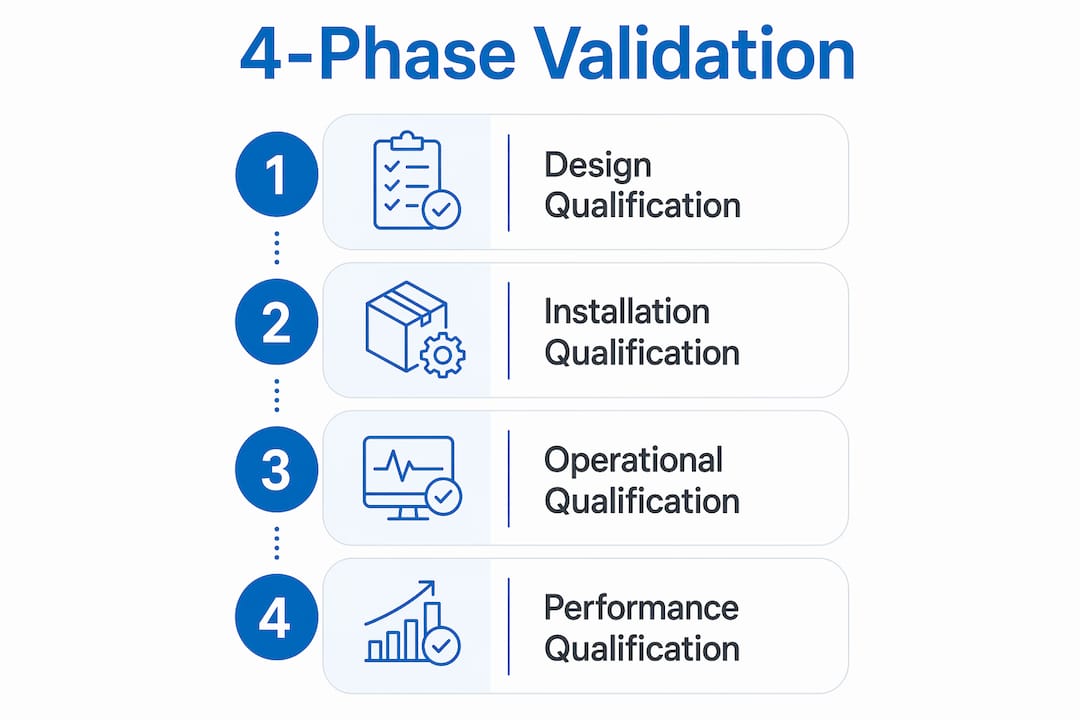
Effective cold chain validation follows a four-stage qualification lifecycle. Each phase builds on the previous one, and skipping any stage creates gaps that regulators will identify during inspection. The four phases are Design Qualification (DQ), Installation Qualification (IQ), Operational Qualification (OQ), and Performance Qualification (PQ).
-
Design Qualification (DQ): Confirm that the proposed transport system, packaging configuration, and lane design are theoretically capable of maintaining required conditions. Activities include reviewing supplier specifications, comparing packaging insulation performance against product stability data, and documenting the rationale for every design decision.
-
Installation Qualification (IQ): Verify that equipment, vehicles, and monitoring systems are installed and configured as specified. This phase produces documented evidence that refrigerated vehicles, data loggers, and packaging materials are present, calibrated, and functioning before any product moves.
-
Operational Qualification (OQ): Test the system under controlled but realistic conditions without live product. OQ studies confirm that the transport environment stays within defined limits across the full range of expected operating conditions, including worst-case temperatures and transit durations.
-
Performance Qualification (PQ): Conduct pilot shipments using actual product or representative thermal mass across different seasons and vehicle types. PQ confirms stability through loading, transit, and unloading phases under real operational conditions.
Pro Tip: During OQ and PQ studies, mimic actual package handling and operator behavior rather than idealized procedures. Validation tests fail most often when they are designed for perfect conditions that do not reflect daily logistics workflows.
| Phase | Primary objective | Key output |
|---|---|---|
| Design Qualification (DQ) | Confirm design suitability | Approved design specification |
| Installation Qualification (IQ) | Verify correct installation | Calibration and configuration records |
| Operational Qualification (OQ) | Test under controlled conditions | Acceptance criteria results |
| Performance Qualification (PQ) | Confirm real-world performance | Pilot shipment data and final report |
Each phase requires a protocol written before execution and a report completed after. Deviations from the protocol must be documented with a root cause analysis and a corrective action before the phase can be closed. This documentation trail is what transforms raw data into a defensible compliance record.
What are the common challenges in logistics validation?
Validation failures occur most often when protocols are designed for ideal rather than real-world conditions. This is the single most common reason healthcare logistics validation programs fail their first regulatory inspection. Understanding the failure modes in advance allows compliance officers to design studies that hold up under scrutiny.
The most frequently encountered challenges include:
- Unrealistic testing environments: Studies conducted in temperature-controlled rooms that do not reflect actual warehouse staging areas or vehicle loading docks produce data that cannot be extrapolated to real operations.
- Inconsistent operator procedures: When different staff members execute the same protocol differently, the results are not reproducible. SOPs must be specific enough to eliminate procedural variation.
- Incomplete documentation and audit trail gaps: Missing timestamps, unsigned records, or undated corrections are among the most common findings during GDP inspections. Every entry must be attributable to a specific person at a specific time.
- Inadequate deviation management: Deviations that are closed without a documented root cause or corrective action leave the validation program vulnerable. A Corrective and Preventive Action (CAPA) process must be applied consistently.
- Requalification triggers not defined: Validation is not a one-time event. Changes to routes, packaging suppliers, vehicle types, or seasonal conditions require requalification. Organizations that do not define these triggers in advance often discover the gap during an audit.
Embedding compliance controls early in ERP workflows is the most effective way to prevent last-minute holds and costly delays. Late detection of compliance failures is the most expensive failure mode in healthcare logistics.
Pro Tip: Integrate validation checkpoints directly into your ERP or logistics management system so that shipments cannot proceed without confirmed protocol adherence. This approach converts compliance from a manual review step into an automated gate.
Which regulatory frameworks govern logistics protocol verification?
Healthcare logistics validation does not occur in a regulatory vacuum. Multiple overlapping standards define what constitutes an acceptable validation program, and compliance officers must understand which frameworks apply to their specific operations and markets.
| Standard | Governing body | Key validation requirement |
|---|---|---|
| WHO GDP | World Health Organization | Risk-based transport qualification, temperature monitoring, and documented deviation management |
| PIC/S GDP Guide | Pharmaceutical Inspection Co-operation Scheme | Qualification of transport lanes, packaging, and vehicles with written protocols and reports |
| USP <1079> | United States Pharmacopeia | Temperature mapping, excursion management, and monitoring system qualification for pharmaceutical distribution |
| ISO 9001 | International Organization for Standardization | Process-based quality management with documented procedures, internal audits, and management review |
| CTPAT | U.S. Customs and Border Protection | Supply chain security validation with advance written notice of approximately 30 days before validation visits |
ISO 9001 certifications last three years with annual surveillance audits. With over 1.3 million valid certificates globally in 2023, ISO 9001 represents the most widely adopted quality management framework in logistics. This breadth means that ISO 9001 certification is increasingly a baseline expectation rather than a differentiator for healthcare logistics providers.
Transport validation is defined as a system-level lifecycle that integrates qualification, ongoing monitoring, and quality governance to build a defensible inspection story. This definition is critical because it positions validation not as a project with an end date, but as a continuous program requiring sustained investment and management attention.
For healthcare logistics operations in Southeast Asia, the Health Sciences Authority (HSA) in Singapore and equivalent national regulatory bodies in Malaysia, Thailand, and Indonesia each reference WHO GDP and PIC/S guidelines as the basis for their own distribution standards. Compliance with these international frameworks is the most reliable path to meeting local regulatory expectations across the region.
What are best practices for maintaining validated logistics protocols?
Sustaining a validated logistics program requires the same rigor applied during initial qualification. The validation report is not the finish line. It is the baseline against which all future performance is measured.
Effective maintenance of validated protocols depends on the following practices:
- Continuous monitoring using IoT sensors and analytics: Real-time data capture across all active lanes provides the evidence base for ongoing compliance and flags excursions before they become regulatory events.
- Routine review of the Validation Master Plan: The VMP must be reviewed at least annually and whenever significant changes occur, including new routes, new packaging suppliers, or seasonal temperature shifts that alter worst-case conditions.
- Supplier qualification and SLA management: Third-party carriers and cold chain logistics providers must be qualified as part of the validation program. Service Level Agreements (SLAs) should specify temperature performance requirements, deviation reporting timelines, and KPIs that are tracked and reviewed regularly.
- Documented rationale for classification decisions: Compliance decisions must capture the reasoning behind product classification and procedural choices, not just the codes or outcomes. Lack of documented reasoning is a common compliance gap that leads to inspection failures years after the original decision was made.
- Policy-as-code integration: Mapping regulations to operational flows and implementing tamper-evident audit trails through logistics IT systems enables automated, testable, and scalable compliance. This approach reduces manual bottlenecks while continuous monitoring validates controls in production.
Pro Tip: Configure automated alerts within your monitoring platform to detect control drift, such as a gradual increase in transit temperature variance, before it crosses the acceptance threshold. Early detection allows corrective action without triggering a full requalification.
For healthcare logistics providers operating cold chain logistics across Southeast Asia, seasonal variation between dry and wet seasons represents a genuine requalification trigger that many organizations underestimate. Worst-case studies conducted in one season may not represent conditions in another.
Key takeaways
Logistics protocol validation in healthcare requires a structured, documented, risk-based lifecycle that integrates qualification phases, ongoing monitoring, and regulatory governance to remain defensible over time.
| Point | Details |
|---|---|
| Four-phase qualification lifecycle | DQ, IQ, OQ, and PQ each produce documented evidence that the system performs as intended. |
| Real-world testing conditions | Validation studies must reflect actual operator behavior and environmental conditions, not idealized scenarios. |
| Regulatory framework alignment | WHO GDP, PIC/S, ISO 9001, and CTPAT each impose specific documentation and qualification requirements. |
| ERP and IT integration | Embedding compliance controls in logistics IT systems converts validation from a manual review into an automated gate. |
| Continuous maintenance | Seasonal changes, new routes, and supplier changes are requalification triggers that must be defined and managed proactively. |
Why validation is more than a compliance exercise
From the perspective of Labgistics, the most persistent mistake in healthcare logistics validation is treating it as a project to be completed rather than a program to be managed. Organizations invest significant resources in initial qualification studies, produce thorough documentation, and then allow the program to drift as operational pressures accumulate. By the time a regulatory inspection arrives, the validated state no longer reflects actual operations.
The second pattern worth addressing directly is the tendency to design validation studies for the best-case scenario. A validation protocol that tests packaging performance in a climate-controlled staging area, with experienced staff following procedures precisely, tells you very little about what happens at a regional distribution hub during peak season with temporary staff. Pharma supply chain security and validation are both undermined by the same root cause: protocols that do not reflect operational reality.
What actually works is embedding validation thinking into daily operations from the start. When compliance controls are built into ERP workflows, when monitoring alerts are configured to detect drift rather than just exceedances, and when the rationale behind every classification decision is documented alongside the decision itself, the validation program becomes self-sustaining. Compliance embedded in ERP systems enables instant audit trail generation rather than retrospective reconstruction, which is the difference between a confident inspection response and a costly remediation exercise.
The organizations that sustain validated logistics programs over years are not the ones with the most elaborate initial studies. They are the ones that treat every operational change as a potential requalification trigger and act on it before an inspector identifies it first.
— Labgistics
Validated healthcare logistics solutions from Labgistics

Labgistics brings over 20 years of experience supporting pharmaceutical companies, medical device manufacturers, and life science organizations across Southeast Asia with tailored healthcare logistics solutions that are built for regulatory compliance from the ground up. From cold chain qualification and calibration services in Singapore to validated distribution across the region, Labgistics provides the infrastructure, documentation support, and technical expertise needed to implement and sustain a defensible validation program. For organizations managing logistics risk in healthcare supply chains, partnering with a provider that integrates compliance into every operational layer is the most direct path to audit readiness and operational confidence.
FAQ
What is logistics protocol validation in healthcare?
Logistics protocol validation is the documented process of confirming that transport and handling procedures consistently meet regulatory and product-specific requirements. It applies to temperature-sensitive pharmaceuticals, medical devices, and biologics distributed through healthcare supply chains.
How many phases does cold chain transport validation require?
Cold chain transport validation follows four phases: Design Qualification, Installation Qualification, Operational Qualification, and Performance Qualification. Each phase requires a written protocol before execution and a signed report after completion.
Which standards apply to healthcare logistics validation in Southeast Asia?
WHO GDP, PIC/S GDP guidelines, and ISO 9001 are the primary frameworks governing healthcare logistics validation in Southeast Asia. National regulators in Singapore, Malaysia, and Thailand reference these international standards in their own distribution requirements.
How often should validated logistics protocols be reviewed?
Validated protocols must be reviewed at least annually and whenever a significant change occurs, including new transport routes, packaging supplier changes, or seasonal temperature shifts that alter worst-case conditions.
What is the most common reason logistics validation programs fail inspections?
The most common failure is designing validation studies for ideal rather than real-world conditions, which produces results that cannot be reproduced in actual operations. Incomplete documentation and undefined requalification triggers are the next most frequent findings.