
The Asia-Pacific healthcare cold chain logistics market is projected to reach significant scale by 2030, with transportation alone accounting for 50.70% of regional spend in 2025. For healthcare administrators and procurement managers across Southeast Asia, this is not just a market trend. It is a signal that the rules of pharmaceutical and medical product distribution are changing fast. Temperature-sensitive products, stricter regulatory frameworks, and increasingly complex supply chains demand a level of operational precision that many organizations are still building toward. This guide breaks down the core pillars of modern healthcare logistics, from cold chain management to compliance and partner selection, so you can make confident, informed decisions.
Table of Contents
- The new landscape of healthcare logistics in Southeast Asia
- Core components: compliance, cold chain, and monitoring
- Key challenges and expert solutions for healthcare supply chains
- How to select and optimize your logistics partner
- Fresh perspective: what most healthcare logistics guides miss about the Southeast Asian market
- Take the next step with reliable healthcare logistics solutions
- Frequently asked questions
Key Takeaways
| Point | Details |
|---|---|
| Market momentum | The healthcare logistics sector in Southeast Asia is expanding rapidly, with cold chain transport being a key driver. |
| Compliance & technology | GSP/GDP compliance and real-time monitoring are essential for safe and legal pharma logistics. |
| 3PL value | Partnering with specialized 3PL providers improves scalability and resilience compared to building logistics in-house. |
| Smart partner selection | Evaluate logistics providers based on compliance, technology, and ability to deliver reliable rural and specialty solutions. |
| Local context matters | Effective healthcare logistics in Southeast Asia require adapting to local standards, rural needs, and climate risks. |
The new landscape of healthcare logistics in Southeast Asia
Southeast Asia is no longer a secondary consideration in global pharma logistics. The region is a primary growth engine, shaped by rising chronic disease rates, expanding healthcare access, and a surge in biologic and specialty drug demand. The Asia-Pacific cold chain market is growing strongly, with China and Vietnam emerging as two of the most active markets for pharmaceutical cold chain investment and infrastructure development.
Vietnam offers a sharp example of this momentum. The country’s pharma cold chain market is valued at approximately US$1.2 billion and expanding at 9 to 10% per year. That pace reflects a broader regional pattern: governments and private sector players are investing heavily in pharma cold chain growth infrastructure to keep up with product complexity and patient demand.
Key regional growth drivers include:
- Increased demand for biologics, vaccines, and specialty therapies requiring strict temperature control
- Expanding national immunization programs that rely on reliable cold chain networks
- Regulatory harmonization efforts aligned with GDP and GSP standards across ASEAN
- Greater adoption of green cold chain solutions that reduce energy use while maintaining compliance
- Growing e-commerce and direct-to-patient distribution models
| Market factor | Impact on logistics |
|---|---|
| Tropical climate | Accelerates product degradation; demands robust temperature control |
| Rural geography | Creates last-mile distribution gaps and compliance risks |
| Regulatory variance | Requires country-specific compliance expertise |
| Infrastructure gaps | Limits compliant cold storage outside major cities |
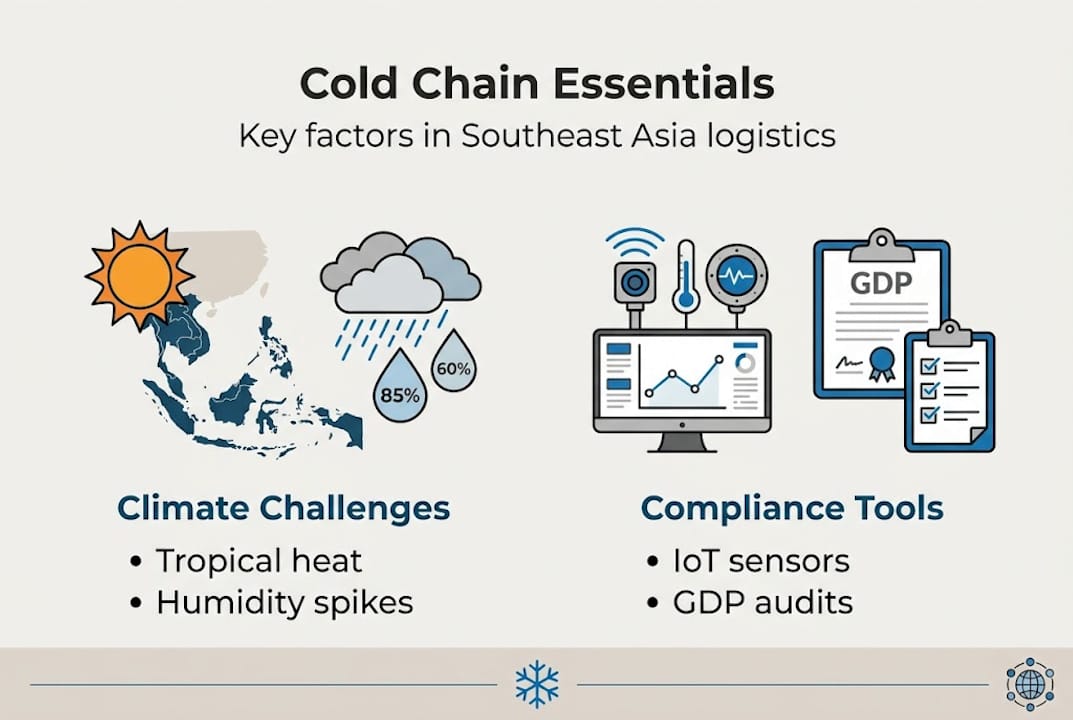
Transportation controls the largest share of cold chain spend, which means that how products move, not just where they are stored, defines risk. Understanding the key healthcare logistics functions that underpin regional distribution is essential before selecting any logistics partner or reviewing your current operations.
With the market context in mind, the next section explains the core building blocks of effective healthcare logistics.
Core components: compliance, cold chain, and monitoring
Three elements form the operational foundation of any reliable healthcare logistics system: regulatory compliance, temperature management, and real-time monitoring. Each one reinforces the others. A gap in any single area creates risk across the entire supply chain.
Regulatory compliance sets the legal and quality baseline. GDP (Good Distribution Practice) and GSP (Good Storage Practice) are the primary standards governing pharmaceutical distribution across Southeast Asia. These frameworks define how products must be stored, handled, transported, and documented. Regional variants, such as KGSP in Korea, add additional layers of specificity. Non-compliance is not just a regulatory risk. It can result in product recalls, license suspension, and patient harm.
Temperature management is where compliance becomes operational. Most pharmaceutical products fall into defined temperature bands:
- Refrigerated (2 to 8°C): vaccines, biologics, insulin
- Controlled room temperature (15 to 25°C): many oral solid dosage forms
- Frozen (minus 20°C): certain plasma products and some diagnostics
- Ultra-low (minus 70°C): advanced gene therapies and some mRNA products
Maintaining these ranges across a multi-leg distribution chain in a tropical climate requires specialized equipment, validated packaging, and trained personnel.
Real-time monitoring is the third pillar. IoT sensors embedded in cold storage units and transport vehicles log temperature data continuously, enabling immediate alerts when excursions occur. Zuellig Pharma’s GDP and KGSP-compliant facilities use redundant cooling systems and real-time sensors to maintain safe vaccine distribution, including products requiring minus 20°C to minus 70°C storage. This model is becoming the benchmark for the region.
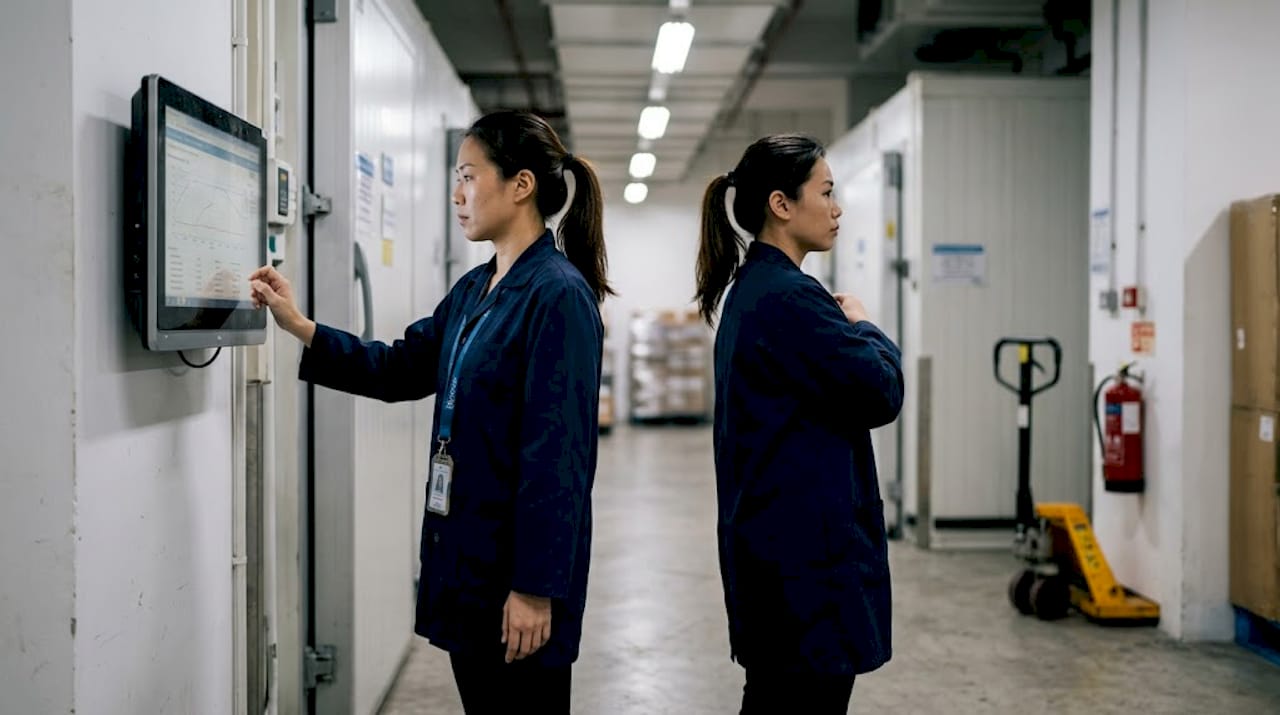
Pro Tip: When evaluating a logistics provider’s monitoring capability, ask specifically for excursion response time data. The speed of corrective action, not just the presence of sensors, determines actual product protection.
Digital systems and AI-based route optimization are also reducing risk by identifying temperature-vulnerable transit windows before shipments depart. Combined with redundant backup power and documented SOPs (standard operating procedures), these tools help solve logistics challenges that once required costly manual intervention. Smart 3PL warehouses are increasingly the operational heart of these integrated systems.
Now that the essential components are clear, it is time to address the main logistical challenges and their proven solutions.
Key challenges and expert solutions for healthcare supply chains
Even well-funded healthcare organizations face persistent operational obstacles in Southeast Asia. Understanding these barriers, and the solutions that industry leaders are using, is essential for procurement managers building resilient supply chains.
Infrastructure and rural coverage remain the most pressing issues. Vietnam, for example, has over 100 commercial cold facilities as of 2023, but shortages persist outside major urban centers, particularly for GSP and GDP-compliant storage. Similar gaps exist across Indonesia, the Philippines, and Myanmar, where road infrastructure and power reliability add further complexity.
Common supply chain challenges include:
- Inconsistent cold chain infrastructure between provinces and rural districts
- Varying regulatory requirements across ASEAN member states
- Limited availability of validated packaging and qualified carriers in secondary cities
- Temperature excursion risks during cross-border customs clearance
- Difficulty maintaining audit-ready documentation across multi-party distribution networks
“The real risk in Southeast Asian pharma logistics is not the metro-to-metro leg. It is the final 50 kilometers, where infrastructure thins out and compliance documentation often breaks down.”
Industry leaders are responding with redundant, data-driven approaches. Real-time tracking, pre-qualified carrier networks, and country-specific SOPs reduce the chance of failure at vulnerable distribution points. For organizations managing supply chain risks across multiple markets, a regional 3PL partner with established local networks provides a level of resilience that in-house teams rarely match.
Pro Tip: When assessing distribution reliability in a new market, request a partner’s documented excursion rate and corrective action log for the past 12 months. This data reveals operational maturity far more accurately than certifications alone.
The case for 3PL partnerships is particularly strong in Southeast Asia. Building proprietary cold chain infrastructure across multiple countries requires capital investment, regulatory expertise, and ongoing validation that most healthcare organizations cannot sustain efficiently. A specialized 3PL for last-mile delivery brings pre-built networks, validated facilities, and regulatory knowledge that accelerate market access and reduce operational risk.
Having addressed major barriers, let’s move to how you can select and optimize your logistics solutions for real-world results.
How to select and optimize your logistics partner
Choosing a healthcare logistics partner is one of the highest-stakes procurement decisions you will make. The right partner protects product integrity, ensures regulatory compliance, and scales with your distribution needs. The wrong one creates liability at every stage of the supply chain.
A practical evaluation framework includes five core criteria:
- Compliance credentials: Verify GDP, GSP, and any country-specific certifications. Ask for recent audit reports and regulatory inspection outcomes.
- Technology stack: Confirm real-time IoT monitoring, digital audit trails, and AI-assisted route optimization are operational, not just listed in a brochure.
- Geographic coverage: Map their network against your distribution footprint, including secondary cities and rural delivery points.
- Specialty capacity: If your product portfolio includes ultra-low temperature therapies, confirm validated minus 70°C storage and transport capability.
- References and performance data: Request client references from comparable product categories and ask for documented KPIs on temperature excursions, on-time delivery, and complaint resolution.
| Evaluation criterion | What to ask | Red flag |
|---|---|---|
| Compliance | Show recent GDP audit results | Certificates without recent audits |
| Monitoring | Provide excursion response time data | Sensors present, no alert protocol |
| Coverage | Map rural and secondary city reach | Metro-only network |
| Specialty capacity | Confirm ultra-low temp validation | No documented validation records |
| References | Share client KPIs in pharma/biotech | Generic testimonials only |
Core methodologies such as compliance frameworks, IoT integration, AI-based routing, and validated temperature control are now the minimum standard for credible partners, not differentiators. If a provider cannot demonstrate all four, they are not equipped for today’s regulatory environment.
Pro Tip: Build a structured quarterly review process with your logistics partner. Track excursion rates, delivery performance, and regulatory updates together. This keeps accountability high and allows you to adapt before problems escalate.
Reviewing cold chain best practices alongside your partner’s SOPs ensures alignment between your quality standards and their operational reality. For a broader view of available service models, comprehensive 3PL solutions tailored to Southeast Asia’s healthcare sector offer a useful reference point.
Fresh perspective: what most healthcare logistics guides miss about the Southeast Asian market
Most published frameworks for healthcare logistics are built on Western European or North American models. They assume consistent regulatory environments, reliable infrastructure, and urban-centric distribution networks. In Southeast Asia, none of those assumptions hold uniformly.
The patchwork of regulatory standards across ASEAN means that GDP compliance in Singapore does not automatically translate to compliant operations in Vietnam or Indonesia. Tropical climate conditions accelerate degradation risks that temperate-zone models underestimate. And outside metro areas, the gap between written SOP and field reality can be significant.
What experienced operators know, and what real-world pharma logistics lessons consistently confirm, is that adaptability matters more than certification count. A partner with deep local relationships, rapid on-the-ground response capability, and genuine regulatory fluency in each target market will outperform a globally certified provider with no regional presence every time.
The most resilient supply chains in Southeast Asia are built on trust, local knowledge, and operational flexibility, not just systems and paperwork.
Take the next step with reliable healthcare logistics solutions
Navigating Southeast Asia’s healthcare logistics landscape requires more than general knowledge. It demands a partner with proven regional expertise, validated infrastructure, and the regulatory depth to keep your supply chain compliant across every market you serve.
Labgistics Asia delivers end-to-end healthcare logistics solutions built specifically for the pharmaceutical, medical, and life sciences sectors across Southeast Asia. From cold chain logistics that protect product integrity at every stage to business support for healthcare logistics that accelerates market entry, our team brings over 20 years of hands-on regional experience. Whether you are expanding into a new market or strengthening an existing supply chain, we provide the compliance credentials, technology, and local networks your operations require.
Frequently asked questions
What is the biggest challenge facing healthcare logistics in Southeast Asia?
The biggest challenge is ensuring GDP and GSP-compliant cold chain storage and distribution, especially in rural and developing regions where infrastructure gaps persist outside major urban centers.
What compliance standards are critical for pharmaceutical logistics?
GDP (Good Distribution Practice) and GSP (Good Storage Practice) are the primary standards, with regional compliance requirements varying by country, ensuring product quality and patient safety across the full distribution chain.
How is technology improving healthcare cold chain logistics?
IoT sensors, real-time temperature monitoring, and AI-based route optimization are now standard tools, with GDP-compliant facilities using redundant cooling and continuous data logging to minimize excursion risk and support regulatory audits.
Should healthcare providers build their own logistics or use a 3PL?
Partnering with a specialized 3PL is typically more efficient, scalable, and compliant than building proprietary infrastructure, particularly in Southeast Asia where regional 3PL expertise provides ready-built networks and validated cold chain capabilities.
Recommended
- Cold Chain Logistics for Pharma in Southeast Asia | Labgistics
- Publications Archives | Labgistics
- News & Publications Archives | Labgistics
- Business support in healthcare logistics: key functions explained
- Efficiënte workflow medische transporten voor veilige levering
- Master laboratory supply chains for reliable reagents