
Regulatory services are defined as the specialized programs that guide healthcare and life sciences organizations through the full lifecycle of product approval, compliance maintenance, and market entry. For pharmaceutical companies, medical device manufacturers, and life sciences firms operating across Southeast Asia and globally, these services translate complex, multi-jurisdictional regulatory obligations into operational controls that protect both patients and business continuity. With the FDA’s Quality Management System Regulation (QMSR) taking effect in February 2026 and the EMA’s centralized procedure setting strict 210-day evaluation timelines, the demand for expert pharma regulatory services has never been more acute.
What are regulatory services in healthcare and life sciences?
Regulatory services in healthcare and life sciences encompass the full range of professional activities that support a product’s journey from development through market authorization. These activities are not limited to paperwork. They represent a structured discipline that connects scientific evidence, legal requirements, and operational execution into a single, defensible compliance program.
Core regulatory capabilities include regulatory writing, submission leadership, and regulatory operations such as eCTD publishing and submission management. Each function plays a distinct role in the approval lifecycle. Regulatory writing produces the clinical, nonclinical, and chemistry, manufacturing, and controls (CMC) documentation that regulators evaluate. Submission leadership provides the strategic coordination needed to manage IND, NDA, BLA, and MAA programs across global agencies. Regulatory operations handle the technical infrastructure: formatting, validation, and electronic submission management that determines whether a dossier reaches a reviewer’s desk without delay.

Beyond submissions, regulatory services also cover pharmacovigilance documentation, safety reporting, document quality management, and transparency obligations. These functions are ongoing responsibilities that do not end at approval. A product on the market must continue to meet post-authorization commitments, and regulatory services teams manage that continuous obligation.
Key functions within a regulatory services program include:
- Regulatory writing: Clinical study reports, investigator brochures, risk management plans, and CMC sections
- Submission leadership: Strategy, timeline management, and agency interaction for IND, NDA, BLA, and MAA programs
- Regulatory operations: eCTD publishing, submission validation, and archive management
- Pharmacovigilance support: Periodic safety update reports (PSURs), expedited safety reporting, and signal documentation
- Document quality management: Version control, audit trails, and traceability across the submission lifecycle
Pro Tip: Integrate regulatory writing, operations, and submission leadership teams from the start of a program. Organizations that treat these as sequential handoffs consistently experience preventable delays at the submission stage.
How have 2026 regulatory updates changed compliance expectations?
The two most consequential regulatory changes affecting healthcare and life sciences organizations in 2026 are the FDA’s QMSR and the EMA’s centralized procedure requirements. Both demand a more sophisticated approach to compliance than the checklist-based systems many organizations relied on previously.
The FDA QMSR took effect on February 2, 2026, replacing the legacy 21 CFR Part 820 framework with a structure aligned to ISO 13485:2016. This shift moves FDA inspection focus away from procedural documentation toward a culture of quality, risk-based decision making, and management involvement. Medical device manufacturers must now demonstrate that their quality management systems operate with genuine risk oversight, not just documented procedures. FDA inspectors evaluate quality systems holistically, assessing management involvement and the frequency and rigor of internal audits and reviews.
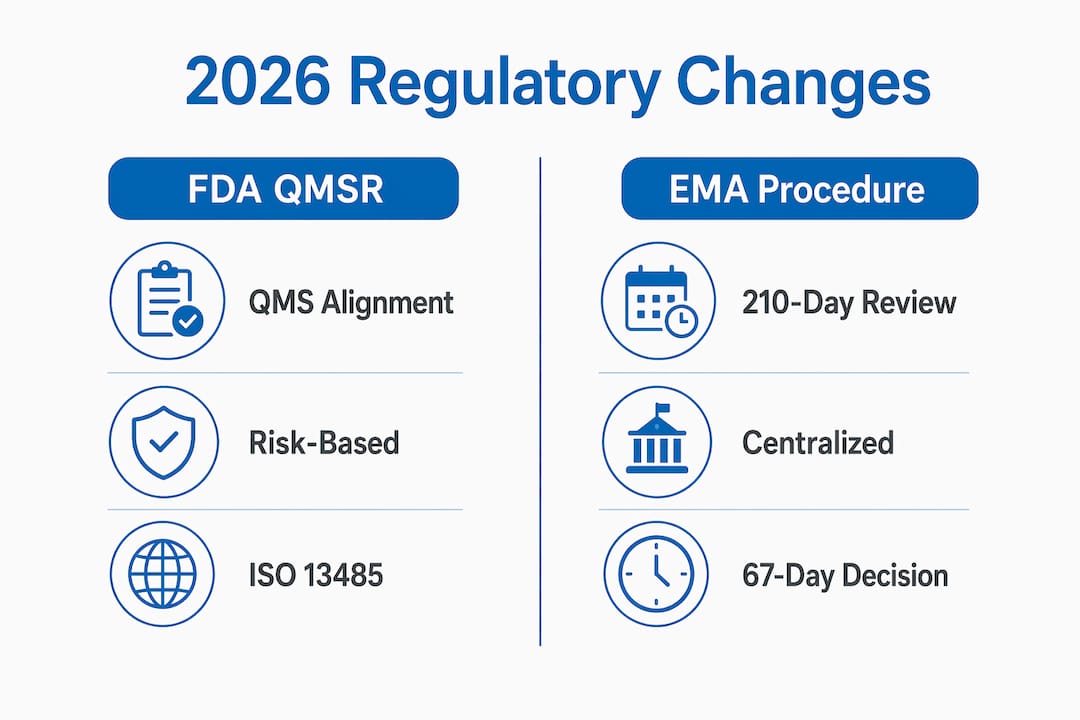
The EMA centralized procedure operates on a 210-day scientific evaluation timeline, excluding clock stops, followed by a 67-day European Commission marketing authorization decision period. Clock stops occur when the EMA issues questions requiring applicant responses. Organizations that fail to prepare response-ready processes before submission routinely lose weeks or months during these periods.
The table below contrasts the old and new FDA frameworks alongside EMA timeline expectations:
| Dimension | Pre-2026 FDA (21 CFR Part 820) | 2026 FDA QMSR / ISO 13485 | EMA Centralized Procedure |
|---|---|---|---|
| Compliance basis | Prescriptive checklist requirements | Risk-based, ISO 13485:2016 aligned | Scientific evaluation, 210-day clock |
| Inspection focus | Procedural documentation | Management involvement, quality culture | Dossier completeness, clock stop management |
| Documentation standard | Procedure-centric records | Demonstrable risk control and CAPA evidence | Standard response packages, proactive evidence |
| Key organizational demand | SOP maintenance | Continuous inspection readiness | Pre-submission response preparation |
Pro Tip: Begin aligning your quality management system to ISO 13485:2016 now if you have not already done so. FDA inspectors under QMSR will assess whether your organization demonstrates genuine risk-based thinking, not just whether your SOPs exist on paper.
For medical device manufacturers in Southeast Asia seeking to access both US and EU markets, the 2026 QMSR requirements represent a significant operational shift. The alignment with ISO 13485 does reduce duplication for organizations already certified, but the inspection culture change requires active preparation.
What are best practices for building an effective compliance framework?
Regulatory services translate external regulatory obligations into implementable governance and controls. The challenge for most healthcare organizations is not understanding what the regulations require. The challenge is embedding those requirements into day-to-day operations in a way that holds up under inspection and adapts as regulations evolve.
Effective compliance management systems include board and management oversight, risk assessment processes, proactive regulatory monitoring, independent audits, staff training programs, and responsive complaints handling. Each element reinforces the others. A training program without audit oversight produces undocumented gaps. An audit function without board-level accountability produces findings that go unaddressed.
The following steps operationalize regulatory requirements into a working compliance framework:
- Map your regulatory obligations. Identify every applicable regulation, guideline, and standard across each market where you operate or intend to operate. For Southeast Asia, this includes HSA requirements in Singapore, BPOM in Indonesia, and FDA Thailand, alongside international standards from the FDA and EMA.
- Conduct a gap assessment. Compare current quality systems, documentation practices, and operational controls against each identified obligation. Prioritize gaps by risk level, not by ease of remediation.
- Assign governance accountability. Designate board-level or senior management ownership for regulatory compliance. Under the FDA QMSR, management involvement is an inspection criterion, not an organizational preference.
- Build horizon scanning into your program. Regulatory requirements change. Assign responsibility for monitoring agency announcements, guidance documents, and enforcement trends. Proactive awareness prevents reactive scrambling.
- Implement traceability across documentation. Every risk-based decision, corrective action, and audit finding must be traceable through your quality management system. Regulators evaluate the quality of CAPA evidence and audit trails, not just their existence.
- Use technology to manage compliance at scale. Electronic quality management systems (eQMS platforms) and regulatory information management tools reduce manual error and support the audit-ready documentation standards that QMSR and ISO 13485 demand.
- Engage multidisciplinary expertise. Effective compliance programs draw on regulatory affairs professionals, legal counsel, quality engineers, and clinical operations specialists. No single function holds all the knowledge required to manage multi-jurisdictional regulatory risk.
For organizations entering Singapore or expanding across Southeast Asia, healthcare logistics compliance is inseparable from regulatory compliance. Cold chain logistics, product storage, and distribution must all meet the same regulatory standards as the product itself.
How do regulatory services reduce approval delays?
Approval delays in healthcare and life sciences are rarely caused by scientific deficiencies alone. Technical and administrative submission issues frequently delay regulatory review before a substantive scientific evaluation even begins. eCTD publishing and validation are critical risk controls in this context, not formatting exercises. A submission that fails technical validation at the FDA or EMA gateway does not reach a reviewer. It returns to the applicant, consuming weeks of schedule.
Regulatory services teams mitigate this risk through coordinated, cross-functional submission management. The key activities that prevent delays include:
- Pre-submission validation: Running eCTD technical checks against agency-specific validation criteria before the submission date, not on it
- Cross-functional quality control: Coordinating regulatory writers, medical reviewers, and operations staff to review documents for consistency, completeness, and formatting compliance
- Agency interaction management: Preparing for and responding to agency questions with speed and precision, including lifting clinical holds rapidly when they arise
- Early delivery planning: Building submission timelines that allow for internal review cycles, not just document production deadlines
- EMA clock stop readiness: Preparing standard draft responses and compiling supporting evidence before the EMA issues its list of questions, so the clock stop period does not consume the organization’s response capacity
Pro Tip: For EMA centralized procedure submissions, treat the clock stop as a scheduled event, not a surprise. Prepare standard response templates and evidence packages before submission. Organizations that do this consistently respond faster and maintain better relationships with the Committee for Medicinal Products for Human Use (CHMP).
For product registration in Singapore and across Southeast Asia, the same principles apply. HSA’s product registration process rewards applicants who submit complete, well-organized dossiers and respond to queries promptly. Regulatory services teams that understand local agency expectations reduce approval timelines materially.
Key takeaways
Regulatory services are the operational backbone of every successful product approval and compliance program in healthcare and life sciences. Organizations that invest in structured, expert-led regulatory services consistently achieve faster approvals, fewer inspection findings, and more sustainable market presence.
| Point | Details |
|---|---|
| Define regulatory services clearly | Regulatory services cover writing, submission leadership, operations, and pharmacovigilance as integrated functions. |
| Adapt to 2026 FDA QMSR | Align quality systems to ISO 13485:2016 and demonstrate risk-based management involvement under the new inspection framework. |
| Manage EMA clock stops proactively | Prepare response templates and evidence packages before submission to protect the 210-day evaluation timeline. |
| Embed compliance into governance | Assign board-level accountability and build horizon scanning into your compliance management system. |
| Treat eCTD validation as risk control | Technical submission failures delay review before science is even evaluated; validate early and validate often. |
Why proactive regulatory investment pays off
From Labgistics’ perspective, the organizations that struggle most with regulatory compliance share a common pattern: they treat regulatory services as a late-stage activity rather than a program that runs in parallel with product development and supply chain planning.
The 2026 FDA QMSR update is a clear signal that regulators expect quality to be embedded in organizational culture, not demonstrated through documentation produced for inspection. The same logic applies to EMA centralized procedure management. Applicants who prepare clock stop responses before they receive questions are not over-preparing. They are operating at the standard the procedure demands.
What Labgistics observes consistently in Southeast Asia is that regulatory risk and logistics risk are connected. A product that clears regulatory approval but enters a distribution network that does not meet GDP standards faces a different kind of compliance failure. The retail medical compliance requirements that govern product handling at the point of care are downstream consequences of the same regulatory frameworks that govern approval. Organizations that manage both ends of this chain together achieve more durable compliance outcomes.
The practical recommendation is straightforward: build your regulatory services program before you need it. Horizon scanning, governance accountability, and submission readiness are not reactive measures. They are the infrastructure that makes market entry predictable rather than uncertain.
— Labgistics
How Labgistics supports your regulatory and compliance needs
Labgistics brings over 20 years of experience supporting pharmaceutical companies, medical device manufacturers, and life sciences organizations across Southeast Asia with end-to-end regulatory and logistics services. From product registration and dossier preparation to cold chain logistics and GDP-compliant distribution, Labgistics connects regulatory compliance with the operational infrastructure that keeps compliant products moving safely through the supply chain.

Whether you are preparing for HSA product registration in Singapore, managing FDA QMSR alignment for medical devices, or planning market entry across the ASEAN region, Labgistics provides the regulatory expertise and accredited logistics infrastructure to support your program. Contact Labgistics to discuss how its regulatory services and pharma logistics solutions can reduce your approval timelines and strengthen your compliance posture across Southeast Asia.
FAQ
What do regulatory services include for pharmaceutical companies?
Regulatory services for pharmaceutical companies include regulatory writing, submission leadership for IND, NDA, BLA, and MAA programs, eCTD publishing, pharmacovigilance documentation, and post-authorization compliance management. These functions work together to support the full product approval and market maintenance lifecycle.
How does the 2026 FDA QMSR affect medical device manufacturers?
The FDA QMSR, effective February 2, 2026, replaces 21 CFR Part 820 with an ISO 13485:2016-aligned framework that shifts inspection focus to risk-based quality management and management involvement. Medical device manufacturers must demonstrate a genuine culture of quality, not just procedural documentation.
What is the EMA centralized procedure timeline?
The EMA centralized procedure involves a 210-day scientific evaluation phase, excluding clock stops, followed by a 67-day European Commission decision period. Applicants must manage clock stop periods by preparing response-ready documentation before submission to protect their evaluation timeline.
How do regulatory services reduce product approval delays?
Regulatory services reduce delays by managing eCTD technical validation, coordinating cross-functional submission quality control, and preparing agency response processes before questions arise. Technical and administrative submission failures are among the most common causes of preventable approval delays.
Why is regulatory compliance important for market entry in Southeast Asia?
Regulatory compliance is the prerequisite for product registration and market authorization in every Southeast Asian market, including Singapore’s HSA, Indonesia’s BPOM, and Thailand’s FDA. Organizations that embed regulatory services into their market entry planning achieve faster approvals and avoid costly remediation after submission.