
Temperature Controlled Storage: A Pharma Compliance Guide
Temperature-controlled storage is the practice of maintaining pharmaceutical and healthcare products within a defined temperature range throughout warehousing and distribution to preserve product stability, safety, and label claims. For logistics managers, the operational baseline is straightforward: keep every product within its labeled range. When no monograph specifies limits, USP Good Storage and Shipping Practices requires protection from freezing, excessive heat, and moisture as the minimum standard.
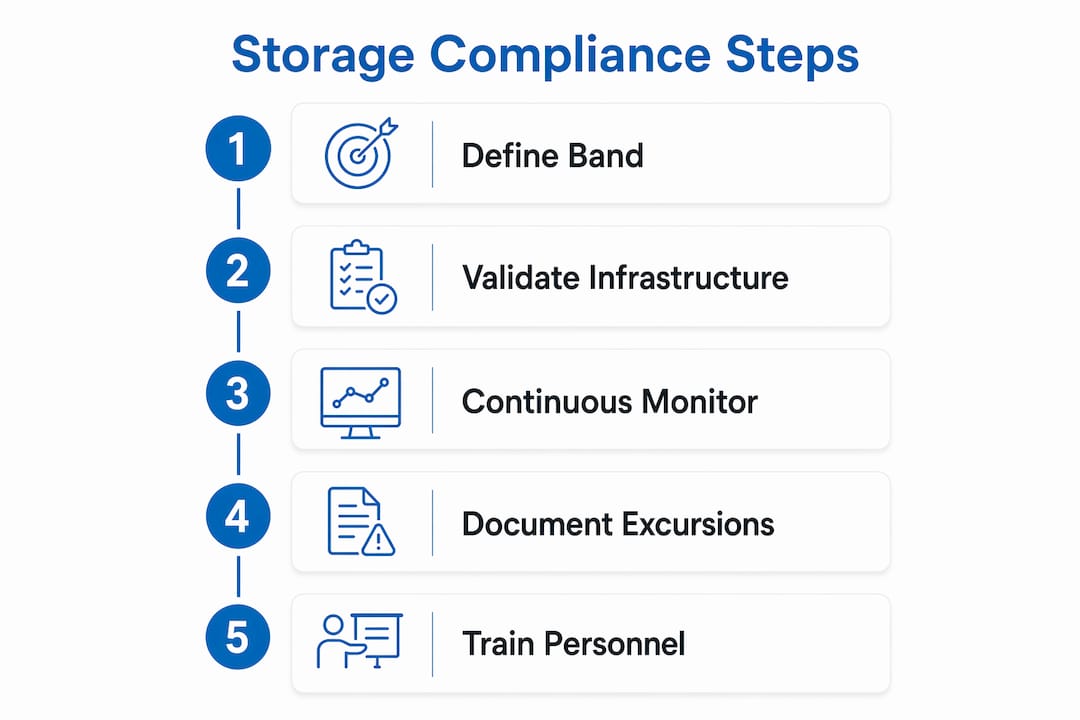
Before approving any storage site, check these three things first:
- Temperature range: Does the facility maintain the exact band your product requires, verified by mapping data?
- Continuous monitoring: Are calibrated data loggers recording conditions around the clock with tamper-evident audit trails?
- Alarms: Are alarm thresholds set, tested, and routed to responsible personnel who can respond within your excursion window?
Table of Contents
- What are the standard temperature bands in pharmaceutical storage?
- What do U.S. regulations require for temperature-controlled storage?
- How should you build your monitoring and validation infrastructure?
- How do you maintain cold-chain continuity during transport?
- What SOPs and documentation does excursion management require?
- Should you build in-house storage or use a specialist 3PL?
- What are the main cost drivers for temperature-controlled storage?
- What are the most common risks and how do you mitigate them?
- Key Takeaways
- The case for treating compliance evidence as a competitive asset
- Labgistics: validated cold chain logistics for pharmaceutical and healthcare clients
- FAQ
- Useful sources for operational and regulatory follow-up
What are the standard temperature bands in pharmaceutical storage?
Pharmacopeial guidance defines several storage classifications, each tied to product stability data and labeling requirements. Standard temperature band definitions used in U.S. practice are as follows:
| Band | Range | Typical Products | Key Risk |
|---|---|---|---|
| Controlled Room Temperature (CRT) | 20–25°C (68–77°F); excursions to 15–30°C permitted | Solid oral dosage forms, diagnostic kits | Cumulative heat exposure; MKT must stay within limits |
| Refrigerated | 2–8°C (36–46°F) | Vaccines, biologics, insulin | Freezing at lower end; potency loss at upper end |
| Frozen | −20°C (−4°F) or colder | Plasma-derived products, some mRNA vaccines | Thaw cycles; packaging integrity |
| Cryogenic | −80°C or colder; liquid nitrogen at −196°C | Cell therapies, certain biologics | Dewar failure; personnel safety |
Mean Kinetic Temperature (MKT) is the tool used to assess the cumulative thermal impact of short-term excursions on CRT products. USP GC1079.2 is explicit: MKT is a mathematical assessment tool, not a substitute for maintaining products within labeled ranges. Repeated reliance on MKT to justify excursions signals a system failure requiring corrective action, not a calculation exercise.
For controlled room temperature logistics, the permitted excursion language on a label does not mean excursions are acceptable by default. Stability data must support any disposition decision.
What do U.S. regulations require for temperature-controlled storage?
FDA and USP set the compliance floor for pharmaceutical storage and distribution in the United States. Three frameworks matter most to logistics managers.
USP baseline protections. When no monograph specifies storage limits, USP guidance requires protection from freezing, excessive heat, and moisture. Treat this as the minimum, then layer product-specific stability data on top.
21 CFR transport requirements. FDA HHS rules under § 1.908 require that vehicles and transport equipment be designed, maintained, and pre-cooled to provide adequate temperature control. Sanitation, recordkeeping, and the ability to demonstrate temperature maintenance during transit are all mandatory, not optional.
Written procedures for shippers. 21 CFR Part 1 Subpart O requires shippers to specify operating temperatures in writing and maintain written procedures for every controlled-temperature shipment. GDP-style expectations follow the same logic: written SOPs, calibrated monitoring, alarm management, and documented management reporting for every excursion.
For biological products, 21 CFR § 600.15 sets product-specific shipment temperatures, including −18°C or colder for cryoprecipitate and specific platelet ranges depending on label storage conditions.
Key compliance point: USP quality experts recommend treating USP guidance as the minimum baseline when labeling or monograph limits are absent, then tailoring controls to each product’s individual stability profile.
How should you build your monitoring and validation infrastructure?
The physical infrastructure of temperature-controlled storage units is only as reliable as the qualification evidence behind it. Primary infrastructure includes cold rooms, monitored refrigerators and freezers, qualified passive and active shippers, conditioned loading docks, and backup power systems.
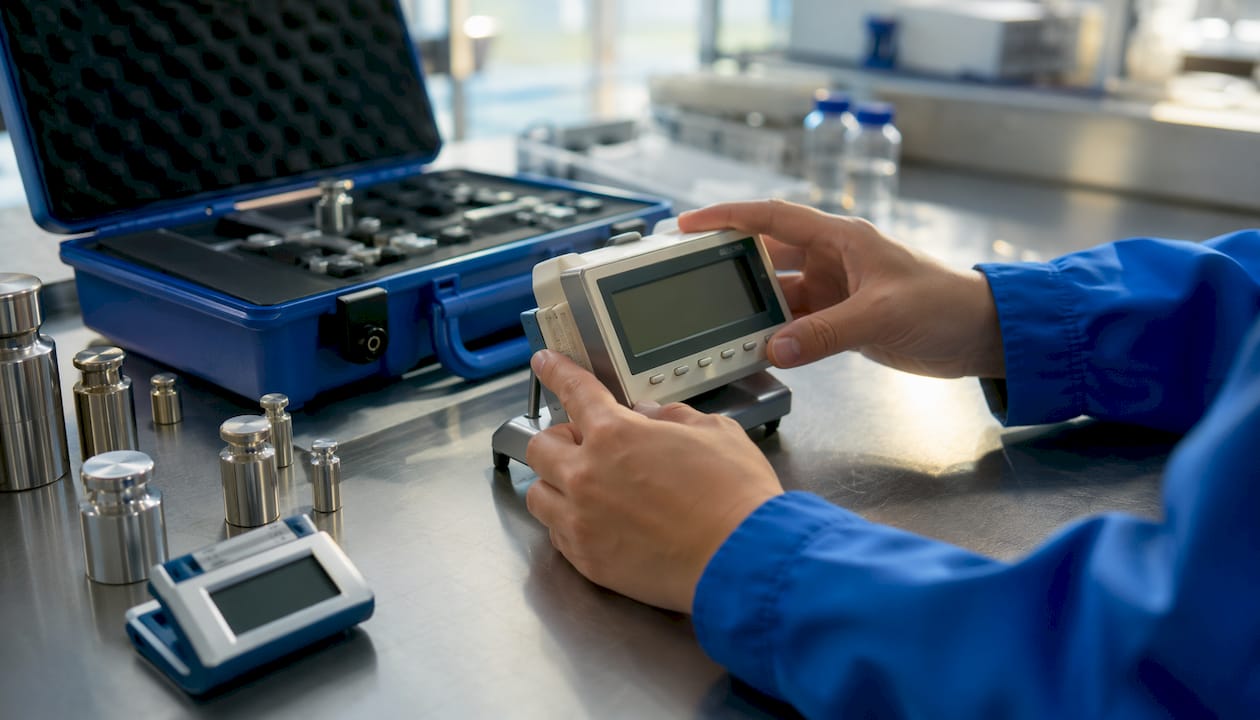
Monitoring architecture must include continuous data logging, calibrated sensors, centralized alarm routing, and tamper-evident audit trails. USPNF chapter 1083.2 requires that monitoring devices have documented SOPs covering calibration frequency, monitoring intervals, data interpretation, and alarm handling. Annual calibration is the typical baseline, though higher-risk applications often require more frequent verification.
Validation follows the IQ/OQ/PQ sequence:
- IQ (Installation Qualification): Confirms equipment is installed per specification.
- OQ (Operational Qualification): Verifies the system operates within defined parameters under controlled conditions.
- PQ (Performance Qualification): Demonstrates the system performs consistently under actual or simulated operational conditions, including full load, seasonal extremes, and worst-case scenarios.
Temperature mapping is the foundation of PQ. USP GC1079.4 recommends adding 5–10% extra calibrated sensors during mapping to reduce the risk of blind spots from device failure or data gaps. Corners, high-density racking areas, and zones near HVAC units or loading doors are the locations most likely to show thermal variability.
Pro Tip: Humidity control is not automatically included in temperature-controlled storage. USP GC1079.4 warns that humidity is frequently overlooked and must be validated separately whenever product or packaging stability requires it. If your product label or stability data references moisture sensitivity, add humidity sensors to your mapping protocol and set discrete alarm thresholds.
How do you maintain cold-chain continuity during transport?
Temperature control does not pause between the warehouse door and the delivery point. USP Good Storage and Shipping Practices notes that thermal hazards during shipping are system-dependent, meaning packaging selection must account for route, transit time, season, and carrier type.
Passive shippers use phase-change materials or insulated foam to maintain temperature without power. Active shippers use refrigeration units and are suited for longer lanes or high-value biologics. Dry ice is common for frozen products but requires validated loading procedures and carrier compliance with DOT hazardous materials rules.
Shipping documentation checklist:
- Pre-cool verification record for the vehicle or shipper
- Temperature data logger placement confirmation
- Chain-of-custody notes at each handoff point
- Conditioned loading evidence (ambient temperature at time of loading)
- Validated shipping window confirmation for the route and season
USPNF 1083.2 PQ protocol elements require that route, packaging, payload location, and monitoring frequency all be addressed in the qualification study. Seasonal re-qualification is required when summer and winter temperature profiles differ significantly along a lane.
Pro Tip: Pre-condition shippers to the target temperature range before loading, not after. Placing warm product into a cold shipper and relying on the phase-change material to compensate shortens the validated window and increases excursion risk at the margins of long routes. For practical guidance on handling temperature-sensitive shipments, pre-conditioning is the single highest-leverage step most teams underinvest in.
What SOPs and documentation does excursion management require?
Every temperature-controlled operation needs written procedures covering at minimum:
- Receipt and incoming inspection (temperature verification on arrival)
- Storage assignment and segregation by temperature band
- Monitoring and calibration schedules
- Excursion detection, quarantine, and disposition
- Training records and management notification protocols
When an excursion occurs, the response sequence is: detect the breach via alarm or data review, quarantine the affected product immediately, assess using MKT and product-specific stability data, document the full temperature record and chain of custody, notify QA and regulatory affairs, and initiate a corrective and preventive action (CAPA) if the root cause indicates a systemic failure. Stability data from the manufacturer informs whether the product can be released, held for further testing, or destroyed.
HIPAA-compliant recordkeeping practices for patient-linked deliveries add another documentation layer: chain-of-custody records must be retained in a manner that protects patient privacy while remaining auditable by regulators.
Training is not a one-time event. Personnel who handle temperature-sensitive products, respond to alarms, or make disposition decisions must be trained on current SOPs and re-trained whenever procedures change.
Should you build in-house storage or use a specialist 3PL?
The build-vs-buy decision turns on five factors: volume profile, SKU diversity and stability requirements, capital versus operating cost tolerance, regulatory burden, and geographic reach.
Factors favoring in-house storage:
- High, stable volume with a narrow SKU range and predictable demand
- Existing validated infrastructure with qualified personnel
- Regulatory preference for direct control over all distribution activities
Factors favoring a specialist 3PL cold chain provider:
- Variable volume, multiple temperature bands, or rapid geographic expansion
- Insufficient capital for PQ-validated cold rooms and backup power
- No internal team with IQ/OQ/PQ expertise
When evaluating a 3PL, ask these questions:
- Can you provide current PQ reports for all storage zones and vehicles?
- What is your continuous monitoring architecture, and how are alarms routed after hours?
- What are your calibration service intervals and documentation practices?
- What is your contingency plan for power failure or equipment breakdown?
- Can you share a sample excursion report and CAPA record?
Red flags that should push you toward outsourcing: no PQ evidence on file, monitoring that relies on manual checks rather than continuous data logging, and no documented emergency power protocol. For a structured 3PL selection checklist, those three gaps alone represent unacceptable regulatory exposure.
What are the main cost drivers for temperature-controlled storage?
| Cost Category | Components | How It Scales |
|---|---|---|
| Capital expenditure (CapEx) | Cold rooms, refrigeration units, backup generators, monitoring hardware | Scales with number of temperature zones and facility size |
| Operating expenditure (OpEx) | Energy (HVAC, freezers), labor, consumables, packaging materials | Freezer energy costs are disproportionately high vs. refrigerated |
| Compliance services | Calibration, validation/PQ, mapping studies, audit support | Increases with SKU diversity and number of storage zones |
| Penalty and remediation costs | Product loss from excursions, regulatory action, recall costs | Highly variable; a single excursion event can exceed annual compliance spend |
Centralized storage reduces capital cost but increases transport risk and last-mile complexity. Regional storage improves responsiveness but multiplies validation and monitoring overhead. The right balance depends on your distribution network and the stability windows of your highest-risk products.
What are the most common risks and how do you mitigate them?
Common risks in temperature-controlled storage fall into four categories: mechanical failure, inadequate mapping, packaging failure, and human error. Each has a distinct root cause and mitigation path.
- Mechanical failure: HVAC or refrigeration breakdown. Mitigate with redundant systems, backup power, and alarm response SLAs.
- Inadequate mapping: Blind spots in cold rooms or vehicles. Mitigate with 5–10% extra sensors during PQ and seasonal re-mapping.
- Packaging failure: Shipper breach during transit. Mitigate with validated shipping windows and route-specific packaging qualification.
- Human error: Incorrect storage assignment or missed alarm response. Mitigate with training, clear SOPs, and automated alarm escalation.
Emergency checklist for an active excursion:
- Secure and quarantine affected product immediately.
- Preserve all temperature records and data logger evidence.
- Document the full chain of custody from last confirmed in-range reading.
- Notify QA and regulatory affairs per your SOP timeline.
- Begin CAPA to identify root cause and prevent recurrence.
For reverse logistics scenarios where excursion-affected product must be returned or destroyed, documentation from step 3 is the evidentiary foundation for any regulatory submission.
Key Takeaways
Temperature-controlled storage requires validated infrastructure, continuous monitoring, written SOPs, and documented qualification evidence at every stage of the cold chain.
| Point | Details |
|---|---|
| Define the band first | Match storage conditions to labeled range; use USP baseline when no monograph limits exist. |
| Validate before you operate | IQ/OQ/PQ and temperature mapping are required, not optional, for every storage zone and vehicle. |
| Monitor continuously | Calibrated data loggers with tamper-evident audit trails and tested alarm routing are the minimum standard. |
| Manage excursions by protocol | Quarantine, assess with MKT and stability data, document, notify QA, and initiate CAPA every time. |
| Labgistics as your 3PL partner | Labgistics provides validated cold chain warehousing and distribution with full compliance documentation for pharmaceutical and healthcare clients. |
The case for treating compliance evidence as a competitive asset
The conventional wisdom in pharmaceutical logistics treats validation documentation as a regulatory burden. That framing is backward. PQ reports, calibration logs, and excursion records are the only objective evidence that a storage system actually performs as claimed. Facilities that maintain meticulous documentation do not just satisfy auditors; they make faster, more defensible disposition decisions when excursions occur, which directly limits product loss and regulatory exposure.
The gap between facilities that claim temperature control and those that can prove it is wider than most managers assume. Continuous monitoring data, mapped qualification studies, and traceable calibration records are what separate a defensible cold chain from a liability. When evaluating any storage partner, ask for the evidence first, not the marketing materials.
Labgistics: validated cold chain logistics for pharmaceutical and healthcare clients
Healthcare logistics managers who have read this far understand the compliance requirements. The harder question is finding a partner who can actually meet them with documented evidence.

Labgistics brings over 20 years of experience in specialized healthcare logistics, operating fully accredited distribution centers with validated cold chain infrastructure across multiple temperature bands. The difference from a general 3PL is concrete: Labgistics maintains PQ-validated storage zones, continuous monitoring with calibrated data loggers, and documented calibration and excursion management protocols aligned with USP and FDA expectations. For pharmaceutical companies and healthcare providers who need a compliant pharma warehousing partner with the audit trail to prove it, Labgistics is the direct path. Contact Labgistics to request a facility qualification summary and discuss your temperature-controlled storage requirements.
FAQ
What is temperature controlled storage in pharma?
Temperature-controlled storage is the practice of maintaining pharmaceutical products within a defined temperature range to preserve stability, safety, and label claims, with USP requiring protection from freezing, excessive heat, and moisture when no monograph limits are specified.
What temperature bands apply to refrigerated pharmaceuticals?
The standard refrigerated band is 2–8°C (36–46°F), covering vaccines, biologics, and insulin; frozen products require −20°C or colder, and cryogenic storage operates at −80°C or below.
How does temperature mapping work for storage facilities?
Temperature mapping places calibrated sensors throughout a storage space during PQ to identify hot and cold spots; USP guidance recommends adding 5–10% extra sensors to reduce blind spots from device failure.
When should a pharma company use a 3PL for cold chain storage?
A specialist 3PL is the better choice when volume is variable, multiple temperature bands are required, or the company lacks the capital and qualified personnel to build and maintain PQ-validated cold chain infrastructure internally.
What are the authoritative references for temperature-controlled storage?
Primary references include USP General Chapter 1079 (risks and mitigation for storage and transport), USP GC1079.2 (MKT guidance), USPNF 1083.2 (environmental conditions management and PQ), and 21 CFR Part 1 Subpart O and § 600.15 for U.S. transport requirements.
Useful sources for operational and regulatory follow-up
Logistics managers implementing or auditing temperature-controlled storage should consult these primary references:
- USP GC1079 Risks and Mitigation Strategies: The foundational USP chapter on storage and transport risks; covers qualification, packaging, monitoring, and excursion management.
- USPNF 1083.2 Environmental Conditions Management: Detailed PQ requirements, mapping protocols, monitoring device placement, and acceptance criteria.
- USP GC1079.2 MKT Guidance: MKT calculation methodology and the regulatory caution against using MKT to excuse repeated excursions.
- USP GC1079.4 Packaging and Mapping Guidance: Humidity control validation, sensor redundancy during mapping, and PQ best practices.
- 21 CFR § 600.15: Product-specific shipment temperature requirements for biological products under U.S. law.
- 21 CFR Part 1 Subpart O: U.S. transport operations requirements including written procedures and operating temperature specifications.
- Labgistics pharmaceutical warehousing guide: Practical compliance guidance and service capabilities for managers evaluating a vetted 3PL partner.
Recommended
- Controlled Room Temperature Logistics: A Pharma Guide
- Pharmaceutical Warehousing Explained: A Compliance Guide
- How to Handle Temperature-Sensitive Shipments in Healthcare
- Why cold chain is crucial for safe pharma logistics