
Specialized logistics is defined as the management of complex, regulated shipments through purpose-built infrastructure, embedded compliance expertise, and tailored service protocols. For healthcare professionals and decision-makers, why choose specialized logistics over a generalist provider comes down to one non-negotiable reality: pharmaceutical products, medical devices, and life science materials cannot tolerate the operational gaps that standard freight services routinely produce. Providers like Labgistics, operating across Southeast Asia with over 20 years of experience, demonstrate that integrating cold chain logistics, cGMP-compliant warehousing, and regulatory services into a single accountable platform is not a convenience. It is a clinical and commercial necessity.
What are the key operational advantages of specialized logistics?
Specialized logistics providers deliver measurable cost and performance gains that generalist carriers cannot replicate. Vertical 3PL networks cut shipping costs by 54% and improve delivery times by 38% compared to generalist providers, with 99.7% order accuracy reducing returns processing costs significantly. For healthcare supply chains, where a single spoiled shipment can delay patient care or trigger a regulatory investigation, that accuracy figure carries consequences far beyond a refund.
The operational gains extend beyond shipping rates. 68% of shippers report improved logistics effectiveness and lower total supply chain costs when partnering with specialized 3PLs. That improvement comes from removing fixed overhead: specialized providers supply the warehouse management systems (WMS), transportation management systems (TMS), and trained staff that healthcare organizations would otherwise fund internally.

Specialized providers also bring integrated carrier networks that improve transport reliability across Southeast Asia’s complex multi-country corridors. A Singapore-based 3PL warehouse with established routes into Indonesia, Malaysia, Thailand, and Vietnam removes the coordination burden that in-house logistics teams face when managing multiple freight relationships. The result is fewer handoffs, faster customs clearance, and more predictable delivery windows.
Key operational benefits include:
- Order accuracy: Near-perfect fulfillment rates reduce costly returns and product write-offs.
- Overhead elimination: No fixed investment in warehouse staff, WMS licenses, or TMS platforms.
- Carrier network depth: Pre-negotiated rates and established relationships across regional lanes.
- Scalability: Capacity adjusts to product launches, clinical trial phases, and seasonal demand without capital expenditure.
Pro Tip: When evaluating a logistics company in Singapore, ask for documented order accuracy rates and carrier network coverage maps. Providers that cannot produce these figures on request are unlikely to meet pharmaceutical-grade service standards.
How does specialized logistics ensure regulatory compliance and risk management?
Regulatory compliance is not a feature that specialized logistics providers add to their services. It is the foundation their operations are built on. Embedded regulatory expertise allows specialized logistics to act as an extension of a manufacturer’s quality assurance department, preventing penalties and product loss before a shipment ever leaves the warehouse.
Specialized pharmaceutical logistics providers customize their SOPs fully around cGMP mandates and healthcare regulatory requirements. This means temperature excursion protocols, chain-of-custody documentation, and deviation reporting are built into daily operations, not triggered reactively after a problem surfaces. For decision-makers managing product registration in Singapore or across Southeast Asia, this embedded discipline directly reduces the risk of shipment holds and regulatory penalties.
“Specialized logistics providers that integrate freight forwarding, customs brokerage, and cGMP warehousing into one platform reduce handoffs and improve supply chain visibility under a single accountable partner.” — Euro-American Worldwide Logistics
Cold chain continuity is the most visible expression of this compliance discipline. Cold chain logistics failures are not just operational setbacks. They are patient safety events. Specialized providers maintain validated cold rooms, redundant power systems, and calibrated monitoring equipment as standard infrastructure. Generalist warehouses in Singapore or across the region typically do not.
The compliance advantages of specialized logistics include:
- cGMP-compliant warehousing: Validated environments with documented temperature and humidity controls.
- Integrated customs brokerage: Reduces shipment holds and avoids penalties at Southeast Asian border crossings.
- Hazardous materials handling: Hazardous materials shipment requires ongoing certifications that general carriers often lack. Specialized providers maintain these as core competencies.
- Reduced compliance cost premiums: Compliance handling cost premiums are reduced by 15–20% compared to generalist providers.
- Radioactive material transport: Specialized providers hold the certifications and trained personnel required for radioactive transportation, which generalists cannot legally or safely provide.
Understanding compliance in healthcare logistics across Southeast Asia requires knowledge of country-specific regulatory bodies, import licensing requirements, and product registration timelines. Providers that embed this knowledge operationally protect their clients from the regulatory friction that delays market access and increases costs.
Specialized logistics vs. generalist providers: how do they compare?
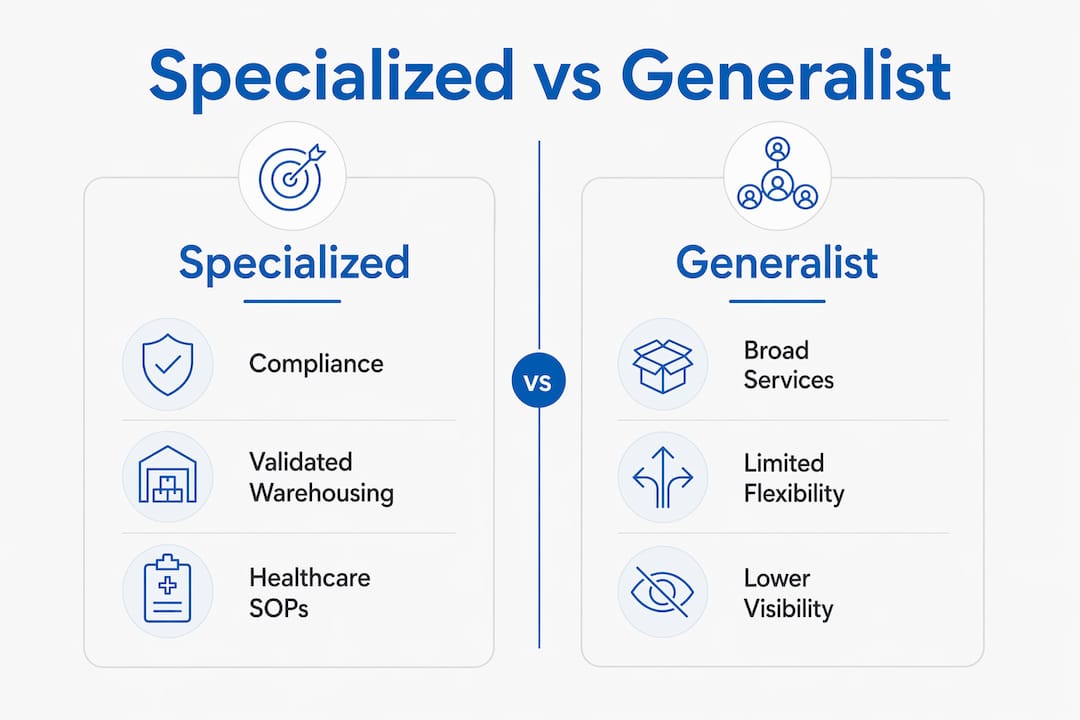
The difference between specialized and generalist logistics providers is not simply a matter of service breadth. It is a difference in operational architecture. Specialized providers offer validated environments with redundant power and active certifications essential for critical healthcare products. Generalist providers typically cannot offer these as standard.
Large global generalist providers lack the flexibility required for clinical trials and market expansion. A pharmaceutical company launching a new product across three Southeast Asian markets simultaneously needs a logistics partner that can adapt SOPs, adjust cold storage capacity, and manage country-specific documentation in parallel. A generalist 3PL warehouse built for consumer goods cannot do this without significant operational drag.
| Capability | Specialized logistics | Generalist provider |
|---|---|---|
| cGMP-compliant warehousing | Standard, validated | Rarely available |
| Cold chain continuity | Redundant systems, monitored 24/7 | Limited or absent |
| Regulatory expertise | Embedded in daily operations | Reactive, outsourced |
| Hazardous and radioactive materials | Certified and trained | Generally not available |
| Clinical trial flexibility | Purpose-built SOPs | Not designed for this |
| Technology integration (WMS/TMS) | Healthcare-specific platforms | Generic systems |
| Customs brokerage | Integrated, proactive | Fragmented, third-party |
| Operational drag risk | Low, documented workflows | High, reactive management |
Technology-enabled providers offer control tower visibility, analytics, and workflow documentation that reduce hidden costs of operational drag and enable better planning. Operational drag, characterized by slow receiving, inaccurate inventory, and reactive customer service, is a hidden cost that decision-makers rarely quantify until it causes a supply disruption. Specialized providers mitigate this through validated environments and documented workflows that generalists do not maintain.
Choosing a logistics provider on price alone ignores these operational drag costs. Technology-enabled partners with proven workflows deliver sustainable growth and service quality that low-cost generalists cannot sustain over time.
What steps should healthcare professionals take when selecting a logistics partner?
Selecting a specialized logistics partner requires a structured evaluation process, not a price comparison. The right provider functions as an extension of your quality assurance and regulatory affairs teams. The wrong one creates liability.
Follow these steps when assessing potential providers:
-
Verify certifications and accreditations. Confirm that the provider holds current Good Distribution Practice (GDP) certification, cGMP compliance documentation, and any country-specific licenses required for your product categories, including medical device regulatory approvals and pharma regulatory services.
-
Assess onboarding and integration capability. Providers with repeatable onboarding playbooks and regulatory validation processes minimize disruption during the critical integration phase. Ask for documented case studies from comparable healthcare clients.
-
Evaluate technology infrastructure. Confirm that the provider operates a healthcare-specific WMS and TMS with real-time visibility, temperature monitoring alerts, and deviation reporting. Generic systems built for retail warehousing are not adequate for pharmaceutical distribution.
-
Examine geographic reach and local expertise. A logistics company in Singapore with regional reach across Southeast Asia provides different value than a local courier. Confirm that the provider has established customs relationships and regulatory knowledge in every market you serve.
-
Test scalability with specific scenarios. Ask how the provider would handle a product launch across three markets simultaneously, or a sudden 40% volume increase during a clinical trial phase. Scalability depends on analytical tools and flexible staffing models, not fleet size alone.
-
Assess cold chain and temperature-sensitive capabilities. Review the provider’s temperature-sensitive shipment protocols, including excursion response times, backup power specifications, and calibration service records.
Pro Tip: Ask every candidate provider to describe their last significant compliance deviation and how they resolved it. Providers with mature quality systems will have a documented corrective action process. Providers without one are a regulatory risk.
Key Takeaways
Specialized logistics providers protect healthcare supply chains by embedding compliance, validated infrastructure, and regulatory expertise into every operational step, not as optional add-ons.
| Point | Details |
|---|---|
| Compliance is built in | Specialized providers embed cGMP and GDP compliance into daily SOPs, not as reactive responses. |
| Cost savings are measurable | Vertical 3PL networks cut shipping costs by 54% and improve delivery times by 38% versus generalists. |
| Generalists carry hidden risks | Operational drag, compliance gaps, and lack of validated environments create costs that price comparisons miss. |
| Technology drives visibility | Control tower platforms and healthcare-specific WMS/TMS systems reduce errors and enable proactive planning. |
| Partner selection requires rigor | Evaluate certifications, onboarding playbooks, technology infrastructure, and scalability before committing. |
The case for treating logistics as a quality function
The healthcare industry has spent decades building quality management systems around manufacturing, clinical trials, and pharmacovigilance. Logistics has often been treated as a separate, transactional function. That separation is where supply chain failures originate.
The providers that deliver the most value in pharmaceutical and medical device distribution are not the ones with the largest fleets or the lowest base rates. They are the ones whose operations are indistinguishable from a quality assurance function. Their deviation logs, temperature records, and chain-of-custody documentation look like GMP batch records because they are built on the same discipline.
The one-size-fits-all model of large generalist providers limits adaptability for healthcare product launches and clinical trials. That limitation is not a minor inconvenience. For a company launching a biologic across Southeast Asia, a logistics partner that cannot adapt its cold chain SOPs to country-specific requirements is a direct threat to product integrity and regulatory approval timelines.
Decision-makers should seek specialized logistics partners that embed compliance as a daily operational discipline rather than a reactive add-on. The providers worth partnering with will not hesitate to show you their validation records, their calibration service logs, and their corrective action history. Transparency at that level is the clearest signal that logistics is being treated as a quality function, not just a cost center.
— Brandcore
Labgistics: specialized healthcare logistics across Southeast Asia
Labgistics brings over 20 years of dedicated experience in pharmaceutical, medical, and life science logistics across Southeast Asia. Its fully accredited distribution centers in Singapore operate under cGMP-compliant conditions, with integrated cold chain logistics, regulatory services, and vendor managed inventory capabilities built for the demands of healthcare supply chains.
For healthcare professionals and decision-makers evaluating their logistics options, Labgistics provides the tailored logistics solutions that generalist providers cannot match. From cold chain continuity and radioactive material transport to product registration support and customs brokerage, every service is designed around the compliance and operational standards that medical and pharmaceutical products require. Learn more about how Labgistics supports pharmaceutical distribution compliance and supply chain reliability across the region.
FAQ
What is specialized logistics in healthcare?
Specialized logistics in healthcare is the management of pharmaceutical, medical device, and life science shipments through purpose-built infrastructure, cGMP-compliant warehousing, cold chain systems, and embedded regulatory expertise. It differs from generalist logistics by treating compliance as a core operational function rather than an add-on service.
Why use specialized logistics instead of a generalist 3PL?
Specialized logistics providers offer validated environments, integrated customs brokerage, and healthcare-specific SOPs that generalist 3PLs cannot provide. Generalist providers carry higher risks of operational drag, compliance failures, and cold chain gaps that create direct costs and regulatory exposure.
How does specialized logistics reduce compliance risk?
Specialized providers embed regulatory expertise into daily operations, maintaining cGMP documentation, deviation reporting, and chain-of-custody records as standard practice. This proactive approach reduces shipment holds, penalties, and product loss compared to reactive compliance management.
What certifications should a specialized healthcare logistics provider hold?
A qualified provider should hold current Good Distribution Practice (GDP) certification, cGMP compliance documentation, hazardous materials handling certifications, and country-specific licenses for every market it serves. Providers handling radioactive materials require additional specialized certifications beyond standard freight qualifications.
How does Labgistics support healthcare logistics in Southeast Asia?
Labgistics operates fully accredited distribution centers in Singapore with integrated cold chain logistics, regulatory services, calibration services, and transportation management tailored for pharmaceutical and medical device clients across Southeast Asia. Its services cover product registration, customs brokerage, and specialized handling of temperature-sensitive and regulated healthcare products.