
Calibration in healthcare logistics is the documented process of measuring, adjusting, and verifying medical and monitoring equipment against recognized standards to guarantee precise and reliable readings. Known formally as metrological calibration, this practice sits at the intersection of regulatory compliance and patient safety. Standards like ISO 13485 Clause 7.6 and FDA 21 CFR Part 820 make calibration mandatory for any organization providing evidence of product conformity. Without it, temperature sensors drift, weight scales give false readings, and the entire integrity of a healthcare supply chain is at risk.
What is calibration in healthcare logistics?
Calibration is defined by the International Vocabulary of Metrology as the process of comparing equipment readings against certified reference standards under defined conditions, then adjusting and documenting the before and after states. That definition matters because it separates calibration from two related but distinct activities: verification and validation. Verification is a review without adjustment. Validation confirms a system performs as intended across its full operating range. Calibration does both the measuring and the correcting, then records every step.
In healthcare logistics, this applies to a specific and critical set of instruments. Temperature data loggers in cold chain transport, humidity sensors in pharmaceutical warehouses, weight scales used for dosage packaging, and pressure gauges in sterile storage environments all require regular calibration. Each of these instruments directly affects product quality and, by extension, patient safety.
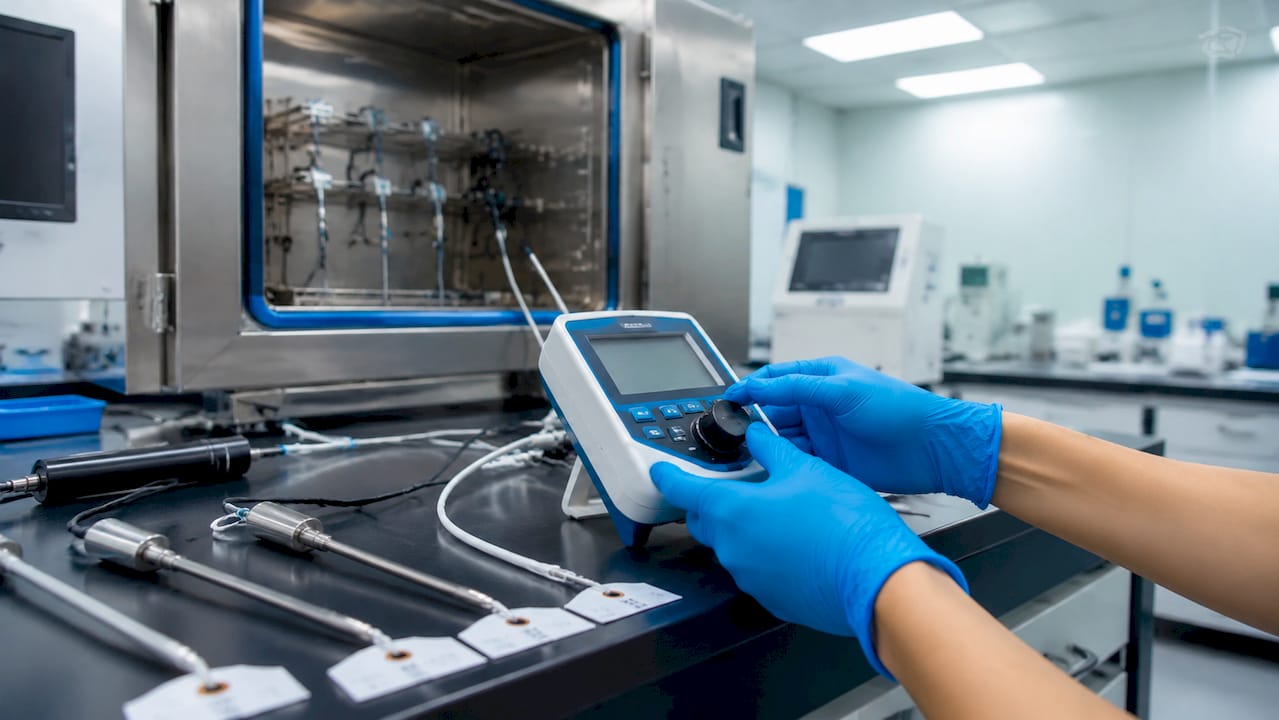
The term “calibration services” in a logistics context refers to the full program: scheduling, executing, documenting, and reviewing calibration events across an organization’s entire instrument inventory. For logistics companies operating as 3PL providers in Singapore and across Southeast Asia, this program is not optional. It is a condition of operating within regulated healthcare supply chains.
What regulatory standards govern calibration in healthcare logistics?
ISO 13485:2016 Clause 7.6 and FDA 21 CFR Part 820 impose mandatory, documented calibration cycles on all equipment that provides product conformity evidence. The FDA’s updated Quality Management System Regulation (QMSR) made calibration compliance a formal requirement beginning february 2, 2026, raising the stakes for any healthcare logistics operation handling medical devices.
Both frameworks share a common requirement: traceability. Every calibration must trace back to a national or international measurement standard, such as those maintained by NIST in the United States or the relevant national metrology institute in the country of operation. For Singapore-based operations, this means alignment with standards recognized by the Health Sciences Authority (HSA) and the Singapore Accreditation Council.
ISO/IEC 17025 accredited calibration laboratories provide the technical rigor needed to manage instrument drift, which is the gradual and often undetected loss of accuracy in equipment over time. ISO/IEC 17025 accreditation is preferred in healthcare logistics over general quality frameworks like ISO 9001 because it specifically addresses measurement competence.
Key documentation requirements under these frameworks include:
- Calibration schedule with defined intervals for each instrument
- As-found records showing the instrument’s state before any adjustment
- As-left records confirming the state after calibration
- Reference standard traceability documentation linking to national or international standards
- Out-of-tolerance reports with impact assessments on previously released products
- Calibrator identity and qualifications for the person performing the calibration
Pro Tip: Maintain a master equipment list that links each instrument to its calibration schedule, responsible party, and last calibration date. Auditors from HSA, WHO, or PIC/S GDP inspectors will request this document first.
How does the calibration process work in healthcare logistics?
A compliant calibration record must include the device ID, dates, calibrator identity, reference standard traceability, as-found and as-left results, adjustments made, and impact assessments if the instrument was found out of tolerance. That level of documentation detail is not bureaucratic excess. It is the legal and regulatory foundation that protects both the organization and the patients who depend on accurate measurements.
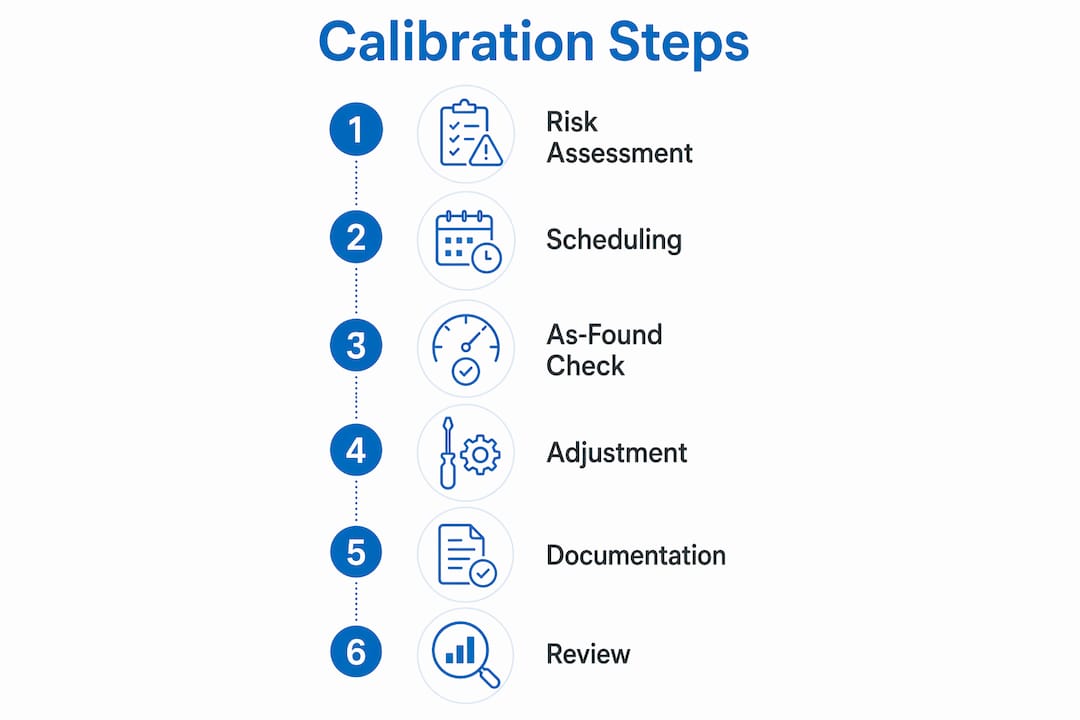
The calibration process in a healthcare logistics setting follows a defined sequence:
- Identify the instrument using its unique device ID and confirm it is due for calibration based on the current schedule.
- Record as-found measurements by comparing the instrument’s current readings against a certified reference standard without making any adjustments first.
- Assess tolerance by determining whether the as-found readings fall within the acceptable range specified for that instrument.
- Perform adjustment if the instrument is out of tolerance, then re-measure to confirm the correction was effective.
- Record as-left measurements to document the instrument’s state after calibration is complete.
- Complete the calibration certificate with all required fields, including the reference standard used and its own traceability documentation.
- Conduct an impact assessment if the instrument was found significantly out of tolerance, to determine whether products measured during the out-of-tolerance period were affected.
- Update the master equipment list and schedule the next calibration event based on risk assessment findings.
Frequency is not a fixed annual default. Risk-based calibration intervals informed by usage intensity and environmental factors yield more effective and cost-efficient schedules than fixed intervals. A temperature sensor in a high-humidity tropical warehouse may require quarterly calibration, while a low-use reference thermometer in a controlled environment may be calibrated annually.
Pro Tip: Always perform as-found measurements before touching the instrument. Skipping this step eliminates your ability to assess whether previous measurements were valid, which is a critical audit failure point.
What are the critical applications of calibration in healthcare logistics?
Calibration supports specific, high-stakes functions across the healthcare supply chain. The table below illustrates the most common applications and the instruments involved.
| Application | Instruments Calibrated | Regulatory Reference | Risk if Uncalibrated |
|---|---|---|---|
| Cold chain pharmaceutical transport | Temperature data loggers, sensors | WHO TRS 961, EU GDP | Product spoilage, patient harm |
| Pharmaceutical warehousing | Humidity sensors, thermometers | ISO 13485, HSA GDP | Storage condition violations |
| Dosage packaging and dispensing | Weight scales, balances | FDA 21 CFR Part 820 | Incorrect dosing, product recalls |
| Clinical trial logistics | Specialized monitoring devices | ICH E6(R2), ISO 13485 | Data integrity failures |
| Sterile product storage | Pressure gauges, differential sensors | PIC/S GDP Guide | Contamination risk |
Cold chain validation is one of the most demanding calibration contexts in healthcare logistics. Cold chain validation requires at least three shipments per season per route with calibrated devices placed at critical locations. This requirement, drawn from WHO TRS 961 and EU GDP guidelines, means that the calibration status of every temperature monitoring device used in those qualification runs must be current and documented before the run begins.
For pharmaceutical companies distributing temperature-sensitive products across Southeast Asia, this is a practical challenge. Routes from Singapore to markets in Indonesia, Vietnam, or the Philippines involve multiple transit environments, each with different ambient conditions. Every data logger placed in those shipments must carry a valid calibration certificate. Learn more about handling temperature-sensitive shipments to understand how calibration fits within the broader cold chain management framework.
Weight scale calibration is equally consequential. In packaging operations, an uncalibrated scale can result in under-filled or over-filled product units. For pharmaceutical products, that is a direct patient safety issue and a regulatory violation. Clinical trial logistics adds another layer of complexity, as data integrity requirements under ICH E6(R2) demand that every measurement instrument used in a trial has a documented calibration history.
How does digital record-keeping enhance calibration management?
Paper logs lack the searchable, timestamped, and digitally signed records that modern auditors require. This is not a minor inconvenience. During an HSA or PIC/S GDP inspection, the inability to retrieve a specific calibration record within minutes can result in a critical observation. Digital systems eliminate that risk.
Modern healthcare logistics operations are moving to Computerized Maintenance Management Systems (CMMS) and Laboratory Information Management Systems (LIMS) to manage calibration programs. These platforms provide:
- Automated scheduling alerts that notify responsible staff when calibration is due, preventing overdue instruments from remaining in service
- Digital signatures that meet 21 CFR Part 11 requirements for electronic records in regulated environments
- Audit trails that log every access, edit, and approval action on a calibration record
- Traceability links connecting each calibration event to the reference standard used and its own certification
- Dashboard reporting that gives QA managers a real-time view of calibration status across the entire instrument inventory
CMMS and LIMS platforms enable digital signatures, traceability, and comprehensive audit reports for calibration events. For a 3PL warehouse in Singapore managing hundreds of instruments across multiple temperature zones, this capability is the difference between a manageable compliance program and an uncontrollable paper trail. Partner platforms like Labrynix offer LIMS integration options that support HL7 and FHIR standards, which is relevant for healthcare logistics operations that need to connect calibration data with broader quality management systems.
The shift to digital also addresses the issue of instrument drift detection. When calibration data is stored digitally over time, trend analysis becomes possible. A sensor that consistently reads 0.3°C high before each calibration event is showing a drift pattern that a paper log would never reveal. Digital systems surface these patterns, allowing QA teams to adjust calibration intervals before an out-of-tolerance event occurs.
What challenges do QA professionals face in calibration programs?
A 2025 study from NCBI found that healthcare logistics professionals face a confidence gap in device-specific calibration tasks despite understanding calibration’s importance. That gap points directly to training deficits. Knowing that calibration matters is not the same as knowing how to perform it correctly, document it completely, or respond appropriately when an instrument is found out of tolerance.
Calibration differs from preventive maintenance: calibration adjusts measurement accuracy, while preventive maintenance addresses mechanical and operational safety. Both have separate documentation requirements under ISO 13485. Conflating the two is a common audit finding and one that is entirely avoidable with proper training and clear SOPs.
Common challenges QA professionals encounter include:
- Fixed-interval scheduling that ignores usage patterns and environmental conditions, leading to either over-calibration or missed out-of-tolerance events
- Incomplete as-found documentation when technicians adjust instruments before recording the initial state
- Inadequate impact assessments when out-of-tolerance instruments are discovered, leaving the organization unable to demonstrate that affected products were reviewed
- Seasonal calibration gaps in tropical climates where humidity and temperature fluctuations affect instrument performance between scheduled calibration events
- Staff turnover that breaks institutional knowledge of calibration procedures and equipment-specific requirements
Pro Tip: Build your calibration program around risk assessments, not calendars. Classify each instrument by its criticality to product quality and patient safety, then set intervals accordingly. This approach is more defensible to auditors and more cost-effective in practice.
For audit-ready documentation practices specific to Singapore’s GDP and GDPMDS inspection requirements, the calibration records guide from Labgistics provides a practical framework for QA teams preparing for regulatory inspections.
Key takeaways
Calibration in healthcare logistics is a mandatory, documented quality process that directly protects patient safety, supports regulatory compliance, and maintains the integrity of every measurement made across the supply chain.
| Point | Details |
|---|---|
| Calibration is legally mandated | ISO 13485 Clause 7.6 and FDA 21 CFR Part 820 require documented calibration for all conformity-critical instruments. |
| As-found records are non-negotiable | Recording instrument state before adjustment is required for valid impact assessments and audit defense. |
| Risk-based intervals outperform fixed schedules | Calibration frequency should reflect usage intensity and environmental conditions, not default annual cycles. |
| Digital systems are now the compliance standard | CMMS and LIMS platforms provide the audit trails, digital signatures, and traceability that paper logs cannot. |
| Training gaps are the leading program failure point | A 2025 NCBI study confirms that confidence in device-specific calibration tasks remains low despite awareness of its importance. |
Calibration is the compliance floor, not the ceiling
After working closely with healthcare logistics operations across Southeast Asia, one pattern stands out clearly. Most organizations understand that calibration is required. Far fewer treat it as a quality intelligence tool.
The conventional view is that calibration is a compliance checkbox. You calibrate on schedule, file the certificate, and move on. That framing misses the most valuable output of a well-run calibration program: trend data. When you track as-found readings over multiple calibration cycles, you start to see which instruments are drifting fastest, which environments are hardest on equipment, and where your risk is actually concentrated. That information should be driving your calibration intervals, your procurement decisions, and your preventive maintenance schedules.
The confidence gap identified in the 2025 NCBI research is real, and it is more consequential than most QA managers acknowledge. A technician who understands the regulatory requirement but is uncertain about the technical execution will cut corners under time pressure. The as-found step gets skipped. The impact assessment gets a generic response. The audit trail looks complete but is not defensible. Closing that gap requires structured, device-specific training, not just annual competency sign-offs.
The regulatory direction is also clear. The FDA’s QMSR update in 2026 and the continued evolution of PIC/S GDP standards signal that calibration documentation requirements will only become more detailed. Organizations that have already moved to digital calibration management systems are positioned to absorb those changes without operational disruption. Those still running paper-based programs are accumulating compliance debt that will eventually come due during an inspection.
The most effective calibration programs treat the process as a continuous quality signal, not an administrative obligation.
— Brandcore
How Labgistics supports calibration and compliance in healthcare logistics
Maintaining a compliant calibration program across a complex healthcare supply chain requires more than good intentions. It requires infrastructure, expertise, and systems built specifically for regulated environments.
Labgistics brings over 20 years of experience in healthcare logistics across Southeast Asia, with dedicated calibration and validation services designed to meet ISO 13485, HSA GDP, and PIC/S GDP requirements. From temperature and humidity instrument calibration to full cold chain validation protocols, Labgistics supports pharmaceutical companies, medical device manufacturers, and 3PL operations in maintaining audit-ready compliance programs. Explore how tailored logistics solutions from Labgistics can support your calibration program and quality assurance objectives across the region.
FAQ
What is calibration in healthcare logistics?
Calibration in healthcare logistics is the process of comparing measurement instruments against certified reference standards, adjusting them as needed, and documenting both the before and after states. It is mandatory under ISO 13485 and FDA 21 CFR Part 820 for all equipment providing product conformity evidence.
Why is calibration important in healthcare supply chains?
Calibration directly protects patient safety by ensuring that temperature sensors, weight scales, and monitoring devices provide accurate readings. Inaccurate instruments can cause product spoilage, incorrect dosing, and regulatory non-compliance.
What is the difference between calibration and verification?
Calibration involves adjustment plus documentation of as-found and as-left states, while verification is a review without adjustment. Both are defined separately under ISO 13485 and the International Vocabulary of Metrology.
How often should instruments be calibrated in healthcare logistics?
Calibration frequency should be determined by risk assessment, not fixed annual defaults. Instruments exposed to high humidity, heavy use, or critical measurement functions require shorter intervals than low-use reference instruments in controlled environments.
What records are required for a compliant calibration program?
A compliant calibration record must include the device ID, calibration dates, calibrator identity, reference standard traceability, as-found and as-left results, any adjustments made, and an impact assessment if the instrument was found out of tolerance.