
Lab inventory management is defined as the systematic tracking, organizing, and controlling of laboratory supplies, reagents, and equipment to maintain accurate stock levels, support regulatory compliance, and protect research reproducibility. Without a structured approach, even well-funded labs lose time and money to stock-outs, expired reagents, and failed audits. Spreadsheets become ineffective for labs with 30 or more scientists, triggering duplicate orders and critical supply gaps. This guide to inventory management in labs covers the tools, processes, and practices that lab managers and technicians need to build a system that scales with their work.
What does a guide to inventory management in labs actually cover?
Inventory control in laboratories goes beyond counting bottles on a shelf. It is the practice of knowing exactly what you have, where it is stored, when it expires, and when to reorder. The industry term for this discipline is laboratory inventory management, and it sits at the intersection of operations, quality assurance, and regulatory compliance.
Effective lab stock management produces three measurable outcomes. First, it reduces waste from expired or overstocked consumables. Second, it prevents research delays caused by unexpected stock-outs. Third, it creates the audit trail that regulatory inspectors and quality teams require. Labs operating in Southeast Asia under frameworks like the Health Sciences Authority (HSA) Good Distribution Practice or PIC/S GDP standards face particularly strict documentation requirements, making inventory discipline non-negotiable.

Inventory must function as a dynamic operational tool rather than a passive ledger. That distinction matters because a passive ledger tells you what you had. A dynamic system tells you what you need next.
What tools and technologies are essential for modern lab inventory management?
When spreadsheets stop working
Many labs start with Microsoft Excel or Google Sheets. That approach works at small scale, but it breaks down quickly. Labs with fewer than 30 scientists can manage with simpler tools, but growth beyond that threshold demands a centralized platform. The core problem with spreadsheets is that they require manual entry, have no real-time sync, and offer no built-in reorder logic.
Barcode and RFID scanning
Barcode scanning integrated with a cloud database is the most cost-effective upgrade for most labs. Barcode scanning with cloud databases reduces manual entry errors and enables real-time stock updates from mobile devices at the bench. RFID goes further by allowing bulk reads without line-of-sight scanning, which is useful for high-volume reagent storage or freezer management.
Dedicated inventory platforms
Two platforms stand out for research and development environments. The Laboratory Inventory Management Engine (LIME) is an open-access platform designed for academic and research labs, offering mobile-first data entry and integration with experimental records. MyAmici targets R&D teams with features including pick-list requests, transfer requests, and integrated purchasing workflows that sync stock levels with supplier pricing in real time.
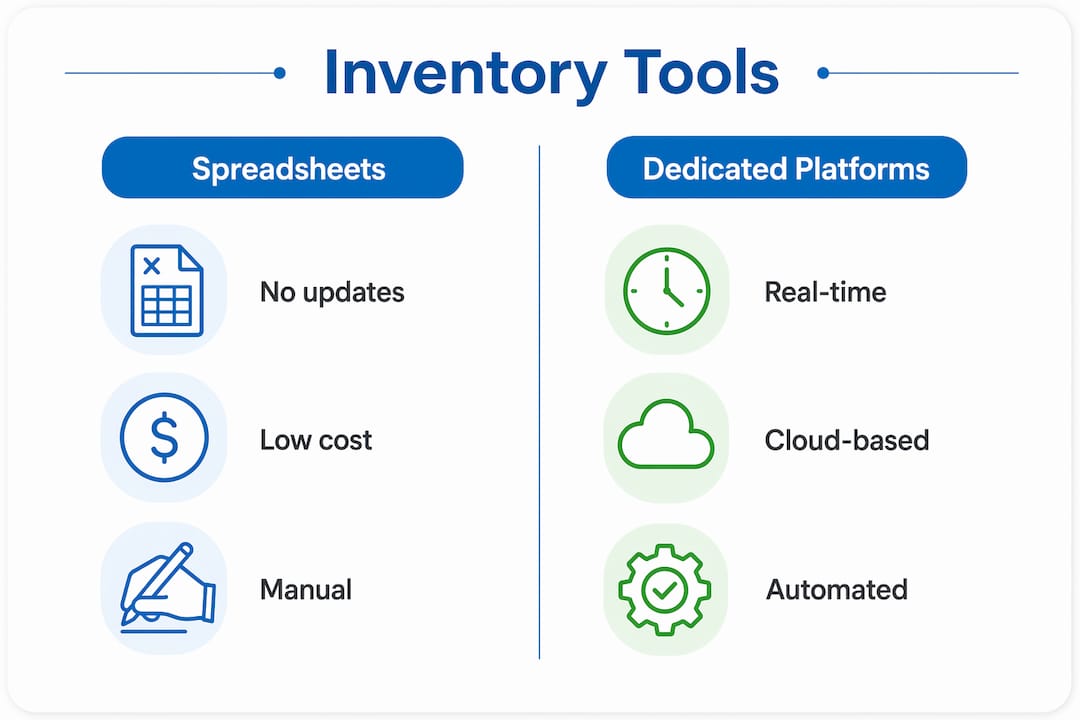
| Feature | Spreadsheets | LIME | MyAmici |
|---|---|---|---|
| Real-time stock updates | No | Yes | Yes |
| Mobile data entry | Limited | Yes | Yes |
| Reorder automation | No | Partial | Yes |
| Purchasing integration | No | No | Yes |
| Best for | Labs under 10 scientists | Academic/research labs | R&D teams with procurement needs |
Pro Tip: Standardize your item metadata, including naming conventions, units of measure, storage location codes, and hazard classifications, before importing any data into a new platform. Inconsistent naming conventions cause false reorder signals and compliance errors that are far harder to fix after the system goes live.
How to establish and maintain robust inventory processes in laboratories
Building reliable inventory workflows requires more than software. It requires defined procedures that every team member follows consistently. The steps below reflect lab inventory best practices for labs of all sizes.
-
Categorize your inventory. Group items by type: reagents, consumables, equipment, and reference standards. Within each category, assign a unique identifier to every stock-keeping unit. This prevents the common error of logging the same item under multiple names.
-
Capture critical data at receipt. When a shipment arrives, record the lot number, expiration date, storage location, supplier, and quantity immediately. Accurate supplier and storage details are the foundation of reliable reorder signals. Missing this step at intake creates gaps that no software can fix retroactively.
-
Implement check-in and check-out workflows. Every time a scientist removes an item from stock, that transaction must be logged in real time. Delayed documentation almost always produces incomplete records and broken inventory trails. Platforms like LIME and MyAmici support mobile check-out directly at the bench, which removes the friction that causes scientists to skip the step.
-
Set dynamic reorder thresholds. Static minimum stock levels become inaccurate as research priorities shift. Review reorder points quarterly and adjust them based on actual consumption data from the previous period. Link reorder thresholds to supplier lead times so the system triggers purchase requests with enough runway to avoid stock-outs.
-
Conduct regular physical audits. Monthly or quarterly physical audits are critical for reconciling recorded stock with actual quantities and maintaining regulatory compliance. High-turnover items such as PCR reagents or cell culture media may require weekly spot checks. Assign audit responsibility to a named team member, not a rotating group, to maintain accountability.
-
Document everything for compliance. Regulatory inspections under HSA or PIC/S GDP frameworks require complete audit trails. Every adjustment, disposal, or transfer must be logged with a timestamp and the responsible user’s credentials.
Pro Tip: Integrate inventory documentation directly into your experimental records at the bench. Recording the reagent name, lot number, and storage condition alongside your protocol data improves both research record reliability and your ability to trace any anomalous result back to its source.
What are the most common mistakes in lab inventory control?
Lab managers consistently encounter the same set of problems when inventory systems fail. Recognizing these patterns is the first step toward preventing them.
-
Delayed documentation at the bench. The disconnect between bench scientists and inventory systems is the single most damaging operational gap in lab stock management. When scientists update records after the fact rather than at the point of use, ghost stock appears and reorder signals become unreliable. The fix is to make real-time logging the path of least resistance, not an additional task.
-
Inconsistent naming conventions. A reagent logged as “PBS 1X,” “Phosphate Buffered Saline,” and “PBS Buffer” in three different entries creates three phantom items in your system. Before any digital migration, audit your item catalog and enforce a single naming standard across all entries.
-
Overstocking and stock-outs from inaccurate thresholds. Labs that set reorder points once and never revisit them end up with freezers full of items they no longer use and empty shelves for items they need weekly. Reorder thresholds must be treated as living data, not fixed parameters.
-
Communication gaps between researchers and procurement. Scientists often order directly from suppliers without notifying the inventory team, creating parallel stock that never enters the system. A centralized pick-list or purchase request workflow, as offered by MyAmici, closes this gap by routing all requests through a single channel.
-
Overwhelming legacy stock during digital transitions. Attempting to digitize years of existing inventory at once causes project failure in most labs. The forward-only logging policy is the proven alternative. Log only new items as they arrive and let legacy stock phase out through normal consumption. This approach reduces administrative burden and gets the system producing accurate data within weeks rather than months.
How does inventory management support research reproducibility and compliance?
Research reproducibility depends directly on knowing the exact materials used in every experiment. Tracking lot numbers and expiration dates is the mechanism that protects experimental consistency. A reagent from a different lot can behave differently in an assay, and an expired standard can invalidate an entire data set. Labs that link inventory records to experimental protocols can trace any anomalous result back to a specific batch, which is the foundation of trustworthy science.
Compliance requirements reinforce this discipline. Regulatory bodies conducting Good Laboratory Practice (GLP) or ISO 17025 inspections expect complete documentation of every material used in a study. An inventory system that captures lot numbers, expiration dates, storage conditions, and chain-of-custody records satisfies these requirements without additional manual effort at audit time.
“Inventory management is not a back-office function. It is the operational backbone of reproducible research. Labs that treat it as an afterthought pay the price in failed experiments, regulatory findings, and wasted procurement budgets.” — Lab Operations, Southeast Asia
For labs handling temperature-sensitive reagents or controlled substances, the stakes are higher still. Cold chain integrity must be documented from receipt through use. Labs working with laboratory quality control frameworks in 2026 are increasingly expected to demonstrate continuous temperature monitoring records alongside standard inventory logs. Connecting inventory data to environmental monitoring systems is no longer optional for GLP-compliant facilities.
The practical benefit of this level of documentation is speed. When an inspector asks for the lot number of the antibody used in a study conducted eight months ago, a well-maintained inventory system produces that answer in seconds. A poorly maintained one produces a multi-day search and a finding on the inspection report.
Key takeaways
Effective lab inventory management requires standardized processes, appropriate technology, and consistent team behavior working together.
| Point | Details |
|---|---|
| Scale your tools to your team size | Labs beyond 30 scientists need centralized platforms like LIME or MyAmici, not spreadsheets. |
| Capture data at the point of use | Real-time logging at the bench prevents ghost stock and broken audit trails. |
| Standardize metadata before migration | Fix naming conventions and units before importing data to avoid false reorder signals. |
| Audit regularly and adjust thresholds | Monthly or quarterly audits reconcile physical stock and keep reorder points accurate. |
| Link inventory to experimental records | Connecting lot numbers and expiry data to protocols protects reproducibility and compliance. |
Why inventory discipline matters more than inventory software
After working across healthcare logistics and life sciences supply chains in Southeast Asia, the pattern is consistent. Labs that invest in software without investing in behavioral change see minimal improvement. The technology is not the hard part. Getting a team of scientists to log a check-out at the bench before walking back to their workstation is the hard part.
The most effective lab managers I have observed treat inventory updates as part of the experimental protocol, not as an administrative task that happens afterward. They build the logging step into their standard operating procedures the same way they build in safety checks. That cultural shift is what separates labs with reliable inventory data from labs that are perpetually surprised by what is missing.
My view on digital transitions is equally direct. Do not attempt a full legacy digitization. It will stall, demoralize your team, and produce a database full of inaccurate historical data. Start the forward-only logging approach on a fixed date, communicate that date clearly to the whole team, and enforce it consistently from day one. Within a quarter, your system will reflect actual working inventory.
Regular audits are not a sign that your system is failing. They are the mechanism that keeps it honest. Schedule them, assign them to named individuals, and treat the findings as operational data rather than performance reviews. Labs that audit frequently catch discrepancies early, when they are easy to correct. Labs that avoid audits discover problems during regulatory inspections, when the cost is far higher.
The lab supply chain trends shaping 2026 point toward tighter integration between inventory systems and procurement platforms, with AI-assisted reorder logic becoming standard in larger facilities. That direction is correct. But the labs that will benefit most from those advances are the ones that have already built the foundational discipline of accurate, real-time documentation.
— Brandcore
How Labgistics supports compliant lab inventory management
Labgistics brings over 20 years of healthcare logistics expertise to the supply chain challenges that laboratory managers face across Southeast Asia. From cold chain integrity to regulatory documentation, the operational demands of a compliant lab require more than internal processes alone.
Labgistics offers tailored logistics solutions designed specifically for pharmaceutical, medical, and life science environments, including inventory management support that reduces waste, maintains cold chain documentation, and prepares facilities for regulatory inspection. For labs managing temperature-sensitive reagents or controlled materials, Labgistics provides the warehousing, distribution, and compliance infrastructure that internal teams cannot build alone. Connect with Labgistics to discuss how a structured logistics partnership can strengthen your lab’s inventory control and audit readiness across the region.
FAQ
What is lab inventory management?
Lab inventory management is the systematic tracking and control of laboratory supplies, reagents, and equipment to maintain accurate stock levels, support compliance, and protect research reproducibility.
When should a lab switch from spreadsheets to dedicated software?
Labs with 30 or more scientists should move to a dedicated platform. At that scale, spreadsheets produce stock-outs and duplicate orders that dedicated tools like LIME or MyAmici prevent.
How often should labs conduct physical inventory audits?
Monthly or quarterly audits are the standard recommendation, with more frequent spot checks for high-turnover consumables to maintain accuracy and regulatory compliance.
What is forward-only logging in lab inventory management?
Forward-only logging means recording only new items as they enter the lab from a set date, allowing legacy stock to phase out naturally. This approach makes digital transitions manageable without requiring full historical digitization.
How does inventory tracking support regulatory compliance?
Complete inventory records including lot numbers, expiration dates, storage conditions, and chain-of-custody data satisfy the documentation requirements of GLP, ISO 17025, and HSA Good Distribution Practice inspections.