
Chain of Custody in Logistics: A 2026 Compliance Guide
Chain of custody in logistics is defined as the chronological, documented record of every transfer, condition check, and handling event for a product from its point of origin to its final destination. Per ISO 21043-1:2025, this record is mandatory for regulatory compliance and evidence admissibility. In healthcare and pharmaceutical logistics, a broken custody chain does not just create paperwork problems. It can render specimens unusable, trigger regulatory penalties, and delay patient care. This guide explains the chain of custody process, the technologies that support it, and the best practices compliance officers and logistics professionals need to maintain it in 2026’s regulated environments.
What is chain of custody in logistics?
Chain of custody in logistics is the structured, auditable trail that documents who held a product, in what condition, at every point in the supply chain. The term originates in legal and forensic contexts but is now a core compliance standard across healthcare, pharmaceutical, and life sciences logistics. The industry also refers to this as “custody tracking” or “product integrity documentation,” though chain of custody remains the recognized standard term.
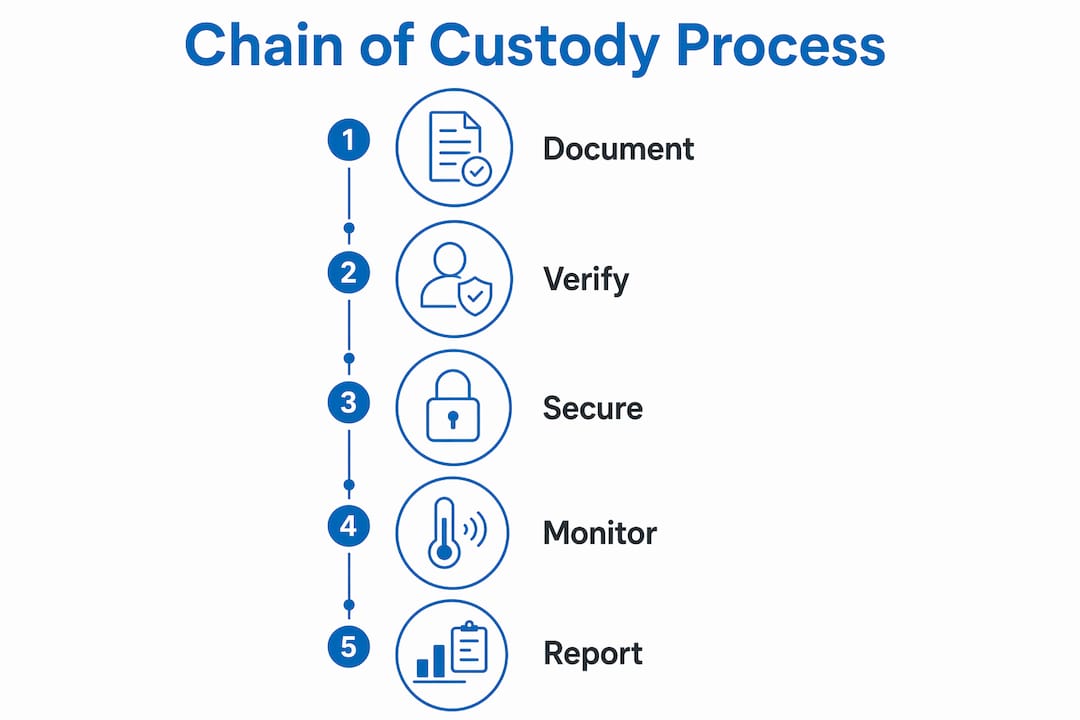
The process covers every handoff: from manufacturer to 3PL warehouse, from warehouse to courier, from courier to hospital receiving dock. Each transfer requires a verified record. That record must capture who transferred the item, who received it, the time and location, and the condition of the product and its packaging at the moment of transfer.

For temperature-sensitive pharmaceuticals, the record also includes continuous temperature logs. For controlled substances or radioactive materials, it includes secure handling confirmations. The result is a complete, unbroken account of how a product was treated throughout its journey.
What are the key components of a chain of custody process?
A defensible custody record requires more than a delivery signature. The following elements form the foundation of a complete chain of custody documentation system:
- Unique item identifiers: Batch numbers, serial numbers, or barcodes that tie every record to a specific product unit.
- Timestamps and locations: Exact date, time, and GPS-confirmed location for every transfer event.
- Transferring and receiving party identities: Full names, roles, and verifiable credentials for both parties at each handoff.
- Condition notes: Written or photographic documentation of packaging integrity, tamper-evident seal status, and any visible damage.
- Temperature logs: Continuous cold chain data linked to the custody record for temperature-sensitive pharmaceuticals.
- Auditable digital ledgers: Secure, time-stamped records stored in systems that prevent retroactive editing.
Automation reduces human errors and shipment disputes by prompting field staff to complete each data point before moving to the next task. This matters because manual logs create gaps that auditors and opposing counsel will exploit.
Pro Tip: Require photographic documentation of tamper-evident seals at every transfer point, not just at origin and destination. Mid-chain seal inspections are the most commonly missing element in audit-challenged records.
How does chain of custody ensure security and compliance?
Regulatory frameworks in healthcare logistics treat custody documentation as a non-negotiable requirement. MHRA GDP guidelines and HIPAA both demand verified handovers with timestamps and signatures, tamper-evident packaging, and temperature monitoring for applicable products. A single missing signature or broken seal can render a specimen or shipment unusable.
The compliance implications are direct:
- Audit readiness: Regulators reviewing a distribution center’s records expect a complete, unbroken chain. Gaps create liability, not just administrative problems.
- Tamper and substitution prevention: A documented chain makes unauthorized access or product substitution immediately visible. Without it, contamination or diversion may go undetected.
- Liability protection: When a dispute arises over product condition at delivery, the custody record determines who bears responsibility. Undocumented transfers leave all parties exposed.
- Hazardous and controlled substance compliance: Radioactive material transport and controlled pharmaceutical distribution carry legal mandates for secure handling documentation that go beyond standard SOPs.
- Insurance and incident investigation: Insurers and investigators rely on custody records to reconstruct what happened, when, and who was responsible.
“Breaks in chain of custody due to missing inspections or documentation create testimony gaps that are exploited in audits, rendering records legally questionable.” — LegalClarity
The importance of chain of custody extends beyond individual shipments. A pattern of documentation failures signals systemic compliance risk to regulators and can trigger facility-wide audits.
What technologies support chain of custody tracking?
Modern custody tracking has moved well beyond paper logs and manual signatures. The table below compares the primary technology categories used in healthcare and pharmaceutical logistics today.
| Technology | Primary Function | Key Limitation |
|---|---|---|
| Mobile custody apps | Capture handoffs, photos, and condition notes in real time | Requires staff training and device management |
| GPS tracking systems | Record location and movement data continuously | Cannot establish responsibility or condition at transfer |
| Digital ledgers with cryptographic hashing | Create immutable, audit-ready custody records | Requires integration with existing WMS or ERP systems |
| Tamper-evident packaging | Provides physical evidence of unauthorized access | Must be inspected and documented at every transfer point |
| IoT temperature sensors | Continuous cold chain monitoring linked to custody records | Data is only useful if integrated into the custody record |
GPS tracking alone cannot establish responsibility or compliance. Location data shows where a package was. It does not show who handled it, in what condition, or whether the seal was intact. A human-mediated audit trail with signed handoffs and condition checks is required to meet regulatory standards.
Automated systems using cryptographic hashing and digital identity-binding produce immutable records that cannot be altered after the fact. This is the standard for high-value pharmaceutical and hazardous shipments. Manual spreadsheets and paper logs are high-risk failures in this context.
Pro Tip: When evaluating mobile custody apps, prioritize platforms that lock the next workflow step behind completion of the current documentation requirement. This design forces compliance rather than relying on staff memory.
What are common challenges and best practices for maintaining chain of custody?
The most frequent failure point in logistics chain of custody is the undocumented “in-between” period. This is the time when a product has left one party’s control but has not yet been formally received by the next. These gaps are where liability disputes concentrate and where auditors focus their scrutiny.
Other common challenges include:
- Missing seal inspections: Staff skip physical tamper-evident seal checks under time pressure, especially in urgent care or emergency distribution environments.
- Memory-based explanations: When documentation is absent, staff rely on verbal recollection during audits. Regulators do not accept this as evidence.
- Inconsistent protocols across handoff points: Different facilities or courier partners use different documentation formats, creating records that cannot be reconciled.
- Manual log vulnerabilities: Paper records can be lost, altered, or simply incomplete. They also cannot be searched or cross-referenced efficiently during an audit.
Best practices that address these challenges directly:
- Standardize SOPs across all handoff points, including third-party courier partners and 3PL warehouse operations.
- Implement automated mobile platforms that prompt signatures and photo capture before allowing the next task to proceed.
- Conduct regular internal audits of custody records, not just during external regulatory reviews.
- Train staff to treat every transfer as a legal event, not an administrative formality.
- Use vendor managed inventory systems that integrate custody tracking with inventory management for a single source of truth.
How does chain of custody integrate with cold chain and hazardous material protocols?
Chain of custody and cold chain logistics are complementary but distinct protocols. Cold chain management controls the physical environment of temperature-sensitive pharmaceuticals. Custody tracking documents who was responsible for maintaining that environment at every step. Together, they create a complete record of both condition and accountability.
| Protocol | What It Controls | What It Documents |
|---|---|---|
| Cold chain logistics | Temperature, humidity, storage conditions | Sensor logs, excursion alerts, equipment calibration |
| Chain of custody | Transfers, handling, and condition at each handoff | Signatures, timestamps, seal inspections, batch matching |
| Combined record | End-to-end product integrity | Full audit trail for regulatory review and incident investigation |
In healthcare logistics, the custody record incorporates timestamps, cold chain temperature logs, batch matching, tamper evidence, and delivery-window precision. This raises the standard above simple tracking. It proves not just where a product was, but how it was handled and whether conditions were maintained throughout.
For radioactive material transport and other hazardous shipments, legal mandates require secure handling documentation that goes beyond standard pharmaceutical SOPs. These shipments require dual-party verification at each transfer, specialized container inspection records, and regulatory authority notifications in some jurisdictions. The cold chain compliance framework used by leading logistics providers in Southeast Asia integrates all of these requirements into a single auditable system.
Key takeaways
Chain of custody in logistics is the documented, human-verified audit trail that proves product integrity and accountability at every transfer point, and no technology or protocol replaces it.
| Point | Details |
|---|---|
| Definition and scope | Chain of custody documents every transfer, condition check, and handling event from origin to destination. |
| Compliance requirement | Missing signatures or seal inspections can render shipments unusable and trigger regulatory penalties. |
| Technology role | Cryptographic digital ledgers and mobile apps create immutable records; GPS alone is insufficient. |
| Common failure point | Undocumented in-between custody periods are where liability disputes and audit failures concentrate. |
| Cold chain integration | Custody records must incorporate temperature logs and batch matching to meet healthcare logistics standards. |
The shift from paperwork to decision provenance
The industry conversation around chain of custody has changed significantly in recent years. The focus has moved from “did we capture a signature?” to “can we prove who made every custody decision, and why?” This concept, sometimes called decision provenance, is where regulated logistics is heading in 2026.
In my experience working with healthcare logistics operations across Southeast Asia, the organizations that struggle most during audits are not the ones with bad intentions. They are the ones that treated custody documentation as a back-office task rather than a front-line operational discipline. A courier who skips a seal inspection because the delivery window is tight is not being negligent in their own mind. They are prioritizing speed. The problem is that regulators and insurers do not accept speed as a defense.
The most effective shift I have seen is cultural, not technological. When field staff understand that a missing condition note is not just a paperwork gap but a legal liability for their employer and a potential patient safety issue, behavior changes. Technology reinforces that culture by making documentation the path of least resistance. Platforms that require a photo before unlocking the next delivery step do not rely on staff judgment. They build compliance into the workflow.
The other underappreciated element is the value of custody records in non-audit contexts. When a temperature excursion is detected, a complete custody record tells you exactly which transfer point introduced the risk. That information is worth more than any insurance claim. It tells you where to fix the process.
— Brandcore
How Labgistics supports chain of custody integrity in healthcare logistics
Labgistics brings over 20 years of experience managing regulated healthcare and pharmaceutical logistics across Southeast Asia, with fully accredited distribution centers and integrated digital custody systems built for compliance-critical environments.
For compliance officers and logistics managers who need more than a standard 3PL warehouse, Labgistics provides tailored logistics solutions that integrate cold chain temperature monitoring, tamper-evident packaging protocols, and auditable digital custody records into a single end-to-end system. Whether you are managing temperature-sensitive pharmaceuticals, medical devices, or radioactive materials, Labgistics’ infrastructure and regulatory expertise are designed to protect product integrity and keep your supply chain audit-ready. Contact Labgistics to discuss how a purpose-built custody framework can reduce your compliance risk across Southeast Asia.
FAQ
What is chain of custody in logistics?
Chain of custody in logistics is the chronological, documented record of every transfer, condition check, and handling event for a product from origin to final destination. It is mandatory for regulatory compliance in healthcare and pharmaceutical supply chains.
Why does chain of custody matter for pharmaceutical shipments?
A single missing signature or broken tamper-evident seal can render a pharmaceutical shipment unusable and trigger regulatory review. Complete custody records protect product integrity and demonstrate compliance during audits.
How is chain of custody different from GPS tracking?
GPS tracking records location data but cannot establish who handled a product or in what condition. Chain of custody requires human-verified handoffs with signatures, condition notes, and seal inspections at every transfer point.
What documents are required for a complete custody record?
A complete record includes unique item identifiers, timestamps, transferring and receiving party identities, condition notes, tamper-evident seal inspection results, and temperature logs for cold chain products.
How do automated systems improve chain of custody compliance?
Automated mobile platforms and digital ledgers using cryptographic hashing eliminate manual log vulnerabilities by prompting required documentation before allowing the next workflow step, creating immutable audit-ready records.
Recommended
- Quality assurance in pharma logistics: A compliance guide
- Maintain GMP Standards in Pharma Logistics: A Practical Guide
- Understand Compliance in Healthcare Logistics: SEA Guide