
Maintain GMP Standards in Pharma Logistics: A Practical Guide
A single GMP failure in the logistics chain can trigger product recalls, regulatory shutdowns, and patient harm events that no quality system can quickly reverse. For pharmaceutical companies operating across Southeast Asia, where supply chains span multiple jurisdictions and regulatory frameworks, the stakes are especially high. Validation failures account for 15-20% of FDA warning letters, with quality system breakdowns driving nearly 70% of all regulatory observations. This guide walks logistics managers and compliance officers through a practical, stepwise approach to maintaining GMP adherence from preparation through ongoing verification.
Table of Contents
- Understanding GMP in pharma logistics
- Preparation: Ensuring readiness for GMP compliance
- Execution: Implementing GMP procedures in logistics operations
- Verification: Monitoring, audits, and continuous improvement
- What most logistics teams miss about maintaining GMP
- How Labgistics can help maintain your GMP edge
- Frequently asked questions
Key Takeaways
| Point | Details |
|---|---|
| GMP vs GDP clarity | Understanding the difference is key to meeting compliance demands at every logistics stage. |
| Preparation matters | Thorough readiness ensures smooth audits and partner qualification in Southeast Asia. |
| Execution routines | Regular checks and standardized steps prevent costly validation failures. |
| Continuous improvement | Ongoing monitoring and CAPA responses keep logistics teams audit-ready. |
Understanding GMP in pharma logistics
GMP stands for Good Manufacturing Practice. It is a system of regulations, standards, and guidelines that ensure pharmaceutical products are consistently produced and controlled according to quality standards appropriate for their intended use. While most professionals associate GMP with manufacturing facilities, the principles extend directly into logistics operations wherever pharmaceutical products are handled, stored, or transported.
In a logistics context, GMP governs how products are received, warehoused, picked, packed, and shipped. It covers personnel hygiene, facility cleanliness, equipment performance, documentation accuracy, and the traceability of every product movement. Failure to uphold GMP during logistics creates the same regulatory and patient safety risks as a manufacturing defect.
GMP versus GDP: understanding the distinction
Many logistics teams conflate GMP with GDP, but the two frameworks serve different functions. As noted in GMP versus GDP guidance, GMP applies to the manufacturing and quality assurance of pharmaceutical products, while GDP (Good Distribution Practice) focuses on maintaining product quality and integrity throughout the distribution and storage phase. GMP operations are overseen by a Qualified Person (QP) responsible for batch release, while GDP compliance is managed by a Responsible Person (RP) who oversees distribution quality.
| Aspect | GMP | GDP |
|---|---|---|
| Primary scope | Manufacturing and batch release | Distribution and storage |
| Responsible role | Qualified Person (QP) | Responsible Person (RP) |
| Key documents | Batch manufacturing records, validation protocols | Distribution records, temperature logs |
| Regulatory body focus | WHO, FDA, PIC/S manufacturing guidelines | EU GDP, WHO GDP, national distribution rules |
| Critical controls | Process validation, sterility, contamination control | Cold chain integrity, secure transport, traceability |
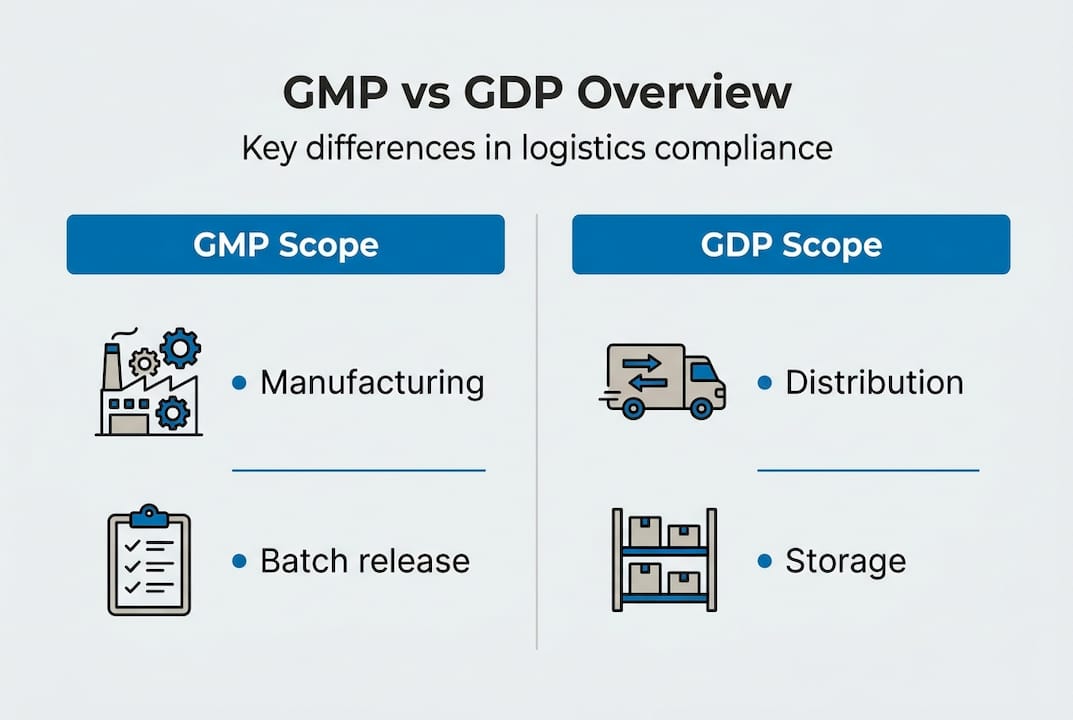
Both frameworks intersect in the logistics space, particularly for temperature-sensitive pharmaceuticals, biologics, and controlled substances. Understanding distribution and compliance basics is essential before any GMP program can be applied effectively to a logistics operation.
Critical GMP elements specific to logistics operations
Several GMP principles carry particular weight when applied to pharma logistics:
- Documentation and traceability: Every product movement must be recorded with sufficient detail to support a full audit trail, from receipt at origin to delivery at destination.
- Risk management: Systematic identification and mitigation of quality risks throughout the supply chain, including supplier qualification, route risk assessment, and contingency planning.
- Hygiene and contamination control: Facilities, vehicles, and equipment must meet defined cleanliness standards to prevent cross-contamination or product degradation.
- Secure transport: Products must be protected from tampering, theft, and environmental exposure throughout transit.
- ASEAN harmonization: Across Southeast Asia, regulatory frameworks are increasingly aligned under ASEAN GMP harmonization initiatives, requiring logistics teams to stay current with both regional standards and individual national authority requirements.
The regional dimension matters. National regulators such as the Health Sciences Authority (HSA) in Singapore and the National Pharmaceutical Regulatory Agency (NPRA) in Malaysia each publish specific requirements that complement the broader ASEAN framework. Logistics operations that serve multiple markets must build compliance architectures flexible enough to satisfy all applicable authorities simultaneously.
Preparation: Ensuring readiness for GMP compliance
Once the definitions are clear, the next step is to prepare your operation for audits and regulatory scrutiny. Preparation is not a one-time exercise. It is an ongoing discipline that demands structured documentation, qualified personnel, validated equipment, and vetted supply chain partners.
Core GMP prerequisites for logistics teams
Before any GMP procedure can be executed consistently, the following prerequisites must be in place:
- Standard Operating Procedures (SOPs): Every routine and non-routine activity must be documented in SOPs that are version-controlled, accessible to relevant staff, and reviewed at defined intervals.
- Qualified and trained personnel: Staff handling pharmaceutical products must receive role-specific GMP training, with records maintained to demonstrate competency.
- Validated equipment: Refrigeration units, temperature monitoring devices, vehicles, and storage facilities must be validated and calibrated against defined performance specifications.
- Approved vendor lists: All suppliers of packaging, transport, and ancillary services must be formally qualified and re-evaluated on a scheduled basis.
- Change control systems: Any modification to facilities, equipment, processes, or personnel structures must pass through a formal change control review before implementation.
Key documentation and resources required
| Document or resource | Purpose | Review frequency |
|---|---|---|
| SOPs for receiving, storage, dispatch | Standardize handling procedures | Annual or upon change |
| Temperature mapping reports | Confirm storage zone performance | Upon installation or modification |
| Supplier qualification records | Verify partner GMP/GDP status | Biannual or upon contract renewal |
| Training records | Document personnel competency | Annual |
| Equipment calibration certificates | Prove instrument accuracy | Per manufacturer schedule |
| Risk assessment reports | Identify and mitigate supply chain risks | Annual or triggered by incident |
For operations in Southeast Asia, aligning with ASEAN GMP harmonization and engaging with national agencies such as NPRA Malaysia and HSA Singapore is not optional. These agencies conduct their own inspections and can issue import bans or distribution suspensions for non-compliant partners.
Selecting GDP-certified third-party logistics providers (3PLs) is equally important. A GDP-certified partner brings pre-qualified facilities, established SOPs, and experienced personnel, reducing the compliance burden on your internal team. Verify certification currency and scope before onboarding.
Pro Tip: When onboarding new suppliers or logistics partners, establish a documented qualification process that includes a desk audit of their quality system, a facility visit checklist, and a formal approval sign-off by your quality team. This single process has prevented many costly compliance failures.
Understanding cold chain compliance requirements for Southeast Asia is a critical preparation step, particularly for biologics, vaccines, and insulin products that require continuous temperature monitoring throughout transit. Reviewing SEA logistics strategies that account for regional infrastructure challenges also helps operations teams plan realistic compliance architectures from the outset.
Execution: Implementing GMP procedures in logistics operations
With your logistics network ready, it is time to embed GMP in daily processes. Execution is where compliance intentions either succeed or break down. Structured implementation, supported by monitoring technology and clear escalation protocols, is what separates a GMP-compliant operation from one that merely looks the part on paper.
Step-by-step GMP execution in logistics
- Standardize product handling: Implement documented handling procedures for all product categories, including fragile items, temperature-sensitive pharmaceuticals, and controlled substances. Train all warehouse and transport personnel to follow these procedures without exception.
- Implement secure shipment protocols: Use tamper-evident packaging, vehicle seals, and chain-of-custody documentation for all outbound shipments. Assign a responsible person to verify seal integrity at each transfer point.
- Maintain real-time recordkeeping: Use electronic systems wherever possible to capture receipt, storage, dispatch, and delivery data in real time. Avoid manual batch recording, which introduces transcription errors and gaps.
- Establish deviation reporting: Create a clear, low-barrier process for staff to report any deviation from SOPs, including temperature excursions, handling errors, or equipment malfunctions. Unreported deviations are far more dangerous than reported ones.
- Conduct routine equipment and facility checks: Schedule and document daily, weekly, and monthly checks for refrigeration performance, warehouse cleanliness, vehicle conditions, and route risk indicators.
Routine GMP checks: a practical numbered checklist
- Verify temperature logger readings against target range before each dispatch
- Inspect cold room door seals and alarm systems at the start of each shift
- Confirm vehicle pre-loading inspection is completed and signed off
- Check product rotation (first expiry, first out) during pick and pack operations
- Review deviation log at end of each working day for open items
- Confirm calibration status of all active monitoring equipment weekly
- Audit a random sample of delivery records for completeness monthly
Edge cases that often catch teams off guard
Several technical requirements are frequently overlooked in logistics GMP programs. Dead legs in piping must be less than 3D, welding standards must be verified for water and utility systems, and equipment qualification (IQ/OQ/PQ) must be repeated every three to five years or following significant changes. For biologics requiring continuous cold chain, backup power systems are mandatory, not optional.
Maintaining validated cold chain pharma logistics across Southeast Asia’s geography, with its tropical climate and variable infrastructure, demands redundancy at every critical point. Equipment validation best practices provide the framework for ensuring each piece of equipment performs within specification throughout its operational life.
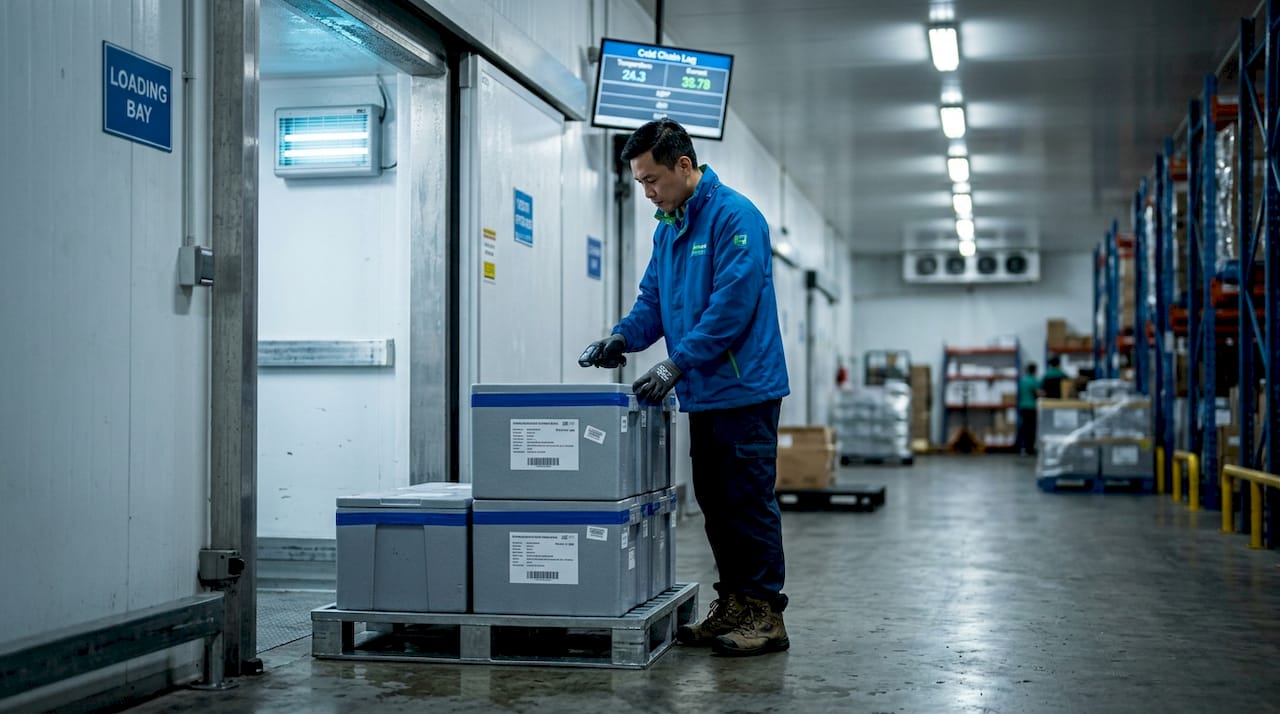
Pro Tip: Implement automated KPI dashboards that flag temperature excursions, documentation delays, and deviation backlogs in real time. Teams that rely on end-of-day manual reviews consistently miss early warning signals that automated systems catch immediately.
Verification: Monitoring, audits, and continuous improvement
Once procedures are in place, vigilant monitoring and fast response to deviations are key. Verification is not the end of the GMP cycle. It is the mechanism that keeps all other steps functioning at the required standard over time.
Structuring periodic audits
Regular internal and external audits, self-inspections, and CAPA processes are the foundation of an effective GMP verification program. Internal audits should be conducted by trained auditors who are independent of the area being reviewed. Self-inspections, completed by the team responsible for the area, offer a more frequent but less objective check. External audits by regulatory authorities or customers provide the most rigorous assessment.
A robust audit schedule typically includes:
- Monthly self-inspections of critical storage and dispatch areas
- Quarterly internal audits across the full logistics operation
- Annual third-party audits of key logistics partners
- Regulatory authority inspections on a risk-based schedule
The CAPA process: addressing nonconformance
When a deviation, nonconformance, or audit finding occurs, the Corrective and Preventive Action (CAPA) process must be initiated promptly. The steps are straightforward:
- Document the deviation with full details, including who identified it, when, and under what circumstances
- Conduct a root cause analysis using structured tools such as the five-whys or fishbone diagram
- Define corrective actions to resolve the immediate issue
- Define preventive actions to eliminate recurrence
- Assign responsibilities and timelines for each action
- Verify effectiveness of completed actions through follow-up review
KPIs and trend review
Ongoing verification through KPIs and trend review is essential for proactive compliance management. Key metrics to track include temperature excursion frequency, deviation closure rate, SOP review compliance, and training completion rates.
Recurring GMP pitfalls to watch for:
- Outdated SOPs that do not reflect current practice
- Training records that list completion without evidence of competency
- Calibration certificates that have lapsed without triggering a replacement workflow
- CAPA items that are closed without effectiveness verification
- Audit findings from external auditors that differ significantly from internal assessments, indicating blind spots
“Always reference primary regulatory sources such as WHO, EU GMP/GDP guidelines, and FDA CGMPs when designing your compliance program. Secondary sources may be outdated or incomplete, and regulatory inspectors will benchmark against the originals.”
Connecting audit outcomes to medical logistics process validation ensures that the systems underpinning your GMP program are themselves verified as fit for purpose. Continuous improvement is not an aspirational goal. It is a regulatory expectation.
What most logistics teams miss about maintaining GMP
The most common assumption we see is that GMP compliance is achieved the moment an audit passes. In reality, that moment is only a snapshot. What determines long-term compliance is not the quality of the SOPs on the shelf, but whether the workforce believes in the reasons behind them.
Most logistics teams invest heavily in documentation systems and equipment validation, then underinvest in the behavioral dimension of compliance. Deviation underreporting is a direct consequence of a culture that treats quality events as failures to be hidden rather than signals to be acted on. Teams that have built psychologically safe reporting environments consistently demonstrate lower rates of repeat deviations.
The most overlooked step after any audit is the adaptation phase. Many operations implement the corrective actions but never revisit whether those actions actually changed behavior on the floor. Regular cross-functional reviews between operations and quality assurance teams prevent these blind spots from compounding. Explore the pharma logistics challenges common across Southeast Asia to understand where culture gaps most frequently intersect with operational risk.
Compliance longevity depends on leadership modeling the behaviors they require from frontline staff. When warehouse supervisors participate in self-inspections and quality managers spend time on the floor, the message to the team is clear: GMP is how we work, not what we do for inspectors.
How Labgistics can help maintain your GMP edge
For teams seeking advanced solutions for sustainable GMP compliance, Labgistics is ready to help.
Labgistics Asia has supported pharmaceutical companies and healthcare logistics teams across Southeast Asia for over 20 years, delivering region-specific GMP and GDP solutions built for the regulatory complexity of this market. From fully accredited distribution centers to expert healthcare transportation optimization and rigorous SEA logistics security protocols, every service is designed to protect product integrity and keep your compliance program audit-ready.
Whether you need end-to-end cold chain and compliance management, validation support, or regulatory guidance across multiple Southeast Asian markets, Labgistics brings the infrastructure, expertise, and accountability your operation requires. Contact us to discuss how we can strengthen your GMP adherence at every stage of the supply chain.
Frequently asked questions
What is the difference between GMP and GDP in logistics?
GMP focuses on the integrity and safety of pharmaceutical products throughout the supply chain, while GDP centers on good distribution practices to protect product quality during transportation and storage. As detailed in GMP versus GDP frameworks, GMP assigns a Qualified Person for batch release while GDP designates a Responsible Person for distribution compliance oversight.
How often should internal audits be conducted for GMP compliance?
Internal audits should be performed regularly, with frequency determined by risk, but annual or semi-annual reviews are best practice for sustained compliance. Regular self-inspections and CAPA processes between formal audits further strengthen the overall verification program.
What are the most common GMP failures in logistics?
Validation lapses and quality system failures are the leading causes of GMP-related regulatory actions in logistics. Specifically, validation failures drive 15-20% of FDA warning letters, while quality system breakdowns account for approximately 70% of all regulatory observations.
How can I ensure my logistics partners are GMP/GDP compliant?
Verify GDP certification, review audit histories, and confirm local regulatory alignment for all logistics partners. For operations in Southeast Asia, aligning with ASEAN harmonization standards and engaging national agencies such as NPRA Malaysia and HSA Singapore provides the clearest benchmark for partner qualification.
Recommended
- Pharma Logistics Challenges and Smart Solutions | Labgistics
- Pharma logistics: Ensuring safe distribution and compliance
- Pharma logistics security: 5 ways to strengthen your supply chain
- How to validate medical logistics processes: 5 key steps