
How to validate medical logistics processes: 5 key steps
A single temperature excursion during vaccine transport can trigger a regulatory breach, a product recall, and a supply interruption that affects patient care across multiple markets. In Southeast Asia, where humidity routinely exceeds 80% and logistics infrastructure varies widely between countries, unvalidated medical logistics processes carry compounded risk. Pharmaceutical and healthcare companies operating across the region face overlapping regulatory frameworks, from WHO Good Distribution Practice (GDP) to country-specific requirements from Singapore’s Health Sciences Authority (HSA) and Malaysia’s National Pharmaceutical Regulatory Agency (NPRA). This guide walks through the regulatory landscape, preparation requirements, step-by-step validation execution, common challenges, and how to measure success.
Table of Contents
- Understand regulatory and compliance requirements
- Prepare for logistics process validation: Tools, roles, and prerequisites
- Step-by-step logistics validation process
- Troubleshooting and common validation challenges
- Measuring success: Validation outcomes and continuous improvement
- Why traditional validation fails and what actually works in Southeast Asia
- How Labgistics supports validated, compliant medical logistics
- Frequently asked questions
Key Takeaways
| Point | Details |
|---|---|
| Regulatory foundations | WHO GDP and local laws must drive all logistics validation efforts in Southeast Asia. |
| Preparation matters | Success depends on gathering the right tools, documents, and team before starting validation. |
| Follow robust steps | Use systematic, documented validation steps tailored for Southeast Asia’s climate and regulations. |
| Monitor and improve | Track key metrics and update processes regularly to maintain compliance and efficiency. |
| Tailored solutions win | Practical, region-specific methods always outperform rigid, generic validation routines. |
Understand regulatory and compliance requirements
Process validation in medical logistics is not optional. It is a documented requirement under international and regional frameworks, and failing to meet it can result in import delays, product rejections, or license suspension. Understanding which regulations apply to your operations is the essential first step.
WHO GDP as the regional baseline
The World Health Organization’s Good Distribution Practice guidelines serve as the primary reference standard across Southeast Asia. Most national regulators in the region have adopted or aligned with WHO GDP, making it the practical foundation for any validation program. WHO GDP covers storage conditions, temperature monitoring, personnel qualifications, documentation, and transportation controls.
Local regulatory requirements
Beyond WHO GDP, country-level requirements add specificity. Key frameworks include:
- HSA Singapore: Requires licensed importers and wholesalers to maintain validated storage and distribution processes. HSA compliance essentials are particularly detailed for temperature-sensitive products and medical devices.
- Malaysia NPRA: Mandates GDP compliance for pharmaceutical distributors, with emphasis on cold chain integrity and product traceability.
- Other ASEAN markets: Thailand, Indonesia, and Vietnam each maintain national GDP guidelines that broadly mirror WHO standards but include local documentation and language requirements.
For product registration steps in Singapore, validated logistics processes are often a prerequisite before market authorization is granted.
Tropical climate as a validation variable
Southeast Asia’s climate introduces risks that temperate-region frameworks do not fully address. Ambient temperatures regularly exceed 30°C, and relative humidity can compromise packaging integrity, accelerate product degradation, and disrupt cold chain performance. Any validation protocol must account for these conditions explicitly.
As the HSA medical manufacturing guidelines emphasize, professionals in Southeast Asia should prioritize WHO GDP compliance, integrate local regulatory requirements, and specifically address tropical climate risks within their validation frameworks.
Documentation and audit trail expectations
Every validated process must be supported by complete, traceable documentation. Regulators expect signed validation protocols, deviation records, corrective action logs, calibration certificates, and training records. Gaps in documentation are among the most common reasons for audit findings in the region.
Prepare for logistics process validation: Tools, roles, and prerequisites
With regulatory requirements clarified, gather your resources and assign roles before initiating any validation activity. Preparation determines whether your validation runs smoothly or requires costly rework.
Key documents and SOPs to prepare
Before execution begins, the following must be in place:
- Validation master plan (VMP) covering scope, objectives, and acceptance criteria
- Standard operating procedures (SOPs) for each logistics process being validated
- Calibration certificates for all monitoring equipment
- Risk assessment documentation identifying critical control points
- Training records confirming staff competency
Roles and responsibilities
Validation is a cross-functional effort. Quality Assurance (QA) leads protocol development and approval. Operations manages execution. Regulatory Affairs ensures alignment with applicable standards. IT or systems teams support digital monitoring tools. Defining these roles in writing before validation begins prevents accountability gaps.

Pro Tip: Involve QA professionals from the very start of validation planning. Retroactively fitting QA requirements into an already-designed process is one of the most common causes of validation failure and rework.
Validation tools and technologies
| Tool or document | Purpose | Example |
|---|---|---|
| Temperature data loggers | Continuous cold chain monitoring | Sensitech, Testo |
| Warehouse management system (WMS) | Inventory tracking and traceability | SAP, Oracle WMS |
| Validation protocol template | Structured execution guide | Internal QA document |
| Calibration certificates | Equipment accuracy verification | Issued by accredited lab |
| Digital audit trail software | Regulatory documentation | Veeva Vault, MasterControl |
Using 3PL warehouse tools that integrate monitoring and documentation functions significantly reduces manual error. The importance of calibration cannot be overstated: uncalibrated equipment produces unreliable data that invalidates the entire validation exercise.
Empirical evidence supports investment in process improvement tools. Lean Six Sigma adoption in medical logistics reduced order fulfillment time from 63.55 to 61.09 minutes and stockouts from 10.20 to 9.81 per month, demonstrating measurable gains from structured process management.
Step-by-step logistics validation process
With preparations complete, carry out each validation step for robust, compliant results. The following sequence applies to most regulated medical logistics operations in Southeast Asia.
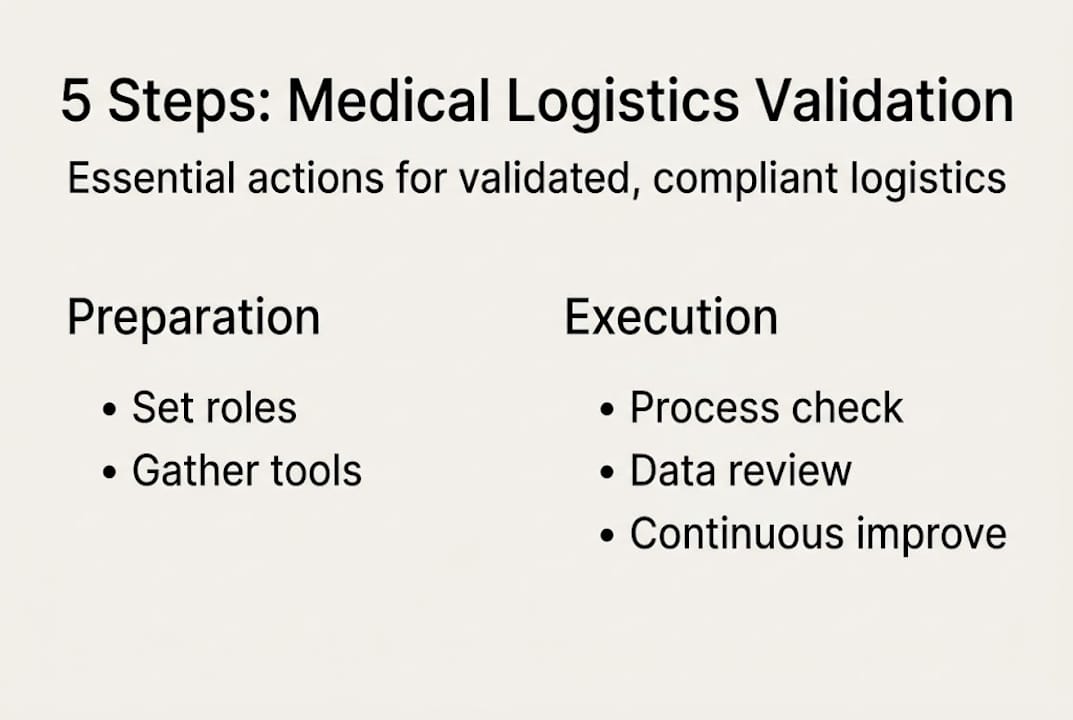
- Define the process scope. Document the exact process being validated: what it covers, where it starts and ends, and which regulatory standards apply. For example, a cold chain validation for vaccines would define the temperature range (typically 2°C to 8°C), the distribution route, and the monitoring frequency.
- Map the process. Create a detailed process flow that identifies every step, decision point, and handoff. This map becomes the basis for identifying critical control points and potential failure modes.
- Develop and approve the validation protocol. The protocol specifies acceptance criteria, test methods, sampling plans, and responsible parties. QA must review and sign off before execution begins.
- Execute the validation runs. Conduct the required number of validation runs (typically three consecutive successful runs for process validation). Collect all data in real time and document deviations immediately.
- Document and review results. Compile all data into a validation report. Compare results against acceptance criteria. Any out-of-specification result must be investigated and resolved before the process is considered validated.
Pro Tip: Use digital temperature monitoring systems for cold chain validation points. Automated data capture reduces transcription errors and speeds up audit preparation significantly.
Paper-based vs. digital documentation
| Approach | Advantages | Limitations |
|---|---|---|
| Paper-based | Low setup cost, familiar format | Prone to loss, slower audits, harder to analyze |
| Digital documentation | Real-time data, audit-ready, searchable | Higher initial investment, requires IT support |
A practical example from the region: validating a vaccine cold chain from Singapore to a provincial distribution point in Indonesia requires mapping temperature exposure across multiple transport legs, customs holding periods, and last-mile delivery. Pharma logistics insights from similar operations show that digital monitoring at each handoff point is what makes these complex validations auditable.
Structured process improvement also yields measurable outcomes. Delivery delays in medical logistics were reduced from 42.89% to 40.86% through Lean Six Sigma application, reinforcing the value of systematic validation. Working with experienced Singapore 3PL providers can accelerate this process by leveraging existing validated infrastructure.
Troubleshooting and common validation challenges
Even the best plans face challenges. Here is how to overcome the most common issues encountered in Southeast Asian medical logistics validation.
Common mistakes that derail validation
- Ignoring ambient humidity: Many validation protocols focus on temperature but overlook relative humidity, which can degrade packaging and compromise product stability in tropical conditions.
- Weak audit records: Incomplete or unsigned documentation is the most frequent finding during regulatory inspections. Every deviation, no matter how minor, must be recorded and closed.
- Outdated SOPs: Using SOPs that do not reflect current processes creates a gap between documented and actual practice, which regulators treat as a compliance failure.
- Inadequate staff training: Validation is only as reliable as the people executing it. Untrained staff introduce variability that undermines the entire exercise.
Effective responses
Regular retraining programs keep staff aligned with current SOPs. Climate risk checklists that explicitly address humidity and temperature excursion scenarios are essential for Southeast Asian operations. Digital logs provide the most reliable audit trail because they are timestamped, tamper-evident, and easily searchable during inspections.
Audit readiness is not a one-time event. Regulators expect that your documentation is complete, current, and accessible at any time, not just when an inspection is announced. The HSA manufacturing guidelines specifically call out tropical climate risks as a validation consideration that must be addressed proactively.
For specialized operations such as radiopharmaceuticals, compliant radioactive transport requires additional validation layers that address radiation safety, containment integrity, and transport time constraints.
Staying ready for recertification
Schedule periodic internal audits between formal recertification cycles. Maintain a living document that tracks all process changes and their validation status. This approach prevents the last-minute scramble that often leads to documentation gaps.
Measuring success: Validation outcomes and continuous improvement
Finally, assess your results and set up structures for ongoing success. Validation is not a one-time event. It is the foundation of a continuous improvement cycle.
Critical KPIs for validated medical logistics
- Order fulfillment time: Measures end-to-end process efficiency from order receipt to delivery confirmation
- Stockouts per month: Tracks inventory availability and supply chain reliability
- Delivery delay rate: Monitors on-time performance against committed delivery windows
- Temperature excursion rate: Quantifies cold chain failures per number of shipments
- Audit finding rate: Tracks the frequency and severity of compliance findings per inspection cycle
Interpreting validation data
Validation data should be reviewed against pre-defined acceptance criteria, not just checked for pass or fail. Trend analysis reveals whether a process is drifting toward non-compliance before it actually fails. For example, a gradual increase in temperature excursion frequency may indicate equipment degradation or a seasonal climate effect that requires a protocol adjustment.
Continuous improvement frameworks
Lean Six Sigma provides a structured methodology for translating validation findings into process improvements. The DMAIC cycle (Define, Measure, Analyze, Improve, Control) maps directly onto the validation workflow and supports sustained performance gains. Regression analysis confirms that order fulfillment improvements correlate strongly with Lean Six Sigma adoption in medical logistics environments.
Tracking logistics KPIs over time creates a performance baseline that supports both regulatory submissions and internal decision-making. Organizations that treat validation data as a management tool, rather than a compliance checkbox, consistently outperform those that do not.
Why traditional validation fails and what actually works in Southeast Asia
Most validation frameworks used in Southeast Asia are adapted directly from US FDA or EU GMP models. That is not inherently wrong, but applying them without regional adjustment is where many programs fail. Western frameworks assume stable ambient conditions, mature logistics infrastructure, and single-jurisdiction regulatory oversight. Southeast Asia offers none of those consistently.
The practical reality is that a validation protocol designed for a temperature-controlled European distribution center will not account for a 35°C customs holding area in Jakarta or a power outage during last-mile delivery in rural Vietnam. Rigid, document-heavy validation systems also struggle when infrastructure is fragmented or when staff turnover is high.
What works in this region is a risk-based approach that prioritizes the highest-impact control points, uses digital monitoring to compensate for infrastructure variability, and builds flexibility into deviation management. Local validation priorities should reflect actual risk exposure, not a template copied from another market.
The HSA manufacturing guidelines reinforce this point by explicitly calling out tropical climate risks as a distinct validation consideration. Digital audit trails are not just a convenience here. In unpredictable climates, they are the only reliable evidence of process control.
How Labgistics supports validated, compliant medical logistics
If you’re ready for validation support, here’s how Labgistics can help.
Labgistics Asia brings over 20 years of specialized experience in validated healthcare logistics across Southeast Asia. From compliance planning and SOP development to real-time cold chain monitoring and audit preparation, the team supports the full validation lifecycle for pharmaceutical, medical device, and life science clients.
Labgistics’s smart 3PL solutions integrate validated storage, calibrated monitoring equipment, and digital documentation into a single managed service. Whether you are entering a new Southeast Asian market or strengthening an existing operation, Labgistics provides the infrastructure and regulatory expertise to keep your logistics processes compliant. Explore our calibration and validation expertise to see how we support audit-ready operations.
Frequently asked questions
What are the key documents required for medical logistics validation?
Typical documents include SOPs, validation protocols, audit records, calibration certificates, and training logs. The HSA manufacturing guidelines specify that complete, traceable documentation is a non-negotiable audit requirement.
How often should medical logistics processes be revalidated?
Processes should be revalidated on a scheduled basis, typically annually, and whenever significant changes to equipment, routes, or procedures occur. WHO GDP and regional guidelines recommend periodic revalidation as a standard compliance expectation.
Which regulatory standards apply to medical logistics in Southeast Asia?
WHO GDP, HSA Singapore, and Malaysia NPRA standards apply across the region, each requiring tailored compliance documentation. The WHO GDP baseline is the common reference point, supplemented by country-specific requirements.
How can Lean Six Sigma improve logistics process validation?
Lean Six Sigma standardizes processes, reduces variability, and improves delivery performance in medical logistics. Documented results show reduced order fulfillment time from 63.55 to 61.09 minutes and stockouts from 10.20 to 9.81 per month following structured adoption.
Recommended
- Why Calibration and Equipment Validation Are Critical in Healthcare Logistics | Labgistics
- Pharma Logistics Challenges and Smart Solutions | Labgistics
- News & Publications Archives | Labgistics
- Publications Archives | Labgistics