
How to Validate Medical Devices: 2026 Compliance Guide
Medical device validation is the documented process of proving that a finished device meets all intended user needs and regulatory requirements under actual or simulated use conditions. Regulatory frameworks including 21 CFR 820.30(g) and ISO 13485 Clause 7.3.7 require this validation before delivery or implementation. The FDA’s Quality Management System Regulation (QMSR) update further aligns American requirements with ISO 13485, making validation and verification equally mandatory design controls. For medical device developers and quality assurance professionals, understanding how to validate medical devices correctly is the difference between market approval and a costly regulatory rejection.
How to validate medical devices: verification vs. validation
The single most common source of confusion in the medical device validation process is treating verification and validation as interchangeable. They are not. Each answers a fundamentally different question, and regulators treat them as separate, mandatory design controls.
Verification answers: “Did we build the product right?” It confirms that design outputs meet inputs through physical testing, inspection, analysis, and demonstration. For example, verifying that a catheter’s burst pressure meets the specification written in the design input document is a verification activity.

Validation answers: “Did we build the right product?” It confirms that the finished device meets user needs in realistic conditions. Conducting a simulated-use study where clinicians operate a new infusion pump under realistic ward conditions is a validation activity.
The distinction matters in practice because:
- Verification can occur at any stage of development, including on subsystems or components.
- Validation must be performed on the finished device or a production-equivalent unit, not a prototype.
- Both are required under ISO 13485 Clause 7.3.6 (verification) and Clause 7.3.7 (validation).
- The FDA’s QMSR explicitly treats them as distinct but mandatory design controls.
Pro Tip: Build a single master list of all user needs at project start. Map each need to at least one verification test and one validation activity. This prevents gaps that auditors will find before you do.
What documents and tools do you need for device validation?
Successful validation rests on a foundation of structured documentation. Missing or incomplete records are the most common reason regulatory submissions fail or audits generate findings.
The core documents every team needs are:
- V&V Master Plan. This is the project’s quality constitution. It defines scope, responsibilities, test environments, acceptance criteria, and the schedule for all verification and validation activities. Treat it as a living document and update it at every design change.
- Requirements Traceability Matrix (RTM). The RTM maps every user need to design inputs, design outputs, verification tests, and validation activities. Auditors use the RTM as their primary tool to verify compliance, making it the most important DHF artifact in any inspection.
- Risk Management File. Per ISO 14971, risk controls must be traceable to specific validation evidence. Without this link, residual risk claims are rejected by regulators.
- Design History File (DHF). The DHF collects all design and development records, including validation protocols, raw data, deviation reports, and final validation reports.
| Document | Primary Purpose | Key Regulatory Reference |
|---|---|---|
| V&V Master Plan | Defines scope, schedule, and acceptance criteria | ISO 13485 Clause 7.3 |
| Requirements Traceability Matrix | Links user needs to all V&V evidence | 21 CFR 820.30 |
| Risk Management File | Connects risk controls to validation evidence | ISO 14971 |
| Design History File | Archives all design and validation records | 21 CFR 820.30(j) |
Pro Tip: Never let the RTM become a static spreadsheet. Assign one person to own it and require a formal update whenever a design change is approved. An outdated RTM is as damaging as no RTM at all.
For teams managing calibration and equipment validation alongside device validation, maintaining separate but linked records for each activity keeps audits manageable.
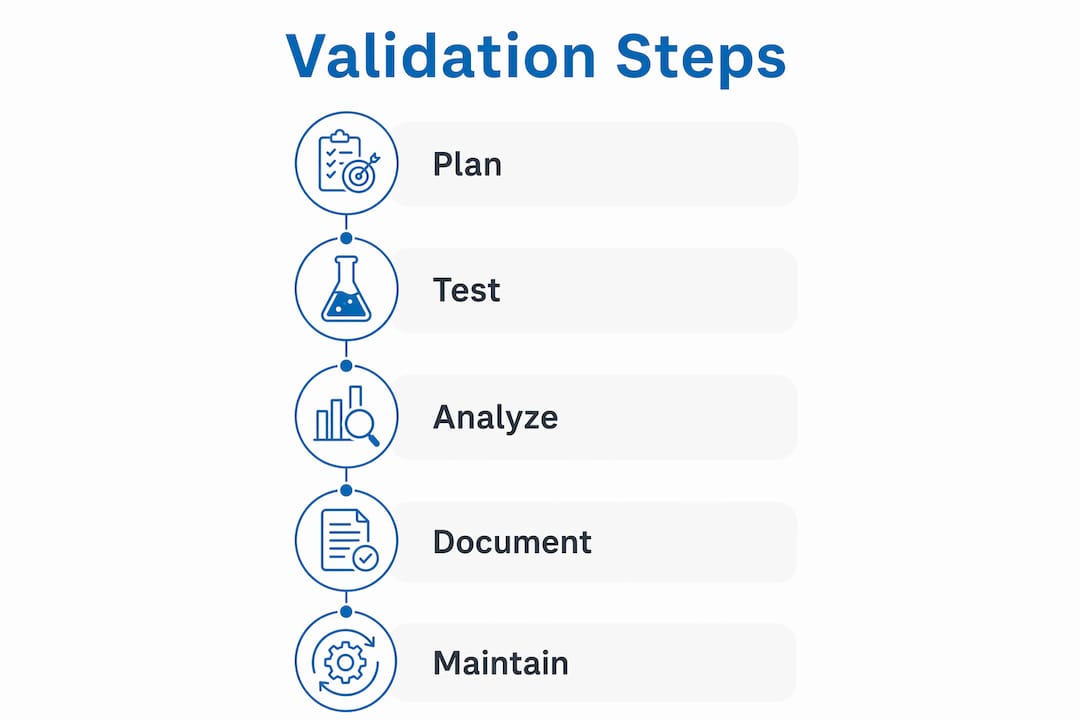
What are the steps to validate medical devices?
The medical device validation process follows a structured sequence. Skipping or reordering steps creates documentation gaps that regulators will flag.
- Freeze the design. Validation must be performed on a production-equivalent unit. Confirm the design is frozen, the manufacturing process is locked, and the software version is final before any validation testing begins.
- Select samples and configurations. Choose samples from initial production lots or production-equivalent builds. Document the rationale for sample size using statistical methods appropriate to the risk level.
- Develop validation protocols. Write detailed test protocols before testing starts. Each protocol must state the objective, test method, acceptance criteria, and statistical rationale. Acceptance criteria must be defined before data collection, not after.
- Execute validation testing. Common design validation activities include:
- Usability validation per IEC 62366-1
- Biocompatibility testing per ISO 10993-1
- Sterility and packaging integrity testing
- Electromagnetic compatibility (EMC) per IEC 60601-1
- Clinical evaluation or simulated-use studies
- Apply the IQ, OQ, PQ framework for process validation. Installation Qualification (IQ) confirms equipment is installed correctly. Operational Qualification (OQ) confirms it operates within specified parameters. Performance Qualification (PQ) involves production over multiple shifts with stable process capability (Cpk) and 95% of results within the defined range.
- Analyze results and resolve deviations. Any result outside acceptance criteria requires a formal deviation report. Determine whether the deviation requires a design change, a protocol amendment, or an engineering justification. Never close a deviation without documented resolution.
- Finalize documentation and update the RTM. Write the validation report summarizing all test results, deviations, and conclusions. Update the RTM to confirm every user need has been addressed. File all records in the DHF.
Running parallel tests, such as biocompatibility, chemical characterization, and EMC testing simultaneously after design freeze, can significantly reduce overall validation timelines without compromising rigor.
For teams navigating medical device regulatory compliance across multiple markets, aligning the validation plan with each target market’s requirements from the start avoids redundant testing later.
What are the most common medical device validation mistakes?
Validation failures are rarely caused by a lack of effort. They result from specific, repeatable errors that teams can prevent with the right processes in place.
- Validating on prototypes. FDA 483 findings frequently cite validation on prototypes as a critical noncompliance. Prototypes do not represent final device performance. Always use production-equivalent units.
- Broken traceability. When risk controls identified under ISO 14971 cannot be traced to specific validation evidence, auditors reject the entire risk management file. Every risk control needs a corresponding test result.
- Ignoring real-world use conditions. Validation conducted in a controlled lab setting that does not reflect actual clinical environments will not satisfy regulators. Usability studies must involve representative end users in realistic conditions.
- Failing to communicate design changes. Even minor changes, such as a battery swap or a software update, require proactive communication with testing laboratories. Early collaboration with labs prevents delays and avoids costly retesting.
- Poor audit readiness. Documentation scattered across shared drives, email threads, and paper binders fails inspections. Centralize all validation records in a structured DHF from day one.
“Auditors frequently examine whether validation evidence demonstrates that risk controls identified under ISO 14971 are correctly implemented and effective. Missing links between risk controls and validation test results can invalidate the entire risk management file, forcing teams to repeat testing and resubmit documentation.”
Reviewing SOP compliance practices alongside your validation SOPs helps teams build the procedural discipline that prevents these errors before they reach an auditor’s desk.
How do you maintain validation through the product lifecycle?
Validation does not end at market approval. Every design change, manufacturing process update, or new intended use triggers a reassessment of existing validation evidence.
Key practices for maintaining validation throughout the product lifecycle include:
- Manage design changes under 21 CFR 820.30(i). Any change to design inputs, outputs, or manufacturing processes requires a formal change control review. Determine whether existing validation evidence still applies or whether new testing is needed.
- Update the risk management file with every change. New risks introduced by design changes must be assessed, controlled, and linked to updated validation evidence before the change is implemented.
- Audit the RTM and DHF regularly. Schedule internal audits of the traceability matrix at least annually and after every significant design change. Gaps found internally are far less costly than gaps found by regulators.
- Integrate post-market surveillance data. User complaints, adverse event reports, and field performance data feed back into the risk management file and may trigger revalidation activities.
- Maintain usability validation cycles. As user populations or clinical environments change, usability validation may need to be repeated to confirm the device remains safe and effective for its intended users.
Pro Tip: Assign a dedicated design change coordinator who reviews every proposed change against the existing validation evidence before approval. This single role prevents the most common lifecycle validation failures.
Teams managing regulatory requirements for healthcare across Southeast Asia should map each market’s post-market obligations to their internal change control process. Requirements vary by jurisdiction, and a single validation package rarely satisfies every market without adaptation.
Key Takeaways
Successful medical device validation requires a structured process linking user needs, risk controls, and documented test evidence from design freeze through the full product lifecycle.
| Point | Details |
|---|---|
| Validation vs. verification | Verification checks design outputs against inputs; validation confirms the finished device meets user needs. |
| RTM is the audit anchor | The Requirements Traceability Matrix links every user need to V&V evidence and is the first document auditors examine. |
| Use production-equivalent units | Validating on prototypes is a cited FDA noncompliance; always test final or production-equivalent builds. |
| Risk controls need test evidence | ISO 14971 risk controls must trace to specific validation results or regulators will reject residual risk claims. |
| Lifecycle validation is mandatory | Design changes under 21 CFR 820.30(i) require formal reassessment of existing validation evidence before implementation. |
What experience actually teaches about device validation
The teams that struggle most with validation are not the ones who lack technical knowledge. They are the ones who treat validation as a final checkpoint rather than a continuous discipline woven into development from the first design review.
The V&V Master Plan is the clearest indicator of a team’s maturity. A plan written at project start and updated at every milestone tells auditors that the team understands what they are doing and why. A plan written retrospectively to justify testing already completed tells auditors the opposite.
Risk management integration is where most mid-sized developers fall short. ISO 14971 is not a separate workstream. Every risk control identified in the risk management file must have a corresponding validation test that proves the control works in the finished device. Teams that maintain these as parallel but disconnected documents create a compliance gap that is expensive to close after the fact.
For startups entering the medical device space, the most cost-effective decision is to hire or contract a validation specialist before the first design review, not after the first failed audit. Rework at the validation stage costs multiples of what prevention costs at the planning stage. Established developers expanding into new markets face a different challenge: assuming that existing validation packages transfer cleanly to new regulatory jurisdictions. They rarely do without at least partial adaptation.
The practical recommendation is straightforward. Build the RTM first. Freeze the design before testing. Communicate with testing laboratories early and often. Treat every design change as a potential revalidation trigger. These are not complex principles. They are disciplines that separate teams who pass audits from teams who do not.
— Brandcore
Labgistics: supporting compliant medical device distribution in Southeast Asia
Medical device validation generates the evidence that regulators require before a device reaches the market. Getting the device to that market safely and compliantly requires an equally rigorous supply chain.

Labgistics supports medical device manufacturers and quality assurance teams across Southeast Asia with pharma and medical device logistics built around regulatory compliance. With over 20 years of experience in healthcare logistics, Labgistics provides calibration and validation services, cold chain logistics, and regulatory support aligned with ISO 13485, HSA requirements, and international distribution standards. For teams managing medical device regulatory compliance across multiple Southeast Asian markets, Labgistics offers the infrastructure and expertise to keep validated products moving through the supply chain without compliance gaps.
FAQ
What is medical device validation?
Medical device validation is the documented process of confirming that a finished device meets all user needs and intended use requirements under actual or simulated conditions, as required by 21 CFR 820.30(g) and ISO 13485 Clause 7.3.7.
What is the difference between verification and validation?
Verification confirms that design outputs meet design inputs. Validation confirms that the finished device meets user needs. Both are mandatory under ISO 13485 and the FDA’s QMSR.
Can you validate a medical device on a prototype?
No. FDA 483 findings frequently cite validation on prototypes as a critical noncompliance. Validation must be performed on production-equivalent units that represent the final device.
What testing is included in design validation?
Design validation typically includes usability testing per IEC 62366-1, biocompatibility testing per ISO 10993-1, sterility testing, EMC testing per IEC 60601-1, and clinical evaluation or simulated-use studies.
What happens when a design change is made after validation?
Any design change triggers a formal review under 21 CFR 820.30(i) to determine whether existing validation evidence still applies or whether new testing is required before the change is implemented.
Recommended
- Medical Device Regulatory Compliance Guide for 2026
- Medical Device Importation Steps: 2026 FDA Guide
- Regulatory Requirements List for Healthcare: 2026 Guide