
Singapore Playbook for Buyers: Controlled Drugs Transport Compliance
Licensed, HSA-compliant transport and warehousing of controlled drugs is available in Singapore when the correct licences and Good Distribution Practice systems are in place. Companies must hold or work with a handler that holds a Controlled Drugs Import Licence (CDIL), Export Licence (CDEL) or Wholesale Licence (CDWL), each carrying its own fee and processing timeline. Beyond paperwork, the operation must demonstrate GDP compliance, a named Responsible Person, verified cold chain integrity, and auditable records covering every handover.
TL;DR:
- Licensing costs $111 per consignment with a 20 working day approval process, plus additional time for response delays, and wholesale licences require an annual fee.
- HSA audits focus on documentation gaps such as temperature logs, calibration certificates, SOPs, and inventory trails, which are essential for license approval.
- Maintaining updated SOPs, calibration records, training logs, and clear contractual responsibilities with 3PL partners is key to passing GDP compliance checks.
- Controls also depend on secure transportation, tamper-evident packaging, and detailed chain-of-custody records to prevent loss or diversion.
- Planning should start early by assembling all required documentation, booking the audit slot, and confirming that 3PL providers hold voluntary GDP certification when possible.
Table of Contents
- Which HSA licences and fees apply to controlled drugs transport in Singapore
- What HSA’s GDP audit process checks before issuing a licence
- Temperature control, calibration and chain-of-custody standards to meet
- How to prepare a controlled drugs shipment and vet your 3PL partner
- What Labgistics Asia brings to controlled drugs logistics in Singapore
- What matters most when planning a controlled drugs shipment
- Get audit-ready support for controlled drugs logistics
- Official resources to consult before you apply
- Sources
- FAQ
Which HSA licences and fees apply to controlled drugs transport in Singapore
Singapore’s regulatory structure splits controlled drugs activity into three licence types, each tied to a specific function. A Controlled Drugs Import Licence (CDIL) authorizes bringing consignments into Singapore, while a Controlled Drugs Export Licence (CDEL) covers outbound shipments. Both are issued per consignment. A Controlled Drugs Wholesale Licence (CDWL) is the annual licence required for ongoing wholesale dealing, and it must be held by a pharmacist registered with the Singapore Pharmacy Council, as set out in HSA’s licence application guidance.
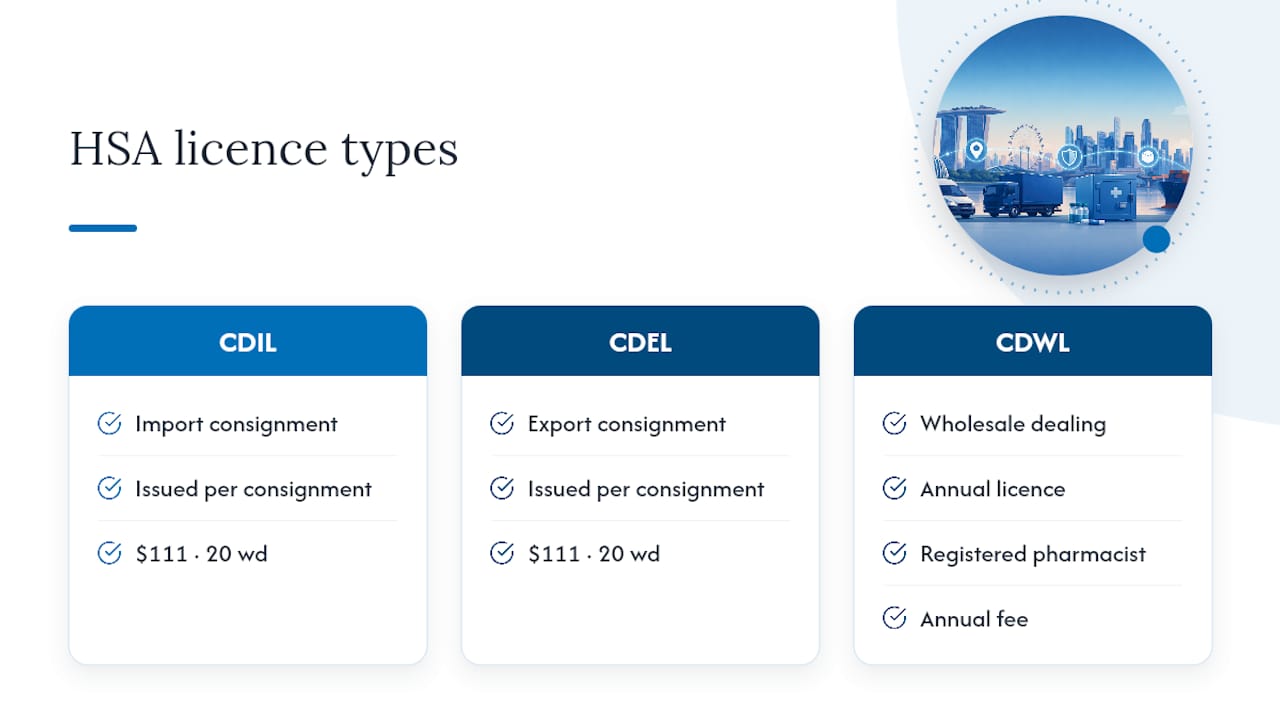
The fees and turnaround times published by HSA set the budgeting baseline: CDIL and CDEL applications cost $111 per consignment with a 20 working day turnaround, and that clock excludes any time the applicant takes to respond to queries. The CDWL carries an annual fee, and because CDIL and CDEL are consignment-specific, they may be non-renewable and must be reapplied for each shipment.
For teams that plan to outsource this function, our HSA wholesaler licence guide walks through premises audit timing in more detail. The practical takeaway is scheduling: build in the full 20 working days for consignment licences, add buffer for any applicant response delay, and confirm early that the licence holder is a registered pharmacist when wholesale dealing is part of the scope.
What HSA’s GDP audit process checks before issuing a licence
Compliance with Good Distribution Practice standards is mandatory for local importers and wholesalers of controlled drugs, and HSA conducts premises audits before licence issuance unless the applicant’s activities are restricted, according to HSA’s GDP guidance. Once an audit closes out satisfactorily, the licence is issued within 10 working days, so the real project timeline hinges on how quickly the site passes.
Auditors tend to flag documentation gaps rather than physical equipment failures, and those gaps are avoidable with preparation. Common shortfalls include:
- Missing or incomplete temperature excursion records for cold chain shipments.
- SOPs that never explicitly link the licence holder’s obligations to a third-party logistics provider’s duties.
- Inventory audit trails with gaps between what was received, stored and dispatched.
- Calibration records for data loggers or cold storage units that are outdated or absent.
Pro Tip: Keep a live audit trail that ties each shipment ID to its calibrated logger output and route timestamp, rather than compiling a summary only when an audit is scheduled.
Building an audit-ready file means keeping SOPs current, maintaining a site master file, logging personnel training, documenting exactly what your 3PL is contractually responsible for, and being able to pull any of this on short notice. Our pharma logistics compliance checklist covers the documentation set procurement teams typically assemble before a first audit.
Temperature control, calibration and chain-of-custody standards to meet
Controlled drugs transport in Singapore rests on operational evidence, not just licences. Temperature-sensitive pharmaceuticals need validated packaging, continuous monitoring through calibrated data loggers, defined alarm thresholds, and a documented SOP for what happens the moment a reading drifts outside range. Our guide to temperature controlled storage covers the validation steps in more depth, and PCS Precision’s overview of cold chain monitoring hardware is a useful technical reference for teams specifying loggers and sensors.
Four categories of evidence recur across HSA audits and GDP reviews:
- Temperature logs covering the full transit window, matched to the shipment ID.
- Calibration certificates for every data logger, sensor and cold room used in the chain.
- Corrective action records for any excursion, showing what was done and when.
- Chain-of-custody documentation, including tamper-evident packaging checks and signed handover records at each transfer point.
HSA’s GDP framework treats documented audit trails as mandatory for local importers and wholesalers, which means the absence of a record is treated the same as a failure of the control it was meant to verify.
Security controls matter just as much as temperature. Restricted access to storage areas, secured transport vehicles, and documented handovers at every custody change reduce the risk of loss, theft or diversion, all of which fall under the Misuse of Drugs Act’s restrictions on handling controlled substances. A device history record approach, borrowed from quality management practice, is a useful model for structuring the traceability file that ties a shipment’s identity to every step it passed through.
How to prepare a controlled drugs shipment and vet your 3PL partner
Before a licence application or audit date is set, procurement teams should gather a specific document set: a site master file, current SOPs, calibration and validation reports for any equipment involved, and staff training records for everyone touching the shipment. Our guide to HSA compliance for medical importers walks through how these pieces fit together for a first-time applicant.
The contract with a 3PL partner deserves equal attention. At minimum, it should specify:
- Which party owns each GDP responsibility, from receiving to dispatch.
- Data access rights so the licence holder can produce records on demand during an HSA audit.
- Notification windows for temperature excursions or security incidents.
- Limits on sub-contracting, since an undisclosed sub-contractor is a common audit finding.
Pro Tip: Ask any prospective 3PL whether they hold voluntary GDP certification. A GDP-certified handler that can produce calibration certificates and validation reports on request typically shortens the path to a clean audit.
SLAs should set explicit temperature compliance targets, a reporting cadence, and defined timelines for reconciliation and corrective action. The Responsible Person named on the licence needs visibility into all of this, since HSA expects the RP to demonstrate oversight, not delegate it silently.
What Labgistics Asia brings to controlled drugs logistics in Singapore
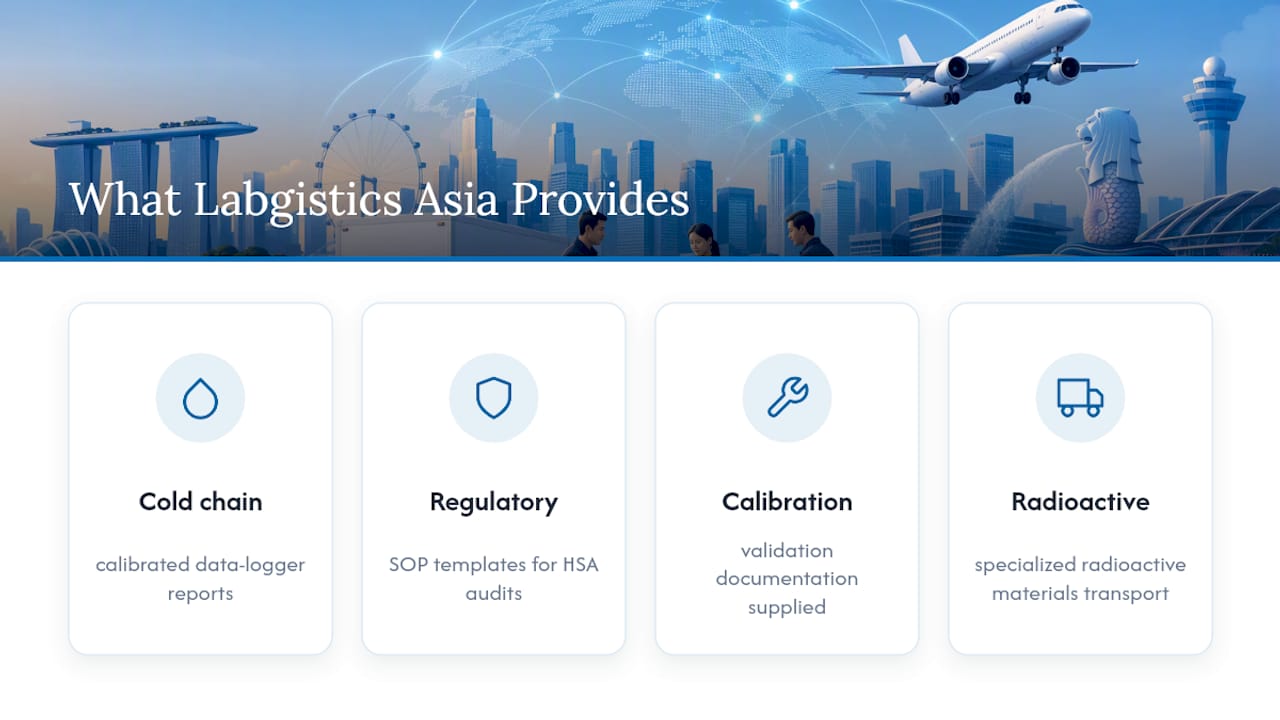
A healthcare logistics provider in Southeast Asia offers services including cold chain logistics, regulatory support, calibration and validation, and specialized radioactive materials transport, serving pharmaceutical companies and healthcare providers as a single point of contact for operational and regulatory sides of controlled drugs handling. Experienced providers in this space typically supply calibrated data logger reports, SOP templates and validation documentation as standard deliverables, the same artefacts an HSA audit will ask to see.
What matters most when planning a controlled drugs shipment
The timeline that catches most teams off guard is the combined effect of the 20 working day per-consignment turnaround and the audit scheduling window ahead of it, plus the 10 working days HSA needs to issue a licence after a satisfactory audit close-out. The mistakes we see most often are late documentation, unclear division of duties between the licence holder and its 3PL, and calibration evidence assembled only after an audit date is confirmed. Start earlier than feels necessary: appoint a Responsible Person, compile your site master file and calibration certificates, and book a GDP audit slot before you need the licence in hand.
— Brandcore
Get audit-ready support for controlled drugs logistics
Pharmaceutical companies and healthcare providers moving controlled drugs in Singapore need a partner that can handle the licensed transport and warehousing side while also producing the calibration and regulatory evidence an HSA audit demands. Labgistics Asia’s relevant services cover exactly that combination.
- Supply Chain Solutions for licensed 3PL warehousing and distribution of controlled and regulated pharmaceutical products.
- Regulatory Services to support HSA licence applications and GDP audit preparation.
- Calibration Services & Equipment Validation to produce the logger and cold room certificates auditors ask for.
- Radioactive Import Clearance & Transportation Services for facilities that also handle radiopharmaceuticals alongside controlled drugs.
Reach out through Supply Chain Solutions to request audit-readiness documentation or arrange a discovery call about your specific licence pathway.
Official resources to consult before you apply
Confirm current fees and forms directly through HSA’s controlled drugs licence application page and its licensing overview for importers and wholesalers, and review GDP alignment against broader WHO and PIC/S regulatory guidance.
FAQ
What licences do I need to transport controlled drugs in Singapore?
You need a Controlled Drugs Import Licence (CDIL) or Export Licence (CDEL) for per-consignment movement, or a Controlled Drugs Wholesale Licence (CDWL) for ongoing wholesale dealing. The CDWL must be held by a pharmacist registered with the Singapore Pharmacy Council.
How long does it take to get a controlled drugs licence approved?
Per-consignment licences carry a 20 working day turnaround, not counting time the applicant takes to respond to queries. For wholesale licences requiring a premises audit, HSA issues the licence within 10 working days of a satisfactory audit close-out.
Who is responsible for GDP compliance during controlled drugs transport?
The licence holder names a Responsible Person who must demonstrate oversight of GDP obligations, and for certain licences that person must be a registered pharmacist, per HSA’s licensing overview. When a 3PL handles physical transport, the contract should clearly divide GDP duties between the licence holder and the logistics partner.
What documents does HSA check during a GDP audit?
Auditors typically review temperature excursion records, calibration certificates for monitoring equipment, SOPs linking the licence holder to any third-party handler, and inventory audit trails. Gaps in these documents, rather than equipment failures, are the most common cause of audit findings.
Can a 3PL like Labgistics Asia handle controlled drugs logistics in Singapore?
Some 3PL providers offer licensed warehousing, cold chain handling, regulatory support and calibration services that align with the operational evidence HSA audits require. Specific licence responsibilities still rest with the named Responsible Person, so any partnership should be structured through a Supply Chain Solutions engagement with clear contractual role division.
Recommended
- Controlled Substances Logistics: A Compliance Guide for 2026
- Understand Compliance in Healthcare Logistics: SEA Guide