
Time and Temperature Labels: The IATA Compliance Guide for Healthcare Procurement
For most pharmaceutical and life science shipments, the right starting point is a pre-printed IATA time and temperature label for booking compliance, paired with an irreversible chemical indicator for receipt verification, and a calibrated electronic data logger for any high-value or release-critical batch.
Here is how that maps to your immediate need:
- Compliance-only (booking alignment): Pre-printed IATA handling labels from Labelmaster, TOTALPACK®, AMS Printing, Air Sea Containers, or Uline. Confirm the lower half shows the external transportation temperature range in Celsius, matching your Air Waybill (AWB).
- Visual verification at receiving: Irreversible indicators such as DeltaTrak TempDot / TempDot Plus, Timestrip Plus, WarmMark Long-Run, or TIPTEMP Non-Reversible Temperature Labels. These give a pass/fail read without any equipment.
- Continuous monitoring and QA release: Electronic data loggers such as Sensitech/TempTale. Required when a downloadable time-series record is needed for release decisions or investigations.
Procurement action: order IATA handling labels in roll format sized to your volume, confirm your carrier’s SOP accepts the label format, and activate a logger before sealing the shipper for any batch requiring documented temperature history.
Key Takeaways
The IATA time and temperature label is a mandatory compliance mark that triggers correct handling but does not verify temperature maintenance; pair it with an irreversible indicator and a calibrated logger for a complete, auditable cold chain control system.
| Point | Details |
|---|---|
| Match label to AWB | The label’s lower half must show the temperature range in Celsius, matching the Air Waybill exactly. |
| Use irreversible indicators at receiving | TempDot Plus, Timestrip Plus, WarmMark, or TIPTEMP provide a visual pass/fail before the shipper is opened. |
| Require calibrated loggers for release decisions | Electronic loggers (Sensitech/TempTale) must carry calibration certificates for use in regulated pharma release. |
| Specify threshold and run-out time | For irreversible indicators, specify trigger temperature and cumulative exposure window in every RFQ. |
| Labgistics integration | Labgistics provides logger calibration, packaging validation, and carrier SOP alignment for compliant healthcare shipments. |
Table of Contents
- Which time and temperature label or indicator fits your shipment?
- What types of time and temperature indicators are actually available?
- How do these indicators work, and where do they fall short?
- IATA acceptance checklist: how to prepare a compliant shipment
- How to specify and order the right labels or indicators
- Where to buy time and temperature sensitive labels in the US market
- Why the label is only one layer of a compliant cold chain
- Procurement and QA perspective: the mistakes that cause rejections
- Labgistics supports compliant temperature-sensitive shipments end to end
- Sources
- FAQ
Which time and temperature label or indicator fits your shipment?
The table below covers the primary product types procurement teams evaluate, organized by function rather than brand.
IATA label vs. integrity verification: An IATA time and temperature sensitive label tells handlers how to treat the shipment. It does not record or verify that the temperature was actually maintained. A separate irreversible indicator or electronic logger is required for integrity verification.
Pro Tip: For most pharmaceutical shipments, the most cost-effective configuration is: pre-printed IATA label (compliance) + TempDot Plus or Timestrip Plus (receipt verification) + Sensitech/TempTale logger for high-value or release-critical batches. This layered approach satisfies both carrier acceptance and QA release requirements without over-engineering every shipment.
The table shows a clear split between handling labels (informational, compliance-driven) and verification devices (chemical or electronic). Start with the handling label class for booking alignment, then select an irreversible indicator matched to your product’s thermal risk profile for receiving checks.
What types of time and temperature indicators are actually available?
Understanding the category taxonomy prevents the most common procurement error: ordering a handling label when a verification device is needed, or vice versa.
Pre-printed IATA handling labels
These are informational marks. They communicate the required external transportation temperature range to handlers and airlines. IATA publishes standard label formats, and vendors including Labelmaster, TOTALPACK®, AMS Printing, Air Sea Containers, Uline, and InstockLabels/Amazon all sell roll or sheet formats sized for carton-level application. The lower half must show the temperature range in Celsius. These labels do not monitor anything.
Irreversible chemical and time-temperature indicators
These devices record cumulative thermal exposure above a set threshold. Once triggered, they cannot be reset. Key products in this class:
- DeltaTrak TempDot / TempDot Plus: Single-use, serial-numbered, with multiple threshold temperatures and run-out times. The color change is unambiguous and the serial number supports traceability in QA records.
- Timestrip Plus Time-Temperature Indicator Labels: Cumulative exposure indicators with a clear visual progression. Suited for short-to-medium transit windows.
- WarmMark Long-Run Indicator: Designed for extended transit times where cumulative warm exposure is the risk. Multiple run-out models available.
- TIPTEMP Non-Reversible Temperature Labels: Adhesive, low-cost, and straightforward. Suited for carton-surface monitoring where a simple pass/fail at receiving is sufficient.
- ColdMark: Monitors cold excursions rather than warm ones. Relevant for freeze-sensitive biologics and diagnostics.
Single-use temperature strips for process monitoring
The ThermoStrip (Temperature Label ThermoStrip for Drying and Curing) falls into a related but distinct category: surface temperature monitoring during manufacturing or processing steps rather than transit. Procurement should not substitute these for transit indicators.
Electronic data loggers
Sensitech/TempTale devices record a continuous time-series temperature profile throughout a shipment. Data downloads via USB or wireless interface and generates a report suitable for QA release decisions. These are the only devices that can answer the question “at what time did the excursion occur, and for how long?” Calibration certificates are required for use in regulated pharmaceutical distribution.
Pro Tip: Pair an irreversible indicator with an electronic logger on any shipment where a single excursion could trigger a batch rejection. The indicator gives the receiving team an immediate visual flag; the logger provides the forensic record QA needs to make a release or reject decision with documented evidence.
For a broader view of temperature control solutions in healthcare logistics, including active and passive packaging options, the technology choices extend well beyond labels alone.
How do these indicators work, and where do they fall short?
The most direct statement procurement and QA teams need to internalize: a handling label is an instruction, not a measurement. An irreversible indicator records cumulative exposure, not real-time temperature. An electronic logger is the only device that provides a time-stamped record.
Irreversible indicators: cumulative exposure and degree-hours
Chemical indicators like TempDot Plus work through a diffusion-based mechanism. When ambient temperature exceeds the threshold, a chemical reaction begins and progresses at a rate proportional to temperature and time. The result is a color change that reflects cumulative thermal load, sometimes expressed as degree-hours above threshold. The critical implication: a brief spike to a high temperature and a prolonged period just above threshold can produce the same indicator response. QA teams must interpret the result in the context of the product’s known thermal stability, not as a precise temperature reading.
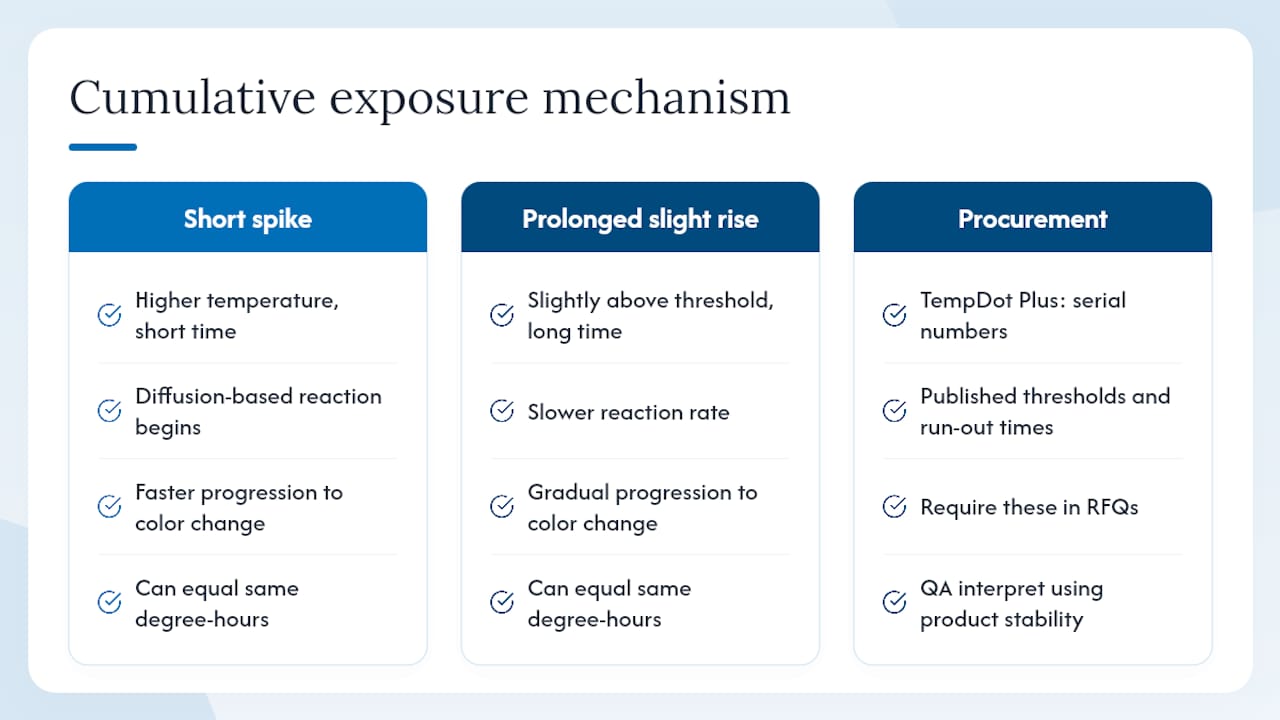
DeltaTrak’s TempDot Plus labels carry serial numbers and published threshold temperatures and run-out times, which procurement should require in any RFQ for this product class.
Placement and thermal mass limitations
Indicator placement matters significantly. Because product internal temperature lags changes in ambient temperature, an indicator placed on the outer surface of a carton will respond faster than the product inside. The IATA Temperature Control Regulations (TCR) address this directly: placement of indicators and loggers inside the primary packaging and near the thermal mass of the product gives a more representative reading than surface placement.
Activation and shelf-life issues
Irreversible indicators have defined shelf lives before activation and storage conditions that must be maintained. An indicator stored above its recommended temperature before use may already be partially triggered. Procurement should require manufacturer datasheets specifying pre-use storage conditions and expiry dates.
The IATA Time & Temperature FAQ is explicit: the label reflects ambient transport conditions and does not guarantee that the product’s internal temperature was maintained throughout the journey. Shippers must arrange appropriate temperature-controlled transport separately. The label triggers correct handling; it does not replace active or passive temperature control. Source: IATA T&T Sensitive Label FAQ
Pro Tip: Never rely on an IATA handling label as evidence of temperature maintenance during a deviation investigation. The label’s purpose is carrier acceptance, not QA evidence. For any investigation, you need the logger data.
IATA acceptance checklist: how to prepare a compliant shipment
The IATA Standard Acceptance Checklist for time and temperature sensitive healthcare shipments has been mandatory since July 2013. Airlines and ground handlers use it to accept or reject shipments at the point of tender. QA and shipping teams should build their pre-dispatch procedure around the same checklist.
- Confirm booking: The shipment must be booked as a time and temperature sensitive service with the carrier. The IATA label is only valid when the booking matches.
- Complete the Air Waybill: The AWB must show a single temperature range in Celsius. Multiple ranges or a blank temperature field will trigger rejection.
- Complete the label lower half: The IATA time and temperature sensitive label’s lower half must show the external transportation temperature range in Celsius, matching the AWB exactly. IATA’s FAQ states that if there is a discrepancy between the label and the AWB, the AWB prevails and the shipment may be rejected or reclassified.
- Affix the label: Place the IATA time and temperature sensitive label on the outer packaging where it is clearly visible to handlers. Do not obscure it with other labels or strapping.
- Include a 24-hour emergency contact: The AWB or accompanying documentation must carry a 24-hour emergency contact number, as required by the acceptance checklist.
- Conduct pre-shipment temperature checks: Verify the container or shipper has been pre-conditioned to the required temperature range before loading product.
- Attach the ACT container check sheet if using an active container, as specified in the checklist.
- Activate logger (if applicable): If an electronic logger is included, activate it before sealing the shipper and record the device serial number in the shipment documentation.
- Retain documentation: Keep copies of the AWB, label photograph, logger activation record, and any pre-shipment temperature check records for QA files.
Pro Tip: Carrier SOPs vary. Some airlines and ground handlers have additional requirements beyond the IATA minimum checklist. Confirm carrier-specific SOP or SLA requirements before dispatch, particularly for routes into or through Southeast Asia, where regulatory expectations may layer on top of IATA requirements.
One language note: the IATA label text and temperature range must appear in English, and temperature must be expressed in Celsius. Labels printed in other languages or using Fahrenheit do not satisfy the IATA requirement.
How to specify and order the right labels or indicators
Ordering the wrong product class is the most avoidable procurement error in this category. Before issuing an RFQ or placing a purchase order, confirm the following specification parameters.
Minimum specification checklist for any order:
- Product class: handling label, irreversible indicator, or electronic logger
- Trigger temperature or temperature range (in °C), matched to the product’s thermal risk profile
- Run-out time (for irreversible indicators): the cumulative exposure window before the indicator activates
- Format: roll, sheet, or card; roll pitch and core size if using a label dispenser
- Adhesive type: permanent, removable, or cold-temperature adhesive for frozen shipments
- Shelf life before activation and required pre-use storage conditions
- Activation method: peel-and-stick, pull-tab, or electronic start
- Serial or lot traceability: required for pharma-grade applications
- Calibration certificate: mandatory for electronic loggers used in release decisions
Vendor questions to include in your RFQ:
- What is the standard lead time for the specified quantity and format?
- Are representative samples available for validation testing before a production order?
- Does the product carry a calibration certificate or validation data sheet? What is the traceability chain?
- What regulatory claims does the manufacturer make (pharma-grade, IATA-compliant, validated)?
- What are the storage and handling requirements for the product before use?
Regarding packaging units: rolls are the standard format for high-volume carton-level application and are compatible with most industrial label dispensers. Sheet formats suit lower-volume or manual application. Card-format indicators (common for Timestrip Plus and WarmMark) are typically applied by hand at the point of packing.
Pro Tip: Always request a sample lot with the manufacturer’s datasheet before committing to a production order. For irreversible indicators, run a bench test at your specified threshold temperature to confirm the run-out time matches the published specification. This step is particularly important when the indicator will be used as part of a validated receiving procedure.
Cost considerations: pre-printed IATA handling labels are low-cost commodity items (typically in the single-digit cents per label range at roll quantities). Irreversible indicators carry a moderate premium. Electronic loggers represent the highest unit cost but are often reusable or available on a per-shipment rental basis from logistics providers.
For guidance on temperature-controlled storage requirements that complement your label and indicator program, including documentation standards for pharma compliance, Labgistics publishes a dedicated compliance reference.
Where to buy time and temperature sensitive labels in the US market
The US market has well-established supply channels for all three product classes. Here is a practical breakdown by vendor type.
For IATA compliance handling labels:
- Labelmaster is the most recognized US supplier of IATA-compliant labels and offers both standard and personalized Time & Temperature Label rolls of 500, available directly and through distribution. Their catalog covers the full IATA label range.
- TOTALPACK® offers 4×4" rolls of 500 at competitive pricing, compatible with standard industrial dispensers. A practical choice for operations running high carton volumes.
- AMS Printing provides multiple design and size options for IATA-style labels, useful when different package formats require different label dimensions.
- Air Sea Containers differentiates on print durability: their 4-color IATA labels use fade-resistant inks on heavier-weight coated stock, suited for long international transit routes where label legibility must survive handling and humidity.
- Uline and InstockLabels/Amazon serve procurement teams that need fast replenishment or smaller quantities without a formal vendor relationship.
For irreversible indicators:
DeltaTrak’s TempDot and TempDot Plus are the benchmark for pharma-grade irreversible indicators in the US market. Serial traceability and published calibration data make them the default choice for QA teams that need documented receiving records. Timestrip Plus and WarmMark cover similar verification needs with slightly different run-out profiles. TIPTEMP offers a lower-cost option where a simple pass/fail is sufficient and traceability is not required. ColdMark addresses the freeze-excursion risk for biologics and diagnostics shipped at 2°C–8°C where cold damage is the primary concern.
For biological sample transport specifically, the choice of transport medium matters as much as the indicator. T-Store tissue storage and transport media from Mayflower Bioscience is one example of a validated medium designed to maintain sample integrity during transit, complementing the temperature monitoring layer.
For electronic data loggers:
Sensitech (TempTale series) is the dominant US supplier for pharma-grade continuous monitoring. Devices are available for purchase or per-shipment rental through logistics providers. Calibration certificates and downloadable reports are standard. DeltaTrak also offers electronic logger options alongside its indicator range.
Why the label is only one layer of a compliant cold chain
The IATA time and temperature sensitive label is a mandatory compliance mark, but it is the starting point of a cold chain control system, not the whole system. IATA’s Pharma & Healthcare program is explicit: the label communicates required handling conditions and must be paired with an appropriately booked temperature-controlled service. The label alone does not guarantee product integrity.
A practical workflow for a compliant pharmaceutical air shipment looks like this:
- Booking: Confirm temperature-controlled service with the carrier and record the AWB temperature range.
- Label affixation: Apply the IATA time and temperature sensitive label with the lower half completed in Celsius, matching the AWB.
- Indicator placement: Affix an irreversible indicator (TempDot Plus, Timestrip Plus, or equivalent) inside the shipper, near the product’s thermal mass.
- Logger activation: For high-value or release-critical batches, activate a calibrated electronic logger and record the serial number.
- Carrier coordination: Confirm the carrier’s SOP, pre-shipment temperature checks, and ACT container check sheet if applicable.
- Arrival verification: At receiving, read the indicator before opening the shipper. Download logger data before making a release decision.
- Documentation: Retain AWB, label photograph, indicator result, and logger report in the batch record.
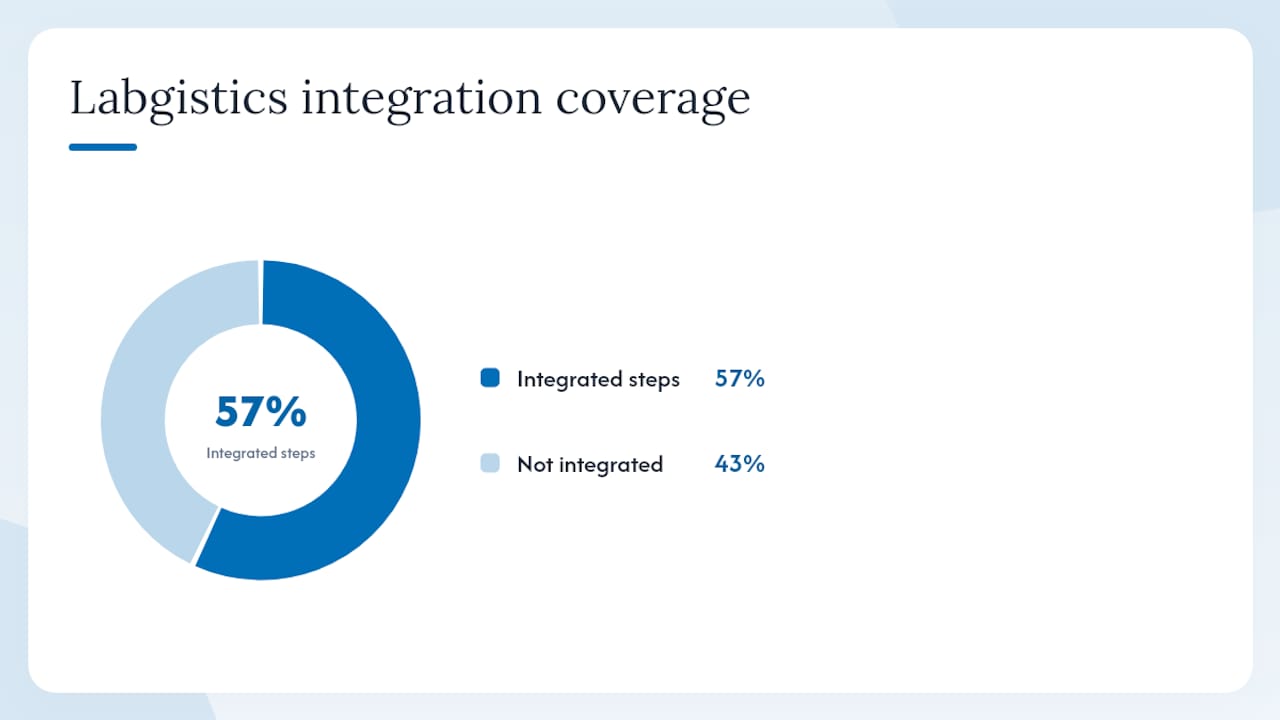
Labgistics integrates directly into steps 1, 4, 5, and 7 through its calibration and validation services for electronic loggers and sensors, carrier SOP alignment, and regulatory documentation support. For procurement teams managing cold chain integrity across Southeast Asia, this integration reduces the coordination burden on internal QA teams.
Pro Tip: Require manufacturer spec sheets and calibration certificates for every electronic logger used in a release decision. QA auditors will ask for them. Build the requirement into your vendor qualification checklist and your SOP before the first shipment, not after the first deviation.
Validation of packaging systems and loggers is a regulatory expectation under PIC/S GDP guidelines for pharmaceutical distribution. Procurement should treat calibration certificates as a non-negotiable line item in logger procurement, not an optional add-on.
Procurement and QA perspective: the mistakes that cause rejections
The most common failures in time and temperature sensitive shipments are not complex. They are procedural gaps that a well-designed SOP eliminates.
Common procedural failures include leaving the label’s lower half blank or with a temperature range differing from the AWB, applying the label without a booked temperature-controlled service, and relying solely on the label without verifying indicators or logger results. These issues can lead to shipment rejection or acceptance errors.
Pre-dispatch QA checks to add to your SOP:
- Verify AWB temperature range matches the label lower half before the shipment leaves the facility.
- Confirm the carrier booking reference includes the temperature-controlled service code.
- Photograph the labeled shipper as part of the dispatch record.
- Record indicator lot number and logger serial number in the shipment file.
Goods-received procedure addition: At receiving, read the irreversible indicator before opening the shipper and record the result (pass/fail, lot number, date/time) in the goods-received record. If the indicator shows an excursion, quarantine the shipment and download the logger data before making any release or reject decision. Do not release product based on visual inspection of the outer packaging alone.
Labgistics supports compliant temperature-sensitive shipments end to end
Labels and indicators are the visible layer of a cold chain program. The operational infrastructure behind them, including carrier coordination, packaging validation, logger calibration, and regulatory documentation, determines whether that program holds up under audit or deviation investigation.

Labgistics provides specialized healthcare logistics services that cover the full workflow: packaging validation, temperature logger calibration and provisioning, carrier booking and SOP alignment, and regulatory documentation support for pharmaceutical, medical device, and life science shipments across Southeast Asia and US lanes. With over 20 years of experience in healthcare logistics, Labgistics works with procurement and QA teams to build SOPs that satisfy IATA, PIC/S GDP, and carrier-specific requirements from the first shipment.
To assess your current cold chain program or request a packaging validation, contact Labgistics directly through the temperature-sensitive shipment handling service page.
Sources
Primary references procurement and QA teams should keep on file:
- IATA – Temperature Control Regulations (TCR)
FAQ
What is a time and temperature indicator?
A time and temperature indicator is a device that records cumulative thermal exposure above a set threshold, providing a visual or electronic signal when a product has been exposed to unacceptable conditions. Unlike an IATA handling label, which is an informational compliance mark, an indicator actively responds to temperature history.
How do temperature indicator stickers work?
Irreversible chemical indicators like TempDot Plus use a diffusion-based reaction that progresses when ambient temperature exceeds the threshold. The result is a permanent color change that reflects cumulative exposure; the indicator cannot be reset, making it a reliable pass/fail tool at receiving.
Can RFID tags track temperature?
Some RFID-enabled labels incorporate temperature sensors and can log or transmit temperature data, but standard RFID tags do not track temperature. For pharmaceutical shipments requiring documented temperature history, a dedicated electronic data logger such as Sensitech/TempTale is the validated standard.
Where can you get a temperature strip for pharmaceutical shipments in the US?
DeltaTrak (TempDot / TempDot Plus), Timestrip Plus, WarmMark, and TIPTEMP are all available through US distributors and direct from manufacturers. For IATA handling labels, Labelmaster, Uline, TOTALPACK®, and AMS Printing are the primary US sources.
What happens if the IATA label temperature range does not match the Air Waybill?
The AWB temperature prevails in any discrepancy, and the carrier may reject or reclassify the shipment at acceptance. Procurement SOPs must include a pre-dispatch step that confirms the label lower half and AWB show the same temperature range in Celsius before the shipment leaves the facility.
Recommended
- Types of Temperature Control Solutions for Healthcare Logistics
- Temperature Controlled Storage: A Pharma Compliance Guide
- How to Handle Temperature-Sensitive Shipments in Healthcare
- Healthcare logistics: cold chain and compliance in SE Asia