
Supply chain security is the strategic management of risks originating from third-party suppliers, logistics networks, and software components to protect and sustain the entire supply chain. In healthcare, the role of supply chain security extends beyond operational continuity. It directly determines whether patients receive safe, uncompromised medical products. Regulatory bodies including the FDA and the European Commission now treat supply chain protection as a clinical safety issue, not just an IT concern. Frameworks like NIST SP 800-161 Rev. 1 and ISO 28000:2022 have moved from optional guidance to baseline expectations for healthcare logistics providers operating across Southeast Asia and globally.
What risks does supply chain security address in healthcare?
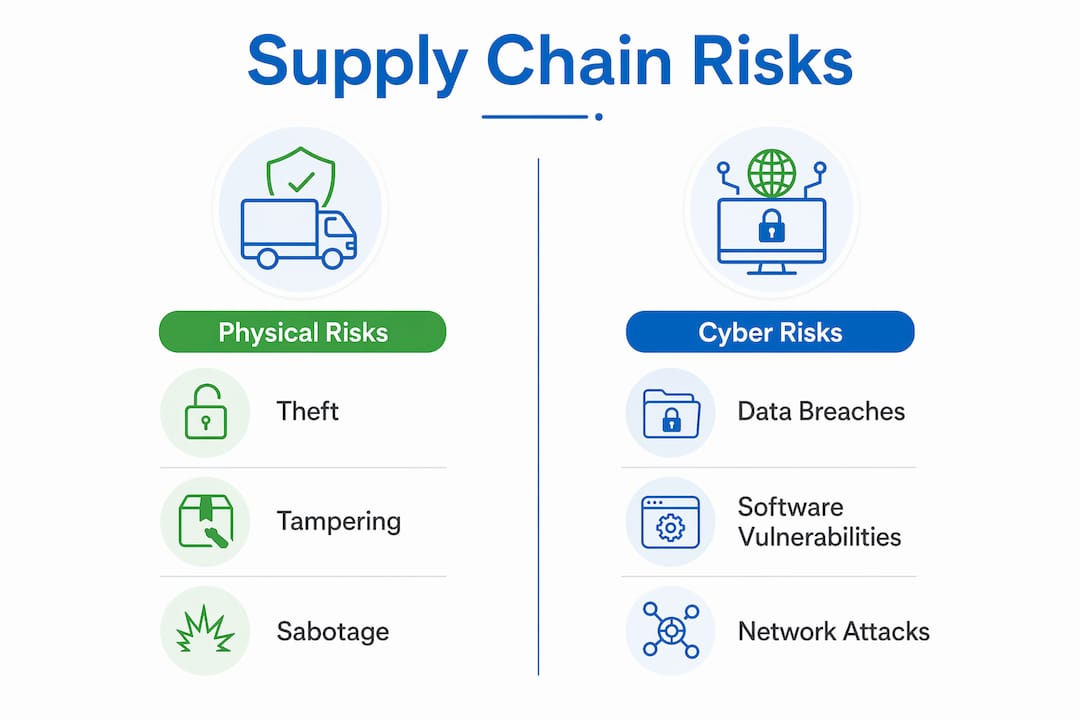
Healthcare supply chains face three distinct categories of risk: physical, cyber, and operational. Each category carries consequences that reach the patient, not just the balance sheet.
Physical threats include theft, tampering, sabotage, and diversion of pharmaceutical products or medical devices during warehousing and transit. Temperature-sensitive pharmaceuticals are especially vulnerable during handoffs between logistics providers. A single break in cold chain custody can render an entire shipment clinically unsafe.

Cyber risks have grown sharply as digital integration expands across healthcare logistics networks. 97% of commercial applications contain open-source software, with 86% carrying known vulnerabilities and 81% classified as high or critical risk. That means nearly every software tool your vendors use is a potential entry point for attackers.
Operational risks include logistics failures, system downtime caused by cyber incidents, and supplier insolvency. Any of these can delay critical medical supplies to hospitals or clinics. The attack surface extends beyond internal networks to include every third-party vendor and partner in the ecosystem.
Key risk categories supply chain managers must monitor:
- Software component vulnerabilities in medical device firmware and hospital management systems
- Compromised vendor access where a trusted supplier becomes the attack vector
- Open-source component risks embedded in commercial software without disclosure
- Physical tampering during cross-border transport, particularly for high-value pharmaceuticals
- Logistics disruptions caused by cyber incidents at freight or warehousing partners
The medical supply chain risks specific to Southeast Asia add regulatory complexity across multiple jurisdictions, making risk visibility harder to maintain.
How do industry standards and regulations shape supply chain security?
Standards and regulations now define the minimum acceptable security posture for healthcare supply chains. Supply chain managers who treat compliance as a checkbox exercise face both financial penalties and patient safety exposure.
NIST SP 800-161 Rev. 1 provides cyber-specific risk management guidance for information and communications technology (ICT) supply chains. It requires organizations to identify, assess, and respond to cybersecurity risks introduced by suppliers and third-party service providers. Healthcare organizations adopting this framework gain a structured method for vendor vetting and continuous monitoring.
ISO 28000:2022 addresses physical security management across the entire supply chain. It covers risk assessment, security planning, and incident response for logistics operations. Together, NIST SP 800-161 and ISO 28000 form complementary frameworks that cover both cyber and physical dimensions of supply chain protection.
The European Cyber Resilience Act and the FDA’s SBOM mandate represent the regulatory frontier. Non-compliance with the European Cyber Resilience Act can result in penalties up to 2.5% of an organization’s global annual turnover. That figure makes supply chain security a board-level financial risk, not just an operational one.
| Framework | Scope | Primary Focus |
|---|---|---|
| NIST SP 800-161 Rev. 1 | ICT supply chains | Cyber risk management and vendor assessment |
| ISO 28000:2022 | Physical supply chains | Security management systems for logistics |
| FDA SBOM Mandate | Medical device software | Software transparency and vulnerability tracking |
| European Cyber Resilience Act | Digital products in EU market | Cyber requirements with financial penalties |
Healthcare organizations operating across Southeast Asia must align with both international standards and local regulatory requirements from bodies such as Singapore’s Health Sciences Authority (HSA). Proper pharmaceutical warehousing compliance requires integrating these frameworks into daily operations, not treating them as annual audit events.
What practical strategies strengthen supply chain security and resilience?
The most effective supply chain protection strategies combine organizational discipline with technology-enabled monitoring. No single tool or policy is sufficient on its own.
-
Adopt a zero-trust posture. The traditional “trust but verify” model no longer applies. Zero-trust security models treat every supplier, partner, and software component as a potential risk until continuously verified. This means removing implicit trust from any vendor with network access to your systems.
-
Implement Software Bills of Materials (SBOMs) as dynamic tools. An SBOM lists every software component in a medical device or application. Treat SBOMs as living documents requiring continuous automated monitoring against vulnerability databases, not static compliance checkboxes filed once and forgotten.
-
Prioritize critical “nexus” vendors. Not all suppliers carry equal risk. Alert paralysis occurs when security teams are overwhelmed by notifications from hundreds of vendors simultaneously. Focus deep audits and collaboration resources on the subset of vendors with the highest system access and operational impact.
-
Build relational governance with key partners. Timely information sharing among supply chain partners reduces attack dwell time and enables coordinated incident response. Formal agreements on threat disclosure and joint response protocols are more effective than one-way vendor questionnaires.
-
Develop executable digital disaster recovery plans. Predefined playbooks triggered automatically when a supplier’s security status changes outperform manual review processes. Your logistics risk management plan should specify exactly which actions follow a confirmed vendor breach.
-
Apply continuous vendor security monitoring. Automated security rating platforms provide real-time visibility into vendor risk posture. This replaces point-in-time assessments that become outdated within weeks of completion.
Pro Tip: Segment your vendor list into tiers based on data access and operational criticality. Reserve your deepest security reviews for the top tier. This approach prevents alert paralysis and concentrates resources where a breach would cause the most harm.
How does supply chain security impact patient safety and clinical outcomes?
Supply chain security and patient safety are not parallel concerns. They are the same concern viewed from different angles. A compromised supply chain directly threatens the clinical integrity of every product that reaches a patient.
Key connections between supply chain security and patient safety:
- Medical device software integrity. SBOMs are critical tools enabling healthcare organizations to identify vulnerabilities in device software before those vulnerabilities cause patient harm. The FDA mandates SBOMs for this reason.
- Compromised device components. Healthcare supply chain security directly supports patient safety, with unaddressed software vulnerabilities in medical devices potentially leading to hazardous clinical outcomes.
- Product recalls and compliance failures. Supply chain visibility reduces the time needed to identify and isolate affected product batches during a recall. Organizations with real-time inventory tracking respond faster and limit patient exposure.
- Operational continuity for clinical services. A ransomware attack on a logistics provider can delay delivery of critical medications or diagnostic reagents. That delay translates directly into deferred or compromised patient care.
- Trust in the healthcare system. Patients and clinicians rely on the assumption that products are authentic, unaltered, and stored correctly. Supply chain security is the operational foundation of that trust.
Pharma logistics security practices that combine physical controls with cyber monitoring create the layered defense healthcare supply chains require. Neither physical nor digital security alone is sufficient.
Key Takeaways
Effective healthcare supply chain security requires integrating zero-trust cyber practices, standards-based physical controls, and relational governance to protect patient safety and sustain clinical operations.
| Point | Details |
|---|---|
| Zero trust is the baseline | Replace implicit vendor trust with continuous verification across every supplier and software component. |
| Standards define minimum posture | NIST SP 800-161 Rev. 1 and ISO 28000:2022 together cover cyber and physical supply chain risk. |
| SBOMs protect patients directly | Treat Software Bills of Materials as dynamic monitoring tools, not one-time compliance documents. |
| Prioritize nexus vendors | Focus deep audits on high-access, high-impact suppliers to avoid alert paralysis and maximize defense. |
| Security failures reach patients | Compromised device software and logistics disruptions translate directly into clinical risk and patient harm. |
The synergy gap is where most healthcare supply chains fail
The hardest part of supply chain security is not identifying threats. It is acting on them fast enough to matter. Most organizations have access to threat intelligence. What they lack is the internal agility to convert that intelligence into coordinated action before damage occurs. This gap between knowing and doing is what researchers call the “synergy gap”, and it is where most healthcare supply chain incidents become serious.
The fix is not more data. It is better governance. IT security teams and supply chain operations teams in healthcare organizations frequently work in separate silos. One team monitors vendor cyber risk ratings. The other manages physical logistics and inventory. Neither team automatically informs the other when something changes. That structural gap creates the conditions for a breach to escalate unchecked.
What actually works is predefined, cross-functional response protocols. When a critical vendor’s security rating drops below a threshold, a specific set of actions should trigger automatically: escalation to procurement, notification to logistics partners, and activation of an alternative sourcing plan. Waiting for a committee meeting is not a response plan.
The future of healthcare supply chain security will reward organizations that build adaptive, relationship-based ecosystems over those that rely on periodic audits and static vendor questionnaires. The threat environment in 2026 moves faster than any annual review cycle. Continuous monitoring, relational governance, and executable playbooks are not aspirational. They are the operational standard.
— Brandcore
How Labgistics supports healthcare supply chain security
Labgistics brings over 20 years of specialized experience in healthcare logistics across Southeast Asia, with fully accredited distribution centers and end-to-end supply chain management built around regulatory compliance and product integrity. For supply chain managers seeking to strengthen security without sacrificing operational efficiency, Labgistics offers tailored logistics solutions that integrate cold chain controls, secure warehousing, and regulatory support under one framework. The team’s deep familiarity with HSA requirements, GDP standards, and regional market access processes makes it a reliable partner for organizations managing pharmaceutical, medical device, and life science supply chains. Explore Labgistics’ healthcare risk management services to see how a structured, compliance-first approach can reduce your supply chain exposure across the region.
FAQ
What is the role of supply chain security in healthcare?
Supply chain security in healthcare protects the integrity, availability, and safety of medical products from manufacturer to patient. It addresses physical threats like tampering and theft, as well as cyber risks from compromised vendor software and logistics systems.
Why do software vulnerabilities matter in healthcare supply chains?
97% of commercial applications contain open-source software, with 86% carrying known vulnerabilities. In healthcare, those vulnerabilities can affect medical device performance and directly compromise patient safety if left unaddressed.
What is an SBOM and why does the FDA require it?
A Software Bill of Materials (SBOM) is a complete inventory of software components in a medical device or application. The FDA mandates SBOMs so healthcare organizations can identify and respond to vulnerabilities before they cause clinical harm.
How does zero trust apply to supply chain risk management?
Zero trust removes implicit trust from all suppliers and software components, requiring continuous verification of every entity with access to your systems. This approach treats the entire supplier ecosystem as an extended attack surface requiring active monitoring.
What penalties apply for supply chain security non-compliance in 2026?
Non-compliance with the European Cyber Resilience Act can result in financial penalties up to 2.5% of an organization’s global annual turnover, making supply chain security a board-level financial priority alongside its clinical implications.