
Inventory Management for Healthcare: A 2026 Guide
Inventory management is the systematic process of ordering, storing, tracking, and controlling stock across a supply chain to ensure the right products are available in the right quantities at the right time. For healthcare organizations managing pharmaceuticals, medical devices, and clinical supplies across Southeast Asia, this process carries consequences that go well beyond cost. A stockout of a critical medication or an expired batch of reagents can directly affect patient outcomes. Effective inventory management reduces operational costs by 20–35% and improves cash flow. That figure reflects why healthcare logistics providers and hospital procurement teams treat inventory control as a clinical priority, not just an administrative one.
What is inventory management in healthcare settings?
Inventory management in healthcare covers two distinct but connected layers: operational and strategic. The operational layer includes receiving shipments, storing products correctly, picking orders, and shipping to wards or clinics. The strategic layer covers demand forecasting, setting reorder points, calculating safety stock levels, and planning for seasonal demand shifts. Balancing both layers is the only way to avoid stockouts while keeping capital tied up in excess stock to a minimum.
For pharmaceutical and medical supply chains, this balance is especially demanding. Temperature-sensitive products require cold chain storage. Controlled substances require audit trails. Medical devices carry regulatory compliance requirements from agencies such as Singapore’s Health Sciences Authority (HSA). Inventory management, when done correctly, integrates all of these constraints into a single, auditable system.

The industry term most professionals use alongside “inventory management” is inventory control, which refers specifically to monitoring and adjusting stock levels. Inventory management is the broader discipline. Understanding the difference matters because confusing the two leads to gaps in responsibility, particularly in larger healthcare organizations where procurement, warehousing, and clinical teams each manage a piece of the process.
What are the essential inventory management processes and methods in healthcare?
Healthcare inventory management relies on four core processes: demand forecasting, stock tracking, reorder management, and stock adjustments for damages or expirations.
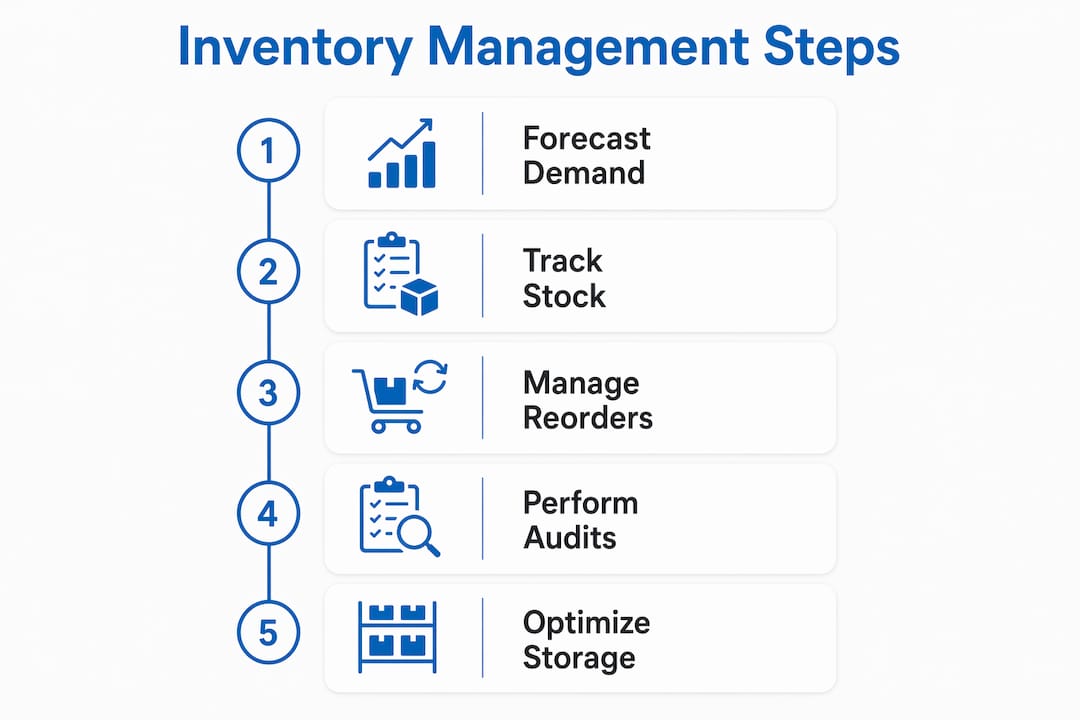
Demand forecasting uses historical consumption data, seasonal trends, and clinical schedules to predict how much of each product a facility will need. A hospital that runs elective surgeries on a predictable weekly schedule can forecast surgical supply consumption with high accuracy. A clinic network responding to an outbreak faces a different challenge entirely. Supply chain mapping supports this forecasting by making consumption patterns visible across multiple sites.
Stock tracking is the continuous monitoring of inventory levels, locations, and movements. In healthcare, this includes tracking lot numbers and expiry dates, not just quantities. A perpetual inventory system updates stock records in real time with every transaction. This contrasts with periodic systems, which only update counts at set intervals and leave gaps where discrepancies can grow undetected.
ABC analysis is the most widely used classification method in pharmaceutical inventory. ABC analysis categorizes items by value and volume: “A” items are high-value, low-volume products requiring strict, frequent monitoring; “B” items fall in the middle; and “C” items are low-value, high-volume consumables managed with less frequency. In a hospital pharmacy, insulin analogs and biologics typically sit in the “A” category, while disposable gloves and gauze pads fall into “C.”
- Demand forecasting: Align purchasing with actual consumption patterns, not assumptions.
- ABC analysis: Focus tightest controls on high-value pharmaceuticals.
- Perpetual tracking: Update stock records in real time to prevent blind spots.
- Cycle counting: Audit small sections of inventory on a rotating weekly schedule.
- Expiry management: Flag products approaching end of shelf life before they become waste.
Pro Tip: Cycle counting small portions weekly catches shrinkage and damage far earlier than an annual full count. For healthcare organizations, early detection of a damaged cold chain shipment or a mislabeled batch can prevent a compliance incident.
How does inventory management differ from warehouse management and inventory control?
Confusing inventory management with warehouse management produces suboptimal supply chain outcomes. The two functions overlap but serve different purposes, and healthcare organizations that treat them as interchangeable often discover accountability gaps during audits.
Inventory management is the broad, strategic oversight of what stock exists, where it should be, and when it needs replenishing. Warehouse management is the physical, operational execution of storing, handling, and retrieving that stock within a facility. Inventory control sits within inventory management as the narrower function of monitoring stock levels and making adjustments.
A practical example: a 3PL warehouse in Singapore managing pharmaceutical distribution handles the physical receipt, temperature-controlled storage, and dispatch of products. That is warehouse management. The pharmaceutical company deciding how much stock to hold, when to reorder, and how to allocate supply across Southeast Asian markets is practicing inventory management. The advantages of centralized warehousing become clear when these two functions are coordinated rather than siloed.
| Function | Focus | Scope | Key activities |
|---|---|---|---|
| Inventory management | Stock availability and cost | Strategic and operational | Forecasting, reorder planning, ABC analysis |
| Warehouse management | Physical storage and handling | Operational | Receiving, put-away, picking, dispatch |
| Inventory control | Stock level accuracy | Narrow operational | Cycle counting, adjustments, discrepancy resolution |
What are the best practices for managing pharmaceutical and medical supply inventory?
The most common failure points in healthcare inventory management are data errors, stockouts, overstock, expiry waste, and reliance on manual processes. Each of these is preventable with the right systems and disciplines in place.
A single data entry error cascades through reorder calculations and financial reports, creating inaccuracies that compound over time. This is why manual spreadsheets and paper logs remain the leading cause of inventory discrepancies in healthcare settings. Digitization is not optional at scale. It is the baseline requirement for accurate pharmaceutical inventory.
Best practices that consistently reduce errors and costs include:
- Adopt digital systems early. Organizations managing as few as 50 SKUs benefit from perpetual inventory software. Waiting until scale forces the issue means inheriting a backlog of data errors.
- Standardize physical warehouse layout. Labeling every bin, shelf, and aisle reduces picking errors and speeds up locating items during urgent clinical requests.
- Apply ABC analysis to pharmaceutical stock. Concentrate monitoring resources on high-value, high-risk products.
- Set automated alerts for low stock and approaching expiry. Manual checks miss items. Automated alerts do not.
- Integrate inventory data with procurement and finance systems. Disconnected systems create the data silos that cause reorder failures.
The importance of inventory management extends to financial reporting accuracy. Overstock ties up capital that healthcare organizations could deploy elsewhere. Expired stock is a direct write-off. Both outcomes are avoidable with disciplined reorder point management and regular cycle counts.
Pro Tip: For pharmaceutical organizations entering Southeast Asian markets, vendor managed inventory arrangements with a qualified 3PL partner can transfer much of the day-to-day inventory control burden while maintaining full visibility and compliance.
Which inventory management systems are recommended for healthcare organizations?
Healthcare organizations have four main technology options for managing inventory, ranging from manual methods to fully integrated digital platforms.
- Manual systems (spreadsheets and paper logs). Appropriate only for organizations with fewer than 50 SKUs and very low transaction volumes. The error rate at scale makes manual systems a compliance risk in regulated healthcare environments.
- Perpetual inventory software. Updates stock records in real time with every transaction. Integration with point-of-sale (POS) or dispensing systems gives multi-channel visibility. This is the standard for hospital pharmacies and medical device distributors.
- Barcode scanning and RFID. Barcode scanning eliminates human error and improves financial accuracy by automating data capture at every stock movement. RFID extends this capability to bulk tracking without line-of-sight scanning, useful for high-volume warehouse environments.
- Integrated healthcare supply chain platforms. Purpose-built platforms include expiry date tracking, lot number management, cold chain temperature logging, and regulatory compliance reporting. These systems connect procurement, warehousing, and clinical consumption into a single data environment.
Organizations managing under 50 SKUs can maintain inventory manually, but the threshold for migrating to a perpetual system is reached quickly. Several hundred transactions per month is the practical trigger point. For healthcare logistics in Singapore and across Southeast Asia, where smart 3PL warehouses increasingly integrate RFID and automated alerts, the gap between manual and digital operations widens every year.
The criteria for selecting a system should include: regulatory compliance features (HSA, PIC/S GDP alignment), cold chain monitoring integration, lot and expiry tracking, and the ability to generate audit-ready reports without manual compilation.
Key Takeaways
Effective healthcare inventory management requires integrating real-time stock tracking, ABC analysis, and digital systems to prevent stockouts, reduce waste, and maintain regulatory compliance.
| Point | Details |
|---|---|
| Define the scope clearly | Inventory management covers strategy and operations; inventory control covers stock level accuracy only. |
| Apply ABC analysis | Classify pharmaceuticals by value and volume to focus monitoring where it matters most. |
| Digitize before scaling | Transition to perpetual inventory software before transaction volumes make manual errors unavoidable. |
| Count inventory weekly | Cycle counting catches discrepancies early and prevents compliance incidents from compounding. |
| Standardize warehouse layout | Label every bin, shelf, and aisle to reduce picking errors and speed up urgent clinical requests. |
Why disciplined inventory management defines healthcare outcomes
Working across healthcare logistics in Southeast Asia, the pattern is consistent: organizations that treat inventory management as a back-office function eventually face a front-line crisis. A stockout of a critical antibiotic, an expired batch of diagnostic reagents discovered during an audit, a regulatory inspection that reveals no audit trail for a controlled substance. These are not rare events. They are the predictable result of treating stock control as secondary to clinical operations.
The misconception I encounter most often is that inventory management is primarily a cost-reduction exercise. Cost reduction is a consequence of doing it well. The primary purpose is reliability. Healthcare providers need to know that the right product will be available when a clinician needs it. That reliability requires both the operational discipline of cycle counting and standardized storage, and the strategic discipline of demand forecasting and reorder point management.
Technology adoption is the area where smaller healthcare organizations consistently underinvest. The assumption is that digital systems are for large hospital networks or major pharmaceutical distributors. The reality is that a clinic managing 80 SKUs of controlled medications faces the same compliance exposure as a large distributor, just at a smaller scale. Barcode scanning and a basic perpetual inventory system are not luxuries at that scale. They are the minimum viable infrastructure for regulatory compliance.
The organizations that manage inventory well share one characteristic: they treat it as a continuous practice, not a periodic project. Cycle counting happens weekly. Reorder points are reviewed quarterly. Staff receive regular training on SOPs. That discipline, more than any specific software platform, is what separates reliable healthcare supply chains from fragile ones.
— Brandcore
How Labgistics supports healthcare inventory management across Southeast Asia
Labgistics brings over 20 years of specialized experience in pharmaceutical and medical supply chain management across Southeast Asia. For healthcare organizations that need more than a generic warehousing solution, Labgistics offers fully accredited distribution centers, cold chain logistics, and inventory management services built around regulatory compliance and patient safety.

The tailored logistics solutions Labgistics provides integrate technology-driven inventory tracking with expert regulatory support, reducing waste, preventing stockouts, and maintaining the audit trails that HSA and PIC/S GDP standards require. Whether your organization is entering the Southeast Asian market or scaling an existing operation, Labgistics provides the infrastructure and expertise to manage pharmaceutical and medical inventory with the precision the sector demands. Contact Labgistics to discuss how a purpose-built logistics partnership can strengthen your supply chain.
FAQ
What is inventory management in simple terms?
Inventory management is the process of ordering, storing, tracking, and controlling stock so the right products are available in the right quantities at the right time. In healthcare, this includes managing pharmaceuticals, medical devices, and clinical supplies across the full supply chain.
What are the main inventory management techniques used in healthcare?
The most widely used techniques are ABC analysis, cycle counting, perpetual inventory tracking, and demand forecasting. ABC analysis classifies stock by value and volume, directing the tightest controls toward high-value pharmaceuticals.
How does inventory management affect patient care?
Poor inventory management causes stockouts of critical medications and supplies, directly disrupting clinical care. Effective inventory control ensures products are available when clinicians need them, supporting both patient safety and regulatory compliance.
When should a healthcare organization switch from manual to digital inventory systems?
Organizations managing more than 50 SKUs or processing several hundred transactions per month should transition to a perpetual inventory system. Manual spreadsheets at that scale produce data errors that cascade into reorder failures and compliance risks.
What is the difference between inventory management and warehouse management?
Inventory management covers the strategic and operational oversight of what stock exists and when to replenish it. Warehouse management covers the physical handling, storage, and retrieval of that stock within a facility. Both functions are necessary, but they serve distinct roles in a healthcare supply chain.
Recommended
- Top inventory management tips for healthcare logistics
- Vendor Managed Inventory for Healthcare Supply Chains
- Lab Inventory Management Guide for Lab Managers in 2026