
Validation in pharmaceutical logistics is defined as the documented, scientific process of proving that transportation and handling methods consistently maintain the conditions required to preserve product quality and patient safety. This is the industry standard term for what supply chain managers often call “transport qualification” or “logistics validation,” and it goes far beyond routine temperature monitoring. Up to 20% of temperature-sensitive pharmaceuticals can be compromised during transit without proper validation. That figure represents not just product loss, but regulatory exposure, patient risk, and reputational damage that no pharmaceutical company can afford. GDP guidelines, USP <1079>, and ICH standards all mandate validated supply chains, and regulators in Singapore, Southeast Asia, and globally are tightening enforcement. Understanding what validation in pharmaceutical logistics requires, and how to execute it correctly, is now a baseline competency for any supply chain manager handling regulated products.
What is validation in pharmaceutical logistics?
Validation in pharmaceutical logistics is the act of generating documented evidence that a transport process is controlled, predictable, and consistently protects product integrity across all conditions. The distinction from basic monitoring is fundamental. Monitoring collects data. Validation proves, through structured testing and documentation, that the process itself is fit for purpose.
Truly compliant validation must be defensible, meaning it documents that transport processes are controlled, predictable, and consistently protect product quality. This standard applies to every link in the cold chain logistics network, from the 3PL warehouse in Singapore to the last-mile delivery vehicle reaching a hospital pharmacy in Jakarta or Manila.

The scope of validation in the supply chain covers packaging systems, refrigeration equipment, transport lanes, carrier SOPs, and handoff procedures. It is not a single test. It is a quality governance framework that integrates risk assessment, equipment calibration, environmental testing, and ongoing performance review. For pharmaceutical professionals managing distribution across Southeast Asia, this framework is the foundation of both regulatory compliance and operational reliability.
What are the core phases of pharmaceutical logistics validation?
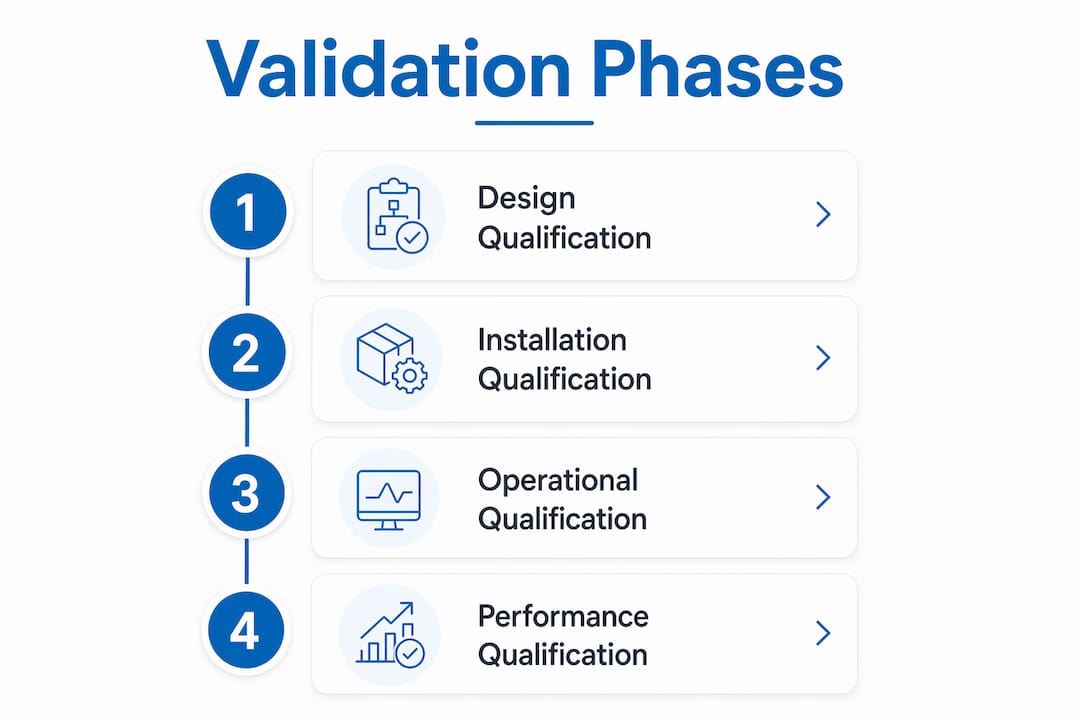
The pharmaceutical validation framework follows four structured phases: Design Qualification (DQ), Installation Qualification (IQ), Operational Qualification (OQ), and Performance Qualification (PQ). Each phase builds on the last, creating a defensible compliance record from concept through real-world operation.
- Design Qualification (DQ): Verifies that the proposed transport system design meets product-specific requirements. This includes packaging selection, vehicle type, lane routing, and temperature excursion risk modeling before any physical testing begins.
- Installation Qualification (IQ): Confirms that all equipment, including refrigeration units, data loggers, and temperature sensors, is correctly installed and calibrated according to manufacturer specifications and regulatory standards.
- Operational Qualification (OQ): Tests system performance under simulated stress scenarios, including temperature extremes, transit delays, and seasonal variation. OQ establishes the operating boundaries within which the system reliably maintains product conditions.
- Performance Qualification (PQ): Evaluates the system under actual transport conditions across defined routes and seasons. PQ is the final proof that the validated process works in the real world, not just in a controlled test environment.
The table below summarizes each phase and its primary objective:
| Phase | Full Name | Primary Objective |
|---|---|---|
| DQ | Design Qualification | Confirm design meets product and transport requirements |
| IQ | Installation Qualification | Verify correct installation and calibration of equipment |
| OQ | Operational Qualification | Test performance under simulated worst-case conditions |
| PQ | Performance Qualification | Confirm consistent performance in real-world transport |
This four-phase structure, also referenced in peptide manufacturing quality benchmarks, provides a scientifically defensible compliance framework that regulators expect to see documented and audit-ready. For 3PL providers and pharmaceutical companies operating across Southeast Asia, completing all four phases is not optional. It is the minimum standard for GDP compliance.
How does validation differ from basic monitoring and why is it essential?
Temperature monitoring is a continuous data collection activity. Validation is evidence-based proof that the process generating that data is controlled and reliable. The gap between the two is where regulatory risk lives.
New regulations and technologies require stronger evidence to maintain product integrity, and temperature monitoring alone is insufficient for robust validation. Monitoring tells you what happened. Validation tells you why the system can be trusted to perform consistently before a shipment ever leaves the warehouse. This distinction matters enormously when a regulator asks for proof of compliance rather than a data log.
The consequences of relying on monitoring alone are concrete:
- Product recalls triggered by excursions that monitoring detected but validation could have prevented through better system design
- Regulatory action including Wholesale Distribution Authorization (WDA) suspension when distributors cannot demonstrate controlled, predictable processes
- Dispute liability at logistics handoff points where timestamped validation evidence is absent and accountability is unclear
- Quality management gaps where CAPA processes lack the validation baseline needed to identify root causes of recurring excursions
Validation is a continuous lifecycle involving risk assessment, routine monitoring, change control, and CAPA integrated in a quality management system. This means a validated supply chain is not a static achievement. It is an active program that responds to route changes, new products, equipment upgrades, and regulatory updates.
Pro Tip: When a carrier changes its vehicle fleet or a new distribution lane is added in Southeast Asia, trigger a revalidation review immediately. Waiting for the next scheduled audit cycle creates an undocumented compliance gap that regulators will identify.
What are the key components of an effective validation program?
An effective pharmaceutical logistics validation program is built on six interconnected components. Each one contributes to the defensibility and audit-readiness of the overall quality management system.
Risk-based validation prioritizes the most vulnerable transport lanes or products for intensive validation, while using targeted confirmation for lower-risk scenarios. This approach optimizes resource allocation without compromising compliance. A biologics shipment traveling from Singapore to a remote distribution point in Vietnam requires more intensive validation than a stable oral solid dosage form moving between two climate-controlled facilities.
The six core components are:
- Validation Master Plan (VMP): The governing document that defines scope, responsibilities, acceptance criteria, and the schedule for all validation activities across the supply chain
- Risk assessment: A formal, documented evaluation of transport lanes, products, packaging, and environmental factors that determines validation intensity and priority
- Equipment calibration: Traceable calibration of all measurement instruments, including temperature loggers, humidity sensors, and refrigeration controllers, against national or international standards
- Temperature mapping and environmental testing: Systematic measurement of temperature distribution, humidity, vibration, and shock across transport containers and vehicles under worst-case conditions
- Deviation and CAPA management: Documented investigation of any excursion or test failure, with corrective and preventive actions that feed back into the validation program
- Periodic revalidation: Scheduled reassessment triggered by route changes, equipment replacement, regulatory updates, or product additions to the distribution network
GDP guidelines and USP <1079> mandate continual temperature and humidity monitoring with proper documentation and competent personnel training. These requirements apply to every node in the supply chain, including third-party logistics providers, freight forwarders, and last-mile carriers. For supply chain managers building or auditing a validation program, the VMP is the starting point. Without it, individual validation activities lack the coherent framework that regulators and auditors require.
Pro Tip: Map every handoff point in your supply chain before writing the VMP. Failures often occur at logistics handoff points, and clear validation protocols with timestamped evidence at these transitions prevent disputes and protect compliance records.
What are the regulatory requirements and risks of non-compliance?
Regulators require distributors to demonstrate continuous compliance with product-specific storage requirements, and failure can result in suspension or revocation of distribution authorization. This is not a theoretical risk. It is an enforcement reality that pharmaceutical companies and 3PL providers in Singapore and across Southeast Asia face with increasing frequency.
The primary regulatory frameworks governing transport validation are GDP (Good Distribution Practice) guidelines issued by the European Medicines Agency and adopted by regulators including Singapore’s HSA, USP <1079> covering pharmaceutical transport conditions, and ICH Q10 addressing pharmaceutical quality systems. Each framework requires documented evidence of controlled processes, not just monitoring data.
“Making transport a controlled quality process rather than a variable logistics risk requires coherent documentation from risk assessment through qualification and monitoring.” — Transport validation and GDP compliance
The financial and operational consequences of non-compliance extend well beyond regulatory fines. Product losses from unvalidated cold chain logistics in Southeast Asia can reach significant value per shipment for high-cost biologics and vaccines. Recalls triggered by validation failures carry direct costs in product destruction, logistics reversal, and customer notification, plus indirect costs in damaged relationships with healthcare providers and regulatory authorities. By 2026, regulators are requiring scientific, documented evidence of transport control rather than accepting historical monitoring data as a substitute for formal qualification. Pharmaceutical companies that have not updated their validation programs to meet this standard face increasing risk at product registration and market access stages, particularly when entering new Southeast Asian markets.
Key takeaways
Validation in pharmaceutical logistics is the documented proof that transport processes are controlled, predictable, and consistently protect product quality across the entire supply chain lifecycle.
| Point | Details |
|---|---|
| Validation vs. monitoring | Validation proves process control; monitoring only records what happened after the fact. |
| Four-phase framework | DQ, IQ, OQ, and PQ together create a defensible, audit-ready compliance record. |
| Risk-based prioritization | Target intensive validation at high-risk lanes and products to allocate resources effectively. |
| Handoff accountability | Document timestamped evidence at every supply chain handoff to prevent disputes and gaps. |
| Lifecycle commitment | Revalidate whenever routes, equipment, or products change to maintain continuous compliance. |
Validation as a quality discipline, not a project milestone
From my experience working across pharmaceutical supply chains in Southeast Asia, the most persistent and costly mistake I see is treating validation as a project with a completion date. Teams invest in a thorough DQ through PQ exercise, file the reports, and then operate as though the validation certificate is permanent. It is not.
The supply chains I have seen perform best under regulatory scrutiny are those where validation is embedded in the quality management system as a living discipline. Change control triggers revalidation reviews. CAPA findings feed back into qualification protocols. Equipment calibration schedules are tied to validation acceptance criteria, not just manufacturer recommendations. This is what continuous lifecycle validation actually looks like in practice.
The other pattern I consistently observe is underinvestment in handoff validation. Companies validate their own warehouses and vehicles thoroughly, then assume their carriers and freight forwarders meet equivalent standards. That assumption creates the exact compliance gap that regulators find during inspections. Requiring timestamped, documented evidence from every logistics partner at every handoff point is not excessive. It is the minimum standard for a defensible quality narrative.
Emerging tools, including IoT temperature sensors with real-time alerts and blockchain-based chain-of-custody records, are making continuous validation evidence easier to collect and harder to dispute. For pharmaceutical companies expanding distribution into Vietnam, Indonesia, Thailand, and the Philippines, these technologies are becoming a practical necessity rather than a future aspiration. The pharma logistics compliance checklist for Southeast Asia is a useful starting point for assessing where your current program stands against regional regulatory expectations.
— Labgistics
How Labgistics supports pharmaceutical logistics validation
Labgistics brings over 20 years of specialized experience in healthcare logistics across Southeast Asia, with fully accredited distribution centers and dedicated validation and calibration services designed for pharmaceutical supply chains.
For pharmaceutical companies and supply chain managers who need a logistics partner that understands GDP compliance, cold chain qualification, and the regulatory requirements of markets from Singapore to the Philippines, Labgistics delivers end-to-end support. From equipment calibration and temperature mapping to Validation Master Plan development and audit readiness, the team provides the technical depth and documentation rigor that regulators require. Explore tailored healthcare logistics solutions to see how Labgistics structures validation support for your specific product portfolio and distribution network. For supply chains with complex risk profiles, the healthcare supply chain risk management framework offers a structured approach to prioritizing and executing validation activities.
FAQ
What is validation in pharmaceutical logistics?
Validation in pharmaceutical logistics is the documented process of proving that transport and handling systems consistently maintain the conditions required to protect product quality and patient safety. It covers packaging, equipment, routes, and procedures, and must meet GDP and USP <1079> standards.
How does validation differ from temperature monitoring?
Temperature monitoring records environmental data during transit. Validation is the structured, evidence-based process that proves the transport system is controlled and reliable before and during shipment, making it the required standard under GDP guidelines.
What are the four types of validation in logistics?
The four phases are Design Qualification (DQ), Installation Qualification (IQ), Operational Qualification (OQ), and Performance Qualification (PQ). Each phase addresses a different stage of transport system qualification, from design through real-world performance.
What happens if a pharmaceutical company fails transport validation requirements?
Regulators can suspend or revoke a company’s Wholesale Distribution Authorization, require product recalls, and impose financial penalties. Non-compliance also creates liability at logistics handoff points and damages relationships with healthcare providers and regulatory authorities.
How often should pharmaceutical logistics validation be repeated?
Revalidation is required whenever significant changes occur, including new transport routes, equipment replacement, new product additions, or regulatory updates. GDP guidelines and quality management best practices also require periodic scheduled revalidation reviews regardless of changes.