
Cross border healthcare logistics is defined as the regulated, end-to-end movement of healthcare products across international borders, with mandatory controls over packaging, customs clearance, temperature management, and chain-of-custody documentation. The industry term used by compliance professionals is international healthcare logistics, though both terms describe the same specialized discipline. This field covers pharmaceuticals, medical devices, biological samples, vaccines, and advanced therapy medicinal products. Every shipment must satisfy Good Distribution Practice (GDP) standards, destination country import regulations, and cold chain requirements simultaneously. For healthcare organizations operating across Southeast Asia, understanding how this system works is the foundation of a compliant and resilient global health supply chain.
What is cross border healthcare logistics and what does it involve?
Cross border healthcare logistics is the regulated, end-to-end movement of healthcare-related products across international borders with stringent packaging, customs, and chain-of-custody controls. This definition separates it from general freight: every handling step is documented, validated, and subject to quality oversight. A shipment of insulin from Singapore to Vietnam and a consignment of oncology biologics from Germany to a clinical trial site in Thailand both fall under this discipline, despite their differences in product type and destination.

Core components of international healthcare logistics
The operational structure of cross border medical logistics rests on six interconnected elements:
- Packaging and handling validation: Packaging must be qualified to protect products through temperature extremes, pressure changes, and physical shock across multi-leg journeys. This includes both passive systems (insulated shippers with phase-change materials) and active systems (powered refrigerated containers). A medical packaging guide details how packaging selection directly affects product integrity during transit.
- Transport mode coordination: Air freight is standard for time-critical biologics and vaccines. Sea freight suits bulk pharmaceutical raw materials where lead times allow. Road transport connects final-mile delivery within country. Multi-modal shipments require handoff protocols at each transition point.
- Customs clearance: Accurate customs valuation, product description, country of origin, and import permits are required at every border crossing. Missing or mismatched documentation is the single most common cause of shipment delays.
- GDP compliance and regulatory documentation: GDP-aligned controls include temperature and time controls, documented custody handoffs, and audit trails that satisfy both origin and destination regulatory authorities.
- Cold chain management: Temperature-sensitive products require validated lanes, calibrated data loggers, and exception management protocols. Cold chain logistics in Singapore and across Southeast Asia must account for high ambient temperatures and variable infrastructure quality.
- Chain-of-custody documentation: Every transfer of a shipment generates a custody log with timestamps and signatures, creating a traceable record from manufacturer to end recipient.
Pro Tip: When selecting a transport mode for temperature-sensitive pharmaceuticals, always validate the full lane, not just the primary leg. A compliant air freight segment can be undermined by a poorly controlled final-mile road delivery.
What are the regulatory and compliance challenges in international healthcare logistics?
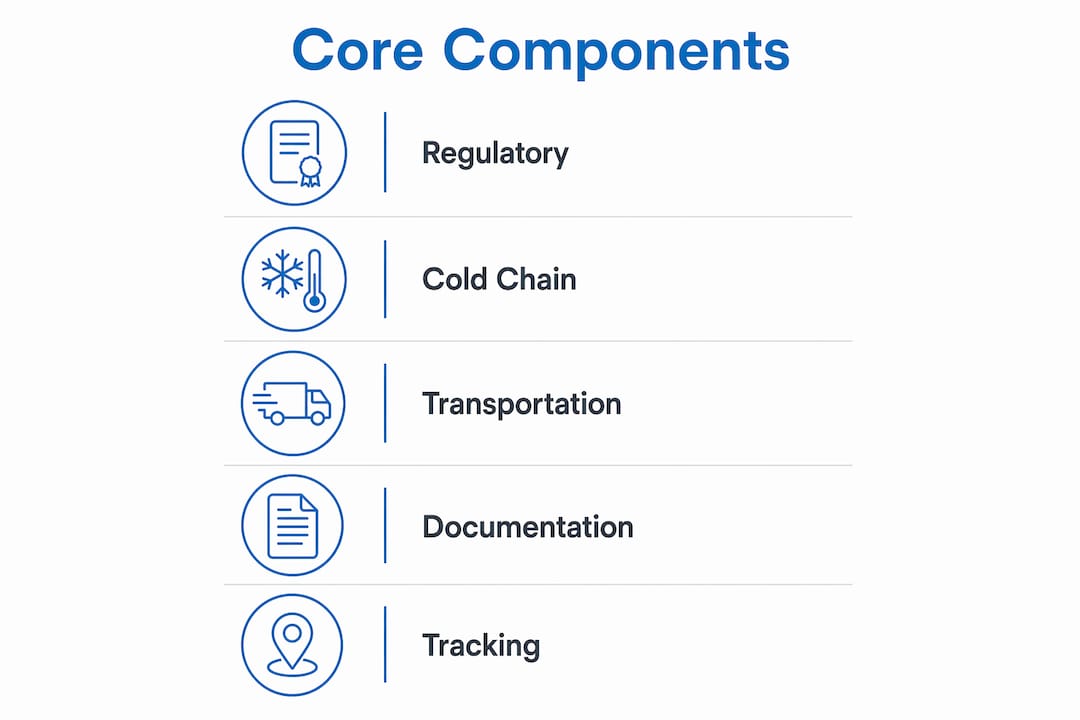
Regulatory complexity is the defining challenge of the global health supply chain. Each country imposes its own import licensing requirements, marketing authorization conditions, and product-specific permits. A pharmaceutical product registered in Singapore under the Health Sciences Authority (HSA) requires a separate registration process in Malaysia, Indonesia, or the Philippines before it can be legally imported and distributed.
Trade compliance for healthcare shipments requires precise documentation across what practitioners call the “Holy Trinity”: customs valuation, product description, and country of origin. A mismatch between the commercial invoice and the regulatory filing causes delays at the border and can trigger full shipment holds. This is especially consequential for clinical trial materials, where a 48-hour delay can compromise a study protocol.
The compliance process for a typical cross-border healthcare shipment follows this sequence:
- Pre-shipment regulatory review: Confirm import permits, marketing authorizations, and any controlled substance licenses are current and correctly issued for the destination country.
- Documentation alignment: Reconcile the commercial invoice, packing list, certificate of analysis, and GDP-compliant transport documentation before the shipment departs.
- Customs broker coordination: Engage a broker with healthcare-specific experience in the destination market. Generic freight brokers frequently misclassify medical products under incorrect HS codes.
- In-transit monitoring: Maintain real-time visibility over shipment status and temperature data so that exceptions can be escalated before customs clearance, not after.
- Post-clearance audit: Retain all documentation for the period required by destination country regulations, which in many Southeast Asian markets is five to ten years.
Early expert involvement in trade compliance planning prevents the costly disruptions that arise when regulatory nuances are discovered mid-shipment. Healthcare organizations that treat compliance as a pre-departure checklist rather than an integrated planning function consistently experience higher rates of delay and product loss.
Pro Tip: For clinical trial shipments, prepare country-specific regulatory rationale documents before the trial begins. Customs authorities in markets like Indonesia and Vietnam frequently request justification for product classifications that differ from standard commercial descriptions.
How does cold chain logistics protect product integrity across borders?
Cold chain logistics is the most technically demanding component of cross border health services. Vaccines, biologics, and advanced therapies can lose potency or become unsafe within hours of temperature excursion. The GDP standards for pharma export extend beyond the origin country to require audit trails and exception management that satisfy destination regulatory authorities as well.
The table below compares passive and active cold chain packaging systems across the criteria most relevant to cross-border healthcare shipments:
| Criteria | Passive systems | Active systems |
|---|---|---|
| Temperature range | +2°C to +8°C, -20°C with phase-change materials | -80°C to +25°C depending on unit |
| Duration | 24 to 96 hours validated | 72 hours to 10 days with power |
| Regulatory validation | Required per lane and season | Required per unit and route |
| Cost per shipment | Lower | Higher |
| Best use case | Short-haul, well-characterized lanes | Long-haul, ultra-cold, or high-value biologics |
Chain-of-custody in healthcare logistics is an auditable, unbroken trail tracking a shipment’s handling, condition, and custody through every transfer. For biologics and patient-specific advanced therapies, this record is not optional. It is a regulatory requirement and a patient safety control. Custody logs must capture timestamps, handler signatures, temperature readings at each handoff, and any deviations with corresponding corrective actions.
Technology plays a direct role in maintaining this integrity. Geo-localization, temperature monitoring, and shipment labels enhance visibility and allow logistics teams to respond to exceptions before product is compromised. Calibration services for data loggers and monitoring equipment must be current and traceable to national standards. In Singapore, calibration services aligned to the Singapore Accreditation Council (SAC) framework are the accepted benchmark for GDP-compliant monitoring equipment.
The consequences of cold chain failure are not abstract. A temperature excursion on a shipment of monoclonal antibodies can result in product destruction, patient treatment delays, and regulatory investigations that affect the shipper’s import license. Healthcare organizations that treat cold chain logistics as a cost center rather than a quality function consistently face higher rates of product loss and compliance exposure.
What operational strategies improve resilience in cross-border healthcare supply chains?
Resilience in cross border medical logistics depends on coordination and innovation to overcome border constraints and infrastructure variability. Time-critical deliveries and border-related disruptions create supply continuity challenges that go well beyond cost efficiency. The organizations that manage these challenges most effectively treat logistics as a regulated quality process with mandatory controls, not as a transactional freight service.
Practical strategies that healthcare logistics professionals apply to improve supply chain resilience include:
- Lane validation and risk scoring: Validate each transport lane under worst-case conditions before committing to it for commercial or clinical shipments. Assign risk scores based on transit time variability, customs clearance history, and ambient temperature profiles.
- Hub standardization: Operational standardization across hubs and coordinated handling protocols reduce variability for advanced therapies and patient-specific shipments. Shared testing and collaborative models between logistics providers improve scale readiness.
- Alternative delivery methods: Drone logistics for cross-border medical deliveries is moving from pilot programs to regulated frameworks in several Southeast Asian markets. Drones address last-mile delivery constraints in geographically fragmented regions like the Indonesian archipelago and the Philippines.
- Technology integration: Real-time data sharing between shippers, 3PL providers, customs brokers, and receiving facilities reduces exception response time. Vendor managed inventory (VMI) systems connected to cross-border shipment tracking allow healthcare organizations to maintain optimal stock levels without over-ordering.
- Staff training and SOP alignment: Logistics personnel handling regulated healthcare products require training aligned to GDP guidelines and updated SOPs that reflect current destination country requirements.
You can assess your organization’s exposure to these risks through a structured review of medical supply chain risks specific to Southeast Asia, where infrastructure variability and regulatory heterogeneity create a distinct risk profile compared to European or North American markets.
The balance between cost, speed, and regulatory compliance is not static. As Southeast Asian markets mature their pharmaceutical regulatory frameworks, the compliance bar for cross-border healthcare shipments continues to rise. Organizations that invest in compliance infrastructure now are better positioned to scale market access across the ASEAN region.
Key takeaways
Cross border healthcare logistics requires integrating GDP compliance, validated cold chain management, and precise customs documentation as a single quality system, not as separate operational tasks.
| Point | Details |
|---|---|
| Regulatory compliance is foundational | Every shipment needs current import permits, aligned documentation, and GDP-compliant controls before departure. |
| Cold chain requires lane validation | Passive and active packaging systems must be validated for each specific route, not just product type. |
| Chain-of-custody is a patient safety control | Auditable custody logs with timestamps and signatures are mandatory for biologics and advanced therapies. |
| Early planning prevents costly delays | Trade compliance experts should be engaged at the planning stage, not after a shipment is held at customs. |
| Resilience requires technology and coordination | Real-time monitoring, hub standardization, and alternative delivery methods reduce supply continuity risk. |
Why cross-border healthcare logistics demands more than good freight management
After two decades of working across Southeast Asia’s healthcare supply chain, the pattern is consistent: organizations that treat cross-border healthcare logistics as a freight problem consistently underperform those that treat it as a quality and compliance function. The difference is not philosophical. It shows up in shipment hold rates, product loss incidents, and the speed at which organizations can enter new markets.
The most common failure point is documentation misalignment. A commercial invoice that does not match the regulatory filing is not a paperwork error. It is a compliance event that can result in shipment destruction, import license suspension, and clinical trial protocol deviations. The fix is not more careful data entry. It is integrating regulatory documentation into the logistics planning process from the start, with compliance expertise embedded in the team rather than consulted after the fact.
Cold chain management deserves the same level of integration. Labgistics has observed that organizations frequently validate their primary packaging system but neglect to validate the full lane, including final-mile delivery in high-ambient-temperature markets. A qualified shipper that performs perfectly on the air freight leg can fail during a two-hour road delivery in Jakarta or Manila. Lane validation under worst-case seasonal conditions is the only way to close that gap.
The emerging opportunity in this space is precision therapy logistics. As cell and gene therapies enter Southeast Asian markets, the chain-of-identity requirement, where a patient-specific product must be traceable from manufacturing to infusion without any break in custody, raises the bar for every logistics provider in the region. Organizations that build this capability now will have a significant advantage as these therapies scale. Those that wait will find the compliance gap difficult to close quickly.
The practical recommendation is straightforward. Engage specialized healthcare logistics partners with demonstrated GDP expertise and country-specific regulatory knowledge before you need them, not when a shipment is already at the border.
— Labgistics
How Labgistics supports your cross-border healthcare supply chain
Labgistics provides end-to-end tailored logistics solutions for pharmaceutical companies, medical device manufacturers, and healthcare organizations operating across Southeast Asia. With over 20 years of experience in cold chain logistics, GDP compliance, regulatory services, and warehousing Singapore operations, Labgistics manages the full complexity of cross-border healthcare shipments so your team can focus on patient outcomes. From validated cold chain transport and calibration services to customs documentation support and vendor managed inventory, Labgistics delivers the precision and accountability that regulated healthcare products demand. Explore how logistics risk management strategies specific to Southeast Asia can protect your supply chain and accelerate market access across the region.
FAQ
What is cross border healthcare logistics?
Cross border healthcare logistics is the regulated, end-to-end movement of pharmaceutical products, medical devices, biologics, and clinical trial materials across international borders under GDP-compliant controls. It includes cold chain management, customs clearance, chain-of-custody documentation, and validated packaging.
How does cold chain logistics work in cross-border healthcare shipments?
Cold chain logistics uses validated passive or active packaging systems, calibrated temperature data loggers, and GDP-aligned documentation to maintain product integrity from origin to destination. Each transport lane must be validated under real-world conditions, including final-mile delivery.
What documentation is required for cross-border healthcare shipments?
The core documentation set includes a commercial invoice, packing list, certificate of analysis, import permits, marketing authorizations, and GDP-compliant transport records. Customs authorities require accurate valuation, product description, and country of origin on every shipment.
Why do cross-border healthcare shipments get delayed at customs?
The most common cause is a mismatch between the commercial invoice and the regulatory filing, a documentation error that triggers shipment holds and compliance reviews. Engaging trade compliance experts before departure and aligning all paperwork to destination country requirements prevents most delays.
What is chain-of-custody in healthcare logistics?
Chain-of-custody is an auditable, unbroken record of every handling, transfer, and condition check a shipment undergoes from manufacturer to recipient. For biologics and advanced therapies, it includes timestamps, handler signatures, and temperature readings at each custody handoff.