
Distribution center validation is the systematic process of confirming that a facility meets both regulatory requirements and operational performance standards through documented qualification protocols and comprehensive audits. In healthcare logistics, this process is not optional. Regulatory bodies including the FDA, PIC/S, and WHO require documented evidence that your distribution center controls product integrity from receipt through dispatch. Understanding how to validate distribution centers correctly protects patients, satisfies inspectors, and prevents costly product losses across pharmaceutical, medical device, and life science supply chains.
How to validate distribution centers: qualification phases and criteria
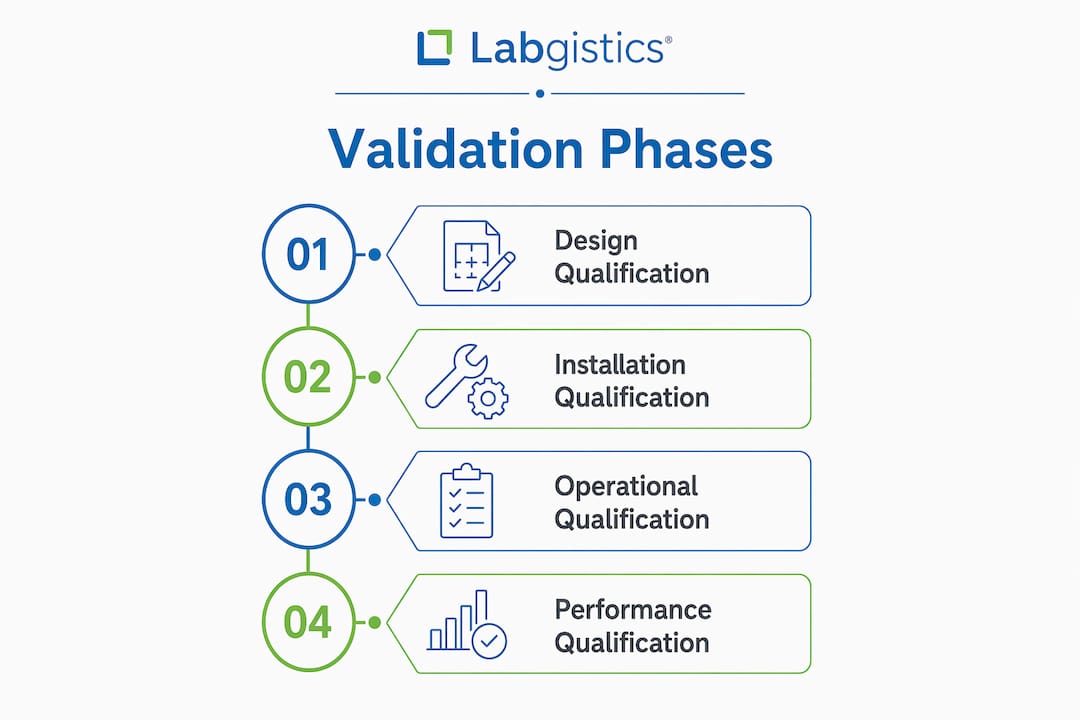
Warehouse validation in regulated healthcare logistics consists of four sequential qualification phases plus process validation for temperature control and shipping operations. Each phase builds on the previous one, and skipping any stage creates documentation gaps that regulators will identify during inspections. The industry standard term for this structured approach is GxP qualification, covering Good Manufacturing Practice (GMP), Good Distribution Practice (GDP), and Good Storage Practice (GSP).
The four qualification phases follow this sequence:
- User Requirements Specification (URS): Define the facility’s intended use, product types, temperature ranges, throughput volumes, and regulatory scope before any physical assessment begins. The URS becomes the reference document against which all subsequent phases are measured.
- Design Qualification (DQ): Verify that the facility design, layout, and equipment specifications meet the requirements defined in the URS. This includes reviewing floor plans, HVAC schematics, cold room specifications, and warehouse management system (WMS) architecture.
- Installation Qualification (IQ): Confirm that all equipment and systems are installed according to manufacturer specifications and approved drawings. Calibration certificates for temperature monitoring devices, humidity sensors, and data loggers must be collected at this stage.
- Operational Qualification (OQ): Test that all systems operate within defined parameters under controlled conditions. This includes running alarm tests, verifying temperature recovery after door openings, and confirming that the WMS records transactions accurately.
- Performance Qualification (PQ): Demonstrate consistent performance under real operating conditions, including peak throughput periods and seasonal temperature extremes. PQ is the phase most often underestimated by teams new to the validate distribution center process.
FDA 21 CFR Part 211 mandates validation of automatic, mechanical, and electronic systems, including documented cleaning, maintenance, and calibration activities reviewed as part of batch record review. This means your equipment qualification records must be current, retrievable, and linked to specific assets.
| Qualification phase | Primary evidence required |
|---|---|
| Design Qualification (DQ) | Approved drawings, equipment specifications, URS sign-off |
| Installation Qualification (IQ) | Calibration certificates, installation records, as-built drawings |
| Operational Qualification (OQ) | Alarm test records, temperature excursion logs, WMS test scripts |
| Performance Qualification (PQ) | Seasonal mapping data, dispatch validation records, deviation reports |

Pro Tip: Complete your URS before engaging any facility contractor or 3PL warehouse provider. A URS written after the fact forces you to justify what exists rather than confirm what was planned, which weakens your regulatory position significantly.
How to conduct an operational audit of a distribution center
An operational audit spanning pre-receipt through shipping identifies risks and performance gaps across the entire operation, promoting comprehensive improvement rather than isolated fixes. Audits of this type typically run from one day to one week depending on operation size. The goal is to produce a synthesized improvement list that addresses root causes, not symptoms.
A thorough distribution center evaluation covers these operational zones:
- Pre-receipt and receiving: Verify that incoming goods are checked against purchase orders, temperature records accompany cold chain shipments, and quarantine procedures are followed for rejected or suspect stock.
- Put-away and storage: Confirm that products are stored in designated zones, FIFO or FEFO rotation is enforced, and segregation between product categories (including controlled substances or radioactive materials) is maintained.
- Picking and packing: Observe whether pickers follow SOPs, whether batch and expiry data is captured at the point of pick, and whether packing materials meet product-specific requirements.
- Shipping and dispatch: Validating picking, packing, labeling, and shipping documentation and verifying linkage to traceability records is critical. Even when temperature is maintained throughout storage, errors at the dispatch stage can compromise product quality and regulatory compliance.
“Live system behavior observation during distribution center audits provides stronger evidence than screenshots or presentations, exposing operational exceptions that directly impact validation confidence.” — Pro Fulfilment Warehouse Tour Playbook
When assessing how to audit a distribution center, request live WMS data during the facility tour rather than pre-prepared reports. Ask the operations team to demonstrate a live transaction, including inventory accuracy queries and cycle count results. This approach reveals real system performance and exposes gaps that polished documentation conceals. Labgistics applies this same live-data methodology when conducting internal qualification reviews across its Singapore distribution facilities.
Pro Tip: During an audit, walk the operation in the sequence a product travels through the facility. Starting at receiving and ending at the loading dock forces you to observe handoff points where documentation errors and process deviations are most likely to occur.
What documentation and inspection readiness steps ensure compliance?
FDA-regulated facilities maintain a validation and inspection kit containing critical compliance records that must be readily available for inspections per 21 CFR 210/211 and FSMA requirements. This kit is updated monthly and includes:
- Current validation documents for all qualified systems and equipment
- Training logs confirming staff competency for each role and procedure
- Calibration certificates for all monitoring and measuring devices
- Standard Operating Procedures (SOPs) with version control and approval signatures
- Emergency preparedness and business continuity documents
- Deviation and CAPA (Corrective and Preventive Action) records with closure evidence
Inspectors value quick retrieval of complete, consistent evidence. A disorganized response to a document request signals poor quality culture and invites deeper scrutiny. Organizing your calibration records for GDP inspections in a structured digital repository reduces retrieval time and eliminates the risk of presenting outdated versions.
Internal audits conducted on a rotating weekly schedule with 100% resolution of temperature excursions within defined SLAs represent the standard for FSMA and GFSI compliance. This frequency keeps compliance readiness continuous rather than reactive. Mini-audits targeting specific process areas, such as cold room entry procedures or label verification at packing, are more effective than infrequent comprehensive reviews because they catch drift before it becomes a systemic failure.
Digital document management systems that enforce version control, require electronic signatures, and generate audit trails are now the baseline expectation for healthcare distribution centers operating under GDP or GMP frameworks. Paper-based systems remain technically acceptable in some jurisdictions but create retrieval delays and version control risks that increase inspection exposure.
How to validate temperature-controlled and sensitive storage conditions
Seasonal temperature and humidity mapping combined with alarm tests and failure simulations is the foundation for validating environmental controls in any temperature-sensitive healthcare warehouse. Static mapping conducted only under one set of ambient conditions does not satisfy GDP or WHO Technical Report Series requirements. You need data from both the warmest and coolest periods of the year.
The validation sequence for environmental controls follows this order:
- Baseline mapping: Place calibrated data loggers at defined positions throughout each storage zone, including corners, near doors, and adjacent to HVAC vents. Run the mapping study for a minimum period defined in your protocol, typically 24 to 72 hours per season.
- Alarm and failure simulation: Disable cooling systems or introduce a controlled heat load to verify that alarms trigger within defined response times. Document the exact time from excursion onset to alarm activation and staff response.
- Recovery capability verification: Measure how quickly the storage zone returns to the validated temperature range after a door opening, power interruption, or equipment failure. Recovery time must fall within the limits defined in your URS.
- Continuous data logging: Implement automated monitoring systems that record temperature and humidity at defined intervals, typically every 15 minutes, and generate alerts via SMS or email when parameters approach or breach limits.
- Deviation management: Establish a written procedure for investigating temperature excursions, assessing product impact, and documenting corrective actions. Every excursion must be closed with documented evidence before the next qualification review.
Seasonality testing and recovery capability studies frequently reveal validation gaps that static paper qualification misses entirely. A cold room that performs within specification during Singapore’s cooler months may breach limits during peak ambient temperatures if HVAC capacity is marginal. This is a common finding in Southeast Asian healthcare logistics facilities and one that Labgistics addresses through its cold chain logistics infrastructure designed for tropical operating conditions.
Pro Tip: Run your alarm simulation tests at the start of a shift, not during off-hours. You need to verify that staff respond correctly, not just that the alarm activates. An alarm that triggers at 2 AM with no documented response protocol is a compliance gap, not a validated control.
Key takeaways
Effective distribution center validation requires combining structured qualification phases with live operational audits, continuous environmental monitoring, and inspection-ready documentation maintained on a rolling basis.
| Point | Details |
|---|---|
| Follow the four qualification phases | Complete DQ, IQ, OQ, and PQ in sequence; skipping phases creates regulatory gaps. |
| Audit operations end to end | Observe live processes from receiving to dispatch to capture real failure modes. |
| Maintain an inspection kit | Update validation documents, calibration records, and SOPs monthly for rapid retrieval. |
| Map environments seasonally | Conduct temperature mapping under both warm and cool conditions to satisfy GDP requirements. |
| Validate dispatch processes | Confirm picking, packing, labeling, and traceability linkage at the shipping stage. |
Why validation is never a one-time event
From Labgistics’ perspective, the most common mistake supply chain managers make is treating distribution center validation as a project with a defined end date. Passing regulatory scrutiny requires sustained control through normal and seasonal operations and dispatch processes. The qualification documents you file at facility commissioning are the starting point, not the finish line.
The facilities that consistently pass GDP and GMP inspections without major findings share one characteristic: they treat compliance as an operational discipline, not a documentation exercise. Their teams observe real process flows against written SOPs on a regular basis, not just before an announced audit. They investigate minor deviations with the same rigor applied to major ones, because minor deviations left unresolved become systemic failures.
Traceability is where many otherwise well-run operations fall short. A facility can have excellent temperature records and a clean qualification file, yet still fail an inspection because the linkage between a specific batch, its storage conditions, and its dispatch documentation cannot be reconstructed quickly. Building that traceability into your medical logistics validation process from the outset is far less costly than retrofitting it under regulatory pressure.
The practical advice: schedule a live operational walkthrough at least quarterly, independent of your formal audit calendar. Walk the process, ask the operators to demonstrate transactions, and compare what you observe against your current SOPs. That gap, however small, is your next validation priority.
— Labgistics
How Labgistics supports distribution center validation and compliance
Healthcare supply chain teams across Southeast Asia rely on Labgistics for end-to-end logistics solutions that are built around regulatory compliance from the ground up.
Labgistics operates fully accredited distribution centers in Singapore with qualification documentation, continuous environmental monitoring, and calibration services aligned to GDP, GMP, and WHO standards. Whether you are commissioning a new facility, preparing for an HSA or FDA inspection, or selecting a 3PL warehouse for pharma supply chains, Labgistics provides the technical infrastructure and regulatory expertise to support your validation program. Explore how tailored logistics solutions from Labgistics can reduce your compliance risk and accelerate your audit readiness across the region.
FAQ
What is distribution center validation in healthcare?
Distribution center validation is the documented process of confirming that a facility meets regulatory and operational requirements through qualification phases (DQ, IQ, OQ, PQ) and process validation. It is required under FDA 21 CFR Part 211, GDP, GMP, and WHO guidelines for facilities handling pharmaceutical and medical products.
How long does it take to validate a distribution center?
Initial qualification of a healthcare distribution center typically takes three to six months, depending on facility complexity and the number of controlled storage zones. Ongoing validation through seasonal mapping, internal audits, and requalification after changes is continuous.
What documents are required for distribution center validation?
Required documents include the URS, qualification protocols and reports for each phase, calibration certificates, SOPs, training records, deviation logs, and CAPA records. FDA-regulated facilities must maintain these in a readily retrievable inspection kit updated at least monthly.
How do you validate temperature-controlled storage areas?
Temperature-controlled areas are validated through seasonal mapping studies using calibrated data loggers, alarm and failure simulation tests, and recovery capability verification. Continuous automated monitoring with defined alert thresholds is required to maintain validated status between formal qualification studies.
What is the difference between an audit and validation?
Validation is the formal qualification process that establishes documented evidence that a system or process consistently meets its specifications. An audit is an independent review that verifies whether validated processes are being followed correctly in practice. Both are required for sustained regulatory compliance in healthcare distribution.