
Type A Radioactive Packaging: What Compliance Teams Must Know
A Type A package is the regulatory packaging class for shipping limited quantities of radioactive material safely under routine transport conditions, and it must pass a defined set of drop, compression, penetration, and water spray tests while staying within the A1/A2 activity limits set for that radionuclide. If your shipment falls above the excepted-quantity threshold but under A1/A2, a Type A package is very likely your answer. If it exceeds A1/A2, you are in Type B territory, and the entire compliance picture changes.
For shippers, radiation safety officers (RSOs), and compliance teams, the immediate to-do list looks like this:
- Confirm the radionuclide’s A1 value (special form) or A2 value (normal form) against your actual activity.
- Verify the package design is an “authorized Type A package” under the applicable performance tests.
- Check surface and 1-meter dose-rate limits before the package leaves the facility.
- Assemble shipping papers, a radioactive material declaration, and retained test documentation.
- Confirm who signs off: consignor, RSO, and often the carrier’s dangerous goods officer.
A Type A package is not a lesser Type B package. It is a purpose-built class engineered around a different risk philosophy: limit the quantity of material rather than engineer for severe accident survival. That single distinction shapes every design decision, every test requirement, and every piece of paperwork that follows.
The controlling references are 49 CFR §173.412 and §173.415 domestically, plus the IAEA’s SSR-6 transport regulations, the UN Model Regulations, and mode-specific rules from ICAO’s Technical Instructions, IATA’s Dangerous Goods Regulations, and the IMDG Code for sea freight. If your operation moves radiopharmaceuticals or industrial sources across Southeast Asia, these frameworks are not background reading. They are the checklist you work from every single day.
Table of Contents
- What Radioactive Type A Packaging Covers and When to Use It
- Primary Standards That Define Type A Packaging
- The Tests That Define a Type A Package
- Markings, Dose Limits, and Required Transport Documents
- Type A Versus Type B: What Changes Operationally
- Handling a Damaged or Nonconforming Type A Package
- Training, Recordkeeping, and QA for Type A Shipments
- Labgistics’ Practical Pre-Shipment Checklist for Type A Packages
- When to Call a Specialist for Type A Packaging Support
- Sources
- FAQ
What Radioactive Type A Packaging Covers and When to Use It
Type A packaging sits in the middle of a three-tier system: excepted/industrial packaging at the low end, Type A in the middle, and Type B for high-activity or accident-resistant needs at the top. The defining feature of Type A is scope. It’s built and tested to protect its contents through routine transport events, defined as the bumps, drops, and weather exposure a package might reasonably encounter on a normal delivery run, not a collision or a fire.
That makes Type A the workhorse classification for radiopharmaceuticals, calibration sources, research materials, and small industrial gauges. Nuclear medicine departments shipping technetium-99m generators, training sources used in radiation safety courses, and moderate-activity industrial radiography sources for non-destructive testing all typically travel in Type A packages. The FEMA training reference on radioactive material transport confirms this is the packaging class used for the bulk of routine radiopharmaceutical, training, and research source shipments precisely because it’s engineered for normal, not accident, conditions.
Whether Type A is even an option depends on three variables working together: the radionuclide’s physical form, the shipping mode, and the activity level relative to A1/A2 values. A liquid source behaves very differently under a drop test than a sealed solid disc, and the regulations account for that. Special form material, meaning a source that would resist dispersal even if the outer packaging failed, gets the more generous A1 limit. Normal form material gets the more restrictive A2 limit. Get that classification wrong and you either overpack unnecessarily or, worse, underpack a shipment that legally required Type B.
Mode matters too. Air transport under IATA’s Dangerous Goods Regulations carries tighter activity ceilings than road or sea transport in many cases, because a cargo hold at altitude presents a different accident profile than a delivery van. A package that clears road transport standards may need a lower fill activity to be air-eligible. This is exactly the kind of variable that trips up teams moving radiopharmaceuticals on tight clinical timelines, where time-critical delivery windows leave no room for a rejected air waybill.
Primary Standards That Define Type A Packaging
No single document owns the Type A definition. It’s built from a layered stack of international and national regulations, and professionals need to know which layer governs which decision.
- IAEA SSR-6 (Regulations for the Safe Transport of Radioactive Material) sets the foundational international performance standards that every other framework below builds on.
- UN Model Regulations (Recommendations on the Transport of Dangerous Goods) translate SSR-6 principles into the broader dangerous goods classification system used worldwide.
- ICAO Technical Instructions for the Safe Transport of Dangerous Goods by Air govern air cargo and passenger aircraft shipments, and airlines enforce these through their own operating manuals.
- IATA Dangerous Goods Regulations (DGR) operationalize ICAO’s rules for commercial carriers, adding airline-specific acceptance criteria that shippers must satisfy before a package is loaded.
- IMDG Code governs sea transport, relevant for bulk industrial sources or shipments where air freight isn’t practical or permitted.
- U.S. 49 CFR, particularly §173.412 and §173.415, sets the domestic design and documentation requirements referenced constantly in this article.
Here’s the practical mapping: if you’re moving a radiopharmaceutical by air out of a regional hub, you’re satisfying ICAO and IATA DGR requirements layered on top of SSR-6. If a shipment travels by container ship, IMDG Code provisions apply instead. Road legs within a single country typically follow that country’s adopted version of the UN Model Regulations. Singapore-based and Southeast Asia-focused logistics teams need to track which version each destination country has adopted, since implementation timelines and amendments vary.
The test prescriptions and marking rules live inside these documents, not in generic safety guidance. §173.415 specifically requires offerors to retain documentation of tests, engineering evaluations, and packaging descriptions and to produce that documentation on request. That’s not a suggestion. It’s a recordkeeping obligation with teeth.
The Tests That Define a Type A Package
Every Type A package design has to survive four standardized tests that simulate the routine stresses of normal transport. These aren’t abstract engineering targets. Each one maps to a specific failure mode regulators worry about.

The water spray test exposes the package to simulated rainfall for one hour, checking whether moisture can compromise closure seals or shielding integrity. The free-fall drop test drops the package onto a hard, flat surface from a height representative of typical handling accidents, simulating a dock worker’s dropped crate or a forklift mishandling. The compression test applies a load significantly greater than the package’s weight, replicating what happens at the bottom of a stacked pallet during a long haul. The penetration test drives a heavy, narrow bar into the package from a moderate height, testing whether a sharp impact, like another crate’s corner, can breach containment.
| Test | Parameters | What It Simulates |
|---|---|---|
| Water spray | 1-hour exposure to simulated rainfall | Moisture ingress compromising seals or shielding |
| Free-fall drop | Drop onto hard flat surface, height scaled to weight | Rough handling, dock drops, forklift impact |
| Compression | Load equal to at least 5x package weight | Stacking pressure during transit and storage |
| Penetration | 13-lb, 1.25-inch bar dropped from 3.3 ft | Sharp impact from adjacent cargo or equipment |
Each test targets a different piece of package integrity: containment of the radioactive contents, structural resistance to deformation, closure system reliability, and shielding retention so dose rates stay within limits even after stress. A package that passes water spray but fails penetration hasn’t demonstrated compliance. All four have to pass together, and 49 CFR §173.412 layers additional design requirements on top, including a temperature performance range and secure positive fastening devices that prevent accidental opening in transit.
Pro Tip: When reviewing a vendor’s or manufacturer’s test report, check for four specific fields: the test date, the location where testing occurred, the tester’s signature, and a written description of any damage observed. A report missing even one of these is not a complete compliance record, and it will not hold up if a regulator or carrier asks for it during an audit.
Design evaluations also have to account for environmental extremes beyond the four core tests. §173.412 specifies a temperature performance range, and packaging engineers need to confirm containment systems and seals hold their integrity across that range, not just at room temperature. This matters more than most shippers realize when radiopharmaceutical shipments sit on a tarmac in tropical heat before loading.
Markings, Dose Limits, and Required Transport Documents
A structurally compliant Type A package still can’t ship without the right external markings and paperwork. Carriers will reject a package at acceptance if any of these are missing, and that rejection cascades into missed clinical windows for time-sensitive radiopharmaceutical deliveries.
Every Type A package needs a radioactive label appropriate to its category (I, II, or III based on dose rate and transport index), a statement of the radionuclide and activity, and, where the shipment falls under dangerous goods classification, the correct UN number. Some jurisdictions also require an explicit “Type A” marking on the outer packaging itself. Get the category wrong and you’ve mislabeled the shipment, which is a documentation failure carriers take seriously.
Dose-rate limits govern how the package can be handled and transported. Surface dose rates and the dose rate measured at 1 meter from the package determine its labeling category and influence where it can be stowed on a vehicle or aircraft. A package reading too high at 1 meter can force a shipment into more restrictive handling than a shipper anticipated, sometimes changing the transport mode entirely.
| Document / Marking | Purpose | Retention Note |
|---|---|---|
| Radioactive label (Cat I/II/III) | Indicates dose rate category for handling | Attached to package at offer |
| UN number and proper shipping name | Dangerous goods identification | On shipping papers |
| Declaration of radioactive material | Confirms contents, activity, and form | Carried with shipment |
| Test and engineering evaluation records | Demonstrates Type A design compliance | Retained per §173.415 |
A tight pre-shipment QA checklist typically confirms: the correct radioactive label is affixed and legible, the shipping papers match the actual radionuclide and activity, the 1-meter dose rate has been measured and recorded, and the retained test documentation is on file and accessible, not just “somewhere in a filing cabinet.” Teams managing radioactive material transport at scale often build this into standard operating procedures precisely so it doesn’t rely on one person’s memory.
Type A Versus Type B: What Changes Operationally
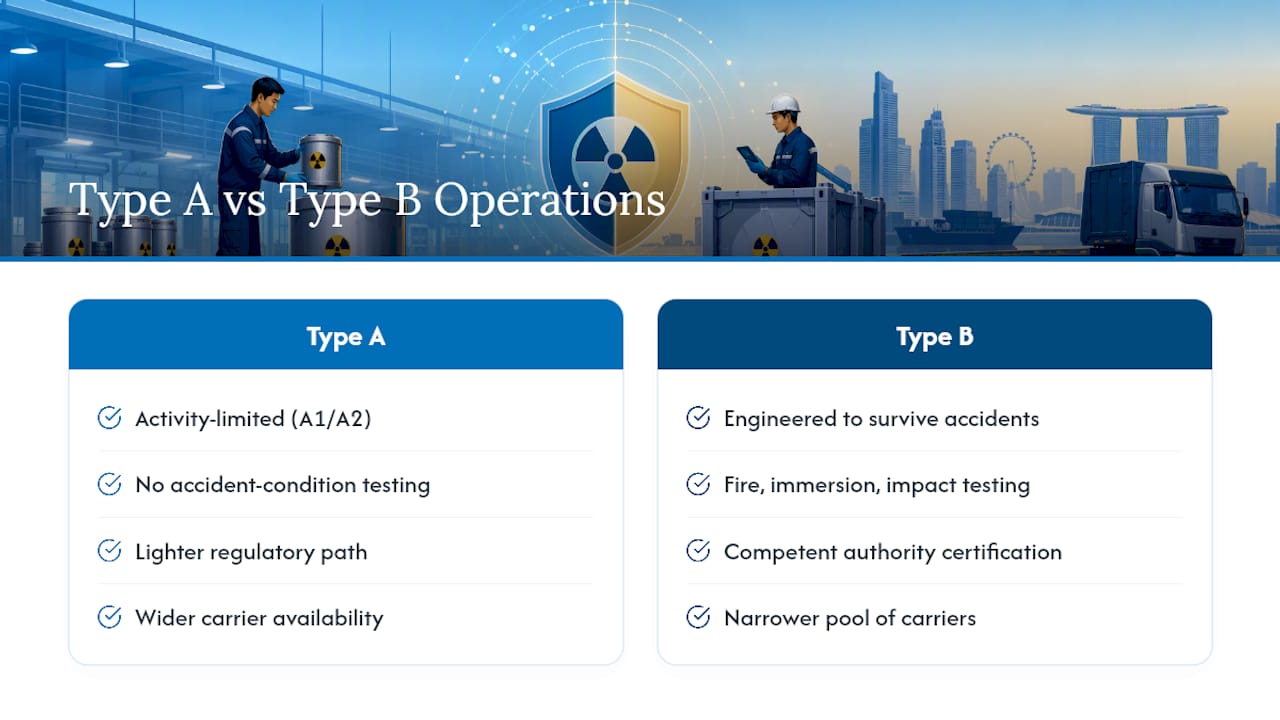
The difference between Type A and Type B packaging isn’t a matter of degree. It’s a different regulatory philosophy entirely. Type A packages are not engineered to survive accident conditions the way Type B packages are. Instead, the risk-control strategy behind Type A relies on limiting activity to A1/A2 values, so that even a damaged Type A package is unlikely to cause meaningful public health consequences. Type B packaging exists precisely because some shipments carry enough activity that this quantity-limiting strategy no longer provides adequate protection, so the package itself has to survive fire, deep water immersion, and severe impact testing that Type A never faces.
That distinction cascades into real operational differences. Type B packages typically require competent authority certification, more extensive carrier vetting, dedicated emergency response planning, and often a narrower pool of carriers willing to accept them. Type A packages move through a comparatively lighter regulatory path, though “lighter” doesn’t mean “informal.” The paperwork burden is still real, and insurance and liability considerations shift depending on which class you’re shipping.
A quick decision framework helps here. Ask: is the activity within A1 (special form) or A2 (normal form) limits for this specific radionuclide? Is the physical form stable and unlikely to disperse under stress? Does the destination or carrier require a lower activity ceiling than the general A2 limit allows? If any answer points toward “no” or “unclear,” that’s the moment to loop in a packaging engineer or RSO rather than guess.
Fissile material and certain special-form sources can also shift classification requirements regardless of activity level, since fissile content triggers additional criticality safety considerations that neither Type A nor a simple A1/A2 calculation addresses. When fissile material enters the picture, treat it as an automatic escalation trigger.
Handling a Damaged or Nonconforming Type A Package
A damaged Type A package is a safety event first and a paperwork event second, and the sequence matters. The immediate priority is personnel safety: isolate the area, prevent unauthorized approach, and avoid direct handling of the package until dose-rate readings confirm it’s safe to approach further.
- Establish a cordon around the damaged package and restrict access to trained personnel only.
- Take dose-rate readings at the surface and at 1 meter before any further handling.
- Photograph the damage, the package identification markings, and the surrounding area.
- Record the radionuclide, activity, and physical form from the shipping papers.
- Collect witness statements from anyone who observed the incident.
- Notify your internal RSO immediately and the carrier’s dangerous goods contact.
- Determine regulatory reporting obligations and timelines based on the jurisdiction and severity.
- Arrange secure containment or return shipment only after clearance from qualified personnel.
An incident report should capture, at minimum, the package ID, radionuclide and activity, dose readings at time of discovery, a damage description, photographs, and the names of everyone involved in the initial response. Keep this template ready before an incident happens, not after, since the first thirty minutes are when the most useful evidence gets collected or lost. Labgistics’ own safety and compliance framework for radioactive transportation builds incident documentation into standard operating procedure rather than treating it as an afterthought.
Training, Recordkeeping, and QA for Type A Shipments
Package design compliance means nothing if the people handling the shipment aren’t trained in hazardous material handling to recognize a problem. Staff offering or accepting Type A packages need documented hazmat training, periodic refreshers, and direct access to an RSO for questions that fall outside their day-to-day competence. This isn’t bureaucratic box-checking. Experts in radioactive transport consistently point out that a valid package design for one type of content can be entirely inadequate for a different radionuclide or physical form without re-evaluation, which means trained judgment matters as much as the package specification sheet.
Recordkeeping runs on a similar principle. §173.415 requires offerors to retain test documentation, engineering evaluations, and packaging descriptions and to produce them on request. In practice, that means every authorized Type A package in your fleet needs a traceable paper trail: when it was tested, what standard it met, who signed off, and where the records live. Loose or scattered documentation is one of the most common findings in operational audits, and it’s also one of the fastest ways a shipment gets held up or rejected at the carrier’s acceptance desk.
Day-to-day procedures should also account for how the package is packed, sealed, and secured inside the transport vehicle, plus temperature and pressure conditions during transit. A package that passed its design tests in a controlled lab environment can still be compromised by a poorly secured load shifting in a delivery van, so securing and bracing during loading deserves the same attention as the package’s own test certification.
Pro Tip: Build an internal QA checklist with a fixed audit cadence, quarterly at minimum for active shippers, and treat every audit like a mock regulatory inspection. Teams that only review documentation when a shipment is flagged tend to discover gaps months after they started, not before.
Labgistics’ Practical Pre-Shipment Checklist for Type A Packages
Years of handling radiopharmaceutical and radioactive material transport across Southeast Asia’s healthcare sector distill down to a repeatable sequence. This is the checklist Labgistics applies before any Type A package is offered to a carrier.
- Verify the radionuclide identity and confirm its A1 (special form) or A2 (normal form) value.
- Calculate actual activity against the A1/A2 limit and confirm the shipment stays within Type A bounds.
- Confirm the package is an authorized Type A design under §173.415, with valid test documentation on file.
- Check that closure fastening devices meet §173.412’s secure positive fastening requirements.
- Measure and record dose rates at the package surface and at 1 meter.
- Confirm the radioactive label category matches the measured dose rate and transport index.
- Verify UN number, proper shipping name, and declaration of radioactive material are accurate and complete.
- Confirm shipping papers match package contents exactly, with no discrepancies in activity or form.
- Inspect physical closure and securement before the package leaves the facility.
- File a copy of all test and engineering documentation before dispatch, not after.
Escalate to an RSO or packaging engineer immediately if any of these red flags appear: the A1/A2 calculation is ambiguous or borderline, the radionuclide’s chemical or physical form is unusual or mixed, a leak or contamination is detected during handling, or the destination carrier has additional acceptance criteria your documentation doesn’t cover. None of these situations should be resolved by guesswork.
Pro Tip: The most common documentation gap operational audits uncover is a missing or incomplete engineering evaluation, not a missing test report. Test reports get filed because someone hands them over at delivery. Engineering evaluations get skipped because nobody owns that step explicitly, so assign it to a named role, not a general “compliance team” bucket.
The IAEA’s guidance on graded safety-feature assessment reinforces this prioritization logic: identify which safety features would cause the worst outcome if they failed, containment loss or shielding degradation, and put your review effort there first rather than spreading it evenly across every package attribute.
Key Takeaways
Type A packaging works because it pairs activity-limited risk control with four mandatory performance tests and strict documentation retention under regulations like §173.415.
| Point | Details |
|---|---|
| Confirm A1/A2 before anything else | Calculate actual activity against the radionuclide’s A1 or A2 value to confirm Type A applies. |
| Four tests must all pass | Water spray, drop, compression, and penetration tests each target a distinct failure mode. |
| Documentation is a legal obligation | Retain test reports and engineering evaluations per §173.415, ready for regulator request. |
| Mode-specific rules still apply | Confirm ICAO/IATA rules for air, IMDG for sea, and local road regulations before shipping. |
| Escalate borderline cases | Involve an RSO or packaging engineer when classification or physical form is unclear. |
| Labgistics builds this into daily operations | Labgistics applies a documented pre-shipment checklist and audit cadence for radioactive material transport across Southeast Asia. |
Quick Reference: Primary Standards and Guidance Documents
- IAEA SSR-6: the foundational international transport safety standard behind every national and modal framework.
- UN Model Regulations: the classification and packaging framework most national road transport rules are built from.
- ICAO Technical Instructions: governs air transport safety requirements for dangerous goods, including radioactive material.
- IATA DGR: airline-facing acceptance criteria layered on top of ICAO’s rules; check annually for amendments.
- IMDG Code: the sea transport equivalent, relevant for bulk or non-air-eligible shipments.
- 49 CFR §173.412 / §173.415: U.S. domestic design and documentation requirements, referenced constantly for Type A specifics.
For air shipments, IATA DGR and ICAO TI take precedence at the carrier level. For sea freight, consult IMDG Code directly. For road transport, your country’s adopted version of the UN Model Regulations governs, and Southeast Asian jurisdictions don’t always adopt amendments on the same timeline, so keep local implementations on hand alongside the international text.
A Practitioner’s View From Labgistics
Handling radiopharmaceutical and radioactive material logistics across Southeast Asia for years surfaces a pattern: most Type A compliance failures aren’t design failures. They’re process failures. A package can meet every performance test on paper and still get rejected at a carrier’s acceptance counter because the engineering evaluation wasn’t filed, the dose-rate reading wasn’t recorded at the right moment, or the shipping papers didn’t match the declared activity down to the decimal.
Operational audits keep turning up the same gaps: missing test dates, incomplete engineering evaluations, and broken chain-of-custody documentation. None of these are exotic problems. They’re administrative discipline problems, and they’re entirely preventable with the right process design.
The fix isn’t more regulation literacy, though that helps. It’s building standardized documentation templates and pre-clearance workflows into daily operations so no single shipment depends on one person remembering every step. Teams that treat the pre-shipment checklist as a living document, updated after every audit finding, consistently ship faster and get flagged less often than teams that treat compliance as a once-a-year training exercise.
When to Call a Specialist for Type A Packaging Support
Reading the regulations is one thing. Running a Type A shipment through actual customs, carrier acceptance, and clinical delivery deadlines in Singapore and across Southeast Asia is another. Labgistics has spent years building the operational backbone for exactly this kind of shipment, radiopharmaceutical logistics, packaging validation, regulatory documentation, and calibration services in Singapore, so healthcare and pharmaceutical teams don’t have to build that capability from scratch internally.

If your team is managing radioactive material transport alongside broader pharmaceutical or medical device supply chains, specialized healthcare logistics support covers the full picture: warehousing, cold chain, and regulatory compliance under one accountable partner rather than several disconnected vendors. For radiopharmaceutical shipments specifically, where a missed window means a wasted dose, Labgistics’ time-critical delivery workflows integrate temperature control and dose-rate verification directly into the delivery schedule.
Every shipment Labgistics handles runs through documented QA checkpoints and audit-ready recordkeeping, so when a regulator or carrier asks for test documentation, it’s already organized and accessible. If your Type A packaging process has gaps you’re not confident about, or you’re expanding radioactive material shipments into new Southeast Asian markets, request a packaging review or pre-shipment consultation with Labgistics before your next shipment goes out the door.
This article is general information, not a substitute for advice from a qualified lawyer. Consult a qualified legal professional about your own circumstances before acting on anything here.
Sources
- Energy
- 49 CFR § 173.412 – Additional design requirements for Type A packages. | Electronic Code of Federal Regulations (e-CFR) | US Law | LII / Legal Information Institute
- Www-pub
FAQ
What is a Type A package for radioactive materials?
A Type A package is a regulatory packaging class designed to safely contain limited quantities of radioactive material, within A1 or A2 activity limits, through routine transport conditions like normal handling, weather exposure, and stacking pressure.
What is a radioactive Type B package?
A Type B package is designed for higher-activity shipments and must survive severe accident conditions, including fire and deep immersion testing, that Type A packages are never required to withstand.
What are the different types of radioactive packaging?
The main categories are excepted/industrial packaging for very low activity, Type A for limited quantities under routine conditions, and Type B for higher-activity material requiring accident-resistant design and certification.
What are Type A containers?
Type A containers are the physical packaging systems, containment vessels, shielding, and fastening devices, engineered and tested to meet the water spray, drop, compression, and penetration standards specified for authorized Type A packages under regulations like 49 CFR §173.412.
Who is responsible for verifying Type A compliance before shipment?
The consignor or shipper bears primary responsibility, typically supported by an RSO and, for ambiguous cases, a packaging engineer; Labgistics builds this verification directly into its radioactive transportation services for clients across Southeast Asia’s healthcare sector.