
Medical Device Importation Steps: 2026 FDA Guide
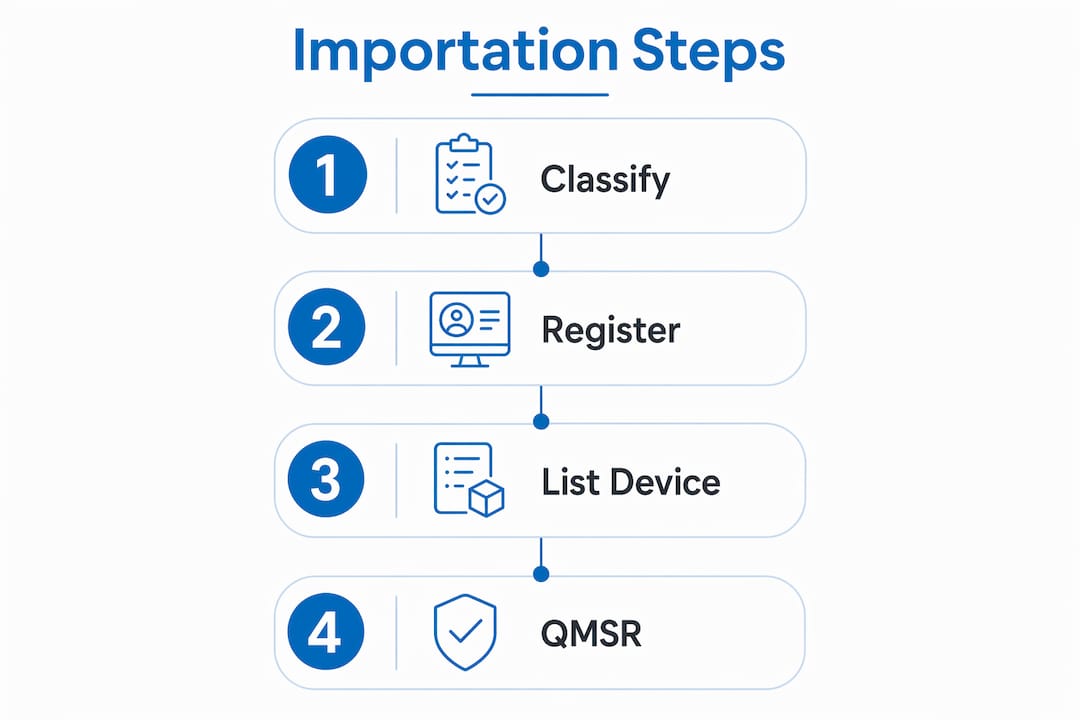
Medical device importation is defined as the process of bringing foreign-manufactured medical devices into the United States under FDA jurisdiction, requiring classification, establishment registration, device listing, and Quality Management System Regulation (QMSR) compliance. The four core regulatory steps apply to every device entering U.S. commerce, regardless of where it received foreign regulatory clearance. The FDA does not recognize foreign approvals as substitutes for U.S. requirements. Businesses and entrepreneurs entering this market in 2026 face a significantly updated compliance environment, including the QMSR effective February 2, 2026, new cybersecurity mandates, and precise documentation timelines that determine whether a shipment clears customs or sits in a hold.
What are the essential medical device importation steps for 2026?
The medical device import process follows four mandatory regulatory steps. Skipping or mistiming any one of them stops your shipment at the border.
Step 1: Determine device classification

The FDA classifies medical devices into three risk tiers. Class I devices carry the lowest risk and are subject to general controls only. Class II devices require Special Controls and, in most cases, 510(k) premarket notification. Class III devices carry the highest risk and require Premarket Approval (PMA). Your device’s classification determines every subsequent regulatory obligation, so confirming it before any other action is non-negotiable.
Step 2: Complete FDA establishment registration
Every manufacturer, importer, and specification developer must register with the FDA annually. The registration window runs October 1 through December 31 each year. Missing this window disrupts import privileges for the following year. The FY2026 registration fee is $11,423, payable at the time of registration. Foreign establishments must also designate a U.S. Agent in FURLS as part of this process. Without a designated U.S. Agent, importation is not permitted.
Step 3: Submit device listing
Device listing must be completed after establishment registration and must reference any applicable premarket authorization, such as a 510(k) clearance number or PMA approval. Under 21 CFR § 807.40©, foreign manufacturers cannot import until both registration and listing are complete. Listing must be updated whenever a device is discontinued or a new device is introduced.
Step 4: Comply with QMSR effective February 2, 2026
The Quality Management System Regulation replaced the legacy Quality System Regulation (QSR) on February 2, 2026. It aligns FDA requirements with ISO 13485:2016 and introduces mandatory cybersecurity standards, including Software Bills of Materials (SBOMs). Every importer and manufacturer must demonstrate compliance with QMSR before and during FDA inspections.
Pro Tip: Map your device’s classification before engaging a customs broker. Brokers need the correct FDA product code and tariff classification to file accurate entry data. Errors at this stage cause holds that can take days to resolve.
How to prepare and submit import documentation
Documentation accuracy is the single most controllable factor in whether a shipment clears FDA review on time. Consistent, complete data across all documents reduces the risk of a customs hold to near zero.
Required documentation for every medical device shipment includes:
- Manufacturer and importer details: Full legal names, addresses, and FDA registration numbers must match exactly across all documents.
- Product and tariff codes: The FDA product code and Harmonized Tariff Schedule (HTS) code must align with the device listing on file.
- Affirmations of compliance: Importers must submit affirmations confirming the device meets applicable FDA requirements, including premarket authorization status.
- Invoice and labeling alignment: The commercial invoice, device label, and shipping documents must reference identical device identifiers, model numbers, and lot numbers.
- Prior Notice submission: The FDA requires Prior Notice for all food and drug products, including medical devices. Prior Notice must be filed 2–8 hours before arrival, depending on the mode of transport. Air shipments require the shorter lead time; ocean freight allows up to 8 hours.
Entry filings go through the Automated Commercial Environment (ACE) system. Complete ACE submissions with all required FDA data fields allow the agency to process entries faster and reduce the likelihood of a manual examination request.
Pro Tip: Brief your customs broker at least 72 hours before the shipment departs. Provide the FDA registration number, device listing number, and all affirmations of compliance in writing. Last-minute handoffs are the leading cause of incomplete ACE filings.
Consequences of documentation errors are significant. A missing affirmation of compliance triggers an automatic FDA hold. Mismatched device identifiers between the invoice and the device label result in a Request for Information that delays clearance by days. Repeated errors can flag an establishment for increased examination frequency, which compounds delays across future shipments.
How do the 2026 QMSR and cybersecurity mandates affect importers?
The transition from QSR to QMSR is the most significant change to FDA medical device quality requirements in decades. The QMSR signals a shift toward transparency, risk management, and a documented quality culture that goes well beyond paperwork compliance.
Key changes importers and manufacturers must address:
- ISO 13485:2016 integration: QMSR incorporates ISO 13485:2016 by reference. Firms already certified to ISO 13485 have a structural advantage, but FDA inspectors will verify that the standard is implemented in practice, not just on paper.
- Risk-based approach throughout the device lifecycle: QMSR requires documented risk management at every stage, from design through post-market surveillance. This is a departure from the QSR’s more prescriptive, checklist-based model.
- SBOM requirements: Under section 524B of the FD&C Act, manufacturers of devices with software components must submit a Software Bill of Materials. SBOMs are now mandatory and will be reviewed even for legacy devices already on the market.
- Removal of audit exclusions: QMSR eliminates the previous provision that allowed manufacturers to exclude internal audit records from FDA review. Inspectors now have access to audit findings, corrective actions, and quality culture indicators.
- Cybersecurity as a product requirement: Secure product development frameworks are now a regulatory expectation, not a best practice. Devices with connectivity features must demonstrate cybersecurity controls as part of their design documentation.
“The QMSR requires detailed, documented integration of risk management throughout the device lifecycle, emphasizing a sustained quality culture. FDA inspections under QMSR focus on risk management, audit transparency, quality culture, and patient safety.”
For importers sourcing from foreign manufacturers, QMSR compliance is a shared responsibility. If the foreign manufacturer cannot demonstrate QMSR alignment, the importer bears regulatory exposure. Verify your suppliers’ quality management documentation before the first shipment arrives. Review their medical device regulatory compliance posture as part of your supplier qualification process.
What are common challenges and best practices for importing medical devices in 2026?
Most import failures trace back to three avoidable errors: mistimed registration, incomplete device listings, and misaligned shipment data. Each one is preventable with structured planning.
Common pitfalls include:
- Late registration: Missing the October 1 to December 31 registration window means the establishment is not registered for the following fiscal year. The FDA will refuse entry of devices from unregistered establishments.
- Incomplete device listings: Listing a device without referencing the correct premarket authorization number creates a discrepancy that FDA reviewers will flag during entry processing.
- Misaligned shipment data: When the manufacturer name on the invoice differs from the name in the FDA registration database, even by a single character, the ACE system flags the entry for manual review.
| Challenge | Root Cause | Recommended Action |
|---|---|---|
| Missed registration window | No calendar reminder or delegated owner | Assign registration ownership by September 1 each year |
| Incomplete device listing | Premarket authorization not linked | Audit listings quarterly against current product portfolio |
| Shipment data mismatch | No pre-shipment data review | Conduct a data alignment check before broker handoff |
| QMSR non-compliance | Supplier not audited against new standard | Include QMSR verification in supplier qualification |
| Prior Notice filing error | Broker not briefed in advance | Provide complete FDA data package 72 hours before departure |
Best practices that consistently reduce import delays:
- Build a compliance calendar that includes registration renewal, device listing audits, and QMSR documentation reviews.
- Conduct a pre-shipment data alignment check comparing the invoice, label, ACE filing, and FDA registration records.
- Engage a regulatory services specialist who understands both FDA requirements and customs broker workflows.
- Maintain buffer time of at least five business days between the planned shipment date and any hard delivery deadline, to absorb FDA examination requests without disrupting operations.
Pro Tip: Request a copy of your customs broker’s ACE filing before the shipment departs. Reviewing it against your FDA registration and device listing takes 15 minutes and catches the majority of data mismatches before they become holds.
Key Takeaways
Successful medical device importation requires completing FDA classification, registration, device listing, and QMSR compliance in the correct sequence and on time.
| Point | Details |
|---|---|
| Classification comes first | Device class determines every subsequent regulatory obligation before registration begins. |
| Registration has a fixed window | The annual FDA registration window runs October 1 through December 31; missing it disrupts import privileges. |
| QMSR is now in effect | The Quality Management System Regulation, effective February 2, 2026, requires ISO 13485:2016 alignment and SBOM submission. |
| Documentation must be consistent | Manufacturer name, device identifiers, and tariff codes must match exactly across all shipment documents. |
| Prior Notice timing is mandatory | File Prior Notice 2–8 hours before shipment arrival, depending on transport mode, or risk a customs hold. |
The compliance shift that most businesses underestimate
The QMSR transition is not a paperwork update. It is a structural change in how the FDA evaluates quality. Firms that treat it as a checkbox exercise will face inspection findings that expose gaps in their quality culture, not just their documentation.
The most common mistake I see businesses make is treating FDA registration as a one-time task. Registration is annual. Device listings change. Cybersecurity requirements now apply to products that were never designed with connectivity in mind. The regulatory environment for importing medical devices has become genuinely dynamic, and static compliance programs do not keep pace.
The businesses that succeed in 2026 are the ones that build compliance into their operational calendar rather than treating it as a reactive exercise. That means assigning clear ownership for registration renewal, scheduling quarterly listing audits, and verifying supplier QMSR alignment before signing purchase agreements. It also means investing in logistics and regulatory partners who understand both the FDA requirements and the physical realities of moving medical devices across borders.
The QMSR’s alignment with ISO 13485:2016 is a genuine opportunity. Firms that achieve ISO 13485 certification gain a framework that satisfies both FDA and many international regulatory bodies simultaneously. That is a meaningful efficiency for any business planning to expand beyond the U.S. market. The cybersecurity mandates, including SBOMs, are harder to absorb but equally important. Treat them as a product quality requirement, not a compliance burden, and the implementation becomes more manageable.
— Brandcore
How Labgistics supports medical device importation compliance
Medical device importation requires precise coordination between regulatory compliance, documentation management, and physical logistics. Getting one element wrong can hold an entire shipment.

Labgistics brings over 20 years of experience in healthcare supply chain logistics across Southeast Asia, with dedicated capabilities for medical device regulatory compliance, cold chain handling, and customs documentation support. The team works directly with importers to align shipment data, manage temperature-sensitive handling requirements, and coordinate with regulatory specialists who understand FDA and regional authority requirements. For businesses entering or expanding in the medical device market, Labgistics offers end-to-end support from regulatory services through last-mile delivery, backed by fully accredited distribution infrastructure.
FAQ
What are the four core medical device importation steps?
The four steps are device classification, FDA establishment registration, device listing, and QMSR compliance. All four must be completed before a device legally enters U.S. commerce.
When must FDA establishment registration be completed?
Registration must be completed between October 1 and December 31 each year. The FY2026 fee is $11,423, and missing the window disrupts import privileges for the following year.
What is the QMSR and when did it take effect?
The Quality Management System Regulation replaced the legacy QSR on February 2, 2026. It aligns FDA requirements with ISO 13485:2016 and adds mandatory cybersecurity standards, including SBOM submission for devices with software components.
How far in advance must Prior Notice be filed for medical device shipments?
Prior Notice must be filed 2–8 hours before a shipment arrives in the United States, with the exact timeframe depending on the mode of transport.
Does foreign regulatory approval satisfy FDA import requirements?
No. The FDA does not recognize foreign regulatory clearances as substitutes for U.S. requirements. Every imported device must independently meet FDA classification, registration, listing, and quality system standards.
Recommended
- Medical Device Regulatory Compliance Guide for 2026
- Product Registration for Pharma and Medical Devices: 2026 Guide